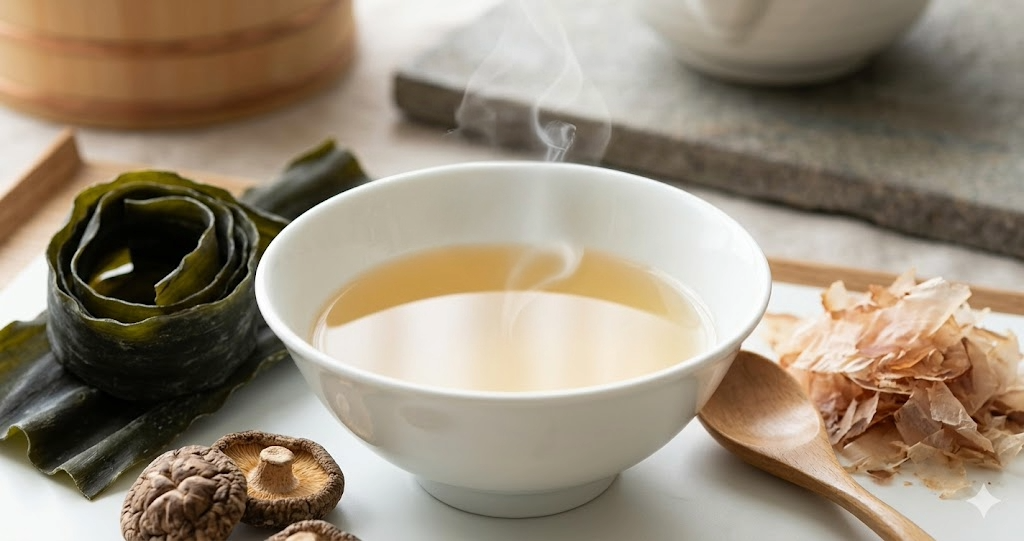
The Philosophy of Dashi: Japan’s Invisible Foundation
Japanese cooks do not make dashi. They draw it. That single verb — hiku, to pull — contains an entire philosophy of cooking, and an answer to why Japanese cuisine tastes the way it does.
Set a bowl of good miso soup in front of someone who has never encountered Japanese cuisine and ask them to describe what they taste. They will likely struggle. It is savory, yes — but not in the way that a meat broth is savory. It is warm and round and somehow present without being assertive. It makes you want another spoonful, and then another, without quite knowing why. The flavor feels less like something added than like something revealed.
What they are tasting, beneath the miso and the tofu and the wakame, is dashi. And dashi is, in a sense, the answer to a question that Japanese culinary culture has been refining for over a thousand years: how do you make food taste more fully like itself?
A Word That Contains a Philosophy
In Japanese, the act of preparing dashi is described with a specific verb: hiku (引く) — to pull, to draw out, to extract. You do not cook dashi. You do not make dashi. You draw it. Dashi wo hiku.
This choice of verb is not incidental. It encodes a philosophy of restraint that runs through the whole of Japanese cuisine. The cook’s role, in this understanding, is not to impose flavor on an ingredient but to draw out what is already present — to subtract what is not needed, to create the conditions under which the ingredient can express itself fully. Dashi wo hiku is the act of pulling essence from raw material and releasing it into water. The water becomes the vehicle. The essence becomes the flavor. The cook stands aside.
This is what commentators on Japanese cuisine mean when they describe it as an “art of subtraction.” Where French cuisine traditionally adds — building depth through the accumulation of butter, cream, and reduction — Japanese cuisine traditionally subtracts, removing bitterness, taming strong odors, stripping back to the point where the natural flavor of the ingredient is most clearly audible. Dashi is the purest expression of this tendency. It is a stock that, at its best, tastes of almost nothing and of everything simultaneously.
What Dashi Actually Is
Dashi (出汁) is a family of stocks — broths produced by extracting flavor compounds from dried natural ingredients into water. The word itself combines the characters for “exit” (出) and “juice” or “liquid” (汁): the liquid that has been drawn out. It is the base for miso soup, clear broth soups, simmered dishes, noodle broths, and a wide range of sauces and seasonings. It is used in the batter of okonomiyaki and takoyaki. It appears, in one form or another, in virtually every category of Japanese cooking.
The most fundamental dashi is awase dashi — a combination stock made from kombu (dried kelp) and katsuobushi (dried, fermented, and smoked skipjack tuna). By the seventh century, a dashi using kombu and katsuobushi had developed in Japan, and it was refined further into what became the country’s most indispensable cooking stock. The version used today, with its characteristic clarity and depth, was substantially shaped during the Edo period (1603–1868), when the method for producing katsuobushi was perfected and the two ingredients were first combined systematically.
What makes awase dashi so fundamental is not merely its flavor, but the way it functions in a dish. Dashi could be said to be the heart of Japanese cuisine — not because of the prominence of its own flavor, but because of the way it enhances and harmonizes the flavors of other ingredients. It is a supporting actor that makes every other element perform better. In its presence, miso tastes more fully like miso, tofu more fully like tofu, vegetables more fully like vegetables. This amplifying, harmonizing quality is not poetic description. It is chemistry.
The Science Behind the Subtlety
The chemistry of dashi is, at its core, the chemistry of umami — the fifth taste, formally identified by Professor Kikunae Ikeda of Tokyo Imperial University in 1908. In February 1908, Ikeda extracted approximately 30 grams of crystals from 12 kilograms of dried kelp. The compound was glutamic acid. He named the taste 旨味 (umami) — literally “delicious taste” — and filed a patent for its sodium salt, monosodium glutamate (MSG).
What Ikeda had done was give scientific language to something Japanese cooks had understood through practice for centuries: that kombu dashi produced a taste that could not be accounted for by any combination of sweetness, saltiness, sourness, or bitterness. It took Western science nearly 100 years to catch up. Specific umami taste receptors on the human tongue were only identified in 2002, finally validating what Japanese cuisine had understood through practice for centuries.
In 1913 and 1957, there followed the discovery of inosinate and guanylate respectively as additional sources of umami. These findings revealed something crucial about the structure of dashi: the reason awase dashi — the combination of kombu and katsuobushi — is so much more powerful than either ingredient alone is that their umami compounds are chemically distinct and synergistic. Kombu has the highest natural levels of glutamate of any foodstuff in the world. Katsuobushi and niboshi contain high levels of inosinate. When two sources of umami are combined, the umami taste is boosted, producing a result greater than the sum of the ingredients. This synergistic effect is not a matter of degree. Studies suggest it can amplify the perception of umami by a factor of seven or more when glutamate and inosinate are combined in appropriate proportions.
This is why dashi makes other flavors taste more fully like themselves. Umami does not simply add a fifth flavor to the palette. It functions as a harmonizing force — amplifying and rounding other taste compounds, reducing the need for salt and fat to achieve depth, creating the sensation of fullness and satisfaction that the Japanese word koku describes. A dish built on good dashi does not need much seasoning because the dashi has already done much of the work of making it taste complete.
The Two Forms: Ichiban and Niban
Traditional dashi preparation distinguishes between two extractions from the same ingredients, each serving a different purpose in the kitchen.
Ichiban dashi — first dashi — is the primary extraction, and it is treated accordingly. Kombu is placed in cold water and brought slowly to just below a boil, at which point it is removed before the water reaches full boiling temperature. Kombu dashi becomes bitter and unpalatable when boiled — the threshold of around 80°C is a critical one, and the cook’s attention to temperature is not fastidiousness but necessity. The katsuobushi is then added to the near-boiling liquid, allowed to steep briefly without stirring, and strained gently through a cloth without pressing or squeezing — actions that would cloud the liquid and introduce bitterness. The result is a stock of exceptional clarity: pale gold, faintly aromatic, transparent enough to read through. This is the dashi used for clear soups and delicate preparations where the stock itself will be visible and its flavor unobscured.
Niban dashi — second dashi — is drawn from the same kombu and katsuobushi after ichiban has been extracted. The spent ingredients are returned to fresh water and simmered for longer, producing a fuller, slightly more robust stock. Niban dashi carries more of the deeper, earthier notes that a longer extraction produces. It is used for miso soup, simmered dishes, and applications where the dashi will be seasoned or combined with other strong flavors. Nothing is wasted. The kombu and katsuobushi that have given twice to the stock are then used in other preparations — simmered with soy sauce and mirin to make tsukudani, or incorporated into rice and vegetable dishes. The logic of the kitchen, like the philosophy of dashi itself, is one of drawing out everything an ingredient has to give.
Beyond Kombu and Katsuobushi
Awase dashi is the most widely used variety, but it is one member of a broader family. Each type of dashi expresses a different dimension of the same underlying principle — the extraction of umami from a dried ingredient into water — and each has its natural home in the Japanese kitchen.
Kombu dashi alone, drawn by cold soaking rather than heating, produces the cleanest and most delicate of all dashi: almost colorless, with a pure mineral quality well suited to the refined cuisine of Kyoto and to preparations where the stock should be nearly invisible. During the Muromachi period, trade ships from the north brought Hokkaido kombu to Kyoto, where its refined, clear flavor became a symbol of elegance in Japanese cuisine.
Niboshi dashi — made from small dried sardines — is the dashi of everyday home cooking, particularly in eastern Japan and Kyushu. It has a toasty, slightly assertive flavor that kombu dashi does not, and it pairs naturally with the more robust flavors of everyday miso and hearty simmered dishes. Dried shiitake dashi, used extensively in Buddhist vegetarian cuisine — shōjin ryōri — draws its umami from guanylate, the third of the three principal umami compounds, producing a stock of deep earthiness and lingering richness. Ago dashi, made from flying fish and associated particularly with Kyushu, has a clean, fragrant umami quality that has gained wider recognition in recent decades.
A useful general principle governs the matching of dashi type to dish: fish broth tends to be used for cooking vegetables, and plant-based broth for fish. The logic is one of contrast and harmony — each dashi type brings out qualities in the ingredients it surrounds that its own character would not produce. This is, again, the art of subtraction at work: choosing what is absent in order to make what is present more vivid.
The Invisible Architecture
A bowl of good dashi, tasted alone, is a quiet thing. It does not announce itself. It offers no obvious richness, no strong fragrance, no assertive taste. To someone expecting the intensity of a reduced Western stock or the depth of a long-simmered braise, it may seem almost insubstantial.
This is precisely the point. Dashi is architecture, not decoration. It provides the structure within which other flavors can function — amplifying, harmonizing, sustaining. When it is present, everything built on it tastes more fully like itself. When it is absent, or replaced with an inferior substitute, something is missing that cannot easily be named but is immediately felt.
The Japanese government designated November 24th as Washoku Day, recognizing dashi as central to the culinary tradition that UNESCO registered as an Intangible Cultural Heritage in 2013. That designation acknowledges something that any careful cook already knows: dashi is not a technique. It is a philosophy made liquid — the conviction that the most profound flavors are not added but drawn out, that the cook’s highest skill is not imposition but revelation.
Dashi wo hiku. Draw it out. Let the ingredient speak for itself.
Read, then Taste
This article is part of Waden’s Technique series — exploring the craft, philosophy, and practice behind Japanese culinary methods. Read more at waden.umamibako.com.
Comment