The Craft of Soba: What the Ratio Reveals
A soba noodle is made from two things: buckwheat and water. The question is how much of each, and what that choice costs the craftsperson — and reveals to the person eating.
There is a question that a serious soba shop must answer before it opens each morning: what ratio? The ratio of buckwheat flour to wheat flour — or buckwheat flour alone, with no wheat at all — determines nearly everything that follows. The texture of the dough. The skill required to work it. The fragility of the finished noodle. The depth and character of the flavor. The price it can be sold for, and the kind of cook who can make it reliably.
This question — the ratio — might seem like a technical detail, a matter for specialists. But in the world of Japanese soba, the ratio is a statement of values. It is a declaration of where the craftsperson stands in relation to the ingredient, to the diner, and to the long history of a food that has been eaten in Japan for over a thousand years.
Buckwheat Without Gluten: The Central Problem
To understand why the ratio matters, it helps to understand what buckwheat flour is — and what it lacks. Buckwheat (Fagopyrum esculentum) is a pseudocereal: not a grass, not related to wheat, but the seed of a flowering plant more closely related to rhubarb and sorrel. Its flour is rich in protein, high in rutin (a flavonoid linked to cardiovascular health), and contains good quantities of B vitamins and minerals including iron, magnesium, and zinc. It has a flavor that is distinctly its own: nutty, slightly earthy, with a clean finish that lingers.
What it does not contain is gluten. Gluten — the protein network formed when wheat flour is hydrated and worked — is what gives most noodles their elasticity and structural integrity. It is the reason udon can be stretched and ramen can be pulled; the reason wheat-based doughs are forgiving and workable. Buckwheat flour has none of this. Mixed with water and worked into a dough, pure buckwheat behaves more like wet sand than like bread dough: it is granular, fragile, prone to cracking. Rolled thin and cut into noodles, it will hold together through cooking — but only just, and only in the hands of someone who knows exactly what they are doing.
This is the central technical problem of soba-making. And the ratio — the decision about how much, if any, wheat flour to add — is the principal answer to it.
The History of the Ratio
The earliest form of buckwheat food in Japan was not noodles at all. Sobagaki — buckwheat flour kneaded with hot water into a thick paste, eaten directly — appears in records from the medieval period and was part of Buddhist vegetarian cuisine (shojin ryori). The first specific reference to buckwheat noodles cut in the modern sense — soba-kiri, buckwheat slices — comes from a temple record of 1574 at Jōshō-ji, which documents that soba-kiri was served to workers repairing the main hall. The cutting of buckwheat into noodles was an innovation that changed the food’s possibilities entirely.
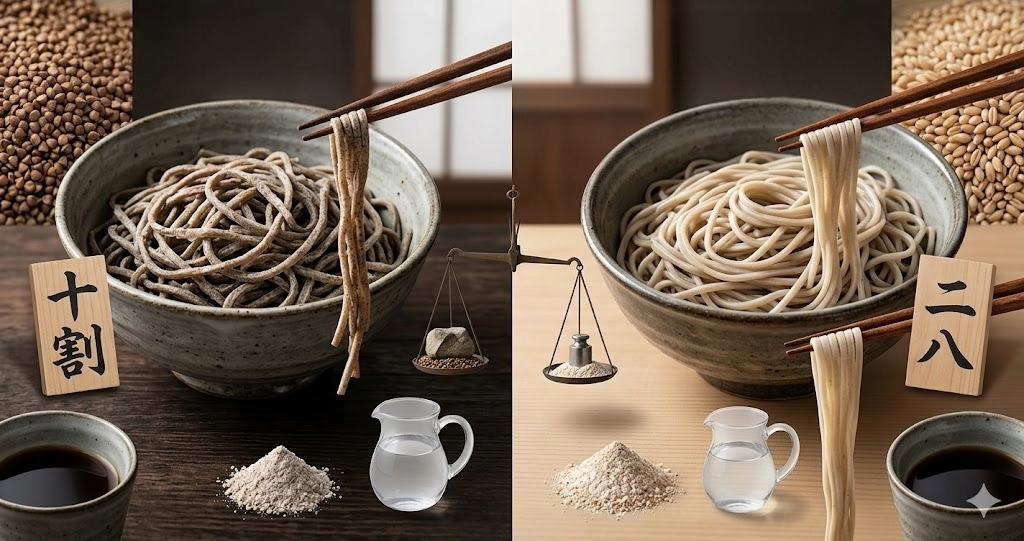
In those early years, soba-kiri was made from pure buckwheat flour. This is the form now called juwari soba — literally “ten-parts soba,” meaning the ratio is ten parts buckwheat to zero parts anything else. It was difficult to make and fragile to handle, and the skill required to produce it consistently was considerable. A craftsperson who could make reliable juwari soba by hand took pride in this ability — and gave the hand-made product a specific name to distinguish it from lesser work: teuchi soba, “hand-struck soba.”
The name teuchi carries a history that is easy to miss. During the Edo period, when buckwheat was mixed with large amounts of wheat flour, the resulting dough required significant kneading force — sometimes worked with the feet, as udon dough still is. A craftsperson making pure buckwheat soba who worked the dough entirely by hand, without the mechanical advantage of foot-treading, coined the term teuchi to express this: “my soba is made by hand, not by foot.” Today the term is used to distinguish hand-made soba from machine-made soba. But its original meaning was a statement of craft pride — a claim that the maker had achieved something technically demanding without compromising the integrity of the grain.
The shift toward wheat flour as a binding agent began during the Kanbun period (1661–1673) of the Edo era, when buckwheat flour quality deteriorated during summer heat. Wheat flour, when added, creates gluten that holds the dough together — making it easier to roll thin, cut uniformly, and handle without breakage. The resulting noodles were also smoother and more elastic, qualities that many diners preferred. Because it was easier even for less skilled craftspeople, the practice spread rapidly through the soba shops of Edo. By the middle of the Edo period, nihachi soba — named for its ratio of two parts wheat to eight parts buckwheat — had become the standard for the city’s soba culture.
Nihachi: Two-Eight
Nihachi (二八) means “two-eight” — a ratio of twenty percent wheat flour to eighty percent buckwheat. This is the most widely eaten soba in Japan today, the standard from which most restaurant soba is made, and the benchmark against which other ratios are measured.
The name has an interesting etymology. The most straightforward explanation is that it describes the blend: two parts wheat, eight parts buckwheat. But soba researcher Shigeru Niijima (1920–2001) noted an alternative theory rooted in Edo-period pricing: during the Bunsei era (1818–1830), a bowl of soba cost sixteen mon. “Nihachi” — two times eight — equals sixteen. The price itself may have given the blend its name, in the wordplay-loving culture of Edo merchants and craftspeople, for whom such numerical wit was a form of social currency. The two theories are not mutually exclusive; both may have contributed to the name’s longevity.
What nihachi soba gains from its wheat content is reliability and texture. The gluten network that wheat provides allows the dough to be rolled thinner without tearing, cut more uniformly, boiled without excessive breakage, and served with a surface smoothness and slight elasticity that pure buckwheat cannot achieve. The noodle holds together in hot broth without disintegrating. It can be made in larger quantities and at greater speed than juwari. It is more forgiving of variation in temperature and humidity — the two environmental factors that affect buckwheat dough most dramatically.
What it gives up is intensity. The twenty percent of wheat flour displaces twenty percent of buckwheat flour, and with it, twenty percent of the grain’s characteristic flavor and aroma. Nihachi soba is subtler than juwari — more approachable, more consistent, less demanding of the diner’s attention. These are not necessarily criticisms. They are the qualities that made nihachi soba the everyday noodle of Edo, available at street stalls and neighborhood shops, consumed quickly and cheaply by a city that ate soba the way a modern city eats sandwiches.
Juwari: The Pure Form
Juwari soba (十割そば) — also called towari or kikouchi soba — is made from one hundred percent buckwheat flour with no wheat or other binding agent. It is the oldest form of soba noodle, and the most technically demanding to produce.
The difficulty is real and not overstated. Pure buckwheat flour, lacking gluten, will not form a cohesive dough through ordinary hydration and kneading. Several techniques exist to compensate. The most traditional method uses hot water rather than cold water to hydrate the flour: heat causes partial gelatinization of the buckwheat starch, which provides a limited but functional degree of cohesion. Another method uses separately gelatinized buckwheat starch as the binding agent — buckwheat binding buckwheat, with no other grain involved. Fine milling of the flour, which produces smaller starch particles with greater surface area, also improves cohesion. Each method requires judgment, sensitivity to the specific batch of flour, and awareness of the day’s temperature and humidity — conditions that change the behavior of buckwheat dough in ways that experience alone teaches.
The result, when successful, is a noodle with a flavor profile significantly more intense than nihachi. Juwari soba offers a bold, nutty, and earthy buckwheat flavor that immediately distinguishes it from blended varieties. The texture tends to be slightly rougher on the surface, with a characteristic dryness that holds dipping sauce differently from the smoother nihachi. It breaks more readily — a bowl of cold juwari served with vigorous chopstick handling will suffer — but this fragility is inseparable from its purity. A craftsperson who can produce consistent, beautiful juwari by hand occupies the highest tier of the soba-making hierarchy. Even in Tokyo, where soba culture is dense and competitive, the number of restaurants that reliably serve hand-made juwari is small.
The Other Ratios
The Japanese soba lexicon is more granular than the juwari-nihachi binary suggests. Between one hundred percent buckwheat and eighty percent buckwheat lies a spectrum of ratios, each with its own name and character.
Kuwari soba is ninety percent buckwheat to ten percent binding agent — one step back from juwari, a concession to workability that retains most of the grain’s intensity. Hachiwari soba is the same as nihachi: eighty percent buckwheat. Nanawari soba is seventy percent buckwheat to thirty percent wheat. Rokuwari soba is sixty percent buckwheat. Below fifty percent buckwheat, the noodle is no longer really a soba noodle in any meaningful culinary sense — wheat has become the primary grain, and buckwheat is a flavoring.
Japan’s quality labeling standards for dried soba noodles require a minimum of thirty percent buckwheat flour for a product to be sold as soba. This threshold is widely regarded within the soba community as insufficiently protective of the category’s integrity. A product at thirty percent buckwheat will have little of the grain’s flavor or nutritional character. Reading the ingredient list carefully — in Japan, ingredients are listed in descending order by weight, so a product in which wheat flour is listed before buckwheat flour contains more wheat than buckwheat — is the most reliable way to understand what you are actually buying.
Binding Agents Beyond Wheat
Wheat flour is the most common binding agent for soba, but not the only one. Several regional traditions use different binders that give their soba a distinctive character.
Hegi soba, from the Uonuma region of Niigata Prefecture, uses funori — a type of red algae — as its binding agent. The funori gives the noodles a distinctive smoothness and translucency, and a slight marine quality that interacts with the buckwheat in a way wheat flour does not. The noodles are traditionally served in bite-sized portions arranged in wave-like folds on a flat wooden board called a hegi.
Jinenjo soba, found in several regions, uses wild mountain yam (jinenjo) as its binder. The yam provides natural starch cohesion and a subtle earthy sweetness that adds a third flavor dimension alongside the buckwheat. Yamakake soba, served with grated mountain yam poured over the noodles, takes this relationship between soba and yam in a different direction — the yam as topping rather than ingredient, its viscous texture coating the noodles and changing the eating experience entirely.
Sobayu: The Final Ritual
No account of soba technique is complete without acknowledging the custom that closes a traditional soba meal: sobayu. After the noodles are eaten and the dipping sauce remains in the cup, the server brings a pitcher of the cloudy, warm water in which the soba was boiled. The diner pours it into the remaining tsuyu, diluting and warming the sauce and creating a light, faintly buckwheat-flavored soup to drink at the end of the meal.
This practice began in the Shinshu region during the Edo period and was established as an efficient way to consume the water-soluble nutrients — particularly rutin and B vitamins — that dissolve out of the buckwheat during cooking. What began as a nutritional practice became a ritual of completion: the meal ends not when the noodles are finished but when the sobayu has been drunk and the cup set down. The water that cooked the soba becomes, in this final step, part of the meal itself. Nothing is wasted. The technique extends to the very last drop.
What the Ratio Tells You
A soba restaurant that serves juwari is making a claim: that its craftspeople have the skill to work pure buckwheat, that its flour is of sufficient quality to reward that skill, and that its customers have the attention to notice the difference. A restaurant that serves nihachi is making a different but equally legitimate claim: that the harmony of grain and texture, the smooth surface and consistent bite, is what it values — and that the everyday pleasure of a well-made noodle served quickly and honestly is an end in itself.
Neither claim is wrong. The history of soba is the history of both — the pure form and the practical form, the artisan’s challenge and the city’s daily bread, developing side by side through four centuries of refinement. What the ratio reveals, ultimately, is what the maker believes soba is for: the concentrated expression of a single grain, or the balanced pleasure of a noodle that anyone can eat well.
Both are worth understanding. And the best way to understand them is the same way soba has always been understood: one bowl at a time.
Read, then Taste
Experience Authentic Japanese Soba at Home
The UMAMIBAKO Ramen & Noodle Culture Box brings together carefully selected Japanese noodles and the ingredients — tsuyu, dashi, and the story behind each element — to help you experience the craft of Japanese noodle culture for yourself.Explore the Ramen & Noodle Culture Box →
This article is part of Waden’s Technique series — exploring the craft, philosophy, and practice behind Japanese culinary methods. Read more at waden.umamibako.com.
Comment