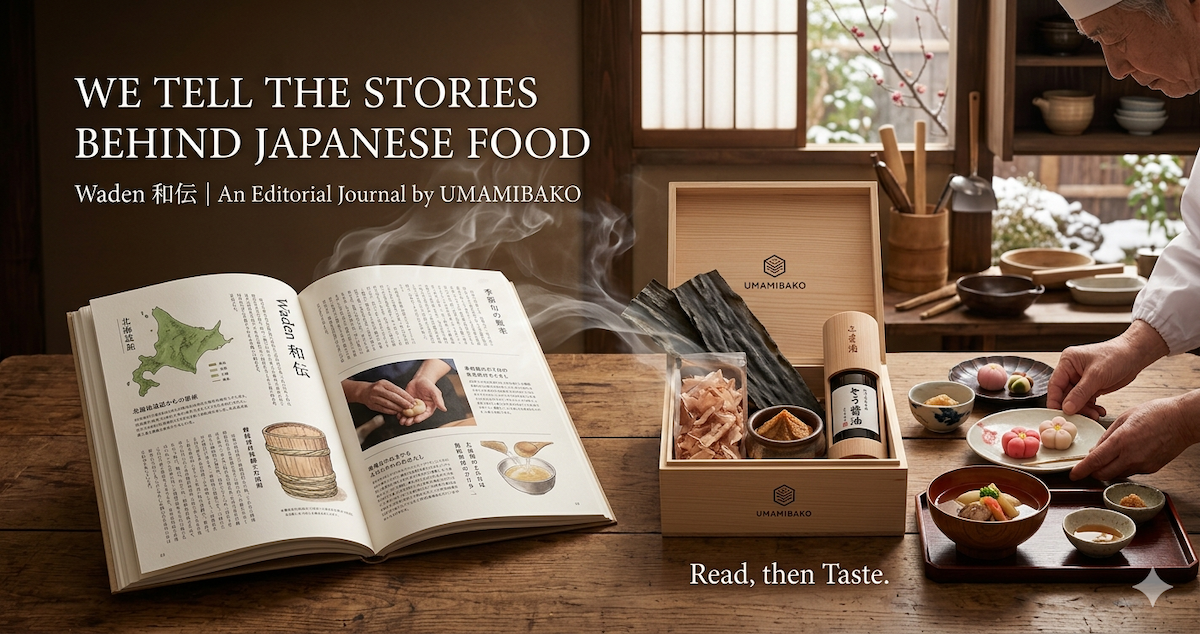
We Tell the Stories Behind Japanese Food
Waden is an editorial journal by UMAMIBAKO — exploring the ingredients, artisans, and traditions that make Japanese cuisine extraordinary.
There is a word in Japanese — umami — that took the world decades to understand. Not sweet, not salty, not sour or bitter. Something deeper. A taste that lingers, that rounds out, that makes you lean in for another bite without quite knowing why.
Japanese food is full of such depths. A bowl of miso soup made from dashi drawn from kelp harvested off the coast of Hokkaido. A piece of wagashi shaped to echo the first plum blossom of February. Soy sauce fermented for two years in cedar barrels older than anyone alive. These are not just ingredients. They are carriers of time, place, and human skill — stories that most of the world has never had the chance to hear.
Waden exists to tell them.
What is Waden?
Waden — 和伝 — is an editorial journal dedicated to the depth and beauty of Japanese food culture. The name comes from two Japanese characters: wa (和), meaning harmony and Japan, and den (伝), meaning transmission and heritage. Together, they express exactly what we are here to do: carry the wisdom of Japanese food forward, across languages and generations.
We write in English, for a global audience. Before the technique, we ask why. Before the recipe, we ask where it comes from — the geography, the history, the people, and the philosophy that shape every dish, every ingredient, every season of the Japanese table. When you understand that context, cooking becomes a different kind of conversation.
Story first — always. We believe understanding the world behind an ingredient deepens the joy of tasting it, and the meaning of preparing it.
Six Lenses on Japanese Food
Every article we publish falls within one of six editorial themes — each a different way of looking at the world of Japanese cuisine.
Fermentation (発酵 / Hakkō) — Japan’s relationship with fermentation is ancient, precise, and alive. Miso, soy sauce, sake, mirin, rice vinegar: each is a collaboration between human intention and microbial time. We trace the science, the craft, and the culture that make Japan one of the world’s great fermentation civilisations.
Origin (産地 / Sanchi) — Food cannot be separated from where it comes from. The minerality of Kyoto water in a cup of matcha. The clean cold of Hokkaido in a piece of kombu. We travel to the landscapes where Japan’s finest ingredients are born, and we listen to the people who tend them.
Technique (技法 / Gihō) — Japanese culinary technique is a form of knowledge, transmitted slowly, refined over lifetimes. How to draw dashi. How to cut fish for sashimi. How to cook rice with the care it deserves. We study these foundations not as instruction, but as a window into a culture that takes craft seriously.
Vessel (器 / Utsuwa) — In Japan, the bowl is as important as the food placed in it. The ceramicist and the chef speak the same language. We explore the art of serving — how form, texture, and season come together at the table.
Seasons (季節 / Kisetsu) — Japanese cuisine is governed by the 24 solar terms: a calendar of subtle seasonal shifts, each with its own flavours and rituals. We follow this rhythm throughout the year, exploring the philosophy of shun — the peak moment of each ingredient’s life.
Heritage (伝承 / Denshō) — Some dishes are disappearing. Some techniques exist in the hands of a single ageing craftsperson. Waden documents what must not be forgotten — regional foods, culinary memories, and the living traditions that give Japanese food its soul.
The Connection to UMAMIBAKO
Waden is the editorial voice of UMAMIBAKO — a curated food box service that brings authentic Japanese ingredients to homes around the world. But the relationship between Waden and UMAMIBAKO is more than branding. It is the heart of what we believe food discovery should feel like.
Every ingredient we write about in Waden is the kind of ingredient you will find in an UMAMIBAKO box. When you read about the world of dashi — the kelp, the katsuobushi, the quiet alchemy of the pot — you can then open a box and hold those ingredients in your hands. When you read about the wagashi makers of Kyoto preserving the shape of the seasons in sweet bean paste, you can taste their craft for yourself.
We call this Read, then Taste.
It is our belief that the most meaningful way to experience a food culture is to understand it first. Not to consume, but to discover. Waden gives you the story. UMAMIBAKO gives you the experience. Together, they offer something that neither could offer alone.
An Invitation
Japanese food has been one of the world’s most admired cuisines for decades. But admiration is not the same as understanding. There is still so much to learn, so many stories untold, so many corners of this extraordinary food culture that have never been written about in English with the depth they deserve.
That is the work we are here to do. We hope you will join us.
Waden is published by UMAMIBAKO. Read more at waden.umamibako.com.

Comments