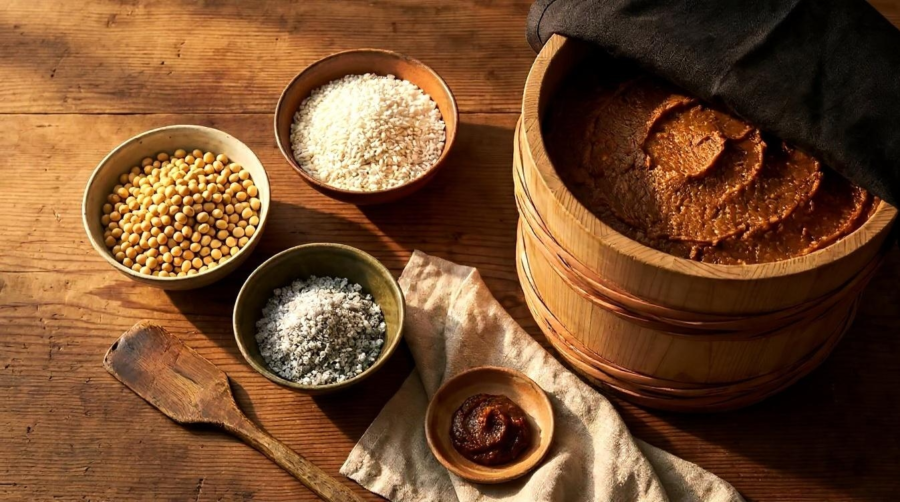
Soybeans, Salt, and Time: What Miso Is, and Why It Tastes the Way It Does
Inside Japan’s oldest pantry staple — the soybeans, the salt, the koji, and the months of patient transformation that make miso unlike anything else on earth.
Open a tub of good miso and bring it close. Before you taste it, smell it. There is something almost alive in the aroma — earthy and sweet, a little sharp at the edges, rounded by something you cannot quite name. That quality has a name in Japanese: umami. But to describe miso as simply “umami-rich” is a little like describing a cathedral as a building with a roof. It is technically accurate and entirely beside the point.
Miso has been part of the Japanese daily diet for more than a thousand years — dissolved into soup at breakfast, used as a seasoning in braised dishes, spread on grilled vegetables, whisked into dressings. It is also, quietly, one of the most concentrated sources of the savory fifth taste Japanese science eventually named in any kitchen on earth.
But what is miso, exactly? And why does it taste the way it does?
Three Ingredients, One Transformation
At its simplest, miso is made from three things: soybeans, salt, and koji. The proportions change. The timing changes. The vessel, the climate, the water, and the hands that tend the batch all leave their mark. But these three elements are the foundation, and understanding what each one brings is the beginning of understanding miso.
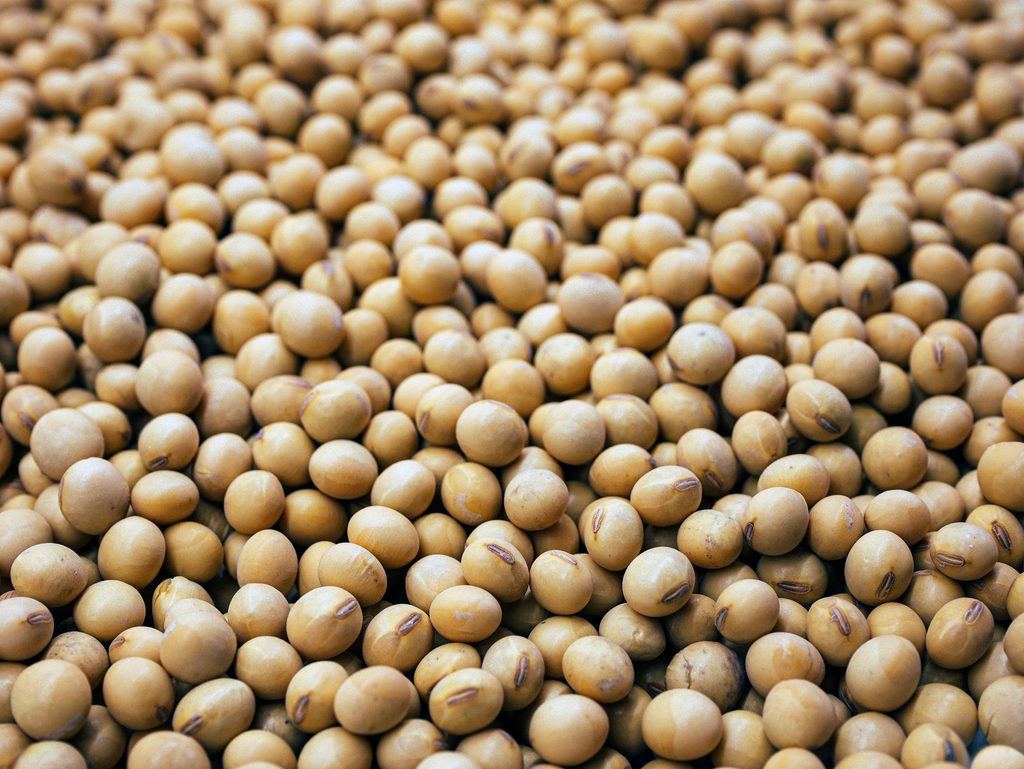
Soybeans are the body. They supply the protein that will eventually be broken down into amino acids — the building blocks of savory depth. Before fermentation begins, the beans are soaked overnight and then cooked until soft, either by boiling or by steaming. Steaming tends to preserve more of the natural sweetness; boiling is faster and produces a slightly more robust flavor. The cooked beans are then mashed into a rough paste, warm and dense, fragrant with a quiet earthiness.
Salt is the guardian. Added in precise amounts, it decides which microorganisms may survive in the fermenting mass, suppressing spoilage organisms while allowing the slower, beneficial processes to proceed. Too little and the miso spoils; too much and fermentation stalls. The figures are more specific than most people expect. Japan’s official food composition tables put a sweet white miso at roughly 6 grams of salt per 100 grams, a standard rice miso at around 12, and the dark soybean miso of Aichi at just under 11. That last number is worth holding onto — we will come back to it. The character of the salt itself matters too, which is why makers who have spent generations on a single recipe tend to be particular about where theirs comes from.
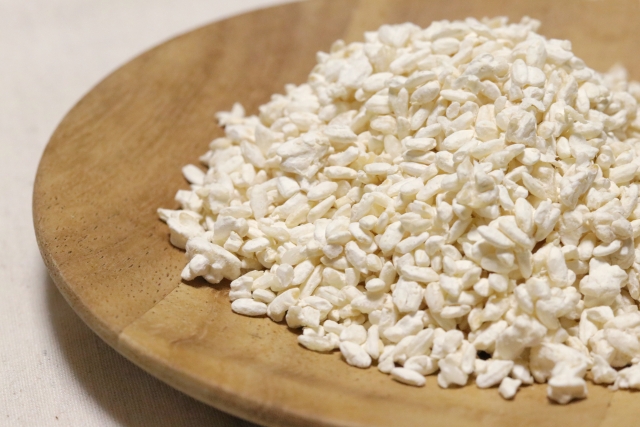
Koji is the engine. Aspergillus oryzae is a mould, cultivated on steamed rice, barley, or soybeans, that produces enzymes capable of dismantling complex proteins and starches into simpler compounds: amino acids, sugars, organic acids. It is the same organism behind sake, soy sauce, mirin, and rice vinegar — which is to say that most of what the world recognises as Japanese flavor traces back to a single fungus. In 2006, a scientific society in Japan formally declared it the national fungus, kokkin. No other country has done anything comparable, and the designation is less eccentric than it sounds.
From Tribute Goods to the Morning Bowl
Miso did not arrive in Japan as miso. Its ancestor is hishio, a family of salt-preserved fermented pastes that came from the Asian mainland, and which in Japan included versions made from fish and meat long before soybeans dominated — the older world that preceded soy sauce as well as miso.
What separates miso from that lineage is a word that does not exist in Chinese: mishō (未醤), written with characters meaning, by the usual explanation, “not yet hishio.” A wooden tax tablet excavated from the Fujiwara palace site carries an early form of it, and the Taihō Code of 701 lists it among the goods handled by the court’s office of seasonings. This was a paste eaten in lumps, taxed as a commodity, and distributed as part of an official’s salary — a luxury of the aristocracy rather than a household staple. The characters 味噌, read miso, are generally said to appear first in a court history completed in 901. (The etymology is not entirely settled; some scholars have argued for a loan from the Korean peninsula rather than the “not yet hishio” reading. The honest position is that we do not know for certain.)
The transformation that mattered came later, and it was mechanical rather than microbial. Somewhere around the Kamakura period, people began grinding the paste in a suribachi. Ground miso dissolves in water; lumpy miso does not. Miso soup, in other words, is roughly eight hundred years old, not a thousand — and its arrival is inseparable from the emergence of one soup, three dishes, the framework that has organised Japanese meals ever since. By the Muromachi period, soybean cultivation had expanded far enough that households began brewing their own, and the aristocratic tribute good became what it has been ever since: the thing at the back of everyone’s refrigerator.
The Patience of the Barrel
Once soybeans, salt, and koji are combined, the mixture is packed firmly into a vessel — traditionally a cedar barrel, though ceramic crocks and modern plastic containers are also used — with care taken to eliminate air pockets. A weight goes on top. A cloth is tied over the opening. And then the waiting begins.
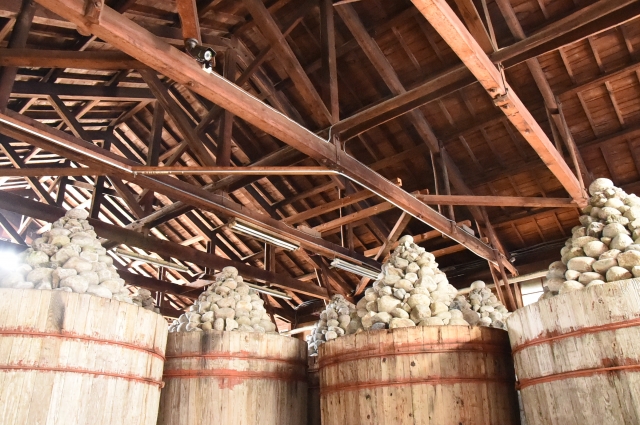
For a young white miso, the wait may be as short as a week or two. For a red miso fermented through summer and winter, a year or more. For Hatchō miso from Okazaki in Aichi Prefecture, the traditional standard is ni-natsu ni-fuyu — two summers and two winters, at least two full years.
The scale of that operation is worth describing precisely, because it is routinely garbled in English. A single cedar barrel holds roughly six tons of miso. On top of it, craftsmen stack about three tons of river stones — some three hundred and fifty of them — by hand, into a cone, arranged so that the pile will hold together through an earthquake. No mortar, no frame. The stones press moisture out of the paste and keep air from finding a way in, and the barrels stand in rows in the dim of a wooden storehouse for the whole of those two years. The barrels themselves last a century or more: one producer’s oldest working barrel is dated 1864 and is still in service. Wooden-barrel brewing now accounts for well under one percent of Japan’s miso production.
During that time, the koji enzymes work steadily through the paste. Proteins become amino acids. Starches become sugars. Sugars and amino acids then react with one another through the Maillard reaction — the same chemistry that browns bread crust — but running slowly, at ambient temperature, over months and years rather than minutes under heat. The color deepens from cream to amber to brown to near-black. The flavor intensifies and mellows simultaneously.
What makes this remarkable is that it is not fully controlled. A maker sets the conditions — the ratio, the temperature of the room, the weight on the barrel — and then steps back. The microorganisms do the rest. This is why experienced producers speak of their batches in language that sounds almost parental: how the miso is developing, whether the season is being kind to it.
The miso is not manufactured. It is tended.
Reading the Label
Walk through a Japanese supermarket and the miso section can feel overwhelming. A few distinctions carry most of the weight.
Color is the quickest guide, and the most honest one, because the color is not chosen — it is a reading of how long the paste has been aging. White miso (shiro miso) is pale, sweet, high in koji, low in salt, and fermented briefly. Red miso (aka miso) is darker, saltier, aged long, and assertive. Mixed miso (awase) is a blend, and the most common thing in Japanese home kitchens. The rule everyone repeats — white is sweet, red is salty — is true enough to be useful, but the interesting question is why the same three ingredients divide into pale and dark in the first place, and the answer is a genuinely elegant piece of cause and effect.
Beyond color, the koji grain matters. Rice koji gives a gentler, sweeter result. Barley koji is earthier and more rustic. Soybean koji — used in Hatchō miso, with no grain at all — produces the most concentrated, austere flavor of the three, with almost no residual sweetness. Which brings us back to that salt figure. Hatchō miso is not, in fact, the saltiest miso on the shelf; at around eleven percent it sits below a standard rice miso. What makes it taste so uncompromising is the absence of grain sugar and its extremely low moisture content. It is not saltier. It is denser.
One last word worth looking for is nama (生), meaning unpasteurized. Most commercial miso is heat-treated to halt fermentation and extend shelf life. Unpasteurized miso keeps its living cultures, and many cooks argue its flavor is simply more alive. It is worth being clear about why: if you are dissolving it into hot soup, the microbes do not survive the bowl either way. The real difference is aromatic — the volatile compounds that pasteurization drives off — and in a bowl of miso soup that difference is immediate and unmistakable.
A Fermented Map
Japan is a long, narrow country, and its climate runs from the snowbound winters of Hokkaidō to the subtropical heat of Kyūshū. Miso records that geography with unusual fidelity. Cold northern regions produced dark, salty, long-aged pastes built to sustain people through months without fresh food. Kyoto, where aesthetics and cuisine have never been separable, produced a pale, low-salt miso so sweet it borders on confectionery. Landlocked Aichi produced a near-black paste made without any grain at all. Kyūshū, where rice arrived and then moved on, built its miso on barley instead.
Each of those is a different answer to the same question, arrived at by people working with what their land gave them — and laid side by side, they amount to a fermented map of Japan drawn in salt and time.
What Miso Actually Does
Soup is where most people meet miso, but it accounts for only part of what the paste does in a Japanese kitchen.
Miso is, first, a curing medium. Fish or meat buried in sweetened miso overnight comes out firmer, sweeter, and seasoned all the way through — the enzymes and salt working inward while the sugars set up a lacquered crust on the grill. It is a thickener and a backbone in simmered dishes, where it does work that soy sauce alone cannot. It is the base of dressings and dipping sauces. And it is one of the four foundational ramen tares, the youngest of them, invented in Hokkaidō in the postwar years and now inseparable from an entire regional style.
The Morning Bowl
All of this history, geography, and microbiology eventually arrives at the same place: a bowl, early in the morning, wisps of steam rising, a scattering of tofu and wakame — or perhaps a few slices of daikon and a garnish of green onion.
Miso shiru is one of the most personal foods in Japanese culture. Ask someone what their ideal bowl tastes like and they will almost certainly describe their mother’s version, or their grandmother’s. The miso that feels right is the miso you grew up with. It is a flavor memory, which is another way of saying it is a form of belonging.
Making it well is not complicated, but it rewards attention. Dashi — the light stock drawn from kombu and katsuobushi — provides the backdrop, and which dashi you draw changes the bowl as much as the miso does. The miso is dissolved into warm, never boiling, dashi at the last moment, preserving the delicate aromatics that high heat would drive off. Traditionally it is served in a lacquered wooden bowl, which is not decoration: lacquer over wood insulates well enough that you can hold a bowl of near-boiling soup in your palm and drink from it directly, which is exactly how it is meant to be drunk.
The choice of miso, the ratio to dashi, the garnishes — these small decisions accumulate into something unmistakably yours.
That is the quiet genius of miso. A thousand years of craft and culture, distilled into a paste that fits in a tub the size of a shoebox. Open it. Smell it. Something alive is still at work inside.
Read, then Taste.
This article is part of Waden’s Fermentation series. Miso is one branch of the koji family — the others are soy sauce, mirin, rice vinegar, shio koji, and amazake. Read more at waden.umamibako.com.
Comment