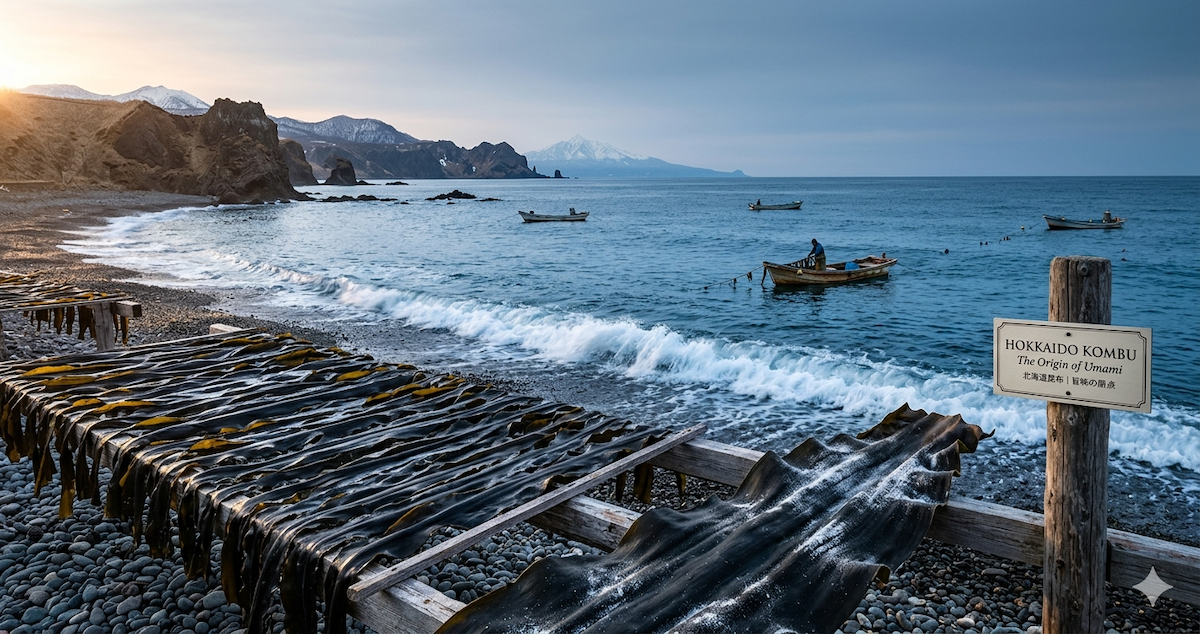
The Cold Waters of Hokkaido: Where Kombu Begins
Before the dashi, before the soup, before the dish — there is the sea. Japan’s kombu culture begins in the cold currents off Hokkaido, where three distinct coastlines produce three entirely different flavors.
Pull a strip of dried kombu from its wrapping and hold it up to the light. It is almost black — a deep, mineral green-black — with a fine white powder dusting its surface. That powder is not mold or salt. It is mannitol, a naturally occurring sugar alcohol that forms as the kombu dries, and it is one of the first indicators of quality. Good kombu blooms with it. Run a finger along the surface and the powder comes away, slightly sweet against the skin.
Kombu is a seaweed — specifically, a variety of large brown kelp belonging to the genus Laminaria — and it is one of the most important ingredients in Japanese cuisine. Not because of how it tastes when you eat it directly, though it can be eaten in many forms. Because of what it gives to water. Submerge a piece of kombu in cold water and leave it overnight, and the water is transformed. It becomes something with depth and roundness, a quiet presence that amplifies everything cooked in it. This is dashi — the foundational stock of Japanese cooking — and kombu is where it begins.
Most of the japan’s kombu supply comes from a single island: Hokkaido, Japan’s northernmost prefecture. The cold, nutrient-rich waters of the Sea of Okhotsk and the Pacific Ocean create conditions that kelp thrives in — low temperatures, strong currents, and an abundance of the minerals that give kombu its distinctive character. But Hokkaido is not one coastline. It is many. And each of its major kombu-producing regions yields a seaweed so distinct in flavor, texture, and best use that Japanese cooks treat them almost as different ingredients entirely.
What Makes Kombu Taste the Way It Does
The flavor of kombu is, at its core, the flavor of glutamic acid — the amino acid that acts as the primary carrier of umami. Kombu contains more free glutamates per gram than almost any other natural food source. When kombu is placed in water, those glutamates dissolve slowly into the liquid, building the savory depth that makes dashi so fundamental to Japanese cooking.
But glutamates alone do not explain the full range of kombu’s flavor. Alongside them, kombu releases a complex mixture of minerals, sugars, and volatile aromatic compounds that vary significantly depending on where the kombu was grown, how long it was aged after harvest, and how it was dried. The sea itself — its temperature, its mineral content, the speed of its currents, the depth at which the kelp grew — is present in every strand. To taste kombu from different regions is to taste different expressions of the same ocean.
Hidaka: The Everyday Kombu
The Hidaka coast runs along the southeastern shore of Hokkaido, facing the Pacific. It is the most productive kombu-growing region in Japan, accounting for the largest share of the national harvest. Hidaka kombu — sometimes called mitsui kombu — is thinner and more tender than the kombu of other regions, with a relatively mild flavor and a greenish-black color that is less intense than its northern counterparts.
Because of its tenderness, Hidaka kombu is well suited to preparations where the kombu itself will be eaten — simmered dishes, pickled kombu, the long-cooked kombu knots that appear in oden and nimono. It softens relatively quickly under heat, becoming almost silky in texture. For dashi, it produces a clean, straightforward stock — present but not assertive, appropriate for dishes where a more delicate umami foundation is needed.
Hidaka kombu is also the most widely available variety outside Japan, and the one most likely to be found in international supermarkets and online retailers. Its approachability makes it a good starting point for cooks encountering kombu for the first time. But it is, in a sense, the entry-level expression of what kombu can be.
Rausu: The Bold One
Travel northeast along Hokkaido’s coastline to the Shiretoko Peninsula — a UNESCO World Heritage Site, one of the most remote and ecologically significant stretches of coastline in Japan — and the kombu changes dramatically. Rausu kombu, harvested from the waters off the Shiretoko coast, is the most intensely flavored of the major varieties. Thick, wide, and deeply colored, it produces a dashi that is rich, almost amber-colored, with a pronounced umami depth and a slight sweetness that lingers.
The cold Oyashio current, which flows south along this coastline carrying nutrients from the Sea of Okhotsk, is largely responsible for Rausu kombu’s intensity. The kelp grows in particularly nutrient-dense water, developing a high concentration of glutamates and minerals that translate directly into flavor. Rausu dashi has a presence that is immediately noticeable — it announces itself in a way that Hidaka dashi does not.
This intensity makes Rausu kombu the preferred choice for heartier dishes — rich miso soups, braised meats and vegetables, noodle broths where the dashi needs to hold its own against strong seasoning. In Kyoto, where culinary culture prizes subtlety, Rausu is sometimes considered too assertive. In the kitchens of Tokyo ramen shops and izakayas, it is a prized ingredient. Like all great regional products, it has its own natural home.
Rishiri: The Chef’s Kombu
Off the northwestern tip of Hokkaido, in the cold waters of the Sea of Japan, lies Rishiri Island — a volcanic cone rising steeply from the water, surrounded by kelp forests that produce what many Japanese chefs consider the finest kombu in the world. Rishiri kombu is thinner and harder than Rausu, with a surface so dark it appears almost black. The dashi it produces is pale, almost water-clear, and extraordinarily clean in flavor — a pure, refined umami with no murkiness, no assertiveness, nothing that distracts from the ingredients it supports.
It is this clarity that has made Rishiri kombu the kombu of choice in Kyoto cuisine for centuries. The refined cooking tradition of the imperial city — kyo ryori — demands dashi that elevates without overwhelming. Rishiri kombu provides exactly that: a stock so clean it seems to make other flavors brighter simply by being present. The delicate tofu preparations, the clear soups, the precisely seasoned vegetable dishes of Kyoto cuisine are built on this foundation.
Rishiri kombu is also the most expensive of the major varieties, and the most difficult to source outside Japan. The island’s harvest is limited by the size of its coastline and the labor-intensive nature of traditional harvesting methods. Divers gather the kelp by hand in summer, cutting it at the base and bringing it to the surface, where it is spread on the rocky shore to dry in the sea wind. The process has changed little in centuries. The kombu is then aged — sometimes for a year or more — in cool, dark storage facilities, where the flavor deepens and mellows before it reaches a kitchen.
Ma-Kombu: The Osaka Tradition
A fourth variety deserves mention, though its growing region sits slightly south of Hokkaido proper, along the coast of the Oshima Peninsula in the southernmost part of the island. Ma-kombu — “true kombu,” sometimes called honkombu — is wide, thick, and pale olive-green, with a sweetness that sets it apart from the more mineral-forward northern varieties.
Ma-kombu has a particular historical significance: it is the kombu of Osaka, carried south from Hokkaido along the historic Kombu Road — the maritime trade route that connected Hokkaido to the markets of Osaka from the seventeenth century onward. Osaka became the kombu capital of Japan not because kombu grows there, but because it was the endpoint of this trade route, and Osaka merchants were the ones who aged, processed, and distributed kombu throughout the country. The kombu culture of western Japan — distinct from that of Tokyo and the east — grew from this commercial geography. Ma-kombu’s sweetness makes it particularly suited to the lighter, more delicate dashi preferred in Osaka and Kyoto, and it remains the variety most closely associated with the kaiseki tradition of formal Japanese cuisine.
The Art of Drawing Dashi
Understanding kombu’s regional diversity is only half the story. The other half is technique — specifically, the art of extracting kombu’s flavor into water without pushing it too far.
Cold extraction — placing kombu in cold water and leaving it for several hours or overnight — produces the cleanest, most delicate dashi. The glutamates dissolve slowly, without the help of heat, and the result is a stock of extraordinary clarity. This method is preferred for preparations where subtlety matters: clear soups, chilled dashi, dishes where the kombu flavor should be present but nearly transparent.
Warm extraction — bringing the water gradually to around 60°C and holding it there before adding or removing the kombu — produces a fuller, more rounded dashi in less time. The gentle heat accelerates glutamate extraction without triggering the release of the alginic compounds that make kombu taste seaweedy and slightly bitter. The critical threshold is approximately 80°C: above this temperature, the kombu begins to give off flavors that most cooks do not want in their dashi. The kombu is removed before the water reaches a boil.
In both methods, the kombu is never squeezed or pressed after removal. Its contribution to the dashi is complete; extracting more would only cloud what has been carefully built. The spent kombu, far from being discarded, becomes an ingredient in its own right — simmered with soy sauce and mirin into tsukudani, chopped into rice dishes, or pickled for use as a condiment. Nothing is wasted. The philosophy of the kitchen extends even to what has already given everything it has.
A Sea in Every Bowl
The next time you encounter dashi — in a bowl of miso soup, in the broth of a noodle dish, in the liquid used to simmer vegetables — consider what is in it. Somewhere off the coast of Hokkaido, in water cold enough to make your breath visible, a strand of kelp spent two or three years growing in the current. It was harvested by hand, dried on stone in sea wind, aged in darkness, and sent across the world to dissolve quietly into your bowl.
That is what kombu does. It disappears into the water and leaves behind something better than itself — a depth, a roundness, a sense of the sea that makes everything it touches taste more fully like what it is.
This is the foundation of Japanese cuisine. It begins, as so many things do, in the cold waters of Hokkaido.
Read, then Taste
This article is part of Waden’s Origin series — traveling to the landscapes and coastlines where Japan’s finest ingredients begin. Read more at waden.umamibako.com.
Comment