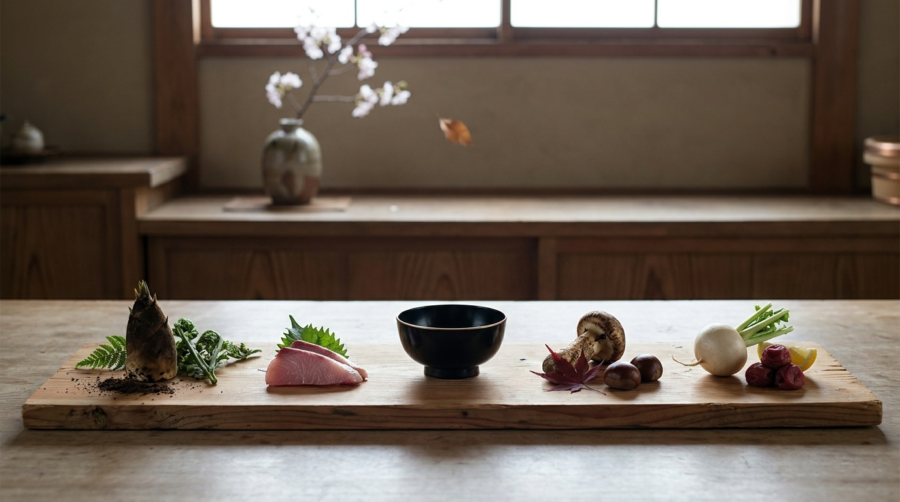
Shun: How Japan Learned to Eat by the Calendar
Japan does not simply observe the four seasons. It counts them in twenty-four parts, and then seventy-two more. Behind this precision lies a philosophy of eating that has quietly shaped Japanese cuisine for over a thousand years.
In Japan, the question of what to eat is inseparable from the question of when. Not in the practical sense of what happens to be in the shops, but in a deeper one: the belief that every ingredient has a moment — a brief window when it is most fully and completely itself. To eat it then is to experience it properly. To eat it at any other time is to settle for something diminished.
This belief has a name: shun (旬). It is one of the most fundamental organising principles of Japanese food culture, and almost everything else in this journal rests on it somewhere.
What Shun Actually Means
Shun describes the period when an ingredient stands at the peak of its flavour, its nutritional value, and — not coincidentally — its abundance, which is to say its affordability. That the three should coincide is not a happy accident. It is the natural consequence of a food arriving in quantity at precisely the moment it is ripe. Seasonality in Japan was never a marketing category. It was a description of how supply actually behaves.
The character itself is older and more specific than its culinary use suggests. In the classical Chinese reckoning that Japan inherited, 旬 meant ten days — the span in which the ten heavenly stems complete a full cycle. It survives in ordinary modern Japanese in exactly that sense: jōjun, chūjun, and gejun are the first, middle, and final ten days of a month. From a fixed unit of the calendar, the word drifted toward the thing the calendar was for — the recurring, reliable arrival of what the land produces. Its meaning narrowed, but the sense of cyclical inevitability stayed. Shun is not a trend. It is a rhythm.
Japanese has a pair of phrases for what that rhythm delivers: yama no sachi, the bounty of the mountains, and umi no sachi, the bounty of the sea. The first covers the bamboo shoots that turn bitter within a day of being dug, the chestnuts and matsutake of autumn, the wild shoots that appear briefly as the snow recedes. The second covers the bonito that arrives on the Kuroshio each spring, the sweet shrimp of winter, the sea urchin whose quality shifts week by week through summer. Together they constitute an enormous seasonal ledger, every entry with its own date of arrival and departure.
A Calendar of Seventy-Two Seasons
To see how seriously Japan has taken the measurement of seasonal change, look at the structure of its traditional calendar.
The year is anchored by four astronomical facts — the two solstices and the two equinoxes — and then by four further points marking the declared beginning of each season. Those eight divisions are each split into three, producing twenty-four sekki, solar terms of roughly fifteen days apiece. The system originated in the agricultural zones of the Yellow River, where reading the seasons correctly was the difference between a harvest and a famine. The Nihon Shoki, completed in 720, records Chinese calendrical knowledge reaching Japan via the Korean peninsula around the sixth century, and the twenty-four terms were absorbed into Japanese life soon after.
But Japan did not stop at twenty-four, and it did not simply adopt what it received. The imported terms described the climate of northern China, and they fit the Japanese archipelago imperfectly. When the astronomer Shibukawa Harumi produced the Jōkyō calendar — Japan’s first domestically calculated calendar, adopted in 1685 — the seventy-two kō, the five-day microseasons nested inside the solar terms, were rewritten to match what actually happens in Japan. The result was called the Honchō Shichijūni-kō, the microseasons of this country. They were revised again under the later Hōreki calendar, and the version most people know today is the one printed in the abridged almanac of 1874.
Their names read like a poetics of observation. Bush warblers begin to sing. The first peach blossoms open. Deer shed their antlers. Cold sets in. Each marks a specific five-day window. This is not decorative language. It is the accumulated attention of generations of people who watched closely enough to notice that things happen in a particular order, at a particular time, and that what there is to eat is part of that order. If you want to see how it plays out on an actual table, we have walked the twenty-four terms in order, from the bitter shoots of a spring declared before it can be felt to the herb porridge that resets the year.
Three Stages Within a Season
Even within a single ingredient’s season, Japanese food culture makes finer distinctions — three of them.
Hashiri is the running-in, the first arrivals at market. Sakari is the peak, when the ingredient is everywhere and cheap and at its best. Nagori is the remainder, the last of it, as the ingredient begins disappearing from the stalls and the next season starts pressing in behind it. These are not merely commercial categories. They describe how the same ingredient changes, and what those changes ask of the cook.
Hashiri carries the excitement of return. First foods of the season are called hatsumono, and the saying attached to them is that eating one extends your life by seventy-five days. Where the number came from, nobody can say with confidence — the explanations range from a condemned prisoner’s last request in the Edo period to the interval between sowing and harvest, and none of them is settled. What is not in doubt is the weight the culture placed on being first. Edo townsmen were notorious for it, and the lean first bonito riding the Kuroshio north was the object of the most extravagant enthusiasm of all — a fish prized precisely for what it lacked, since the fat would not arrive until autumn.
Sakari is where cooking becomes easy, because the ingredient is doing the work. The autumn table is the clearest case: grill the fish whole, tear the mushroom nobody has learned to farm by hand, cook the new rice in plain water. The season arrives already finished and the correct response is to get out of its way.
Nagori is the interesting one, because its register is not culinary but emotional. To eat a late-season ingredient is to know it is leaving, that the season is closing, and that its return is a year away. This awareness of impermanence, built into the act of eating, connects directly to mono no aware — the recognition that transience is not a flaw in beautiful things but a condition of them. It also explains why the same ingredient gets treated differently at either end of its run. A matsutake at hashiri, cap still closed, is firm and high-toned and belongs on the grill; the same mushroom at nagori, fully opened, is earthier and belongs in the rice. Same organism, three weeks apart, two different dishes.
Hashiri is arrival, sakari is abundance, nagori is farewell. The Japanese kitchen names all three, because the same ingredient does not mean the same thing at each.
How the Calendar Shapes the Table
The solar terms are not only weather markers. They set the agricultural year, and the food follows. Risshun, the declared beginning of spring in early February, opens the traditional year while the ground is still frozen. Kokuu, the “grain rain” of late April, names the warmth and wet that produce the conditions for the first tea picking. Autumn is governed by several terms in quick succession, each marking a different stage of ripening — rice, mushrooms, roots, and the cold-water fish putting on fat before winter.
Kaiseki, the formal multi-course cuisine most closely associated with Kyoto, tracks these transitions with something close to journalistic precision. A kaiseki menu turns not with the four seasons but with the solar terms, and sometimes with the microseasons inside them. Serving a particular ingredient is a statement about time: this is what is happening right now, in the fields and in the sea, and this is us reflecting it back to you. The confection that accompanies the tea does the same work in miniature — a sweet shaped like the week it is served in, and withdrawn from the shop window the moment that week has passed.
Home cooking runs on the same logic, less formally. Supermarkets flag produce as being in shun. Fish counters change week by week. And the question a Japanese home cook asks in front of them is not “what do I feel like eating” but “what is good right now” — which is the whole philosophy, compressed into the most ordinary domestic decision there is. It is also one of the reasons UNESCO’s recognition of washoku cites respect for nature and the seasons as a defining feature rather than any particular dish.
Does the Nutrition Argument Hold?
Shun is usually presented as an aesthetic philosophy. It is worth asking whether it is also a factual claim, and whether that claim survives examination.
Some of what is said on the subject does not. The idea that seasonal eating explains Japanese longevity is repeated constantly and rests on nothing in particular. But there is a much better piece of evidence, and it comes from an unglamorous source: the Standard Tables of Food Composition in Japan, the national reference published by the education ministry. For spinach, the tables do not give a single entry. They give three — year-round, summer-harvested, and winter-harvested — because the difference was too large to average away. Summer spinach carries around 20 mg of vitamin C per 100 g. Winter spinach carries around 60 mg. Same vegetable, three times the vitamin C, and the government’s own reference data treats them as effectively different foods.
That is what shun looks like when it is measured rather than asserted. The older intuition — that summer vegetables cool the body while winter roots warm and strengthen it — belongs to a pre-modern framework shared with Chinese medicine, and one need not accept the whole system to notice that the underlying observation is sound. Food eaten at its peak of ripeness, grown nearby and picked recently, does tend to carry more of what makes food worth eating. The wild mountain vegetables of early spring are the extreme case: bitter, briefly available, foraged rather than farmed, and impossible to encounter at any other point in the year.
What Shun Cannot Explain
It would be tidy to say that shun governs the Japanese table. It does not, quite, and the exceptions are as revealing as the rule.
Ritual can override it outright. The most famous seasonal food in the Japanese year is grilled eel on the midsummer day of the ox — and midsummer is the leanest moment of the eel’s year, since wild eel fattens in autumn and winter. An entire nation eats a fish at its worst because a date derived from a fifteen-hundred-year-old calendar says to. Shun is one force acting on the table. It is not the only one, and it does not always win.
Preservation suspends it deliberately. A great deal of Japanese food culture consists of technologies for defeating the calendar: miso that takes two summers and two winters to mature, a rice-bran bed kept alive for decades, bonito dried and moulded into something closer to wood than fish. These exist precisely because the peak moment does not last, and somebody wanted it in February. Shun tells you when an ingredient is best; fermentation is the answer to what happens afterward.
And some of what looks like seasonality is really geography wearing a seasonal coat. Kyoto’s heritage vegetables are prized for where they were grown and how long they have been grown there, not for the week they appear. Place and time are different arguments, and Japanese food culture makes both.
Shun in a World Without Seasons
Modern supply chains have largely dissolved the practical necessity of any of this. Strawberries in December, asparagus in October, almost any fish year-round through aquaculture and air freight. Japan is not exempt. Tokyo supermarkets stock tomatoes and cucumbers in winter, and for many shoppers shun has become more aspirational than operative.
It persists anyway — as a concept, a value, a way of thinking that still shapes Japanese cooking at every level from the home kitchen to the three-star restaurant. It persists because it encodes something that remains true whatever the supply chain does: food has a natural time, and eating it then is a different experience from eating it at any other. Not merely fresher or more nutritious, but more connected to where it grew, to the season that ripened it, to the cycle of which any single meal is a small real part. It is the same conviction that led a Tokyo chemist to look for the reason kelp broth tastes the way it does and to name a fifth basic taste: the assumption that what seems obvious at the table is worth taking seriously enough to investigate.
To eat with an awareness of shun is to eat with an awareness of time. That, in the end, is what Japanese food culture has always been asking of us.
Read, then Taste.
This article is part of Waden’s Seasons series, following the rhythm of the Japanese culinary year. For the year walked in order, read A Year at the Japanese Table; then stand inside a single season with spring, summer, and autumn. Read more at waden.umamibako.com.
Comment