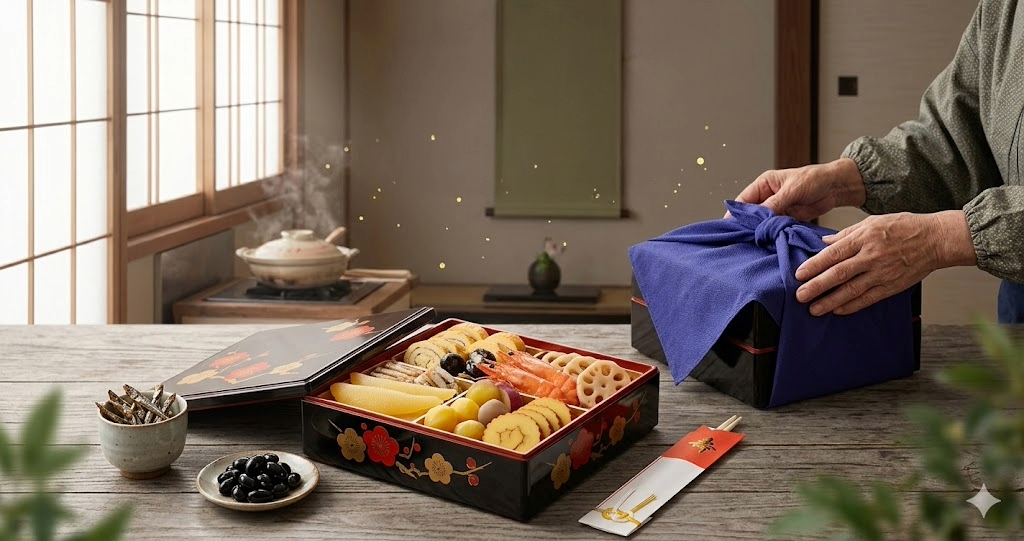
Osechi: New Year in a Lacquer Box
Every January, Japanese families open a box that has taken days to fill — each small dish carrying a wish, a wordplay, a piece of history. Osechi is not simply a New Year feast. It is the most complete expression of Japanese food culture as an act of transmission.
On the morning of January 1st, before anything else happens, the box is opened. It sits at the center of the table in its lacquered tiers — black on the outside, red within — and the family gathers around it. There is a formality to this moment: the chopsticks used are iwaibashi, ceremonial chopsticks thinner at both ends than ordinary ones, designed for an occasion that belongs equally to the human and the divine. The phrase exchanged is Akemashite omedetō gozaimasu — “The new year has dawned, congratulations.” And then the dishes are eaten.
What is inside the box has taken days to prepare. Some families have spent the final days of December in sustained, organized kitchen labor — one dish per day, each requiring specific ingredients, techniques, and timing. Others have ordered their osechi weeks in advance from a department store or a restaurant, receiving a box assembled by professionals who follow the same ancient compositions. Either way, the contents of the box are largely fixed: an arrangement of dishes whose names, colors, shapes, and ingredients have been encoded with meaning accumulated over more than a thousand years of tradition.
Osechi is Japan’s most storied food tradition — and one of its most pressured. Understanding what it is, where it came from, and why it persists requires understanding both the weight of what it carries and the fragility of how it is passed on.
From Imperial Court to Kitchen Table
The name osechi derives from sekku — the five seasonal festivals of the traditional lunisolar calendar, adopted from China, at which ritual offerings of food were made to the gods. As far back as the Nara period (710–794), ceremonial banquets called sechie were held at the imperial court on these turning-point days, offering food to the deities and consuming it in a shared ritual of naorai — the practice in which those who pray eat together with the gods. New Year was the first and most important of these festivals, and the food prepared for it gradually acquired its own name: osechi ryori.
By the Heian period (794–1185), these court banquets had become elaborate affairs, with specific dishes prescribed for each seasonal festival. The current array of osechi dishes, however, took its recognizable form much later. Osechi changed greatly under the influence of honzen-ryōri, a banquet format ritualized in daimyo and samurai society during the Muromachi period (1336–1573). Many of the standard dishes that make up osechi today are derived from honzen-ryōri. The three celebratory foods now considered essential to the first tier — kuromame (black soybeans), tazukuri (candied sardines), and kazunoko (herring roe) — were originally served as sake accompaniments at honzen banquets, carried home by guests after the feast as gifts. Kamaboko, datemaki, and kuri kinton were similarly honzen dishes before they migrated into osechi.
The democratization of osechi occurred during the Edo period, as economic development brought the chōnin (townspeople) class into contact with traditions that had previously belonged only to samurai and nobility. From the late Edo period, some of the dishes in osechi began to be packed in jūbako, and from the Meiji era to the Showa era, the variety of dishes packed in jūbako increased, becoming a luxurious product sold in department stores. With the modernization of Japanese society, women’s schools were established and osechi was taught as a dish that housewives should master. The various regional styles of osechi that had existed until then were gradually standardized throughout the country.
This standardization is part of what makes osechi’s transmission so specific — and so fragile. A tradition preserved in women’s schools and department store catalogues rather than in family kitchens is a tradition that exists at one remove from lived practice.
The Architecture of the Box
The jūbako — the tiered lacquer boxes in which osechi is served — is itself a statement of intention. Black on the outside, red on the inside, the boxes represent the wish for repeated good fortune: the stacking of tiers is the stacking of luck. The number of tiers varies regionally, but in the case of five tiers, the top often includes special celebratory foods and appetizers to accompany drinks, the second vinegar-dressed and grilled dishes, the third more grilled dishes, and the fourth simmered dishes. There is a custom to leave the bottom tier empty to allow fortune to come in.
The fourth tier carries a particular delicacy of nomenclature. The number four in Japanese is typically read shi — the same sound as the character for death. The fourth box in osechi is accordingly called yo-no-ju rather than shi-no-ju, using an alternative reading of the character to sidestep the inauspicious association. This small linguistic maneuver — renaming a number to avoid a sound — is a precise example of the broader principle that structures all of osechi: the belief in kotodama, the spiritual power of words to enact what they name.
Kotodama is why so many osechi dishes are chosen for their names rather than their flavor alone. The selection of each ingredient is partly a linguistic act: a choice to speak certain words into the new year, to invoke through eating what eating names.
The Language of the Dishes
The first tier of osechi contains the three iwaizakana — festive side dishes — that have been considered the core of the tradition since the Edo period, though with regional variations between Kanto and Kansai.
Kuromame — black soybeans, simmered for many hours in sugar and soy sauce until they achieve a deep, glossy black finish — are the wish for health and diligence. The word mame carries the double meaning of “bean” and “hardworking” or “healthy.” To eat kuromame at New Year is to express the intention to work diligently and remain healthy throughout the year. Some traditional recipes add a few iron nails to the simmering pot: the iron oxide reacts with the tannins in the soybeans, deepening the color to a richer, more intense black. The technique is purely functional — achieving a more perfect black — but the image of iron nails in a pot of sweet beans is a reminder that osechi cooking has never been entirely separate from craft.
Kazunoko — herring roe, a cluster of thousands of tiny golden eggs — is the wish for the prosperity of descendants. Kazu means number; ko means child. The sheer quantity of eggs in a single piece of kazunoko makes the symbolism immediate and literal. The roe is typically brined, then soaked in fresh water to remove excess salt before being marinated in dashi and soy sauce. Its texture is firm and slightly crunchy, with a clean, briny flavor. It is one of the more expensive components of a traditional osechi, and its presence in the box is a statement about the seriousness of the household’s hopes for the new year.
Tazukuri — tiny dried sardines glazed with sugar, soy sauce, and mirin until they become crunchy and sweet-savory — carry the wish for an abundant harvest. The name derives from an older agricultural practice: sardines were used as fertilizer in rice fields (ta means rice field; tsukuru means to make or cultivate). A dish that began as a symbol of agricultural plenty has persisted in urban osechi boxes long after its original context disappeared — the wish for harvest surviving into a world where most of the people eating it have never worked a rice field.
Beyond the three iwaizakana, the box fills with dishes whose symbolism ranges from the straightforward to the elaborately punning. Datemaki — a sweet rolled omelette made from white fish surimi and egg, baked in a rectangular pan and rolled with a bamboo mat — represents elegance and learning; its spiral cross-section resembles a scroll. Konbu maki — kelp rolls often stuffed with herring — draw on the similarity between konbu and yorokobu (to rejoice), and on the fact that maki can also refer to volumes of books, making them auspicious for study. Ebi — shrimp, cooked until their backs curve into the bent posture of old age — express the wish for long life. Renkon — lotus root, with its distinctive round holes when sliced in cross-section — represents the wish for a clear, unobstructed view into the future: because you can see through the holes, the coming year will have no hidden obstacles.
Kuri kinton — mashed sweet potato mixed with sweetened chestnuts, golden in color — expresses the wish for financial prosperity. The golden color of the dish is the color of gold, and the word kinton shares characters with coins and wealth. It is reliably one of the most popular osechi dishes with children, its sweetness and richness making it the most immediately approachable element in a box that also contains vinegared burdock and brined fish roe.
The Fire That Is Not Lit
One of the practical foundations of osechi is a prohibition that most modern cooks have largely forgotten. Fires were not to be used in the first few days of the year, except to heat ozoni, the Japanese New Year mochi soup made with a dashi-based broth and mochi rice cakes, so foods were prepared in advance. The prohibition against lighting cooking fires during the New Year was both spiritual — to avoid disturbing the toshigami, the year god who brings the new year’s blessings — and practical: the days of New Year were designated as rest, and the cook was not expected to work.
This constraint shaped osechi’s character entirely. Every dish in the box must be preparable in advance and must remain safe and palatable for three days without refrigeration. The solutions the tradition developed — heavy seasoning with sugar, salt, and vinegar; thorough drying; glazing with soy sauce and mirin — are also, not coincidentally, techniques that produce intensely flavored food. The preservation requirement and the flavor profile of osechi are inseparable. The sweetness of kuromame, the saltiness of kazunoko, the sticky glaze of tazukuri: all are properties of food designed to keep. The modern refrigerator has made the three-day preservation requirement technically unnecessary, but the flavors it produced have become the flavors of osechi itself, and departing from them risks departing from the tradition.
The Transmission Problem
Making osechi from scratch is a considerable undertaking. A full set of traditional dishes requires several days of preparation, specific ingredients that must be sourced in advance, and a working knowledge of techniques — the long simmering of kuromame, the careful rolling of datemaki, the preparation of kazunoko — that are not part of everyday Japanese cooking. This knowledge was once transmitted within families, from mother to daughter across generations, in the sustained kitchen labor of the final days of December.
That transmission is now under significant pressure. The majority of Japanese families today purchase their osechi rather than making it — from department stores, from convenience chains, from specialist restaurant services that produce elaborate multi-tiered boxes in volumes impossible to imagine in a domestic kitchen. The food inside these purchased boxes is technically correct: the dishes are present, the symbolism is intact, the jubako is lacquered and properly tiered. But the knowledge of how to make it — the hours at the stove, the judgment required to simmer kuromame to exactly the right gloss, the family memory of a grandmother’s datemaki — is not transmitted through a department store order.
This is the inheritance question that osechi poses with particular sharpness, because osechi is, at its core, a tradition about transmission. The word denshō — heritage, the Waden theme to which this article belongs — contains the character for “to transmit.” Osechi was always a form of cultural transmission: the offering of food to the gods, the sharing of that offering within the family, the encoding of wishes for the future in the names and shapes of what is eaten. A tradition about passing things forward is now at risk of not being passed forward in the form that made it meaningful.
The families who still make osechi by hand — who spend December 28th making kuromame and December 30th rolling datemaki and December 31st assembling the box — are doing something that goes beyond cooking. They are performing the transmission itself, enacting the tradition in the only way that keeps it alive: by doing it, in a kitchen, with their hands, once a year.
The Box, Opened
On January 1st, the box is opened and the dishes are eaten in their prescribed order, with the prescribed chopsticks, while the prescribed words are spoken. The toshigami has been welcomed. The wishes have been named. The new year has been addressed in the language that Japan has been developing for this occasion for over a thousand years.
Whether the person eating knows the etymology of kazunoko or the agricultural history of tazukuri is almost beside the point. The tradition does not require intellectual awareness of its meanings to function. It requires only the opening of the box, the gathering of the family, and the eating of the food. In that act — repeated across millions of households on the same morning, as it has been repeated for centuries — something is transmitted that cannot be purchased or packaged, though it can, with enough care and enough time in the kitchen, still be made.
This article is part of Waden’s Heritage series — documenting the traditions, techniques, and foods that must not be forgotten. Read more at waden.umamibako.com.
Comment