One Soup, Three Dishes: The Framework That Shaped Japanese Eating
Ichiju sansai is four words in Japanese. It is also the organizing principle behind over a thousand years of Japanese food culture — a structure so quietly functional that most of the people who follow it every day have never needed to name it.
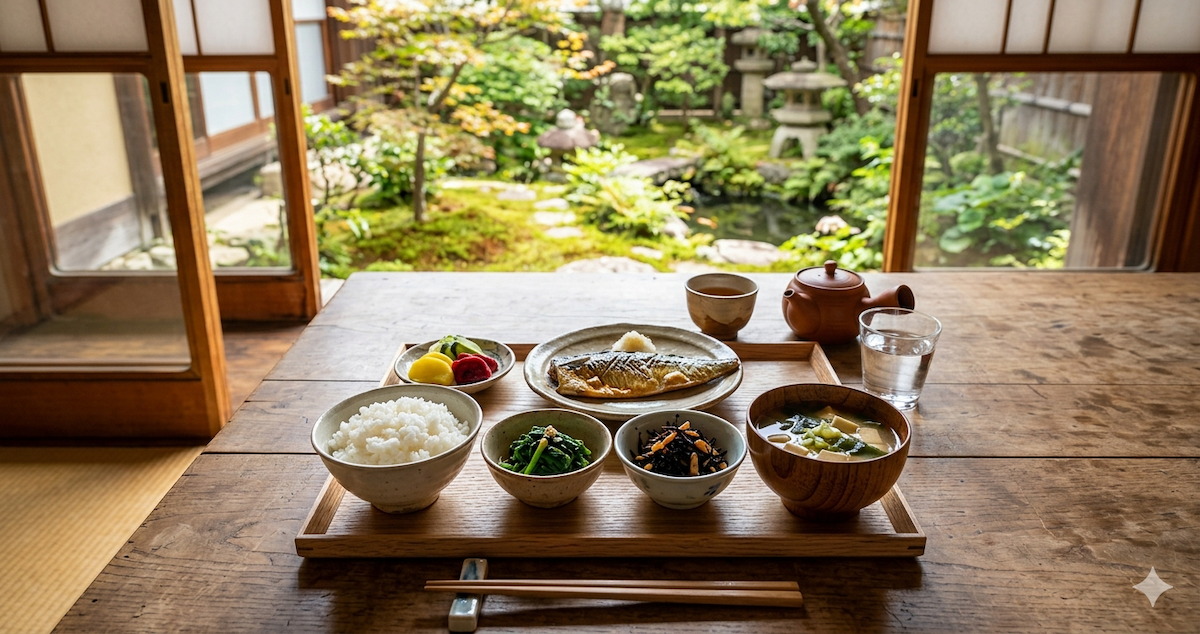
Set a traditional Japanese breakfast on the table and the arrangement is immediately recognizable: a bowl of rice at the lower left, a bowl of miso soup at the lower right, and three small dishes arranged in the upper field — perhaps a piece of grilled fish, a dish of simmered vegetables, a small plate of pickles. The rice and soup frame the meal. The three dishes fill it. Nothing dominates. Nothing is missing.
This is ichiju sansai — one soup, three dishes — and it is the foundational structure of Japanese home cooking. It appears at breakfast, lunch, and dinner. It appears in the set meals of casual restaurants, in the lacquered trays of ryokan, in the bento boxes of schoolchildren, in the hospital meals of elderly patients, in the offerings prepared for the dead at Obon. It is so pervasive and so quietly consistent that it functions less as a rule than as an assumption — the shape that a meal simply takes, in the same way that a sentence in English takes a subject and a verb.
Understanding ichiju sansai as a tradition requires understanding both what it is and where it came from: how a banquet format developed for medieval samurai became the unconscious blueprint for a nation’s daily eating.
The Unspoken Ingredients
The name ichiju sansai counts only the soup and the three dishes. It does not count rice or pickles. This omission is itself significant: both are so fundamental to the Japanese meal that naming them would be redundant, like specifying that a letter should be written in sentences. Rice — gohan — is the center around which everything else is organized. The three dishes are called okazu, a word that means “foods that accompany rice.” The meal is named for its accompaniments because it is understood, without stating, that rice will always be present.
Pickles — tsukemono — occupy a similar position of silent necessity. Their role is palate-cleansing and digestive: the acidity and saltiness of pickled vegetables cut through the umami of the soup and the richness of the main dish, resetting the mouth between bites and aiding in the digestion of rice. In the formal structure of ichiju sansai, tsukemono are sometimes listed separately as kōnomono — “fragrant things” — a category distinct from the three counted dishes. Their presence is assumed. Their absence would be noticed.
The three counted dishes have their own internal hierarchy. The shusai (主菜) — main dish — is typically protein-based: grilled fish, sashimi, braised meat, tofu, eggs. It provides the meal’s substance and focus. The two fukusai (副菜) — side dishes — are typically vegetable-based: simmered root vegetables, dressed greens, seaweed, tofu preparations, nimono. They provide variety, texture, color, and the vitamins and minerals that a protein-and-rice meal alone would not supply. The soup — typically miso soup in everyday cooking, clear broth in more formal contexts — provides warmth, hydration, and the umami foundation that ties the meal together.
In its original formulation, the three dishes of ichiju sansai followed a prescribed cooking-method pattern: one nimono (simmered dish), one namasu (raw or vinegared dish), and one yakimono (grilled dish). This prescription ensured variety not only in ingredient but in technique — each dish prepared differently, each contributing a different set of flavors and textures to the meal as a whole. The prescription is no longer followed rigidly in contemporary cooking, but its logic persists: the underlying principle that the three dishes should not repeat each other in flavor, texture, or cooking method remains embedded in how Japanese home cooks intuitively compose a meal.
From Court to Samurai: The Ancestry of a Format
The origins of ichiju sansai reach back to the Heian period (794–1185), when court cuisine and meals for Buddhist monks first established the pattern of rice accompanied by soup and multiple small dishes. The tradition owes its roots to the one-serving-per-person meimeizen of the common people and daikyou of the upper class, which began during the Heian period. But the direct ancestor of ichiju sansai as a codified format is honzen-ryōri — the ceremonial banquet style that became established during the Muromachi period (1336–1573) as the standard dining form for the samurai aristocracy.
Honzen-ryōri was built around a series of small lacquered tray tables — zen — set before each guest in precise arrangement. The primary tray, the honzen, held the core of the meal: rice, soup, pickles, and three dishes. This was the baseline. For a high-status guest, the meal could expand across additional trays: a second tray, the ninozen, added two soups and five dishes; a third, the sannozen, added three soups and seven dishes. The elaboration signaled the host’s wealth and the guest’s importance. But the foundation — one soup and three dishes — remained constant regardless of how many additional trays were added. It was the irreducible core of a proper meal.
Honzen-ryōri comprised several dishes of mostly fish and vegetables, as meat consumption was typically discouraged in Japanese medieval culture under Buddhist influence. The dishes were governed by precise rules of arrangement, service, and eating sequence. The ritual nature of the meal was as important as its flavor: eating honzen was also a performance of status and social knowledge. Knowing the correct order, the correct posture, the correct way to handle the individual bowls was a form of cultural fluency that marked a person as educated and well-bred.
This formality also contained the seeds of its own obsolescence. Honzen-ryōri was impractical for daily life — the multiple trays, the elaborate service, the strict protocols. By the Edo period (1603–1868), as economic development brought the chōnin (townspeople) class into greater prosperity and cultural influence, the most basic form of honzen — one soup, three dishes, rice, pickles — had begun its transition from aristocratic ceremony to everyday standard. By the twentieth century, this simplified version had become the de facto model for a proper Japanese meal, taught in domestic science classes and embraced in homes across the country.
The Spectrum: From Ichiju Issai to Ichiju Gosai
Ichiju sansai occupies the middle of a spectrum of meal formats that expand and contract according to occasion, budget, and circumstance. The full range of named formats reflects how thoroughly Japanese food culture has codified the relationship between a meal’s complexity and its social meaning.
At the simplest end is ichiju issai — one soup, one dish. This is the meal of austerity, associated with Zen Buddhist practice and with the philosophy of simplicity espoused by the monk and food writer Dōgen in his thirteenth-century text Tenzo Kyōkun (Instructions for the Cook). Dōgen’s argument was that a meal of one soup and one dish, prepared with full attention and eaten with full presence, was not a lesser meal than an elaborate banquet but a more complete one — that the quality of attention brought to simple food was itself a form of practice. Ichiju issai has recently found renewed cultural relevance as a framework for mindful, minimal eating.
Ichiju nisai — one soup, two dishes — is the practical everyday minimum for many Japanese households: slightly more varied than ichiju issai, slightly less demanding than the full three-dish format. Ichiju gosai — one soup, five dishes — represents an elaboration of ichiju sansai for more formal occasions. Beyond this lie the kaiseki formats, where multiple courses replace the simultaneous presentation of ichiju sansai’s dishes, and the full honzen structure, now found only in the most formal ceremonial contexts.
The relationship between ichiju sansai and kaiseki-ryōri is one of shared ancestry rather than equivalence. Both descend from honzen-ryōri. But where ichiju sansai simplified honzen into a practical everyday structure, kaiseki elevated it into a multi-course art form in which each dish is brought to the table in sequence, timed to the season and the occasion. The rice, soup, and pickles of ichiju sansai appear in kaiseki too — but at the end of the meal, after numerous small courses, rather than as its frame. Ichiju sansai is the everyday application of principles that kaiseki elevates into high art.
The Placement of the Bowls
In ichiju sansai, the arrangement of dishes on the table is not arbitrary. The rice bowl is placed at the lower left; the soup bowl at the lower right. This positioning — rice to the left, soup to the right — reflects the traditional hierarchy of the two: rice is the most fundamental element of the meal, and in Japanese spatial convention, left is the position of greater honor. The main dish is placed at the upper center, directly above the rice. The two side dishes occupy the upper left and upper right. Pickles are placed between the main dish and the rice bowl.
This arrangement is taught in Japanese elementary schools as part of food education, and it is replicated in the visual design of traditional lunch trays, teishoku set meals, and hospital meal services. The consistency of the layout across such different contexts is a measure of how deeply embedded the format is. A Japanese person who has never consciously thought about ichiju sansai has nonetheless internalized its spatial logic through thousands of meals eaten in its arrangement.
The simultaneity of presentation — all dishes on the table at once, eaten in any order — is one of ichiju sansai’s most distinctive characteristics, and one that sets it apart from the sequential course structure of Western formal dining. The Japanese diner chooses their own path through the meal: a bite of rice, a sip of soup, a piece of fish, a few bites of simmered vegetable, back to the soup. The sequence is personal, variable, responsive to appetite and preference. The frame is fixed; the movement within it is free.
Balance as Inheritance
The nutritional logic of ichiju sansai was not designed by nutritionists. It emerged, over centuries of practice, from an empirical understanding of what a meal needed to contain in order to be satisfying and sustaining. Rice provides carbohydrates and energy. The main dish provides protein. The side dishes provide vitamins, minerals, and dietary fiber. The soup provides warmth, hydration, and the umami that ties the flavors together. Pickles provide acidity and probiotics. The full set covers the nutritional bases without requiring their enumeration.
This alignment between traditional practice and nutritional science is one of the reasons ichiju sansai has received increasing attention in global discussions of healthy eating. The tradition found renewed relevance among the general populace and influenced everyday meal structures, contributing to the contemporary image of washoku. When UNESCO registered washoku as an Intangible Cultural Heritage in 2013, ichiju sansai was specifically cited as one of the key structural principles that give Japanese cuisine its distinctive character — not a recipe or a technique, but a framework that makes balance the default.
What ichiju sansai transmits is not a specific set of dishes. The dishes change with the season, the region, the household, the occasion. What is transmitted is a structure: the expectation that a meal will contain variety, that no single element will dominate, that the staple and its accompaniments will be in a relationship of balance rather than hierarchy. This structure is what a Japanese child absorbs at the family table, what a cook internalizes through years of making breakfast, what a restaurant replicates in its lunch set.
Heritage, in this sense, is not about preserving specific foods. It is about preserving the way of thinking about food that generates them — the framework within which any particular meal can be composed, season after season, in an endless and always slightly different repetition of the same essential shape.
One soup. Three dishes. Rice. The meal is set.
This article is part of Waden’s Heritage series — documenting the traditions, techniques, and foods that must not be forgotten. Read more at waden.umamibako.com.
Comment