The Drink That Belongs to the Gods: A Story of Sake
Before sake was a beverage, it was an offering. Before it was enjoyed, it was given away. To understand sake is to understand how deeply Japan has always believed that eating and drinking are not merely human acts — but conversations with something larger.
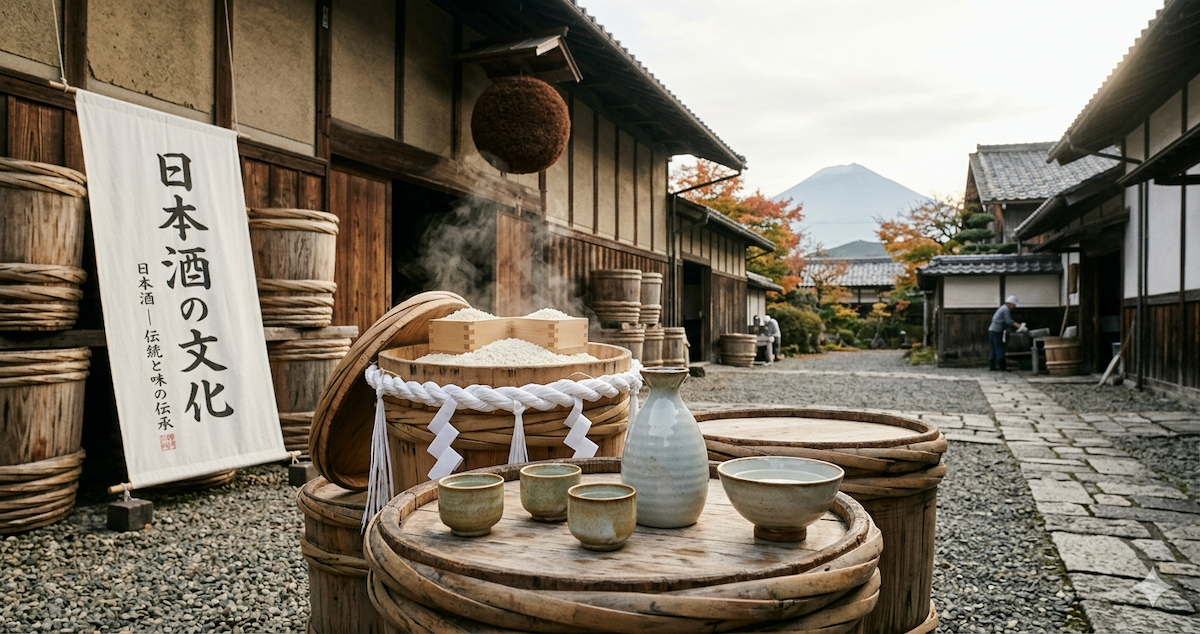
Walk through any Shinto shrine in Japan and you will find them: rows of white ceramic flasks or wooden barrels stacked at the entrance to the main hall, often wrapped in rice straw or decorated with ceremonial paper. These are offerings of sake — omiki — presented to the enshrined deity in the same gesture that Japanese people have been making for well over a thousand years. The sake will not be drunk by the god in any literal sense. It will eventually be consumed by the priests, or shared among worshippers after the ceremony. But its first purpose, its essential purpose, is the offering itself — the act of placing the best product of the rice harvest at the feet of the divine, as both thanks and petition.
This origin — sake as sacred offering rather than social beverage — is the thread that connects every aspect of Japan’s relationship with rice wine. It explains why sake is present at weddings, at New Year celebrations, at the opening of new buildings, at the rituals of mourning. It explains why the people who make sake have traditionally been called toji — master brewers — and treated as custodians of a craft with spiritual dimensions. And it explains why, despite centuries of change in how sake is produced and consumed, the drink has never fully shed the quality of significance that its origins gave it.
Rice, Water, and the First Brewers
The origins of sake are inseparable from the origins of rice cultivation in Japan. Sake making, with rice as the main ingredient, started when wet rice cultivation was introduced to and took root in Japan — between the Jōmon and Yayoi periods, as wet-field rice farming spread from the Asian mainland through Kyushu and into the rest of the archipelago. The first methods of producing an alcoholic drink from rice were correspondingly primitive. Kuchi-kami no sake — “mouth-chew sake” — was made by chewing cooked rice, spitting the result into a vessel, and allowing it to ferment with wild yeast. The enzymes in saliva converted the starches of the rice into sugars, which the yeast then fermented into alcohol. The act of brewing sake in Japanese — kamosu — is believed to derive from the word kamu, to chew. The first sake was, in the most literal sense, made by the human body.
Only female shrine attendants — miko — were qualified to perform this act, an indication of the ritual dimension that sake production carried from its earliest forms. The chewing of rice was not kitchen work. It was a sacred act performed by people set apart for sacred purposes.
Alcoholic beverages are mentioned several times in the Kojiki, Japan’s first written history, compiled in 712. By the Nara period (710–794), rice cultivation had stabilized sufficiently for sake production to become more systematic. The formal history of sake as we know it began during the Nara period, when the production process became more standardized, and sake was initially brewed in Shinto shrines and temples as a sacred offering to the gods. A brewing department called Sake no Tsukasa was established within the walls of the Imperial Palace in 689, formalizing sake production as a function of the imperial state. The connection between rice, sake, and divine authority was not incidental — it was structural.
The Monastery Brewers
The transformation of sake from a sacred offering into a refined beverage owed an enormous debt to Buddhist monks. From about the Heian period, sake was brewed in monasteries — the sake produced there was called sōbōshu. Records from the mid-Heian period describe various methods of brewing sake with rice, koji, and water that are still used today. In addition, the monks of a temple in Nara developed a brewing process with polished rice known as morohaku.
The monks had both the time and the institutional resources to develop and refine brewing techniques across generations. Monasteries kept written records of their methods — something that individual households and small producers could not do — and these records allowed knowledge to accumulate rather than being lost with each generation. By the Muromachi period (1336–1573), temple sake was considered the finest in Japan, and the techniques developed in monastery breweries had become the foundation of what would eventually become the secular sake industry.
The true transformation of sake into a refined and widely consumed drink occurred during the Muromachi period. The introduction of polished rice and the separation of the fermentation process into multiple steps marked the beginning of modern sake production. Pasteurization — the heating of sake to kill unwanted microorganisms and stabilize the brew — was practiced in Japan during this period, predating Louis Pasteur’s articulation of the same principle in Europe by approximately three hundred years. The monks who developed these techniques did not call it pasteurization. They called it hi-ire — “entering fire” — and they understood empirically that it preserved their sake without knowing the microbiology that explained why.
Sake and the Ritual Year
Japanese sake is not a drink for all occasions equally. Its presence at certain moments of the year — and its specific forms at those moments — reflects the calendar of ritual life that has organized Japanese society since long before the country had a written history.
At New Year, the most important ritual drink is o-toso — a spiced medicinal sake consumed on the morning of January 1st, prepared by steeping a mixture of herbs and spices in mirin or sake overnight. The custom is said to have originated in China and reached Japan in the Heian period, where it was adopted at the imperial court before gradually spreading to the general population. The drinking of o-toso follows a specific order within the family: from youngest to oldest, the sequence moving through the generations in a direction that is simultaneously practical — the youngest member of the family benefits most from the medicine — and symbolic, expressing the wish that youth and vitality will pass forward through the family.
At weddings, sake takes the form of san-san-kudo — the three-times-three ritual exchange of cups between bride and groom. Three cups of graduated size are filled with sake, and each partner drinks three sips from each cup, in a specific order. The number three, repeated three times, produces nine — an auspicious number in Japanese tradition. The ritual enacts the union of the couple in the most literal sense: they share the same liquid, drawn from the same vessel, at the same moment. The sake is witness and participant simultaneously.
At matsuri — the festivals that punctuate the Japanese year — sake is inseparable from the celebration. One of the most notable traditions is kagami biraki, the “opening of the mirror,” where a wooden sake barrel is ceremoniously opened to mark celebrations such as weddings, business milestones, or New Year festivities. This ritual symbolizes good fortune and unity, as participants share the sake to strengthen bonds. The barrel’s wooden lid, which is struck open with a mallet rather than removed gently, produces a sharp crack that cuts through the noise of the celebration — a sound that marks the moment when the gathered community becomes, through shared drinking, temporarily one.
The Toji and the Kura
The people who make sake — and the buildings in which sake is made — carry their own tradition of accumulated meaning. The kura (蔵) — the sake brewery — is a building of considerable historical weight. Traditional kura are built from thick earthen walls designed to maintain stable temperatures through the cold months of the brewing season, their dark interiors familiar to generations of brewers who worked through winter nights tending the fermentation.
The toji — the master brewer — held a position of both technical and social authority in the traditional sake world. Toji were itinerant craftspeople, moving from region to region between brewing seasons, carrying their knowledge with them and training apprentices who would eventually become toji themselves. Several of Japan’s most celebrated toji traditions are regional: the Nanbu toji of Iwate Prefecture, the Echigo toji of Niigata, the Tanba toji of Hyogo. Each regional tradition developed its own characteristic approaches to the brewing process, shaped by the local climate, the local water, and the accumulated preferences of generations of brewers who had worked in those conditions.
A sake kura that has been in operation for several centuries — and there are many in Japan — contains within its walls, its barrels, and its brewing equipment a microbial ecosystem that is unique to that building. The wild yeasts and bacteria that have colonized the kura over generations contribute to the flavor of the sake brewed there in ways that cannot be fully replicated by starting fresh in a new facility. This is why older kura are treated with reverence that goes beyond mere heritage tourism: the building itself is part of the production, and its age is an ingredient.
Water and Rice: The Two Conversations
Sake requires only four ingredients: rice, water, koji, and yeast. Of these, water is perhaps the most influential in determining regional character. Sake has traditionally been associated with specific water sources — the soft water of Kyoto’s Fushimi district, which produces sake of delicate sweetness; the hard water of Nada in Hyogo Prefecture, which produces a drier, more robust style known as otokozake (man’s sake). Nada, on the coast near Kobe, emerged as Japan’s most productive sake region in the Edo period, its access to high-quality water, proximity to Yamada Nishiki rice cultivation, and efficient sea transport to Edo making it the dominant commercial force in sake production for centuries.
Rice, too, matters in ways that go beyond its role as raw material. Premium sake is made from specific varieties of sake rice — shuzo kotekimai — bred for the characteristics that support brewing rather than eating. The most celebrated of these varieties is Yamada Nishiki, grown primarily in Hyogo Prefecture, sometimes described as the “king of sake rice.” Its large grains and low protein content make it ideal for the high degree of polishing that premium sake requires. Omachi, Gohyakumangoku, and Miyama Nishiki are other significant varieties, each with its own regional associations and flavor tendencies. In recent years, a movement to revive heirloom sake rice varieties — grains that were supplanted by modern breeding programs — has produced sakes with flavor profiles not seen for generations, a form of flavor archaeology that mirrors similar movements in the worlds of wine and whisky.
A Drink of Becoming
Sake is not a drink that stays still. It changes in the glass as it warms from cellar temperature. It changes in the cup as it is heated — certain styles opening and softening in warmth, others losing subtlety. It changes in the bottle over months and years: some premium sake is aged deliberately, developing a richer, more complex character that enthusiasts call koshu, aged sake, a style that was once ubiquitous and is now being rediscovered. It changes with the season of its production — sake brewed in the coldest winter months from the freshest new-harvest rice carries a brightness and vitality that is described as shinshu, new sake, and celebrated in its own right as a seasonal arrival.
All of this change is the behavior of a living product: a fermentation that was never fully stopped but merely slowed, continuing to evolve in ways that reward attention. The Japanese tradition of drinking sake with awareness of these changes — of knowing when a sake is best served cold, when warmed, when it has been aged long enough to open into something new — is an extension of the same seasonal attentiveness that the concept of shun applies to food. Sake, like the ingredients it most naturally accompanies, has its moment of peak expression. To drink it at that moment, in the right vessel, at the right temperature, in the right season, is to participate in a tradition that has been accumulating meaning for two and a half thousand years.
The white flasks at the shrine entrance are still being filled. The tradition continues.
This article is part of Waden’s Heritage series — documenting the traditions, rituals, and knowledge that have shaped Japanese food culture across the centuries. Read more at waden.umamibako.com.
Comment