Why Japanese Chefs Still Choose Lacquerware
In a world of ceramic, glass, and stainless steel, the lacquered wood bowl persists — in home kitchens, in Michelin-starred restaurants, in temple offerings, in New Year boxes. The reasons are older than any of those alternatives, and more precise than they first appear.
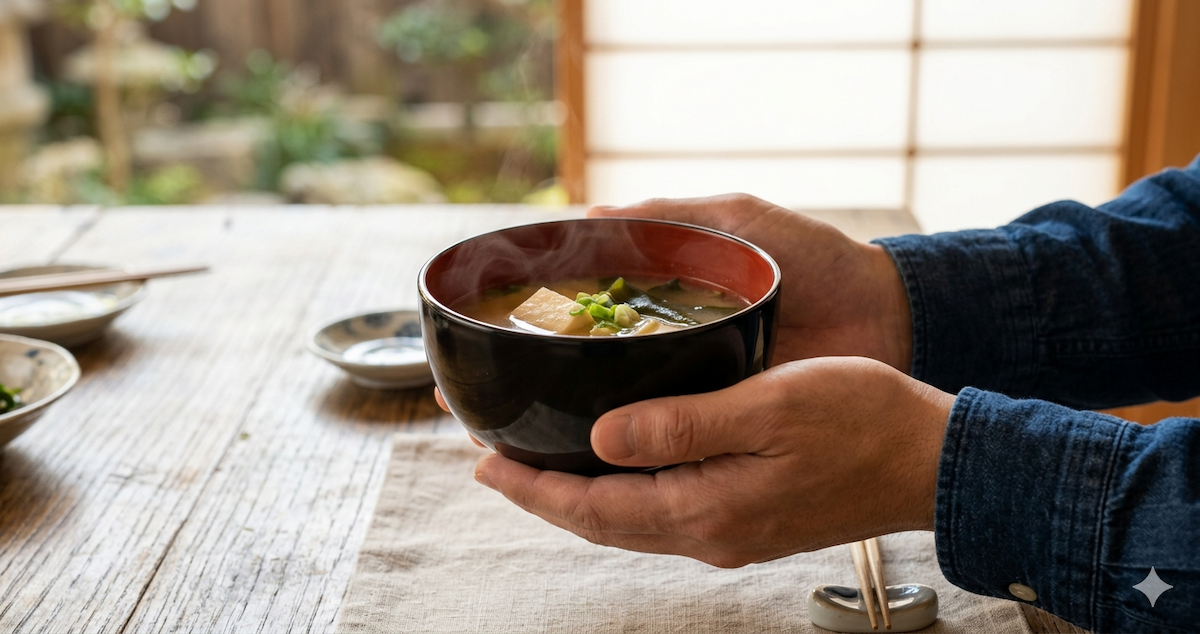
Lift a lacquered miso soup bowl and you will notice the weight before anything else — or rather, the absence of weight. A well-made lacquer bowl feels almost impossibly light for something so durable. Then the warmth: the wooden body of the bowl does not conduct heat the way ceramic does, so the soup inside stays hot while the exterior of the bowl remains comfortable to hold. In Japan, where it is customary to lift bowls from the table and hold them while eating, this is not a small thing. It is the reason lacquerware has been used for exactly this purpose for over nine thousand years.
The choice of lacquerware in a Japanese kitchen is rarely discussed as a choice. It is simply what soup bowls are, what miso arrives in, what certain formal meals are served on. But behind this unreflective familiarity lies a set of precise functional and aesthetic reasons that have kept lacquerware at the center of Japanese dining through millennia of culinary change. Understanding those reasons requires understanding what lacquerware actually is — and what it does to food, to flavor, and to the experience of eating.
What Urushi Is
Japanese lacquerware — shikki (漆器) — is made by applying urushi to a substrate, most commonly wood. Urushi is the refined sap of the urushi tree (Toxicodendron vernicifluum), a deciduous broadleaf species that grows across Japan, China, and Southeast Asia. The tree is tapped by making shallow cuts in the bark and collecting the oozing resin — a slow, painstaking harvest that produces only a small quantity of sap per tree per season. The sap is then filtered, aged, and refined through the kurome process, in which it is heated and dehydrated until it reaches the consistency and color appropriate for each layer of application.
The chemistry that makes urushi remarkable is its curing process. Urushiol — the primary active component — undergoes enzymatic oxidation via the enzyme laccase when exposed to warm, humid conditions: approximately twenty to thirty degrees Celsius and sixty to eighty percent humidity. This is the opposite of most paints and varnishes, which cure by drying in open air. Urushi hardens in humid warmth, and once cured, it becomes extraordinarily durable. Urushi is resistant to water, acids, alkalis, alcohol, and heat, and exhibits antibacterial and insect-repelling properties. A bowl properly finished with urushi will not absorb odors, will not harbor bacteria, will not warp from moisture, and will not conduct heat in a way that burns the hand holding it.
The use of natural lacquer known as urushi has a nine-thousand-year history in Japan. Lacquered artifacts dating back to the prehistoric Jōmon period have been found at various archaeological sites throughout Japan. A lacquered branch discovered at the Torihama Shell Mound in Fukui Prefecture is estimated to be around twelve thousand six hundred years old, confirming that the urushi tree was already growing in Japan during this period. The craft that grew from this material is the oldest continuous production tradition in the country.
The Three Functional Advantages
The decision to use lacquerware in a Japanese kitchen — rather than ceramic, metal, or glass — rests on three overlapping advantages that no other traditional material combines in the same way.
The first is heat insulation. Wood is a poor conductor of heat, and the multiple layers of urushi applied to its surface reinforce this property. When it comes to handling hot dishes, lacquerware, crafted from insulating wood, is often the more comfortable choice compared to ceramics. This matters because Japanese dining involves holding bowls. A ceramic miso soup bowl at serving temperature would be uncomfortable to hold for the duration of a meal. A lacquer bowl at the same temperature is warm but not painful. The insulation also works in reverse: the bowl keeps the soup hot longer, because less heat is lost through conduction into the hand holding it. This is a practical advantage that has been understood and valued since the first lacquered vessels were made.
The second is weight. The wooden core of a lacquer bowl, turned on a lathe to the minimum thickness consistent with structural integrity, produces a vessel that is dramatically lighter than ceramic or metal equivalents. Compared to ceramics, lacquerware is lighter, easier to hold, and aesthetically more versatile. The lightness is most apparent when the bowl is lifted from the table: the gesture that begins a Japanese meal — lifting the rice bowl and the soup bowl simultaneously, one in each hand — is made effortless by the weight of lacquerware in a way that heavier materials would not permit across an entire meal.
The third is the quality of the surface against the mouth. Lacquerware has a characteristic feel at the lip of the bowl — smooth, slightly warm, with a softness that ceramic lacks. This tactile quality is not incidental. Japanese chefs and food writers have consistently noted that the material from which a vessel is made affects the perception of the food inside it: temperature, texture, and flavor are all modulated by the first contact the mouth makes with the vessel. The warmth and smoothness of a lacquer bowl’s rim is considered particularly suited to hot liquids, allowing the soup to flow across the lip without the slight edge-sensation that a hard ceramic bowl produces. This is a subtle difference, but in a cuisine where subtlety is a primary value, it is a difference that is taken seriously.
Black and What It Does to Color
The most common color for the interior of a Japanese lacquer bowl is black — kuronuri. The second most common is vermilion — shunuri. Both are ancient, and both have a specific visual function in relation to the food they hold.
Black lacquerware in particular has a special allure: its deep, glossy surface frames the colors of the food it holds, enhancing their appeal and making each dish feel more intentional. A white square of tofu floating in pale amber miso broth against a black lacquer background is a composition: the colors of the food are amplified by the contrast, each element more distinctly itself against the dark ground. This is why black lacquerware is preferred for soups and rice at the most formal level of Japanese cuisine. The bowl is not a neutral container. It is part of the visual presentation of the food — a background chosen to make the foreground as vivid as possible.
Vermilion has the opposite quality: it warms everything near it, casting a glow of celebration and festivity that makes it the preferred color for the interior of jubako (osechi boxes), wedding ceremony vessels, and sake cups used in formal rituals. The traditional Japanese wedding ceremony uses lacquerware sake cups — the exchange of sake between bride and groom is performed with vermilion lacquered sakazuki. The color is doing cultural work as much as practical work: it signals the occasion, establishes the register of the meal, performs a meaning that plain ceramic or glass could not convey.
The Making: Layers and Time
A piece of lacquerware is not produced quickly. The process involves multiple distinct stages, each requiring specific expertise, and each taking time. A wooden base is shaped — turned on a lathe for round forms, bent and joined for boxes, carved for more complex shapes. The wood is sanded, dried, and prepared for the first coat of lacquer. Urushi is applied in thin layers, each one requiring a period of curing in a warm, humid environment before the next can be applied. Between layers, the surface is sanded to remove imperfections and create a key for the next coat. This sequence — apply, cure, sand, apply again — is repeated many times.
The number of layers varies significantly by region and intended use. A simple everyday bowl might receive eight to twelve coats of lacquer. A piece of Wajima lacquerware — the most celebrated and durable of Japan’s regional traditions — undergoes a process of over one hundred distinct steps, with artisans at each stage specializing in a single part of the process. Wajima-nuri is famous for its durable undercoating achieved by the application of multiple layers of urushi mixed with powdered diatomaceous earth (ji-no-ko) onto delicate zelkova wooden substrates. The jinoko — fossilized algae found only in the Wajima area — creates a matrix structure that the lacquer penetrates and hardens within, producing a base coat of exceptional strength. A properly maintained piece of Wajima lacquerware can last over one hundred years of daily use.
The final coat is applied in a dust-free room, with a brush made from human hair — the only material fine enough to leave no brush marks on the surface. The goal is a surface so even, so glossy, and so free of imperfection that it appears not to have been applied by hand at all. The paradox of lacquerware at its finest is that the evidence of extraordinary human labor is the complete absence of evidence of human labor.
The Regional Voices of Japanese Lacquer
Japan’s lacquerware traditions are not monolithic. They are a collection of regional styles, each shaped by the local trees available, the preferences of local lords and artisans, and centuries of accumulated technical refinement. The diversity of these traditions — each producing lacquerware that is immediately recognizable to a trained eye — is one of the craft’s most extraordinary features.
Wajima, on the Noto Peninsula of Ishikawa Prefecture, represents the apex of durability and formal beauty. Ishikawa is home to three famous production regions, giving rise to the saying: “Yamanaka for wood bases, Wajima for lacquering, and Kanazawa for maki-e.” Echizen lacquerware from Fukui Prefecture has a different character — known for balancing elegance with everyday practicality. Echizen lacquerware accounts for approximately eighty percent of the domestic food service industry and business use. The lacquerware of restaurant trays and institutional dining across Japan is overwhelmingly Echizen — the tradition that made durability and volume its specialization, without sacrificing the visual qualities that make lacquerware worth choosing over alternatives.
Tsugaru lacquerware from Aomori Prefecture takes a completely different approach: its karanuri technique involves applying dozens of alternating layers of differently colored lacquer to a base of local cypress, then grinding back through the layers to reveal a distinctive mottled pattern — sometimes described as resembling raindrops, or the surface of a stormy sea. The leading design is karanuri, which boasts a distinctive speckled pattern resembling raindrops achieved by forty-eight layers of painting, drying, and grinding. Where Wajima emphasizes formal restraint, Tsugaru celebrates complexity and surprise — two expressions of the same material and the same underlying craft sensibility.
Kishu lacquerware from Wakayama Prefecture occupies yet another register: simple, sturdy, practical, without the elaborate decoration of Wajima or Tsugaru. Its negoro-nuri style — in which the black undercoat is intentionally allowed to emerge through the vermilion overcoat through use and wear — produces pieces that become more beautiful as they age, their surfaces recording the history of use in a pattern of darkening that is unique to each piece. Negoro-nuri is the aesthetic of the well-used tool: the conviction that a vessel gains meaning from being handled.
Urushi and the Living Object
Lacquerware, unlike ceramic or glass, is not static after it leaves the workshop. Urushi continues to respond to its environment: it deepens in color with age, gaining a lustre and richness that new lacquerware does not have. It becomes stronger in humid environments. It can be repaired when damaged — scratched, chipped, or cracked lacquerware can be refinished by a skilled craftsperson, the damage filled and covered with new lacquer until the surface is restored. This repairability is not incidental to the craft’s persistence. It is one of the reasons lacquerware has remained economically viable for high-quality tableware across centuries of change: a bowl that can be repaired and used for a hundred years is a different kind of object from one that must be discarded when it chips.
The concept of the living object — one that changes, ages, responds to use and care, and can be returned to service after damage — is deeply aligned with broader Japanese aesthetic values: the acceptance of impermanence, the recognition that the trace of time on an object can be a form of beauty rather than decay. Lacquerware embodies these values not as a philosophical statement but as a physical fact. The bowl in your hands is not the same object it was when it was made. It is, in some small way, the product of every meal it has been part of.
This is why Japanese chefs still choose lacquerware. Not from nostalgia, not from tradition for its own sake, but because the material continues to do things that no alternative does as well: keeps soup hot, sits lightly in the hand, feels right against the mouth, makes food look like itself, repairs when damaged, and improves with age. These are not small advantages. In a cuisine built on the conviction that how food is presented is inseparable from how it tastes, they are everything.
This article is part of Waden’s Vessel series — exploring the art of serving and the objects that shape the Japanese table. Read more at waden.umamibako.com.
Comment