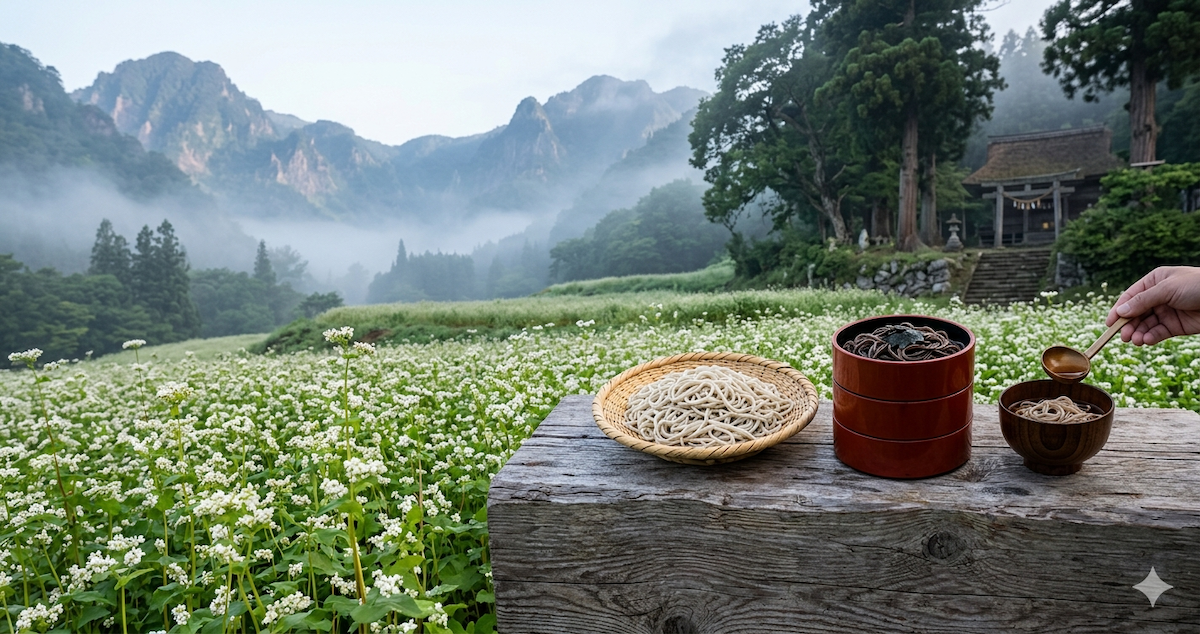
The Geography of Soba: How Place Shapes a Noodle
Buckwheat grows where rice cannot — in cold highlands, volcanic soils, and mountain villages that have shaped some of Japan’s most distinctive regional food cultures. To eat soba is to eat a landscape.
Order a bowl of soba in Tokyo and you will receive something quite different from what arrives in Shimane. The color will be different. The texture will be different. The way the noodles are served — in a lacquer box, on a flat board, in a small ceramic bowl, or in a cascade of successive tiny servings — will tell you something immediately about where this tradition comes from. The dipping sauce may be poured over the noodles rather than served alongside them. There may be no dipping sauce at all.
Soba is often described as a single dish, but it is more accurately described as a family of regional traditions that share a common ingredient — buckwheat — and diverge in almost every other respect. The divergence is not random. It follows the geography and history of the places where soba culture took root: the altitude of the highland, the temperature range of the mountain, the particular character of the local water, and the historical figures who carried their preferences from one domain to another.
To understand Japanese soba is to travel across a country in which food has always been shaped by place.
Buckwheat and the Mountains
Buckwheat — soba (蕎麦) in Japanese, referring to both the plant and the noodle — is a cold-hardy crop that thrives in conditions where rice cannot be grown. It tolerates poor soil, cold temperatures, and short growing seasons. It matures quickly: planted in August, its white flowers bloom in September and the crop is ready to harvest by mid-October. These qualities made it an indispensable food in Japan’s mountainous regions, where the altitude, the temperature, and the soil made rice cultivation difficult or impossible. Soba was an emergency crop for people living in mountains, grown so that communities could survive severe winters.
This agricultural history is the first reason why Japan’s finest soba tends to come from highland regions rather than lowland plains. The same cold, wide temperature swings between day and night that make mountain life demanding also produce buckwheat with a more concentrated starchiness and a more pronounced, nutty flavor. The noodles made from highland buckwheat carry the character of the land they grew in. This connection between terroir and flavor — so familiar in the world of wine — is no less real in the world of soba.
Japan’s three most celebrated soba traditions are widely known as the Three Great Soba: Wanko Soba from Iwate Prefecture, Izumo Soba from Shimane Prefecture, and Togakushi Soba from Nagano Prefecture. Each represents a distinct regional approach to the same grain, shaped by different landscapes, different histories, and different understandings of what eating soba should feel like.
Shinshu and Togakushi: The Birthplace of the Noodle
Nagano Prefecture — historically known as Shinshu — occupies a central position in the story of Japanese soba. The region’s volcanic soil, significant temperature differences between day and night, and cold winters create conditions particularly suited to buckwheat cultivation. Only noodles containing forty percent or more buckwheat flour can carry the Shinshu name, a standard that reflects the region’s commitment to the integrity of the grain.
Within Shinshu, the Togakushi district — a highland area northwest of Nagano City, centered on the ancient shrine complex of Togakushi — holds a special place. The origin of eating soba in Togakushi began when mountain ascetics during the Heian period (794–1185) valued buckwheat flour as portable food. The sacred peak of Mount Togakushi was a training ground for practitioners of shugendo, a demanding set of ascetic practices combining elements of Shinto and Buddhism. These practitioners valued buckwheat as a food that could sustain them through long periods of exertion — eaten as sobagaki, a simple paste of buckwheat flour kneaded with hot water, before the noodle form was developed.
The techniques for making soba noodles — soba-uchi (mixing and kneading) and soba-kiri (cutting) — reached Togakushi during the Edo period, and the practice of serving soba to pilgrims visiting from across Japan gradually developed into what we now call Togakushi soba. At Chusha, the middle shrine of Togakushi Shrine, the New Soba Offering Festival is still held every year in early November — a ritual in which craftsmen make soba noodles from the freshly harvested buckwheat crop and offer them to the gods. The festival connects the present practice of soba-making to the agricultural and spiritual history of the mountain in an unbroken line.
Togakushi soba uses a flour called hikigurumi, made by grinding buckwheat after removing only the outermost husk, retaining the layers closer to the seed. The result is a noodle with a slightly darker color and an intense buckwheat fragrance that distinguishes it from the paler soba more common elsewhere. It is traditionally served in bocchi-mori style: small portions arranged in loose bundles in baskets woven from nemagari-dake bamboo, a craft unique to the Togakushi area. The condiment is Togakushi daikon, a local radish variety. Every element of the serving — the flour, the basket, the radish — comes from the same mountain. In this respect, Togakushi soba may be the most completely local food in Japan: a dish in which every component is an expression of a single place.
Izumo: Darkness and Depth
Travel west across Honshu to Shimane Prefecture, and the soba changes dramatically. Izumo soba is darker than almost any other variety in Japan, with a color that ranges from deep brown to near-black and an aroma that announces itself before you taste the noodle. The reason lies in the milling method: hikigurumi, in which the buckwheat seeds are ground with their hulls intact, producing a flour that includes all four layers of the seed — not just the inner, paler core that most other soba regions use. The result is a noodle with a robust, slightly earthy character, higher in fiber and nutrients than its paler counterparts, and with a flavor intensity that is immediately distinctive.
The historical connection between Izumo soba and Shinshu is direct and documented. It is said that soba spread to the Izumo region in the early Edo period when Naomasa Matsudaira, the first lord of the Matsudaira family of the Matsue domain, brought soba craftsmen with him when he transferred from the Matsumoto domain in Shinshu. The technique traveled with the lord; the local buckwheat and the local milling method gave it a new character entirely.
Izumo soba is traditionally served in one of two ways. Wariko soba — the cold presentation — comes in a stack of three round lacquerware containers, each holding a portion of cold noodles. The dipping sauce is poured directly over the noodles in the top container, and when that portion is finished, the remaining sauce is poured down into the second container, and then the third, accumulating flavor as it goes. The layered serving, the round lacquerware, the practice of pouring sauce over rather than dipping — all of it is specific to this region, shaped by its particular aesthetic and social history. Kama-age soba, the hot version, dispenses with cold-water rinsing entirely, serving the noodles directly from the boiling pot into a hot broth — a style said to have originated near Izumo Taisha Shrine, where food stalls serving pilgrims omitted the rinsing step for speed.
Wanko Soba: Hospitality as a Serving Style
North across the Tohoku region to Iwate Prefecture, and the soba tradition takes on a completely different character — one defined less by the noodle itself than by the ritual of eating it. Wanko soba consists of small servings of soba noodles in small wooden bowls, continuously refilled by a server who chants encouragement — “Hai, jan-jan!” or “Hai, don-don!” — and adds more noodles the instant a bowl is emptied, until the diner places the lid on the bowl to signal they have finished.
The word wanko comes from the regional dialect of Iwate, meaning a small wooden soup bowl. The tradition’s origins are said to lie in soba furumai — the custom of serving soba to guests as a gesture of warm welcome — where the small bowl format allowed soba to be distributed quickly among many people at once. Wanko soba symbolizes the spirit of hospitality in Iwate Prefecture. As a rough guide, ten to fifteen bowls is equivalent to one ordinary bowl of kake soba — making the stacking of empty bowls a visible, tactile measure of the meal’s progress. In December 1957, the first annual contest for the most bowls of wanko soba was held at the Hanamaki Cultural Centre, a competition that continues today and attracts participants from across Japan and beyond.
Yamagata: A Prefecture of Soba Roads
Yamagata Prefecture does not hold a place among the Three Great Soba, but its soba culture is arguably the most diverse in Japan — a patchwork of local traditions, serving styles, and buckwheat varieties that reflect the prefecture’s distinct internal geography. While Murayama, Okitama, Shonai, and Mogami have each nurtured unique food cultures, the traditional food common to all these areas is soba noodles.
The most distinctive local style is ita soba — soba served on long wooden boards rather than in boxes or bowls. The practice traces its origins to soba furumai, the tradition of serving soba communally after farmwork, where boards allowed many people to eat together efficiently. Ita soba uses unpolished buckwheat flour, which gives the noodles a stronger texture and a more pronounced buckwheat fragrance than polished flour would produce. The noodles are cut slightly wider than standard soba, reinforcing their rustic character.
Yamagata’s relationship with soba also has a documented historical connection to Shinshu. It is said that the Kanzarashi Soba tradition — buckwheat seeds soaked in cold river water and exposed to cold winds before milling — was introduced to Yamagata by Hoshina Masayuki, a lord of the Takato clan in Shinshu, when he became lord of the Yamagata domain. The same figure, Hoshina Masayuki, who loved the soba of his home domain, became an instrument of its diffusion across the country. Areas in Yamagata with high concentrations of soba restaurants are called soba kaido — soba roads — of which there are more than ten across the prefecture, each with its own map and festival calendar.
Hokkaido: The Source of the Grain
No account of Japanese soba’s regional character is complete without acknowledging where most of the buckwheat actually comes from. Although Nagano, Shimane, Yamagata, and Iwate are the cultural heartlands of soba tradition, Hokkaido is by far the largest producer of buckwheat in Japan, accounting for the majority of the national harvest. The cold climate, the volcanic soils, and the wide open agricultural land of Japan’s northernmost island provide conditions exceptionally suited to buckwheat at scale. The Etanbetsu region around Asahikawa has its own named soba variety. Hokkaido buckwheat travels south to become Shinshu soba, Izumo soba, and the soba served in Tokyo’s great old restaurants — the grain of the north transformed by the craft and culture of the south.
The Noodle and the Place
What connects these regional soba traditions — beyond the shared grain — is a conviction that the noodle should express the place that made it. The altitude of Togakushi is in the flour. The hull of the Izumo buckwheat is in the color and the fragrance. The communal farming culture of Yamagata is in the board on which the noodles are served. The hospitality tradition of Iwate is in the ritual of the small bowl and the server’s call.
This is what it means to say that Japanese cuisine is rooted in place — not as a marketing phrase, but as a physical and historical fact. The soba in your bowl grew somewhere specific, was milled by someone with knowledge of that specific grain, and was prepared according to a tradition that formed in response to that specific landscape. Taste it with that in mind, and something additional comes through — not just buckwheat, but the cold mountain air in which it ripened.
Read, then Taste
This article is part of Waden’s Origin series — traveling to the landscapes and regions where Japan’s finest ingredients begin. Read more at waden.umamibako.com.
Comment