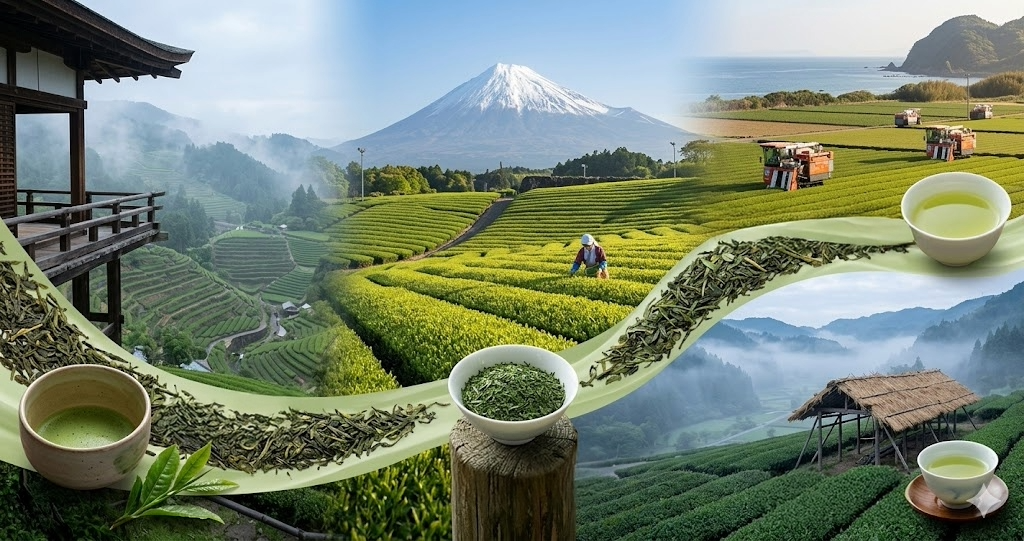
Where Tea Becomes Itself: The Regional Geography of Japanese Green Tea
The same species of plant, grown fifty kilometers apart, produces two teas so different in flavor they seem to come from different worlds. Japan’s tea regions are not simply growing areas. They are distinct expressions of soil, altitude, water, and the accumulated knowledge of the people who tend them.
There is a traditional saying that tea people in Japan still cite: Iro wa Shizuoka, kaori wa Uji, aji wa Sayama ni kagiru. “For color, Shizuoka. For aroma, Uji. But for taste, Sayama is unmatched.” It is a saying rooted in regional pride, designed to assert the virtues of Sayama — the tea district north of Tokyo — in an argument that Shizuoka and Uji would also claim to win. That such an argument exists at all, and that it has existed for centuries, tells you something important about how Japan thinks about tea.
Tea is not a commodity in Japan. It is a conversation between a plant, a place, and the people who have spent generations learning how to coax the best out of both. The result is a landscape of regional tea cultures — each with its own variety of tea, its own production methods, its own flavor signature — that is unlike anything found in any other tea-growing country in the world.
Japan grows tea in a belt that runs from Kagoshima Prefecture in the far south, at approximately 31°N latitude, to Saitama Prefecture north of Tokyo, at 36°N. Within this five-degree span of latitude, the climate, altitude, and soil conditions vary dramatically — and so does the tea.
How Terroir Shapes a Cup
Before traveling through Japan’s tea regions, it helps to understand why geography produces such different results from the same plant. All Japanese green tea comes from Camellia sinensis var. sinensis — the same species grown in China and across Asia. The differences in flavor between regions are not primarily genetic. They are environmental: the product of what tea people call terroir — the combination of soil, climate, altitude, water, and human practice that gives an agricultural product its distinctive character.
For Japanese green tea, several environmental factors are particularly significant. Temperature variation between day and night slows the growth of the tea plant, allowing more time for flavor compounds — particularly the amino acid L-theanine, which is responsible for the characteristic sweetness and umami of high-grade Japanese green tea — to accumulate in the leaves. Altitude amplifies this effect: mountain tea grown at higher elevations where temperatures drop significantly at night tends to have more complex flavor than flatland tea. Soil composition affects the mineral character of the leaves. Water quality influences extraction during both growing and brewing.
Then there is shading. Japan is the world’s leading practitioner of shaded tea cultivation — the deliberate blocking of sunlight from tea plants for a period before harvest. Shade slows photosynthesis, which reduces the conversion of L-theanine into catechins (the compounds responsible for astringency and bitterness) while preserving and concentrating the amino acids that give tea its sweetness and depth. The longer and more complete the shading, the more umami-forward and less astringent the finished tea becomes. Gyokuro is shaded for around twenty days. Matcha’s raw material, tencha, is shaded similarly. Kabusecha is shaded for approximately two weeks. Sencha grows in full sun.
These variables — temperature, altitude, soil, and shading — interact differently in each region, producing the distinct regional characters that Japan’s tea geography expresses.
Uji: The Origin and the Standard
Uji, a small city on the Uji River just south of Kyoto, holds a place in Japanese tea culture that no other region can claim: it is where Japanese tea cultivation effectively began. In 1191, the Zen priest Eisai brought tea seeds to Kyoto from China, and Buddhist monks began planting tea seeds around Kyoto’s temples and the surrounding towns — one of which was Uji. The Obukudani area at the foot of Mt. Jubu in Uji is regarded as the very first birthplace of Japanese tea cultivation, and the tea grown there was considered so fine that it was reserved for the Imperial House.
What makes Uji’s terroir so favorable for the highest grades of Japanese tea is a combination of geography and microclimate. The Uji and Kizu river valleys create natural mists that shade tea bushes, enhancing amino acid development — a microclimate ideal for tencha and gyokuro production. The rivers moderate temperature extremes, and the natural mist that rises from the water in the early morning replicates some of the effects of artificial shading, contributing to the softness and sweetness that Uji teas are known for.
Uji accounts for approximately three percent of national tea volume, but commands the highest brand premium globally. It is the dominant source for the finest ceremonial matcha — the grade used in formal tea ceremonies — and for gyokuro of the most traditional expression. Uji farms are small, labour-intensive, and concentrated on the southern side of Kyoto around Ujitawara, Wazuka, and Minamiyamashiro.
One important distinction deserves mention. “Uji Tea” is a Regional Collective Trademark, not simply a geographical statement. Tea can carry the “Uji” label if leaves originate from Kyoto, Nara, Shiga, or Mie prefectures. A tea labeled “Uji” is not necessarily grown in the city of Uji itself. Readers of tea labels should approach the name as a quality signal and a historical reference, not a precise geographical guarantee.
Shizuoka: The Nation’s Tea Capital
Shizuoka, the breathtaking province surrounding Mount Fuji, is the largest tea-producing area in Japan. About forty percent of Japan’s green tea comes from Shizuoka’s rolling fields. The region’s volcanic soil, well-drained hillsides, and pure water from Mount Fuji’s snowmelt provide conditions that tea plants thrive in, and the prefecture has been at the center of Japan’s tea industry for centuries.
Within Shizuoka, the geography is not uniform. The prefecture contains both steep mountain farms — in areas like Kawane, on the upper reaches of the Oi River, and Tenryu — and flatter plateau areas like the Makinohara tableland. The famous “Mountain Tea” (yama-cha) from regions like Kawane and Tenryu, grown at high altitude with intense temperature swings, produces teas with distinctive floral aromas that flatland cultivation cannot replicate.
Shizuoka is above all a sencha region. It is historically the largest sencha prefecture, producing mostly asamushi or chumushi: crisp, clean, and the classic sencha profile. The deep-steamed fukamushi sencha of the Makinohara plateau — where longer steaming produces a softer, sweeter, cloudier cup — has become increasingly significant as the region adapts to changing consumer preferences.
Shizuoka’s reputation was built on steep hillside farms that require hand or small-machine harvesting. As farmers age, with an average age of sixty-five or above, these labor-intensive plots are being abandoned. The structural challenges facing Shizuoka’s mountain tea culture are real and ongoing — a reminder that terroir alone cannot sustain a regional tradition without the people to tend it.
Kagoshima: The New Engine
At the southern tip of Kyushu, Kagoshima Prefecture has emerged as Japan’s second-largest tea producer — and by some measures, the most dynamic. The region’s volcanic ash soil, ample sunshine, and subtropical climate create ideal conditions for tea cultivation. The famous shirasu — the pale volcanic ash deposit that covers much of the prefecture — provides the mineral-rich, well-drained soil that tea plants favor.
Kagoshima’s advantages are partly climatological and partly structural. The warm southern climate allows an earlier first harvest than northern regions — sometimes as much as three to four weeks ahead of Shizuoka — giving Kagoshima tea an advantage in the shincha (new tea) market, where the first flush of spring commands premium prices. The relatively flat topography of the tea-growing areas around Chiran, Kirishima, and Ei allows full mechanization, enabling consistent large-scale production that mountain regions cannot match.
While Kagoshima is widely recognized for its high-quality sencha, shading techniques commonly reserved for teas such as gyokuro or matcha are applied to nearly all sencha grown in Kagoshima — unlike other growing regions where shaded sencha is specifically labeled as kabusecha. In Kagoshima, shaded sencha is simply considered the standard. This widespread shading practice contributes to the softness and reduced astringency that characterizes Kagoshima sencha.
Kagoshima has aggressively pursued organic certification and is practically the only viable source for large-volume organic tea contracts. It is also a leader in cultivar development, breeding new tea varieties that combine flavor quality with climate resilience — a growing priority as weather patterns become less predictable.
Yame: The Gyokuro Capital
In the mountain basins of southern Fukuoka Prefecture, the Yame and Hoshino Rivers run through valleys where morning mist collects and temperature inversions trap moisture against the hillsides. This microclimate — cool, humid, and naturally shaded — is among the most favorable in Japan for the production of gyokuro, the most labor-intensive and highest-grade of all Japanese green teas.
Yame accounts for only three to four percent of national tea volume, but produces approximately forty-five percent of Japan’s gyokuro. The concentration is remarkable: nearly half of Japan’s finest tea comes from a single small district. “Yame Dentō Hon Gyokuro” (Yame Traditional Authentic Gyokuro) consistently ranks at the top in national tea competitions, with quality acclaimed as the best in Japan.
What distinguishes Yame gyokuro is both its terroir and its method. “Yame Dentou Hon Gyokuro” is a traditional appellation that requires hand-picking, natural rice-straw shading on a tana structure, and specific cultivars. The rice-straw shading — building a framework over the tea plants and layering straw across it to block the sun — is a labor-intensive traditional method that has been largely replaced elsewhere by synthetic shade fabric. In Yame, it is a protected practice, and the flavor difference is perceptible: the natural shading material allows a small amount of diffuse light through, producing teas with a specific aromatic complexity that synthetic shading cannot replicate.
The result is tea with exceptionally high amino acid content — “liquid umami,” a soup-like savory density that exceeds even Uji or Shizuoka. Yame gyokuro is brewed at very low temperatures — fifty to sixty degrees Celsius — and in small quantities. Sipped slowly, it tastes less like tea in the conventional sense than like a distillation of something essential: sweet, deep, and almost savory, with a finish that lingers long after the cup is empty.
Nishio and Mie: The Unsung Producers
Two regions that receive less international attention deserve mention for their significant contributions to Japan’s tea landscape.
Nishio, a coastal city in Aichi Prefecture, is the largest single producing area for matcha in Japan. Nishio produces roughly a fifth of Japan’s matcha by volume, known for consistent mid-grade ceremonial output. Much of the matcha sold outside Japan passes through Nishio at some point. Its climate — warm summers, mild winters, and sufficient humidity — produces tencha with a reliable flavor profile well suited to the large-scale commercial matcha market.
Mie Prefecture, on the southeastern coast of Honshu, is ranked third in terms of the annual production of green tea in Japan, after Shizuoka and Kagoshima. A third of Japan’s kabusecha is produced in Mie, making it the leading production area for this partially-shaded tea style. Kabusecha — shaded for approximately two weeks, longer than sencha but shorter than gyokuro — occupies a middle ground in the flavor spectrum: less astringent than full-sun sencha, with a gentle sweetness that approaches gyokuro without the full depth that twenty days of shading produces.
Reading the Label, Reading the Land
Japan produces less than two percent of the world’s tea by volume, but within that small share, it has developed a range of regional expression that no other tea-growing country matches. From the umami density of Yame gyokuro to the clean briskness of Shizuoka asamushi sencha, from the prestige matcha of Uji to the efficient, organic-forward sencha of Kagoshima — each region has found its identity by working with its specific landscape rather than against it.
Terroir is not a marketing add-on in Japanese tea. The same cultivar tastes different between Kyoto and Kagoshima because climate, altitude, soil, and shading discipline all vary. When a tea label names its origin — Uji, Yame, Chiran, Kawane — it is naming not just a place but a set of conditions, a set of practices, and a relationship between people and landscape that has been refined over centuries.
To drink Japanese tea with an awareness of where it comes from is to drink it differently. Not better, necessarily — but more fully present to what is actually in the cup.
Read, then Taste
Experience the Depth of Japanese Tea
The UMAMIBAKO Wagashi & Tea Box brings together carefully selected Japanese tea alongside traditional wagashi — chosen for their quality, their regional character, and the stories behind them. Taste the difference that origin makes.Explore the Wagashi & Tea Box →
This article is part of Waden’s Origin series — traveling to the landscapes and regions where Japan’s finest ingredients begin. Read more at waden.umamibako.com.
Comment