The Fish That Japan Follows Through the Year: Katsuo and the Meaning of Two Seasons
No fish is more deeply embedded in the Japanese sense of season than katsuo — known in English as skipjack tuna or bonito — that arrives in spring as a lean harbinger of summer, and returns in autumn transformed, fat and rich, from its long journey north. The same fish, tasted twice.
There is a haiku, composed in the late seventeenth century by the poet Yamaguchi Sodō, that every Japanese person with any interest in food has encountered at some point: Me ni wa aoba, yama hototogisu, hatsugatsuo. For the eyes, fresh green leaves. For the ears, the mountain cuckoo. For the mouth, the first katsuo of the year.
In three compact images, the poem captures the full sensory experience of early summer in Japan — the season arriving simultaneously through sight, sound, and taste. That the taste it reaches for is katsuo — a migratory fish that appears off the Japanese coast for a few weeks in spring before disappearing north — tells you something important about what this fish has meant to Japanese food culture. It is not merely an ingredient. It is a seasonal event.
And unlike most seasonal foods, katsuo offers this experience twice. Once in spring, and again in autumn, it arrives as a different version of itself — leaner or fatter, lighter or deeper, the product of a journey that covers thousands of kilometers and transforms the fish’s body along the way. Understanding katsuo means understanding how a single species can carry two entirely different meanings depending on when it is caught.
The Migration That Creates Two Seasons
Katsuo — known in English as skipjack tuna or bonito, Katsuwonus pelamis — is a pelagic fish of the mackerel family, distributed across subtropical and tropical waters throughout the Pacific and Indian Oceans. In Japan, it arrives via the Kuroshio Current: the warm, nutrient-rich ocean current that flows north along the Pacific coast of the Japanese archipelago from the waters around the Philippines and Taiwan.
Each spring, as water temperatures rise, schools of katsuo move northward along the Kuroshio. They pass Kochi and the southern cape of Shikoku in March and April, reach the Kanto coast — the waters off Chiba and the Sanriku coast of Tohoku — in late April and May, and continue pushing north until they reach the southern waters of Hokkaido, where the warm Kuroshio meets the cold Oyashio current flowing south from the Bering Sea. Here, where two oceanic currents collide and the nutrient content of the water is extraordinarily high, the katsuo feed intensively through summer on small fish and squid. By late summer and early autumn, the Oyashio strengthens and water temperatures drop. The katsuo, which prefer warm water, turn south and begin the return journey — the same route in reverse, following the same coastlines back toward the tropical waters where they will spawn.
It is this migration — north in spring, south in autumn — that creates the two seasons of katsuo. The fish caught on the northward journey, before it has spent the summer feeding in cold northern waters, is called hatsugatsuo (初鰹): the first katsuo. The fish caught on the southward return, after months of feeding in nutrient-dense waters, is called modorigatsuo (戻り鰹): the returning katsuo. The same species, the same migratory route, but the fish that makes the return journey is physiologically different from the one that began it.
Hatsugatsuo: The First Arrival
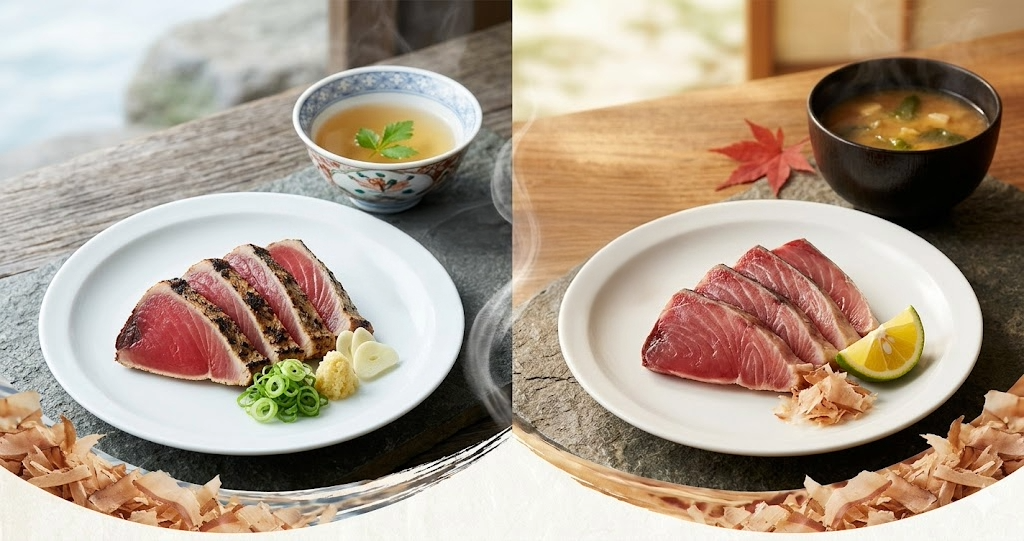
Hatsugatsuo peaks in April and May, with the main landing ports shifting northward as the season progresses — Kochi in the south first, then Choshi and the Sanriku ports further north. These early-season fish are lean. They have been traveling on stored energy since leaving tropical waters, feeding opportunistically but not yet having the benefit of the summer banquet in northern seas. Their flesh is firm and compact, vividly red with very little fat — sometimes described as having a translucency to it when fresh, like the raw tuna served in a good sushi restaurant but cleaner and more bracing in flavor.
The leanness of hatsugatsuo is not a deficiency. In Japanese culinary culture, it is precisely the point. The clean, bright flavor of the first katsuo — unencumbered by fat, singing clearly on the palate — is what marks it as a hashiri, the earliest arrival of a seasonal food, the food that announces the season rather than filling it. Hatsugatsuo is a taste of arrival: fresh, direct, slightly sharp, with none of the richness that autumn will bring.
The most traditional preparation for hatsugatsuo is tataki: the surface of the fillet seared briefly over a straw fire or with a torch, enough to create a thin cooked layer and release aromatic compounds from the fat just beneath the skin, while leaving the interior almost completely raw. Served with generous quantities of yakumi — green onion, ginger, garlic, myoga, sliced yuzu peel — the tataki style suits the lean flesh of hatsugatsuo well. The aromatics add a dimension that the fat of a richer fish would provide naturally. Together, they produce a dish that is quintessentially spring: bright, clean, herbal, and unmistakably of the moment.
In the Edo period (1603–1868), hatsugatsuo acquired a cultural significance that went well beyond its flavor. Hatsumono — the first food of any season — was considered auspicious, believed to extend life by seventy-five days. Katsuo was among the most celebrated of all hatsumono, and the eagerness of Edo townspeople to eat the first katsuo of the year became legendary. The expression “pawn your wife and children to eat hatsugatsuo” captures the hyperbolic enthusiasm of a culture that treated the seasonal debut of this fish as an occasion worth almost any sacrifice. The Japanese name katsuo also carries the reading “man who wins” — an auspicious association that made the fish particularly popular in a society where such wordplay was taken seriously.
Modorigatsuo: The Return
By September and October, the katsuo that survived the northward journey are heading south again. These are not the same fish that passed through in spring. They are larger — the months of intensive feeding have added mass — and their fat content has increased dramatically. Modorigatsuo is sometimes described as having fat content roughly ten times that of hatsugatsuo. The flesh has changed in texture from firm and compact to mochi-mochi — soft, yielding, with a richness that led to it being nicknamed abura-gatsuo (fat katsuo) or toro-gatsuo, in reference to the prized fatty belly of bluefin tuna.
The main landing ports for modorigatsuo are the Sanriku coast and the waters off Miyagi and Iwate Prefectures, where the southward-moving schools pass close to shore. The fish are heavier and command higher prices per kilo than their spring counterparts — a reversal of the hatsugatsuo premium, which is driven by cultural significance rather than fat content. At the Toyosu fish market in Tokyo, autumn katsuo is typically among the most sought-after seasonal arrivals, its price reflecting both its richness and its brevity: modorigatsuo season, like hatsugatsuo season, is short.
The richer flesh of modorigatsuo calls for different treatment than the lean spring fish. Where hatsugatsuo benefits from the brightness of yakumi and the contrast of the tataki sear, modorigatsuo is often eaten as sashimi — raw, in thick slices, with nothing more than soy sauce and perhaps a little grated ginger or garlic. The fat carries enough flavor on its own. Some preparations use only garlic; some use nothing at all but the soy sauce and wasabi of the most classical sashimi presentation. The fish is the statement. The cook stands aside.
In sensory terms, hatsugatsuo and modorigatsuo represent opposite ends of a spectrum. The first is an exercise in freshness and restraint, a lean red flash of early summer. The second is an exercise in depth and richness, a soft autumn indulgence. That the Japanese food calendar offers both, from the same species, six months apart, is one of the more extraordinary coincidences of natural and culinary history.
The Fish Beneath the Flake: Katsuo and Katsuobushi
The story of katsuo cannot be told without its transformation into katsuobushi — the dried, fermented, smoked fillet that is one of the two essential ingredients of Japanese dashi, and one of the most unusual preserved foods in the world.
The word katauo — an older form of katsuo, combining the characters for “hard” and “fish” — appears in Japan’s oldest historical chronicle, the Kojiki, compiled in 712 CE. According to the Yōrō Code of 757, nikatauo — boiled and sun-dried skipjack — was listed as one acceptable form of tax payment to the imperial court. Large quantities of skipjack bones have been excavated from Jōmon-period shell mounds along the Pacific coast, indicating that the Japanese have been eating this fish for at least four thousand years. During the Muromachi period (1338–1573), samurai valued the preserved fish as portable high-protein rations, carried in times of war to stave off hunger.
The modern method of making katsuobushi — smoking the filleted and boiled fish over hardwood, then applying mold to the dried block and repeating the cycle of molding and sun-drying — developed in stages during the Edo period. The smoking technique is credited to Kadoya Jintarō, a fisherman from Kii province (present-day Wakayama Prefecture), who around 1674 began using wood rather than straw for smoking, producing a harder and more stable product. The mold fermentation step — which gives honkarebushi its distinctive depth and is responsible for enzymatically breaking down the fish’s proteins into the amino acids that contribute so powerfully to umami — began around 1770, with several accounts attributing it to an accidental discovery when arabushi in storage grew mold and was found to have improved rather than spoiled in flavor.
It is significant that katsuo destined for katsuobushi production is almost always hatsugatsuo — the lean spring fish rather than the fat autumn fish. The reason is practical: fat oxidizes during the long drying process, producing off-flavors that compromise the quality of the final product. The low fat content of hatsugatsuo makes it ideal for the months of smoking, drying, and molding that katsuobushi requires. The fish that arrives in spring as a cultural event becomes, through a process of extraordinary transformation, the foundation of Japanese cuisine — the primary source of inosinate-based umami in dashi, the invisible ingredient beneath miso soup, clear broth, simmered dishes, and noodle broths across the country.
A Fish in Four Seasons
While hatsugatsuo and modorigatsuo are the two celebrated peaks, katsuo is present in Japanese waters across a broader range of the year. Between the spring and autumn peaks, natsugatsuo — summer katsuo — is landed in significant quantities, with flesh and fat content between the two extremes. In winter, a rarer phenomenon occurs in the Sea of Japan: mayoigatsuo, “lost bonito,” fish that have somehow ended up in the cold waters of the Japan Sea rather than making their southward migration in the Pacific. These out-of-season fish are treated as a curiosity and a luxury at Tokyo’s Toyosu Market, selling for prices approaching the prized autumn tuna, prized precisely because they should not exist at this time of year.
The existence of mayoigatsuo speaks to something that katsuo’s two-season calendar makes visible: the Japanese attention to the anomaly as much as the norm, the delight in the exception that proves the rule. A fish that appears when it should not is not a disruption. It is a conversation — nature departing briefly from the calendar that Japanese food culture has carefully constructed around its behavior, and the cook and the diner responding with interest rather than confusion.
The Same Fish, Twice
To eat hatsugatsuo in April and modorigatsuo in October is to eat the same species at the two furthest points of its physical journey — the fish before the summer and the fish after it, carrying in its flesh the trace of everything it has experienced in between. The Kuroshio that carried it north. The cold Oyashio that met it at the limit of its migration. The months of feeding in the rich northern waters. The turn south, and the long return.
Japanese food culture has always understood that eating is a form of attention — to the season, to the place, to the particular moment that will not come again. Katsuo offers this attention twice a year, in two completely different forms. Each time, it asks the same question: do you know what time it is?
Read, then Taste
Experience Katsuo in Its Preserved Form
The UMAMIBAKO Dashi Experience Box includes carefully selected katsuobushi — the transformed, dried form of the same katsuo that Japan’s seasons celebrate — alongside kombu and everything needed to draw your first bowl of authentic dashi. The lean spring fish, preserved for the ages.Explore the Dashi Experience Box →
This article is part of Waden’s Seasons series — following the rhythm of the Japanese culinary year. Read more at waden.umamibako.com.
Comment