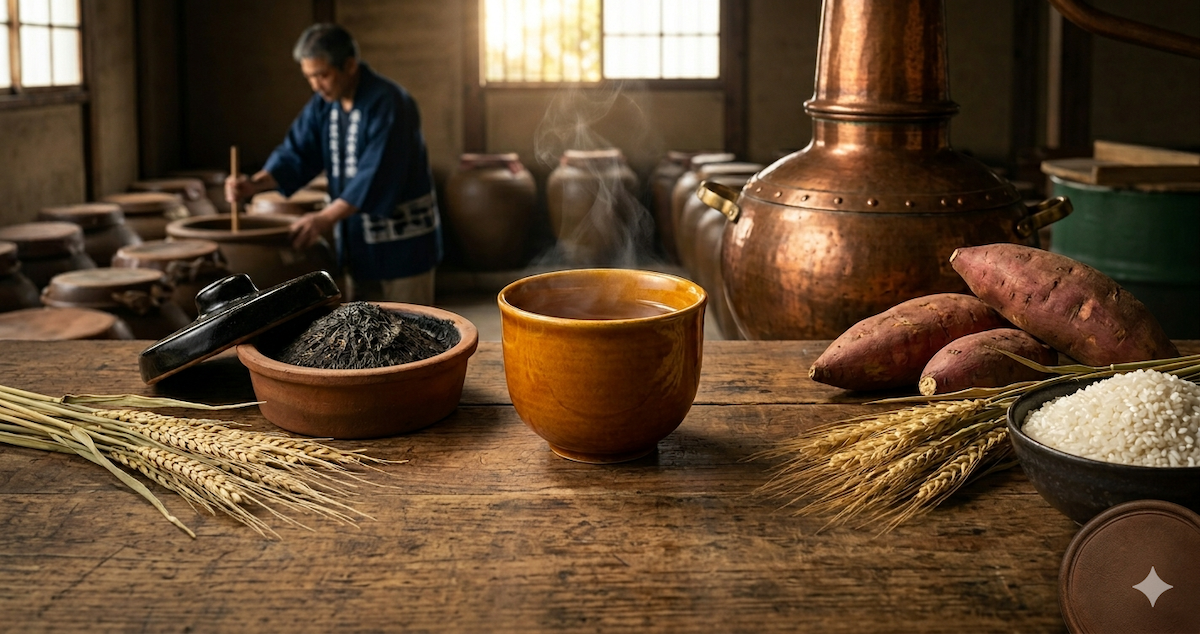
Land, Mold, and Fire: An Introduction to Shochu, Japan’s Everyday Spirit
Japan’s most consumed spirit is made by the same ancient mold as miso, soy sauce, and sake. Most of the world has never heard of it.
The Spirit Hidden in Plain Sight
There is a spirit that outsells sake in Japan — and has done so every year since 2003. It is poured at family dinners and festival tables. It is sipped slowly on hot summer evenings and warmed in ceramic cups through winter nights. Farmers have made it from whatever the earth gave them: sweet potato from volcanic soil, barley from island fields, rice from warm river valleys. Its name is shōchū (焼酎), and outside Japan, most people have never tasted it.
This is not a story about Japan’s best-kept secret. Secrets imply concealment. Shōchū was never hidden — it simply lived, quietly and persistently, within a culture that did not need to explain it to the outside world. But that culture is worth understanding. Because shōchū is not just a drink. It is a portrait of a people, a landscape, and a centuries-old relationship between human hands and living mold.
What Shōchū Actually Is
Shōchū is a distilled spirit, typically between 20 and 25 percent alcohol by volume — stronger than sake or wine, but lighter than whisky or vodka. The word itself is a Japanese rendering of the Chinese shāojiǔ (燒酒), meaning “burned liquor,” a reference to the heat of distillation. That process — fermenting a base ingredient, then heating the mash to collect and condense the alcohol vapor — is the same fundamental act that produces whisky, grappa, or rum. What makes shōchū different is not the still. It is what happens before the still.
Japanese law divides shōchū into two broad categories. Kōrui shōchū is continuously distilled, producing a clean, neutral spirit suitable for cocktail mixing — the type that fills most canned drinks in convenience stores. Otsurui shōchū, more commonly known as honkaku (本格) shōchū, meaning “authentic” or “genuine,” is different in almost every respect. It is distilled only once, in a pot still, which preserves the aroma and character of its ingredients. It must be made from approved agricultural ingredients using koji mold. And it is this mold — not the base ingredient, not the distillation method — that makes honkaku shōchū a spirit unlike any other on earth.
Among all distilled spirits in the world, only honkaku shōchū uses koji to convert starch into sugar before fermentation. This single fact separates it from whisky, vodka, rum, and every other spirit tradition.
Koji: The Living Foundation
Koji (Aspergillus oryzae and related strains) is a filamentous mold — a fungus cultivated on grain, most often rice or barley, that produces enzymes capable of breaking down starches into fermentable sugars. It is the same organism responsible for miso, soy sauce, sake, mirin, and rice vinegar. In Japan, koji is not merely an ingredient. It is the cornerstone of an entire fermentation civilization.
In shōchū production, koji-inoculated grain is combined with the main base ingredient — sweet potato, barley, rice, or others — along with water and yeast, in what is called a two-stage fermentation. During this process, saccharification (the conversion of starch to sugar) and alcoholic fermentation occur simultaneously, in the same tank. This is known as heikō fukuhakkō, or “multiple parallel fermentation,” and it is a technique unique to Japan — shared only with sake brewing.
The strain of koji used matters enormously. White koji (shiro kōji) produces a light, clean spirit with mild citric acidity — the most common choice for barley and rice shōchū. Black koji (kuro kōji), an ancient strain originating in Okinawa, produces a deeper, earthier fermentation and is traditional in sweet potato shōchū and awamori. Yellow koji (ki kōji), the strain used in sake brewing, offers delicate fruity notes and is occasionally used in premium rice shōchū. Each strain shapes the character of the final spirit in ways that distillation alone cannot replicate.
A Spirit Born in the South
The origins of shōchū are debated, but the most widely accepted account traces distillation technology from Southeast Asia — specifically from Siam, present-day Thailand — through trade routes to the Ryukyu Kingdom (now Okinawa) sometime in the 15th century. From Okinawa, the practice spread north through the Amami Islands to Kyushu, Japan’s southernmost main island, where conditions were ideal: warm temperatures and high humidity, the same climate in which koji thrives.
The earliest surviving written reference to shōchū in Japan is carved graffiti found at Kōriyama Hachiman Shrine in Kyushu, dating to 1559. A shrine carpenter left behind a complaint that a visiting priest had been too stingy to share his shōchū. The spirit was already, by then, a part of everyday life. By the Edo period (1603–1868), shōchū had been sent as a gift to the Tokugawa Shogunate. It had value not only as a beverage but also as a disinfectant for sword wounds.
For most of its history, however, shōchū was considered the drink of farmers and laborers — the working spirit of southern Japan, rough around the edges and deeply local. When the ruling samurai of Nagasaki outlawed the use of rice for alcohol production, distillers adapted: barley became the base ingredient on the island of Iki, where barley shōchū has been made for over 400 years. When sweet potatoes were introduced to Kyushu from Okinawa and found to thrive in the volcanic soil where rice refused to grow, they became the basis of what is now Japan’s most distinctive regional shōchū style.
Shōchū did not evolve in spite of constraint. It evolved because of it — shaped by geography, taxation, and necessity into a spirit that maps the land it comes from.
The Language of Ingredients
Because honkaku shōchū retains the character of its base ingredient — distilled only once, preserving aroma and flavor — the question of what it is made from is also the question of where it is from and who made it. Each variety speaks a different dialect.
Imo shōchū (芋焼酎), made from sweet potato, is the most immediately distinctive. Produced primarily in Kagoshima, on the volcanic southern tip of Kyushu, it can be rich, earthy, and floral — with notes sometimes described as roasted root vegetable, dried fruit, or wild herbs. It is the variety most likely to surprise first-time drinkers, and the one most beloved by devotees. The sweet potato variety caused a national shortage of its own base ingredient when Japan’s early-2000s shōchū boom drove demand beyond what Kagoshima’s farms could supply.
Mugi shōchū (麦焼酎), made from barley, is lighter and more approachable — a gentle spirit with mild sweetness and a clean finish. Produced in Oita, Miyazaki, and on the island of Iki in Nagasaki Prefecture, barley shōchū has earned geographical indication protection in Japan. When aged in oak, it acquires a character that recalls single-malt Scotch whisky. It is often the entry point for new drinkers.
Kome shōchū (米焼酎), made from rice, shares its base ingredient with sake but arrives at an entirely different place. Rice shōchū tends to be smooth and clean with a gentle sweetness — less fruity than sake, more structured, with a longer finish. The Kuma region of Kumamoto Prefecture is particularly celebrated for its rice shōchū, which holds geographical indication status. Some sake breweries also produce rice shōchū, drawing on the same fermentation expertise while working within the distillation tradition.
Beyond these three major varieties, the world of shōchū extends further: kokutō shōchū (黒糖焼酎), made from brown sugar, is produced exclusively in the Amami Islands of Kagoshima Prefecture, yielding a spirit that is mellow and gently sweet. Soba shōchū (蕎麦焼酎), made from buckwheat, was first produced in Miyazaki in 1973 and has since spread to buckwheat-growing regions including Nagano and Hokkaido — light and nutty, with a distinctive aromatic quality.
How to Drink It
Shōchū does not prescribe a single drinking style. It adapts to the season, the occasion, and the preference of the person holding the glass — a flexibility that reflects both its distilled nature and its deeply domestic character.
The most traditional ways of drinking honkaku shōchū are mizuwari (水割り), diluted with cold water, and oyuwari (お湯割り), diluted with hot water. In the oyuwari style — water is poured first, then the shōchū added — the spirit opens up, releasing aromas and softening the alcohol, making it particularly well-suited to the earthy depth of imo shōchū on a winter evening. On the rocks (on za rokku) is common with mugi shōchū, where the chill sharpens the lightness of the barley character. Shōchū is also the base of chūhai (酎ハイ), carbonated mixed drinks with fruit flavoring that have become ubiquitous in Japanese daily life — and the spirit behind umeshu (plum liqueur), one of the most recognizable Japanese fruit infusions.
What connects these styles is restraint. Shōchū is not drunk to overwhelm, but to accompany. It sits alongside food — grilled meats, sashimi, pickled vegetables, hearty stews — without competing with them. It is, in this sense, the spirit of the table rather than the spirit of the occasion.
From the South to the World
For most of the 20th century, honkaku shōchū was a regional drink, little known outside Kyushu and Okinawa. It began spreading through Japan around 1980, and by 2003, domestic shipments had surpassed sake for the first time. The early 21st century saw shōchū bars open across Tokyo, premium bottles enter the market, and the spirit’s image shift from blue-collar grog to an object of connoisseurship. Young drinkers — including women, who had rarely been the target audience — began to explore it.
Internationally, awareness has grown slowly but steadily. Bartenders in the United States and Europe have discovered shōchū’s versatility as a cocktail base — its lower alcohol content (relative to whisky or vodka) and complex flavor making it an interesting alternative to more familiar spirits. JETRO, Japan’s external trade organization, has actively promoted honkaku shōchū abroad, framing it alongside Japanese whisky as a craft spirit category worthy of serious attention.
And yet shōchū remains, in important ways, a drink most fully understood when tasted in the place it was made — in a Kagoshima izakaya with Satsuma imo in the glass and the smell of volcanic earth still hanging in the memory, or on Iki Island with barley shōchū and the sea outside. There are over 600 shōchū distilleries in Japan. Each one tells a version of the same old story: land, mold, water, fire, and time.
The Japanese have a word, fūdo (風土), that captures the indivisible relationship between climate, soil, and culture — the spirit of a place made tangible. Shōchū is one of its most faithful expressions. It does not ask to be understood through comparison with other spirits. It asks only to be tasted slowly, on its own terms, in the company of food and people and the particular light of wherever you happen to be.
This article is part of Waden’s Heritage series — documenting the traditions, techniques, and foods that must not be forgotten. Read more at waden.umamibako.com.
Comment