Fragrant Things: What Tsukemono Reveals About How Japan Thinks About Food
Japan calls its pickles konomono — fragrant things. The name is not decorative. It tells you exactly what these small dishes are for.
The Smallest Dish on the Table
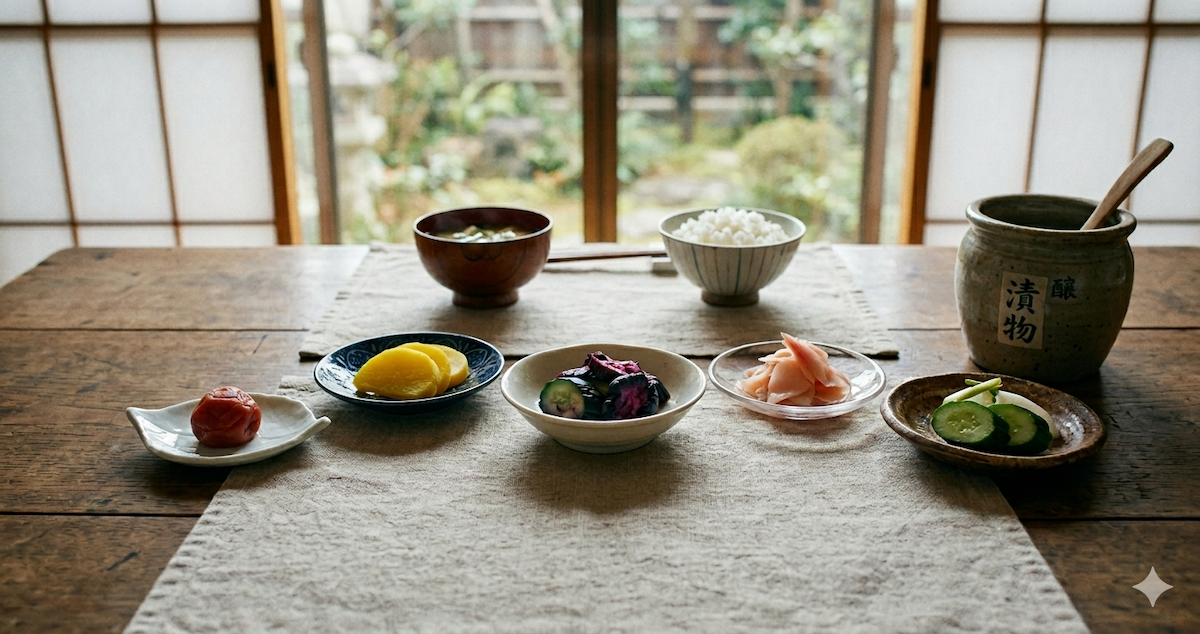
At a traditional Japanese meal, a small dish of pickled vegetables appears almost without ceremony. It might be a few slices of bright yellow daikon, a cluster of purple cucumber and eggplant, a single wrinkled umeboshi plum resting at the edge of a lacquer bowl. It takes up the least space of anything on the table. It receives the least attention. And yet, if you have spent enough time eating Japanese food, you begin to notice that its absence changes everything — the meal feels slightly unfinished, the rice less appetizing, the fish heavier and harder to move past. Something is structurally missing.
These pickles are called tsukemono (漬物) — literally “pickled things.” They are one of the oldest and most technically varied expressions of Japanese food culture, with a history stretching back more than a thousand years. They are also one of the least understood foods in Japan’s global culinary export, overshadowed by sushi, ramen, and tempura — dishes that announce themselves dramatically. Tsukemono whispers. But once you understand what it is doing at the table, you cannot eat a Japanese meal without noticing it.
What Tsukemono Actually Is
Tsukemono is a category, not a single food. The word describes any vegetable — or occasionally fruit, seaweed, or even fish — that has been preserved and transformed through pickling. The pickling medium can be as simple as salt or as complex as a living fermentation bed of rice bran that must be tended daily for years. What unifies the category is not a shared flavor or texture but a shared function: tsukemono exists at the edge of a Japanese meal to provide contrast, acidity, crunch, and refreshment against the meal’s dominant flavors.
The ingredients used are deliberately seasonal and local. Daikon radish, cucumber, eggplant, turnip, cabbage, carrot, ginger, lotus root, and ume plum are among the most common raw materials, though the actual spectrum is considerably wider — virtually any vegetable that grows in Japan has at some point been pickled somewhere in the country. The result is a form that changes face entirely depending on the region, the season, the vegetable, and the method — a single category containing preparations that look and taste nothing like each other, unified only by what they do at the table.
An important note for readers more familiar with Western pickling traditions: the word “pickle” can be misleading. In many countries, pickles are primarily a condiment — a strongly acidic, sharply flavored garnish applied to sandwiches or burgers. Japanese tsukemono includes preparations that are comparably sharp, but also preparations that are faintly sweet, subtly earthy, mildly fermented, or delicately sour — a spectrum of intensity that ranges from something you can eat by the bowlful to something you consume in small, careful bites. The word “pickle” does not fully capture this breadth. Konomono — fragrant things — comes closer.
One Thousand Years of Salt and Time
The oldest written references to tsukemono appear in the Nara period (710–794 CE), describing salt-packed vegetables offered to the imperial court. This is not surprising: salt pickling is one of humanity’s oldest food preservation methods, and Japan’s development of it closely parallels similar traditions in Korea, China, and across the fermented food cultures of East Asia. But Japan’s approach to tsukemono diverged from simple preservation early.
By the Heian period (794–1185 CE), pickling had evolved beyond mere conservation into something more deliberate. Court records document dozens of distinct preparations, and the practice became accessible to commoners as a way of extending the life of seasonal produce through lean months. During the Muromachi period (1336–1573), the fermentation process was developed further, resulting in better flavor and taste, and pickles started to be called ko no mono — “fragrant things.” In samurai households, pickles played an important role in cleansing the palate and refreshing the mouth in the middle of lavish meals of meat and fish. Their portability during military campaigns also made them a valued ration — a practical quality that reinforced their place in everyday Japanese eating.
In the Edo period (1603–1867), daikon radish, which had originally been pickled with millet and salt, started to be pickled using a rice bran paste produced from refining brown rice, and takuan — the most iconic daikon pickle — was created. The Edo period also saw the growth of dedicated tsukemono shops in cities like Kyoto, where specific regional preparations became identified with their places of origin and acquired reputations that persist to this day. By the early 1900s, tsukemono were commercialized into a major industry and became a staple wartime ration, given their long shelf life. The combination of preservation need, culinary refinement, and regional pride produced a form of extraordinary diversity — one that had moved entirely beyond its practical origins into something closer to an art.
The Structure of a Japanese Meal
To understand why tsukemono matters, it helps to understand the traditional template of a Japanese meal. That template is called ichiju sansai (一汁三菜) — literally “one soup, three sides.” A complete traditional Japanese meal consists of plain steamed rice at the center, one soup (typically miso soup), and three accompanying dishes: a main protein, a vegetable side, and tsukemono. In that structure, tsukemono is not optional garnish. It is one of the three sides, a palate-cleanser and umami anchor that bridges rice, soup, and protein.
The logic of this placement is easy to understand once you have experienced it. Japanese cooking is built heavily around umami — the deep, savory, glutamate-rich quality found in dashi, soy sauce, miso, fermented seafood, and aged proteins. It is an extraordinary flavor, but it is also a persistent one that coats the palate and can become numbing over the course of a meal. Tsukemono’s acidity and sharpness cut through this coating, resetting the palate and restoring the appetite for the next bite. In this sense, tsukemono performs the same structural function as a squeeze of lemon over fried fish, or a grating of horseradish beside roast beef — but the Japanese version is formalized into the meal’s architecture rather than left to individual discretion.
The pairing with plain rice is equally significant. A piece of takuan, a few shiozuke cucumber slices, or a single umeboshi alongside white rice is itself a complete simple meal in traditional Japanese eating. The pickle’s salt seasons the bland rice; the rice’s starch tames the pickle’s sharpness. The two foods are designed to be eaten together, alternating in small quantities — a rhythm that defines the pace of a Japanese meal in a way that is difficult to appreciate until you have experienced it directly.
The Methods: From Hours to Years
What distinguishes Japanese pickling from many other traditions is the sheer variety of its preservation media. Each medium produces a fundamentally different result, and the choice of method is not incidental — it reflects what qualities the maker wants to bring out in a particular vegetable, and how long they are willing to wait.
Shiozuke (塩漬け) — salt pickling — is the oldest and simplest method. Vegetables are either rubbed with salt and pressed under weights, or submerged in a light saltwater brine. The salt draws moisture from the vegetable through osmosis, creating a natural brine that concentrates flavor and creates a clean, crisp texture. Depending on the salt concentration and the time allowed, shiozuke can be ready in as little as thirty minutes or as long as several weeks. Asazuke (浅漬け), meaning “shallow pickle,” is a variation using very light, brief salting — the quickest form of tsukemono and common in home kitchens where lefover vegetables are pickled overnight.
Nukazuke (糠漬け) is one of Japan’s most distinctive and demanding pickling traditions. Vegetables are submerged in nukadoko — a living fermentation bed made from roasted rice bran, salt, kombu, and other seasonings that develops its own complex microbial ecology over time. The nukadoko must be turned by hand daily to introduce oxygen and prevent undesirable fermentation, meaning that a nukazuke bed is essentially a living object that must be cared for continuously. Vegetables fermented in nukadoko develop a deep, earthy sourness and absorb the layered complexity of the bed itself. The most famous nukazuke preparation is takuan — sun-dried daikon radish fermented in rice bran for six months or more, producing the bright yellow slices ubiquitous in bento boxes across Japan.
Misozuke (味噌漬け) involves burying vegetables — or sometimes fish and meat — in miso paste for extended periods ranging from a few days to several years. The miso’s enzymes slowly penetrate the ingredient, imparting saltiness, umami, and a distinctive depth that no other method produces. Saikyo-zuke, in which whitefish is marinated in sweet Kyoto-style white miso before being grilled, is one of the most celebrated applications of this method — the miso tenderizes the flesh and caramelizes during grilling into a glossy, amber-glazed surface.
Kasuzuke (粕漬け) uses sake lees — the rice sediment left after sake is pressed — as the pickling medium. The alcohol content of the lees preserves vegetables slowly and deeply, producing pickles with a faint alcoholic character that intensifies over months or years. Narazuke, from Nara Prefecture, are perhaps the most extreme example: vegetables soaked in sake lees for multiple years, emerging with a pungent, deeply complex flavor and an almost brown color entirely unlike their original state. They are typically served alongside rich, heavy dishes — grilled eel is a traditional pairing — where their intensity functions as a counterpoint to fat.
Suzuke (酢漬け) and shoyuzuke (醤油漬け) use rice vinegar and soy sauce respectively as pickling agents. Vinegar pickles are typically quick and produce a crunchy, sweet-sour result, though their lower acidity means they require refrigeration. Soy sauce pickles range from delicate to intensely savory depending on the concentration of the brine and the duration of the pickling — fukujinzuke, the sweet soy-brined vegetable relish served alongside Japanese curry, is among the best-known examples.
“A nukazuke bed must be turned by hand daily. It is a living object that requires continuous care — and what it produces cannot be replicated by any other method.”
Varieties Worth Knowing
Within the broad category of tsukemono, several preparations have acquired national recognition that makes them worth understanding individually.
Umeboshi (梅干し) — salt-dried ume plums — occupies a special position in Japanese food culture that goes well beyond its classification as a pickle. The ume, a stone fruit often translated as “plum” though botanically closer to an apricot, is harvested in June and preserved in salt for weeks before being dried in the sun during the peak summer heat. The result is intensely sour, salty, and slightly astringent — a flavor that divides non-Japanese tasters sharply but is beloved in Japan as a digestive aid, a rice companion, and an onigiri filling. A single umeboshi placed at the center of a bowl of white rice — its red color against the white grain — is one of the most enduring images in Japanese food aesthetics.
Takuan (たくあん), the yellow daikon pickle, is arguably the most widely consumed tsukemono in Japan. Its crunch, mild sweetness, and faintly yeasty flavor make it a versatile accompaniment that appears in bento boxes, alongside ramen, rolled into maki sushi, and beside almost every set meal at a traditional Japanese restaurant. Its bright yellow color — produced either by a specific strain of bacteria or by the addition of natural coloring — is one of the visual signatures of Japanese food.
Gari (ガリ) — the thinly sliced sweet pickled ginger served at sushi restaurants — is perhaps the most internationally familiar tsukemono. Its function is specific and structural: eaten between pieces of sushi, it resets the palate, clearing residual flavors so that the next fish can be tasted on its own terms. Its pale pink color, a natural byproduct of young ginger reacting with the rice vinegar brine, has become a visual cue for Japanese food globally.
Shibazuke (柴漬け) is a Kyoto specialty: cucumber, eggplant, and shiso leaves pickled together in plum vinegar, producing a vivid purple color and a salty, mildly sour flavor with a complex herbal note from the shiso. It is one of Kyoto’s most recognizable culinary ambassadors and a visual representation of how tsukemono, at its most refined, is also a form of aesthetic expression — color, texture, and flavor considered together as components of a complete meal.
Encountering Tsukemono Outside Japan
For readers outside Japan, tsukemono is most likely to appear first as gari at a sushi restaurant, as a small side dish at a Japanese teishoku (set meal) restaurant, or as the yellow takuan slices in a bento box. These are reasonable entry points. But the full spectrum of tsukemono — the deeply fermented nukazuke, the sake-lees complexity of narazuke, the austere intensity of a properly made umeboshi — is considerably harder to encounter without seeking it out.
Japanese specialty grocers in major cities typically stock a reasonable selection: packaged takuan, umeboshi in varying intensities (the most traditional are aggressively salty; sweetened versions are more approachable for first-time tasters), and quick-pickled vegetables under the asazuke label. Larger Japanese supermarkets may carry nukazuke and misozuke preparations. High-quality hon mirin, sake lees, and rice bran for home pickling are also increasingly available through online suppliers.
The most useful practical orientation is this: approach tsukemono not as a condiment to be consumed in isolation but as a structural element of a meal. Eat it alongside plain rice. Use it to punctuate bites of richer foods. Allow it to reset what the previous bite left behind. When eaten in this way — as Japanese cooking has always intended — tsukemono stops being the smallest dish on the table and reveals itself as the one around which everything else is quietly organized.
Every culture that pickles does so first out of necessity — as a way of extending the life of perishable food across seasons without refrigeration. Japan is no exception. What is exceptional is what Japanese pickling became after the need for pure preservation was met: a form of attention to seasonal produce, a technique of transformation that can take weeks or years, and a structural element of the meal so fundamental that its absence is immediately felt. To understand tsukemono is to understand something essential about how Japan relates to time — in the kitchen, at the table, and in the slow patience that turns a radish, a plum, or a handful of cucumber into something irreplaceable.
Comment