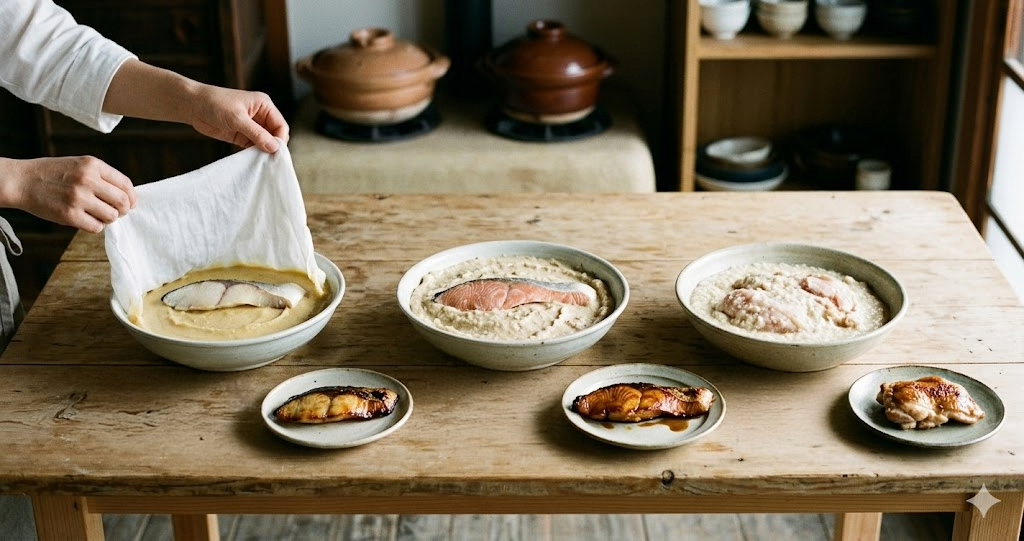
Before the Grill: Japan’s Tradition of Marinating Fish and Meat in Fermented Pastes
What began as a method of preservation became one of Japanese cuisine’s most refined techniques — a way of transforming raw ingredients from the inside out, before heat ever touches them.
The Work That Happens Before Cooking
In many culinary traditions, preparation ends when cooking begins. You season the surface of a piece of fish or meat, apply heat, and the work of flavor-building takes place in the pan or over the flame. Japanese cuisine has always understood something different: that the most meaningful transformation of an ingredient can happen before the fire is lit, during the hours or days it spends buried in a fermented paste that slowly changes its chemistry from within.
This practice — marinating fish, meat, and sometimes vegetables in beds of miso, sake lees, or shio koji for extended periods — is not a modern technique or a chef’s affectation. It is one of the oldest food traditions in Japan, with roots stretching back more than a thousand years to a time when refrigeration did not exist and the ability to extend the life of protein was a matter of daily necessity. What those early practitioners also discovered, almost incidentally, is that the fermented pastes they used for preservation were doing something far more interesting than simply keeping food from spoiling. They were making it taste better — more deeply flavorful, more tender, more complex — in ways that fresh seasoning alone could never achieve.
Today, dishes produced by these methods — saikyo-yaki, kasuzuke, shio koji-marinated fish — appear on the menus of the best Japanese restaurants in the world. Understanding what they are and how they work is the clearest path to understanding one of the most important dimensions of Japanese cooking.
What Fermented Pastes Actually Do to Protein
Before moving to specific preparations, it is worth understanding what makes fermented marinades fundamentally different from conventional seasoning. When you salt the surface of a piece of fish or rub it with a spice mixture, you are adding flavor to the exterior. The inside of the fish tastes primarily of fish. A fermented paste does something categorically different.
Fermented ingredients like miso and sake lees are rich in enzymes — particularly proteases, which break down proteins, and amylases, which convert starches into sugars. When a piece of fish is buried in miso paste, these enzymes migrate into the flesh through osmosis. Over the course of one to several days, they begin breaking down the fish’s own proteins into shorter amino acid chains, including glutamates — the compounds responsible for umami. At the same time, they break down muscle fibers, softening the texture and producing a characteristic tenderness that no amount of heat or conventional marination can replicate. The miso’s salt simultaneously draws moisture from the fish’s surface, concentrating its natural flavor while the interior undergoes its enzymatic transformation.
The result is not fish with a miso coating. It is fish that has been changed by miso — more savory, more tender, more aromatic, with a surface that caramelizes readily under heat because of the sugars the enzymes have produced. This process is what Japanese chefs mean when they speak of a marinade penetrating an ingredient rather than merely flavoring it. And it is why, when you taste a properly prepared saikyo-yaki or kasuzuke, the complexity you encounter is not located on the surface but distributed throughout every layer of the flesh.
“You are not adding flavor to the exterior. You are changing the fish from within — more savory, more tender, more aromatic than anything surface seasoning can achieve.”
Misozuke: Miso as Marinade
Misozuke (味噌漬け) is the broad term for marinating ingredients in miso paste. Among its many expressions, the most celebrated — and arguably the most globally recognized — is saikyo-yaki (西京焼き): fish marinated in the sweet white miso of Kyoto and then grilled over direct heat until its surface caramelizes into a lacquered, amber crust.
The history of saikyo-yaki is inseparable from the history of saikyo miso itself. Saikyo miso is a particular style of white rice miso produced in Kyoto, characterized by its low salt content (around 4–6%, compared to the 12% of typical Japanese miso), its high ratio of rice koji to soybeans, and its distinctively sweet, almost buttery flavor. Its origins trace to the Heian period (794–1185), when the imperial court in Kyoto cultivated a taste for refined, delicate flavors. The use of miso as a marinade for fish emerged from this court culture — Kyoto is a landlocked city, far from the sea, and preserving fish transported from the coast required techniques that would extend its life while improving its flavor. Saikyo miso, with its gentle sweetness, proved ideal: it masked the off-notes that develop in transported fish without overwhelming its natural character.
The technique that emerged, and that Kyoto restaurants still practice in its traditional form, is called hon-zuke — “true marination.” Fish fillets are embedded in saikyo miso for a minimum of two days and two nights, often longer. Skilled chefs adjust the duration based on the season, the temperature, and the density of the fish. Fatty fish — black cod (gindara), Spanish mackerel (sawara), salmon — are the most common candidates, because their fat content allows the miso’s enzymes to penetrate evenly and the flesh to remain moist and rich during the high heat of grilling.
Before grilling, the miso is wiped — not washed — from the surface of the fish. A thin residual layer remains. Over direct heat, this layer undergoes the Maillard reaction: its amino acids and sugars caramelize rapidly, producing a surface that is simultaneously charred at the edges, lacquered in the center, and deeply fragrant with the concentrated aroma of sweet fermented rice. The inside of the fish, transformed by days of enzymatic activity, is flaky and yielding, with a savory depth that reads less like “seasoned fish” and more like the fish has always tasted this way.
Outside Kyoto, the term misozuke is also used more broadly for any fish or meat marinated in miso — often with darker, saltier varieties that produce a more assertive, less sweet result. A misozuke made with red miso or standard shinshu miso will be more intensely savory and less caramel-like than the Kyoto version, with a deeper color and a more pronounced fermented character. Both are legitimate expressions of the same underlying technique; the choice of miso entirely determines the outcome.
Kasuzuke: The Taste of Sake Itself
Kasuzuke (粕漬け) uses a different fermented medium: sake lees, the compressed rice solids left behind after sake has been pressed and filtered from its fermentation tank. Known in Japanese as sake kasu (酒粕), this byproduct of sake production is soft, fragrant, and slightly alcoholic — a pale, putty-colored paste that carries the concentrated aromatic compounds of fermented rice without the liquid that has been extracted as sake.
The history of kasuzuke is among the oldest of any Japanese food preparation. It was made in the Kansai region as early as the Nara period, approximately 1,200 years ago — a technique said to have originated with Buddhist monks, who served kasuzuke to samurai as a portable, imperishable provision for military campaigns. A book published in 905 CE documents the kasu-zuke method, making it one of the earliest recorded cooking techniques in Japanese culinary history. It was during the Edo period that sake dealers began promoting kasuzuke more widely, using the increasing availability of high-quality sake kasu from Japan’s expanding sake industry to bring the preparation into ordinary households.
To make a fish kasuzuke, the sake kasu is typically mixed with mirin, sugar, salt, and sometimes soy sauce or ginger to form a pliable, aromatic paste called kasudoko (粕床) — the marinating bed. Fish fillets are salted first, rested for thirty minutes to draw surface moisture and concentrate flavor, then patted dry and embedded in the kasudoko for anywhere from several hours to several days. The salt-first step is essential: as one Japanese chef has described it, salt draws water from the fish like a sponge being wrung out, and the resulting space is then filled by the flavor compounds of the kasudoko as they penetrate the flesh.
The result, when grilled, is one of the most distinctive preparations in Japanese cooking. The surface caramelizes deeply — more intensely than with miso, because sake kasu contains a higher concentration of fermentation-derived sugars — into a near-black glaze with an extraordinary complexity. The flesh beneath is dense and moist, carrying a characteristic sake fragrance that is unmistakable once encountered: slightly earthy, faintly sweet, with a depth that reads as both fermented and somehow clean. Cod, salmon, butterfish, and sea bream are among the most common fish for kasuzuke. The kasudoko itself can be reused many times, replenished as needed, and improves in complexity with repeated use — similar in principle to the sour dough starter that becomes more nuanced the longer it is maintained.
“The kasudoko can be reused many times and improves with repeated use — a living medium that accumulates the history of every ingredient marinated within it.”
Shio Koji: The Gentlest Transformation
The third major tradition of fermented marination in Japan uses neither miso nor sake lees but shio koji (塩麹) — a mixture of rice koji and salt that has been allowed to ferment for one to two weeks until the koji’s enzymes have been fully activated and its starches converted into glucose. The result is a soft, grainy paste, pale in color and faintly sweet, that looks deceptively simple but performs an extraordinary enzymatic role when applied to protein.
Shio koji is the most delicate of the three fermented marinades — less pungent than miso, less alcoholic and aromatic than sake kasu, with a gentle sweetness and a clean, pure umami character derived directly from the koji’s amino acid production. It has experienced a significant revival in Japan in recent decades as home cooks have rediscovered it, particularly for its remarkable tenderizing properties: the koji’s proteases break down muscle fibers with exceptional efficiency, producing a tenderness in even inexpensive cuts of fish and meat that rivals the effect of far more costly preparations.
For fish, shio koji is applied simply: the fillet is coated, covered, and refrigerated for several hours to overnight. The koji’s enzymes gently reorganize the protein structure, producing flesh that is more yielding and more fragrant after cooking. For chicken and pork, shio koji marinades of one to three days produce a similarly remarkable tenderness, with a surface that browns beautifully under heat and an interior that remains consistently moist despite the inevitable moisture loss of high-temperature cooking. Because shio koji is lower in salt than miso or kasudoko, it is also more forgiving — the risk of over-marination and over-salting is considerably lower, which makes it the most accessible of the three traditions for cooks encountering these techniques for the first time.
The Role of Heat: What Grilling Does to a Marinated Ingredient
Each of these marinating traditions — misozuke, kasuzuke, shio koji — is almost always completed by grilling. This is not a coincidence. Grilling does specific things to a fermented-marinated ingredient that other cooking methods cannot replicate, and those effects are precisely what makes the tradition coherent.
High direct heat caramelizes the residual sugars on the surface of the fish or meat, producing the lacquered glaze that defines these dishes visually. The Maillard reaction — the same chemical process responsible for the crust of a seared steak or the color of toasted bread — operates with exceptional speed on the amino acid-rich surfaces produced by enzymatic marination, creating a depth of color and fragrance that plain fish would take far longer to develop, if it could develop it at all. The caramelized crust also seals the surface, trapping the moisture and volatile aromatics inside the flesh that days of marination have built up.
The practical implication of this chemistry is the most important thing to know when cooking these dishes at home: the residual marinade on the surface of the fish must be wiped off, not washed away, before grilling. A thin layer remains and caramelizes; too thick a layer burns before the fish is cooked through. Saikyo-yaki in particular requires attention at this stage — its high sugar content means it can go from golden to charred in seconds. Many Japanese cooks wrap the marinating fish in muslin (a thin cotton cloth) that absorbs the outermost layer of miso and can be peeled away before grilling, leaving the fish with only the thin coating needed for the glaze.
Encountering These Preparations Outside Japan
For many people outside Japan, the first encounter with these traditions comes through Nobu Matsuhisa’s miso-marinated black cod — a dish that appeared on the menu of his New York restaurant in the 1990s and became one of the most widely recognized Japanese preparations in global fine dining. The dish is a version of saikyo-yaki using black cod: the fish is marinated for two to three days in a mixture of white miso, mirin, and sake, then broiled until the surface is deeply caramelized and the flesh falls apart in large, lacquered flakes. Its international success made misozuke legible to a global audience in a way that centuries of Japanese cooking tradition had not.
But the preparation Nobu popularized is a version of something that has existed in everyday Japanese home cooking for a very long time — a dish that ordinary households make on weekday evenings from vacuum-sealed packets of miso-marinated fish sold at the supermarket, and that appears in teishoku (set meal) restaurants at every price point across Japan. Its apparent elegance in a fine dining context is real, but so is its accessibility. The technique requires very little active work: the preparation is done by the marinade over time, and the cooking is a matter of minutes. The complexity in the finished dish is not the cook’s achievement. It is the achievement of the fermented paste, and of the patience that allowed it to do its work.
For readers who want to begin exploring these traditions, the most practical entry point is saikyo-yaki with salmon or cod, using white miso adjusted with mirin, sake, and a small amount of sugar to approximate the sweetness of authentic saikyo miso. A minimum of two days of marination in the refrigerator produces a noticeably different fish than one marinated for hours; three days pushes the result further. Kasuzuke requires sourcing sake kasu, which is available at Japanese specialty grocers and increasingly online. Shio koji is the most accessible starting point of the three — it can be purchased ready-made or prepared at home with koji rice and salt — and its gentleness makes it an excellent introduction to what fermented marination is capable of before moving to more intensive preparations.
Every piece of fish or meat that emerges from a bed of miso or sake lees carries the accumulated work of days inside it — days during which enzymes moved slowly through the flesh, breaking down protein into flavor, tightening texture, and building a depth that no amount of surface seasoning could approach. The grill completes the transformation in minutes. But the grill is not where the cooking happens. The cooking happens in the quiet of the refrigerator, over time, in the company of fermented things. To understand this is to understand something fundamental about Japanese cuisine: that its most striking results are often the product of the least visible work.
Comment