The Bottle That Makes Japanese Food Shine: An Introduction to Mirin
It is not sake. It is not sugar. It is something Japanese cooks have reached for instinctively for centuries — and once you understand what it does, you cannot cook Japanese food without it.
Three Bottles Before Anything Else
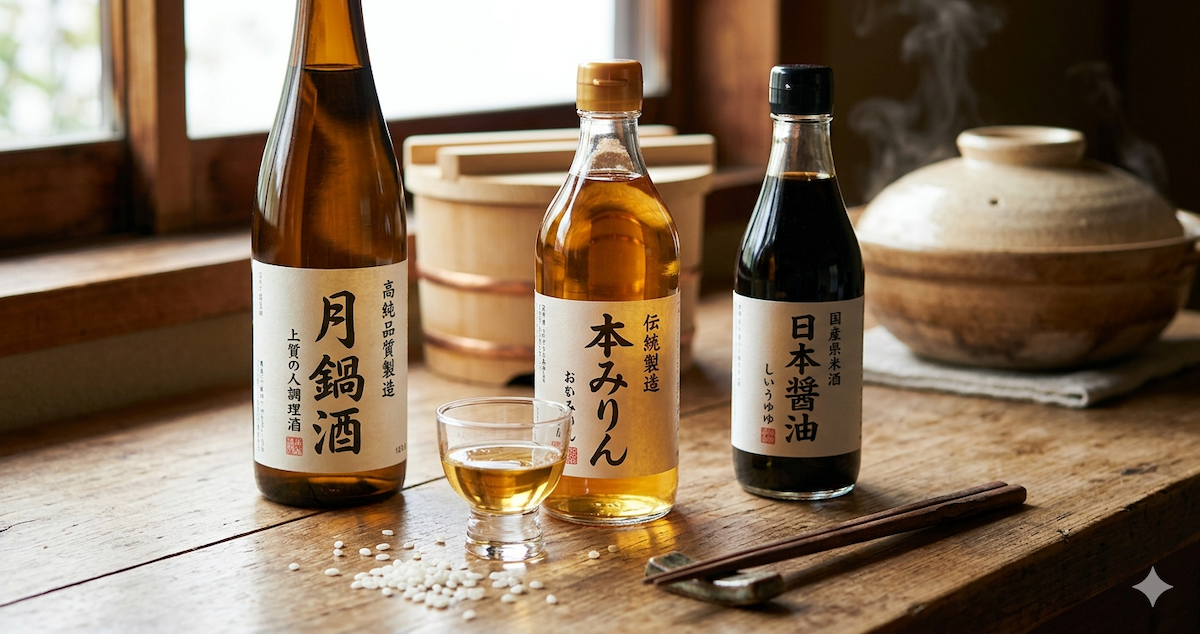
Watch a Japanese home cook set up for dinner and you will notice a pattern. Before the knife comes out, before the dashi is measured, three bottles appear on the counter: sake, mirin, and soy sauce. They are not remarkable objects — amber-colored, unassuming, purchased at the neighborhood supermarket without much ceremony. But these three liquids, used in combination and in proportion, are the structural foundation of Japanese savory cooking. Together, they account for the depth, sweetness, saltiness, and gloss that makes a bowl of nikujaga or a plate of teriyaki taste unmistakably Japanese.
Outside Japan, soy sauce has become internationally familiar. Sake is increasingly known as a beverage, if less well understood as a cooking ingredient. But mirin — the third bottle, the sweet one, the one responsible for that particular lacquered shine — remains genuinely obscure in most parts of the world. It is frequently mislabeled, widely substituted for, and commonly replaced by cheaper imitations that share its name while sharing little of its character. This article is an attempt to do mirin justice: to explain what it actually is, how it is made, how it differs from sake, and what it does in the kitchen that nothing else can quite replicate.
What Mirin Actually Is
Mirin (味醂) is a sweet, viscous rice-based liquid with an alcohol content of around 14% — roughly the same as a full-bodied white wine. It is made from three ingredients: steamed glutinous rice (mochi-gome, the short-grain sticky rice also used to make rice cakes), rice koji (rice cultivated with the beneficial mold Aspergillus oryzae, the same organism used in soy sauce, miso, and sake production), and a distilled spirit, typically shōchū. These three components are combined into a mash and left to undergo saccharification — a process in which the koji’s enzymes break down the starches in the glutinous rice into a spectrum of sugars, including glucose and oligosaccharides, while also producing amino acids and organic acids that contribute to mirin’s flavor. No sugar is added; the sweetness is entirely a product of fermentation.
What results, after straining, is a golden-amber liquid with a viscosity slightly thicker than water, a natural sweetness considerably more complex than sugar, and an alcohol content that plays an important functional role during cooking. Traditional hon mirin (本みりん — literally “true mirin”) is then aged for a further period, anywhere from two months to three years, during which the flavors deepen and the color darkens. A hon mirin aged for ten years develops a brandy-like amber hue and is occasionally used as a drinking liqueur in its own right.
The key word in all of this is hon, which means “real” or “true.” The distinction matters enormously because the vast majority of products labeled “mirin” on supermarket shelves are not hon mirin at all. They are mirin-style seasonings (mirin-fu chomiryo) — inexpensive liquids made from corn syrup, water, alcohol, and acidifiers, with less than 1% alcohol content. These products share mirin’s sweetness but lack its fermentation chemistry, and they cannot replicate the caramelization properties and glaze that make hon mirin irreplaceable in Japanese cooking. In Japan, over 95% of the “mirin” sold in typical supermarkets is actually this type of imitation product; genuine hon mirin, subject to liquor tax as an alcoholic beverage, is harder to find and more expensive. For readers outside Japan, seeking out hon mirin specifically — at Japanese grocery stores or online — is worth the effort for any dish where mirin plays a central role.
“No sugar is added. The sweetness is entirely a product of fermentation — and that distinction changes everything about how it behaves in the kitchen.”
From Luxury Drink to Kitchen Essential
Mirin’s origins are somewhat contested. Two main theories exist: that it was introduced from China during the Sengoku period (approximately 1467–1615), where a sweet liquor called mii-rin had existed; and that it evolved from older Japanese sweet liquors called nerizake and shirozake, to which distilled shōchū was added to improve preservation and increase sweetness. What is clear is that by the late Sengoku period, mirin was being consumed in Japan as a beverage — a sweet, relatively mild alcoholic drink favored particularly by women and by those who found the higher-alcohol nihonshu (Japanese sake) too intense. Like many ingredients later absorbed into cooking, it was initially a luxury enjoyed by the aristocratic class before gradually becoming more widely available.
The transition from beverage to seasoning happened slowly, through the Edo period (1603–1868), as Japan’s food culture became more sophisticated and the flavoring possibilities of sweet fermented liquids became better understood. The first documented uses of mirin in cooking were in the sauces for two dishes that remain emblematic of Edo-period gastronomy: unagi kabayaki (broiled eel basted in a dark, sweet soy-based sauce) and soba tsuyu (the dipping broth for cold buckwheat noodles). Both dishes depend on the same structural logic — a combination of soy sauce’s saltiness and umami with mirin’s sweetness and gloss, reduced together into a sauce of concentrated intensity. This logic, once established, spread across Japanese cooking and became its permanent foundation.
By the Meiji period and into the 20th century, hon mirin was considered a luxury ingredient, used primarily in professional kitchens and fine restaurants. It was only after the post-war recovery, and particularly after tax laws changed to make it more accessible, that mirin became a standard household ingredient. According to the Japanese National Tax Agency, consumption of hon mirin grew threefold between 1970 and 2020 — a period during which sake consumption declined to roughly one-third of its former level, suggesting that mirin’s role in Japanese cooking had, if anything, expanded as sake’s drinking culture contracted.
Mirin and Sake: A Necessary Comparison
Because both mirin and sake are rice-based fermented liquids used in Japanese cooking, they are frequently confused — and occasionally substituted for one another in ways that undermine the dishes they are meant to improve. Understanding the difference between them is not a matter of connoisseurship; it is practical knowledge that changes how food tastes.
Sake is brewed from polished non-glutinous rice, water, and koji, with yeast driving an active fermentation that produces alcohol as its primary product. The result is a dry, aromatic liquid with an alcohol content of roughly 15–17% and relatively little residual sugar. In cooking, sake’s role is savory: it adds umami depth, softens the structure of proteins, carries aromatic compounds into ingredients, and deglazes surfaces with its alcohol. It is particularly effective at neutralizing the fishy or gamey odors that Japanese cooks describe as kusami — an undesirable background note in raw fish, meat, and offal. Sake is added early in cooking, often before other seasonings, to allow its alcohol to evaporate and its aromatic effects to develop.
Mirin serves a fundamentally different function. Where sake is dry and savory, mirin is sweet and viscous. Its alcohol content — around 14% in hon mirin — is present not to be tasted but to be transformed. When mirin is heated, two things happen simultaneously: the alcohol evaporates, concentrating the liquid’s sugars and flavors; and those sugars begin to caramelize on the surfaces of whatever they coat, producing the glossy, lacquered finish that Japanese cuisine is famous for. The word teriyaki literally comes from teri (shine) and yaki (grilled) — and that shine is impossible to achieve without mirin. Sugar alone cannot replicate it: mirin’s complex sugars caramelize differently from sucrose, producing a thinner, more even, more lustrous glaze.
The relationship between the two ingredients is one of deliberate complementarity. Sake is dry, with minimal residual sugar; it adds depth, deglazes, tenderizes proteins, and carries aromatic compounds into a dish. Mirin is sweet and viscous; it adds sweetness, creates glazes, and produces complex caramelization that sake cannot. In most Japanese recipes that call for both, sake is added first and mirin later, following the Japanese mnemonic sa-shi-su-se-so — a rough sequencing guide for seasonings in which sugar (and by extension mirin) is added before salt, soy sauce, and miso, on the logic that the larger molecules in sweet seasonings penetrate ingredients more slowly and need a head start. Mirin added at the end of cooking, by contrast, is used for glazing and finish.
“Sake builds the savory foundation of a dish. Mirin rounds it out with sweetness and gives sauces that beautiful gloss. They are a team, not alternatives.”
What Mirin Does in the Kitchen
The range of mirin’s functions in Japanese cooking is wider than most people outside Japan realize. It is commonly understood to add sweetness, but that description undersells the specificity of what it contributes.
Sweetness without sharpness. Hon mirin is composed of multiple types of sugars produced during fermentation, including glucose, oligosaccharides, and other complex carbohydrates. This variety produces a mellow, layered sweetness that integrates naturally into sauces and broths — softer and more persistent than the immediate, sharp sweetness of granulated sugar. The glycemic index of hon mirin (approximately 15) is also considerably lower than that of refined sugar (approximately 109), because its sugars are complex and absorb more slowly. For simmered dishes and marinades where subtlety matters, this quality is significant.
Gloss and adhesion. This is mirin’s most distinctive and irreplaceable contribution. When applied to proteins or vegetables and heated, mirin’s sugars caramelize into a thin, even, adhesive glaze. The technique known as teri-zuke — brushing mirin directly onto a protein during the final minute of grilling — produces the lacquered surface that defines Japanese grilled dishes from yakitori to unagi kabayaki. The thick, dark sauce that covers a piece of broiled eel at a traditional restaurant — known as nitsume — is a long-reduced mixture of soy sauce, mirin, sake, and sometimes sugar, cooked down over low heat for 20 to 30 minutes until almost black, with a complexity that builds in flavor with each application and reduction.
Odor masking. Mirin’s alcohol content helps neutralize the kusami of raw fish and meat, making it a common ingredient in marinades and in the initial preparation of ingredients before cooking. This function overlaps with sake’s, but mirin’s combination of alcohol and sweetness is particularly effective for delicate fish that would be overwhelmed by sake’s stronger aromatic profile.
Texture and structural integrity. In simmered dishes, mirin’s sugars help proteins hold their shape during cooking, preventing the kind of flaking and disintegration that can occur when proteins are heated in highly acidic or salty environments. This is why mirin appears so often in the braising liquids for fish and tofu.
Flavor balance. Perhaps most fundamentally, mirin functions as the counterweight to soy sauce. In any dish that uses soy sauce or miso, mirin acts as the counterweight — its sweetness tempers the salt, preventing dishes from becoming harsh or one-dimensional. Japanese cooking instructors often describe the pairing of soy sauce and mirin as the essential binary of the cuisine — the salt and the sweet, the dark and the light, always used together and always in calibrated proportion.
Mirin in Practice: The Dishes That Define It
Several classic Japanese preparations exist primarily to demonstrate what mirin makes possible.
Teriyaki (照り焼き) is the most globally recognized example. The name means “glaze-grilled,” and the dish is defined by its sauce: soy sauce, mirin, sake, and sometimes a small amount of sugar, reduced together into a thick, glossy liquid that is brushed onto proteins — originally fish, later chicken — during the final moments of grilling. The teri (shine) in the name is mirin’s direct contribution. Without it, the sauce becomes flat, matte, and sweet in a one-dimensional way that lacks the depth of a proper reduction.
Unagi kabayaki (鰻の蒲焼) — broiled freshwater eel lacquered with a dark, sweet-savory sauce — is the dish most deeply associated with mirin’s origins in Japanese cooking. The sauce, called tare, is a long-reduced mixture of soy sauce, mirin, and sake that is built and maintained over years at traditional eel restaurants, with new sauce added to the old as it depletes. The resulting liquid carries decades of concentrated flavor. It is among the most complex condiments in Japanese cuisine, and its soul is mirin.
Nikiri (煮切り) is hon mirin brought briefly to a boil to evaporate its alcohol, producing a mellow, sweet liquid used by sushi chefs as a brush-on glaze for nigiri. Rather than having customers dip each piece of sushi in soy sauce — which can overwhelm the fish — sushi chefs brush a blend of nikiri (boiled mirin), soy sauce, and sake directly onto the finished piece. It delivers seasoning in a more controlled, concentrated form while adding the characteristic gloss associated with high-end sushi.
Understanding What You Are Buying
For a cook outside Japan approaching mirin for the first time, navigating the labeling is the most important practical challenge. The three categories to know are:
Hon mirin (本みりん): Traditional mirin, made from glutinous rice, rice koji, and shōchū, fermented and aged without added sugar. Alcohol content around 14%. Subject to liquor tax in Japan. The correct choice for any dish where mirin plays a defining role. Available at Japanese grocery stores internationally, and increasingly through online retailers. The price is higher than mirin-style alternatives, but the functional difference in dishes that depend on glazing and caramelization is substantial.
Shio mirin / hakko chomiryo (塩みりん / 発酵調味料): A fermented seasoning made similarly to hon mirin but with salt added (at least 1.5%) to prevent consumption and thereby avoid alcohol tax. Alcohol content similar to hon mirin. The salt must be accounted for when seasoning dishes — reduce other salt accordingly. Widely available and acceptable for most cooking applications.
Mirin-fu chomiryo (みりん風調味料): Mirin-style seasoning made from corn syrup, acidifiers, and flavorings with less than 1% alcohol. Widely available and inexpensive. Suitable for dishes where mirin’s contribution is primarily background sweetness, but unable to produce the caramelization and glaze of hon mirin. In dishes like teriyaki and unagi tare where the gloss is the point, it is an inadequate substitute.
In the absence of hon mirin, the most commonly recommended substitute is sake combined with sugar in a ratio of roughly 3:1 by volume. This preserves the Japanese flavor profile and some of mirin’s functional sweetness, though it cannot fully replicate the complexity of fermented sugar or the adhesion of a proper mirin glaze. In a pinch, it is a reasonable approximation. For dishes where mirin is the defining ingredient, investing in a bottle of hon mirin is simply the correct choice.
Mirin is not a mysterious ingredient. It is, at its core, a fermented sweet rice liquid that has spent several centuries being refined into one of the most precise and functional seasonings in any culinary tradition. What distinguishes it is not complexity for its own sake but purposefulness — every quality it possesses, from its layered sweetness to its glazing chemistry, exists because Japanese cooks discovered, over generations, exactly what they needed it to do. To understand mirin is to understand something essential about the discipline of Japanese cooking: that flavor is not applied, but constructed, one carefully chosen bottle at a time.
Comment