A Country in a Jar: How Japan’s Regions Shaped Miso Into Many Different Worlds
Miso is not one thing. It is a fermented map of Japan — drawn in salt, time, and the particular character of wherever it was made.
The Paste That Divides and Unites
Open the refrigerator of almost any Japanese household and you will find a container of miso paste tucked toward the back. Its color might be pale cream, or a deep reddish-brown, or something in between — amber, ochre, the color of old wood. The container tells you little about where in Japan the family is from, but ask them what miso they use, and the answer often carries the weight of a hometown, a grandmother’s kitchen, a particular brand that has been repurchased for decades without a second thought. In Japan, miso is not a single ingredient. It is a category — vast, regionally fractured, and quietly personal.
If you are new to miso, a brief orientation may be helpful before we go further. Miso (味噌) is a fermented paste made from soybeans, salt, and koji (麹) — a beneficial mold cultivated on grain that drives the fermentation process. The grain used in that koji — most commonly rice, barley, or soybean — determines a great deal about how the finished miso will taste, smell, and behave in the kitchen. Fermentation time and salt concentration do the rest. The longer miso ages, the darker and more complex it becomes; the more salt added, the more stable and the more intensely savory the result. We explore miso’s foundations, its place in the Japanese kitchen, and its role as a vehicle for umami in greater depth in our introduction to miso — if you would like to start there, that article will give you the context to fully appreciate what follows here.
What this article concerns itself with is geography. Japan is a mountainous archipelago roughly 3,000 kilometers long, with climates ranging from the snowy winters of Hokkaido to the subtropical heat of Kyushu. Those differences in temperature, humidity, available grain, and local culinary tradition shaped miso differently in every region. The result is a fermented landscape of extraordinary variety — one where the same basic ingredients, applied differently in different places, produce pastes that can seem to have almost nothing in common.
What Makes One Miso Different From Another
Before tracing miso across Japan’s regions, it helps to understand the variables that drive its divergence. Miso’s taste and aroma vary by region and season; other important factors include temperature, fermentation duration, salt content, variety of koji, and fermenting vessel. Each of these variables interacts with the others in ways that create a near-infinite spectrum of outcomes.
The ratio of koji to soybeans is the most fundamental lever. A miso made with a high proportion of rice koji — more grain relative to soybean — will ferment quickly and taste sweet. The koji’s enzymes convert the grain’s starches into sugars before they can be consumed by fermentation, leaving residual sweetness in the finished paste. Conversely, a miso with a low koji ratio and high salt content will ferment slowly and over a long period, developing darker color, more complex acidity, and a deeper, more austere flavor. White miso has a higher proportion of koji and less salt, and is only matured for a few days to several weeks, so it retains the original flavor of the soybeans, making it mild enough to be eaten straight. If the salt content is higher, it can be matured for a longer period, becoming more complex in flavor and deepening in color over several years.
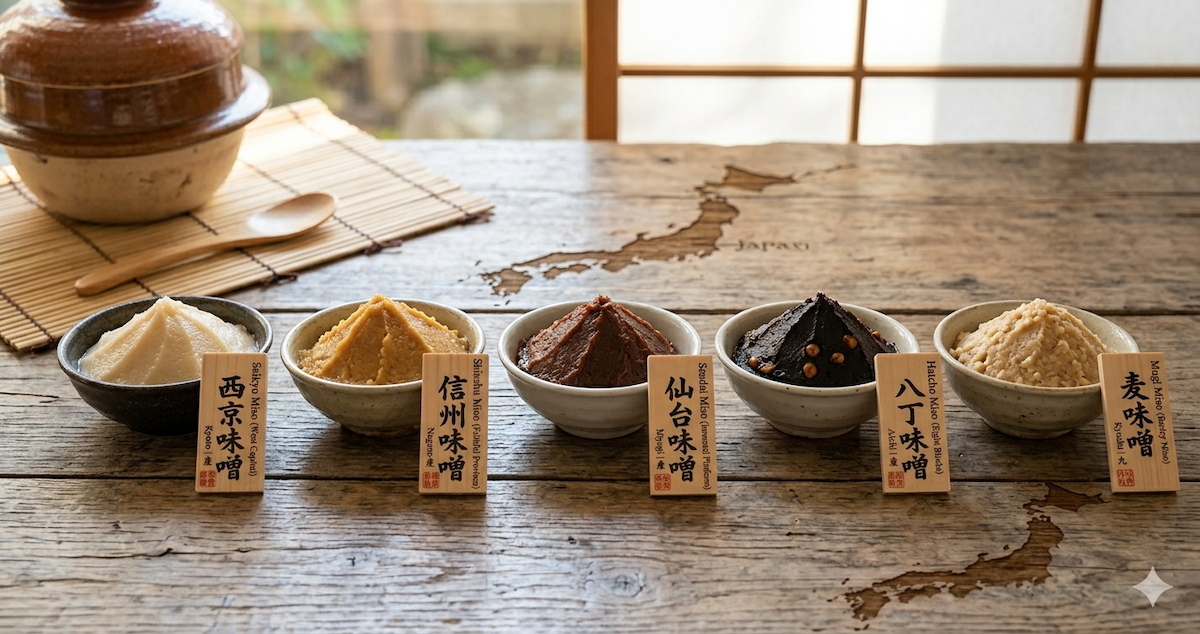
In broad terms, it is accurate enough to remember that white miso is sweet and red miso is salty — though the reality is considerably more nuanced than that binary suggests. The spectrum runs from Kyoto’s pale, butter-soft saikyo miso at one extreme to Aichi’s near-black, almost chocolaty hatcho miso at the other, with every shade of amber, ochre, and rust in between.
“White miso is sweet and red miso is salty — though the reality is considerably more nuanced than that binary suggests.”
Kyoto: The Sweetness of an Imperial Court
If there is one miso that carries the flavor of a specific cultural moment, it is saikyo miso (西京味噌) from Kyoto. Pale cream to pale yellow in color, extremely low in salt, and mildly, almost floral in sweetness, saikyo miso is an outlier among Japanese fermented pastes — a variety that seems to belong more to the world of pastry than to the world of preserved protein.
Its origins trace back approximately 200 years, to a master brewer named Tanbaya Mosuke who set up a shop near the Old Imperial Palace of Kyoto and received orders for miso to be used in dishes prepared for the Imperial Court. During the 1,000-year period when Kyoto was Japan’s capital, saikyo miso was a special ingredient in palace ceremonial feasts as well as Zen Buddhist vegetarian cuisine, both of which demanded refinement over intensity. For that reason, the miso was developed for its luxurious sweetness and beautiful appearance rather than for shelf life. When the capital moved from Kyoto to Tokyo following the Meiji Restoration, Kyoto came to be called Saikyo — literally “Western Capital” (西京) — and the name transferred to its most distinctive miso.
Saikyo miso is made with roughly twice as much rice koji as soybeans, and its salt content is around 5% — approximately half that of typical Japanese miso. Fermentation lasts only one to two weeks, which is why the paste retains such prominent sweetness and such a delicate, buttery aroma. Chefs use it primarily as a marinade, particularly for fatty fish such as black cod or Spanish mackerel in the preparation known as saikyo-yaki (西京焼き), where the miso’s sugars caramelize during grilling into a lacquered, amber glaze. It also appears in refined miso soups, as a dip for vegetable crudités, and in the sweet ozoni miso soup traditionally served in Kyoto on New Year’s Day.
Nagano: The Miso That Feeds the Nation
If saikyo miso represents the aristocratic extreme, then shinshu miso (信州味噌) from Nagano Prefecture represents the democratic center. Yellowish-brown in color, balanced between sweetness and saltiness, and packing substantial umami, shinshu miso accounts for roughly half of all miso produced in Japan. It is the variety most likely to be found in Japanese grocery stores outside Japan, and the one that forms most people’s first impression of what miso tastes like.
Shinshu is the old name for Nagano Prefecture, which lies in the mountainous interior of Honshu. The region has been making miso since the Kamakura period (1185–1333). Its clean mountain water, cool temperatures, and abundant rice supply created ideal conditions for miso production, and the region’s output expanded dramatically after the Great Kanto Earthquake of 1923, when shinshu miso was distributed as part of relief packages and became familiar to populations across Japan that had never encountered it before.
Shinshu miso is made from soybeans and rice koji, fermented for a medium period of roughly six months to a year, and contains enough salt to produce a balanced, savory flavor without excessive sharpness. Its versatility is its defining quality. It performs well in miso soup, in marinades, in sauces, and in hotpots. For a cook newly exploring Japanese flavors, shinshu miso is the most forgiving entry point — complex enough to be interesting, mild enough not to overwhelm.
Aichi: The Miso That Took Two Years to Make
In the Tokai region surrounding Nagoya, the dominant miso is something altogether different. Hatcho miso (八丁味噌) is made from soybeans and salt alone — no added grain, no rice koji, no barley. The result is a paste of extreme concentration: near-black in color, deeply bitter and umami-forward, with what many tasters describe as a faintly chocolaty, almost coffee-like depth. Its salt content and its absence of residual grain sugars give it an austere, almost monolithic quality that is unlike any other fermented food in Japan.
Hatcho miso takes its name from Hatcho Town in Okazaki City, Aichi Prefecture, where it has been produced since the Sengoku period (16th century). The production method has remained largely unchanged for centuries: soybeans are combined with salt and pressed into enormous cedar barrels, then covered with a pyramid of river stones that can weigh several tons. The weight presses moisture from the paste and prevents air pockets from forming over a fermentation period that typically runs from 16 to 24 months. Because it has a very low water content, hatcho miso is extremely thick, almost solid. Its flavors were so valued historically that the imperial family made hatcho their miso of choice from 1892 to 1954.
In the kitchen, hatcho miso rewards restraint. A small quantity stirred into a broth or sauce delivers a depth of umami that lighter varieties cannot approach. It is the standard base for miso nikomi udon (味噌煮込みうどん), the region’s famous noodle dish in which thick udon noodles are simmered directly in a hatcho miso broth — a dish that could only have originated in a place where this particular paste was the default.
“A pyramid of river stones weighing several tons. A fermentation of 16 to 24 months. This is how hatcho miso has been made since the 16th century.”
Sendai: The Samurai’s Miso
Sendai miso (仙台味噌) is a red rice miso from Miyagi Prefecture in the Tohoku region, and its origins are unusually well-documented. The miso has been produced since the early 17th century, when the famed samurai general Date Masamune established a miso factory near Sendai Castle. The story holds that the miso was so well regarded that soldiers in Date’s army carried it on campaign — and when they encountered rivals whose supplies had spoiled, sendai miso remained intact. Its reputation spread from there.
Made from soybeans, salt, and rice koji and fermented for anywhere from four months to a year, sendai miso is red in color, slightly salty, and balances bitterness and sweetness in a way that reads as distinctly northern — more assertive than shinshu, more textured and rougher than the polished pastes of Kyoto. The soybeans used in sendai miso are more coarsely mashed than in many other varieties, giving the finished paste a rougher, more rustic texture that reflects the region’s less courtly sensibility. It is excellent in miso soup, particularly in the hearty, ingredient-heavy preparations typical of Tohoku winters.
Kyushu: When Barley Replaced Rice
In the southern island of Kyushu, a different agricultural history produced a different miso entirely. Rice cultivation first arrived in Japan through northern Kyushu roughly 3,000 years ago, then spread north and east into more central areas of the country rather than further south into Kyushu itself. As a result, many communities in southwestern Japan depended on barley rather than rice as their primary grain — and barley became the koji grain of choice. The result is mugi miso (麦味噌), or barley miso.
Kyushu mugi miso is pale in color and sweeter and less salty than the rice-based misos of central and eastern Japan. It has a distinctive malty, slightly earthy character that sets it apart from all other varieties — recognizable immediately to anyone raised in the region, and sometimes polarizing to those who encounter it for the first time. The fermentation period can range from a few months to several years depending on the producer; shorter fermentation produces a milder, more approachable result, while longer-aged mugi miso develops considerably more complexity. Mugi miso accounts for less than three percent of Japan’s total miso production, making it genuinely rare outside its home region. It performs particularly well in soups with root vegetables, in glazes for roasted produce, and as a cooking miso for hearty winter stews.
What This Map Tells Us
Laid out side by side, Japan’s regional misos reveal a logic that goes deeper than local preference. Climate, grain availability, political history, and culinary tradition each left a mark. Kyoto’s sweet saikyo miso was shaped by imperial court culture and the aesthetic demands of kaiseki cuisine. Aichi’s austere hatcho miso was shaped by geography — a landlocked region with limited access to rice, where soybeans alone were the available raw material, and where the region’s hot summers accelerated the fermentation that the stone-weighted barrels could sustain over years. Nagano’s shinshu miso was shaped by altitude and water, and Kyushu’s mugi miso by a grain history that diverged from the national mainstream millennia ago.
The eastern Kantō region that includes Tokyo historically favored the darker, saltier akamiso varieties, while the western Kansai region encompassing Osaka, Kyoto, and Kobe preferred lighter shiromiso. This east-west divide in miso preference mirrors a broader cultural divergence between Japan’s two great metropolitan centers — one rooted in samurai pragmatism, the other in imperial refinement — that runs through countless other aspects of Japanese food culture.
For a cook outside Japan, this regional diversity is an invitation. Most specialty Japanese grocers — and an increasing number of online suppliers — stock at least two or three distinct miso varieties. Starting with shinshu miso as a daily-use base, adding saikyo miso for marinades and delicate soups, and seeking out hatcho miso for dishes that demand depth and richness is a practical way to begin exploring this spectrum. Each variety will change how you cook with it, and each jar, in its small way, carries a specific place in Japan inside it.
Japan’s regions did not set out to make miso differently. They made miso with what they had, in the climate they lived in, according to the tastes they developed over centuries. What resulted is not a collection of variations on a single theme but a gallery of distinct fermented identities — each one rooted in a specific patch of land, and each one inseparable from the people who tended it.
Curious to taste the difference for yourself? UMAMIBAKO curates handpicked Japanese pantry staples — including carefully selected miso from different regions of Japan — delivered directly to your door. Each box is a way to explore the breadth of Japanese fermentation culture without leaving home.Explore the UMAMIBAKO BOX →
Comment