One Bite, One Truth: Why Sushi Was Never Meant to Be Divided
A piece of nigiri holds its shape for only a moment. Everything the chef has built — the temperature, the balance, the intention — exists inside that window.
The Moment Before the Bite
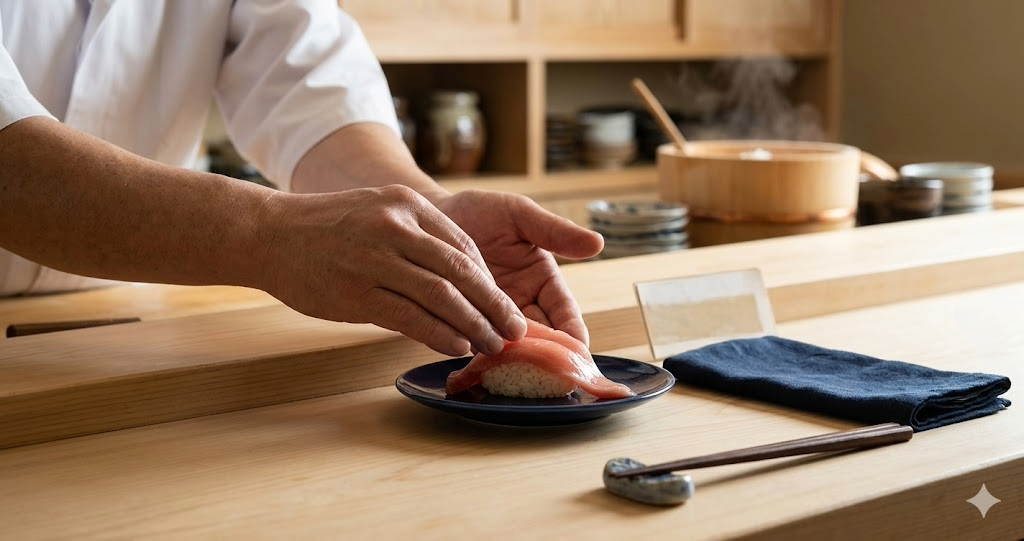
You are sitting at a hinoki wood counter, close enough to watch the chef’s hands. The restaurant is quiet — not hushed by formality, but by attention. The chef lifts a portion of vinegared rice, shapes it in a single continuous motion between palm and fingers, lays a translucent slice of fish across its surface, and sets the finished piece directly in front of you. There is no announcement. No instruction. Only the implicit understanding that this piece of sushi was made for right now, and that right now will not last long.
For a first-time visitor to a Japanese sushi counter, this moment can feel unexpectedly pressured. What is the correct thing to do? Should you pick it up with your fingers or with chopsticks? Should you dip it in soy sauce, and if so, which side? And beneath all of these questions sits a more fundamental one — one that most people outside Japan have never thought to ask: are you supposed to eat it in one bite?
The answer, in traditional Japanese sushi culture, is yes. But “yes” is not a rule invented by etiquette manuals or high-end restaurant protocols. It is the practical, inevitable conclusion of two centuries of craft — the point at which technique, temperature, proportion, and philosophy all converge in a single mouthful. Understanding why requires stepping back to where nigiri began: not at a lacquered counter, but at a street stall in Edo-period Tokyo.
Fast Food From the Streets of Edo
The sushi most people recognize today — a pressed mound of vinegared rice topped with a slice of raw fish, known as nigiri-zushi (握り寿司) — is a relatively modern invention. Its origins are traced to the early 19th century in Edo, the city we now call Tokyo. The modern form of sushi is believed to have been created by Hanaya Yohei, who invented nigiri-zushi around 1824 in the Edo period (1603–1867). The word nigiri itself comes from the Japanese verb nigiru — to grasp, to press.
Back then, sushi wasn’t the small, elegant bite we know today. Edo-period nigiri were two to three times larger — roughly the size of a child’s palm — meant to satisfy hungry laborers quickly. It was true fast food: eaten standing, sold at stalls, and wrapped in bamboo leaves to go. Hanaya Yohei’s innovation was not just culinary but logistical: instead of relying on lengthy fermentation, he introduced nigiri sushi which featured fresh fish placed atop seasoned sushi rice, emphasizing speed so customers could enjoy fresh sushi at outdoor food stalls.
What matters here is the logic embedded in the original form. Sushi was designed to be immediate. The fish, the rice, the seasoning — they were brought together at the moment of service and consumed without delay. There was no table, no porcelain plate, no intermediate step between the chef’s hands and the diner’s mouth. The one-bite custom did not arise from formality. It arose from the nature of the food itself: a perishable, precisely balanced combination that degrades the longer it waits.
The Architecture Inside a Single Piece
To understand why dividing a piece of sushi disrupts it, you first need to understand what a well-made piece of nigiri actually contains. It is not simply rice with fish on top. It is a structure — one in which every element has been calibrated to work together at the exact moment it is eaten.
Consider the shari (しゃり), the vinegared rice at the core of the piece. The ideal temperature for sushi rice is 35–40°C (95–104°F), approximately human body temperature. This warmth allows the vinegar seasoning to release its aroma, keeps grains soft and glossy, and melts the fat of fish toppings upon contact for optimal flavor release. A skilled chef does not simply cook rice and set it aside. They prepare it in small batches throughout a service, fan it to the correct temperature, and cover it with a damp cloth to preserve its moisture. The moment the shari cools below this range, the grains begin to firm and contract. The texture changes. The vinegar aroma fades. The rice no longer melts against the fish — it sits beside it.
Now consider the neta (ねた), the fish or seafood that rests on top. It is kept cold, usually just above refrigeration temperature, so that it remains firm and clean-tasting. The contrast between warm shari and cool neta is not accidental — it is the thermal architecture of the bite. As a sushi chef, it is important to focus on the temperature difference with the neta, enjoying the change in taste in your mouth. When both elements reach the same ambient temperature — as happens when sushi sits on a plate — this contrast collapses. The piece becomes flat, thermally and in flavor.
Master sushi chefs spend years learning to proportion each piece perfectly. The rice-to-fish ratio, the amount of wasabi, even the temperature contrast between cool fish and room-temperature rice — all are calculated for a single, complete flavor experience. Breaking that into multiple bites changes everything. The rice might crumble. The fish slides off. You taste components separately instead of as one harmonious whole.
“The contrast between warm shari and cool neta is not accidental — it is the thermal architecture of the bite.”
What the Chef’s Hands Actually Do
The physical act of forming nigiri — called nigiri-kata (握り方) — is itself the reason a single-bite structure holds together. When a skilled itamae (板前, sushi chef) presses rice into shape, the goal is not compactness. The pressure when forming the shari is important, and sushi chefs spend many years of training to master the perfect balance of not breaking the neta while making it crumble in your mouth when eaten. The finished piece should feel light, almost impossibly so — held together by just enough cohesion to survive the journey from plate to mouth, then yield completely when bitten.
This is a narrower structural tolerance than it might appear. A piece of nigiri pressed too firmly will feel dense and heavy in the mouth, releasing its flavors slowly rather than all at once. A piece pressed too loosely will fall apart when lifted. The chef is engineering a brief structural window — one that begins when the piece leaves their hands and ends shortly after it is consumed. Each piece is shaped small enough to enjoy the shari and topping together in one mouthful, ensuring they harmonize perfectly.
When a diner bites partway through a piece of nigiri and sets it down, several things happen simultaneously. The rice loses its internal cohesion at the cut point and begins to collapse. The fish shifts. The wasabi, placed between the shari and the neta to release gradually during the bite, may either fall away or hit the palate too directly. The piece that remains on the plate is no longer what the chef made — it is a damaged structure, and it will continue to degrade with each passing second.
Immediacy as Respect
In Japan, the expectation that sushi be eaten promptly upon being served is not a formality. It is a practical acknowledgment of what the chef has just done. When the itamae places sushi before you, consume it within 10–30 seconds. This timing ensures optimal neta temperature and shari texture. The numbers are specific because the degradation is real and measurable — shari at body temperature loses roughly a degree per minute once it leaves the rice cooler. Neta begins warming the moment it sits on the warm rice beneath it. The window in which the piece is at its intended temperature differential is short.
This is why, at serious sushi counters in Japan, pieces are often served one or two at a time rather than as a full platter. The chef is not being conservative with portions — they are synchronizing the delivery of the food with the diner’s pace of eating. Each piece arrives when the previous one has been consumed, which means each piece is eaten at its thermal peak. A platter of six pieces served simultaneously means that by the time you reach the last one, the first three are already compromised.
“The chef is not being conservative with portions — they are synchronizing the delivery of the food with the diner’s pace of eating.”
What Happens Inside the Mouth
Eating a piece of nigiri in one bite is not merely a matter of structure or temperature. It is also, fundamentally, a matter of taste. The flavor of a well-made piece of sushi is not located in any single ingredient. It is an event — something that occurs only when all elements are present simultaneously and in the correct proportion.
Consider the sequence: the initial cool fish, the yielding rice, the lingering wasabi heat — this complete sensory arc happens only when all elements combine simultaneously. The cool, clean protein of the fish arrives first. Then the mild acidity and sweetness of the vinegared rice. Then, delayed slightly, the nasal heat of wasabi. If the piece is eaten in two bites, the second bite contains a different ratio of these elements than the first. The fish may be mostly gone, leaving a mouthful of rice. The wasabi may have dissipated. The experience the chef designed does not occur.
As the celebrated Japanese chef Masaharu Morimoto has stated, eating nigiri in one bite is the only way to enjoy the perfect harmony of fish, rice, and wasabi. If you bite halfway, the balance will be lost. This is not a philosophical position. It is a description of physical chemistry: the flavor compounds in fish, rice vinegar, and wasabi interact differently depending on their ratio and temperature. The chef has calculated these interactions. The single bite is the delivery mechanism.
What This Looks Like in Practice
For a first-time visitor to a Japanese sushi counter, all of this can feel like a great deal of pressure. But the practical implications are simpler than they appear. Sushi is designed to be eaten in one bite. To fully enjoy its flavor, you should never cut sushi into smaller pieces. If the sushi feels too large, it’s better to ask the chef to make it smaller for you. This is not a sign of weakness or inexperience — requesting a smaller portion is, in fact, considered a mark of sophistication. It shows that you understand what you are about to eat and that you intend to eat it correctly.
The question of whether to use fingers or chopsticks is secondary, though not trivial. Unlike sashimi, which is almost always eaten with chopsticks, nigirizushi is traditionally eaten with the fingers, even in formal settings. The reason is structural: fingers cradle the sides of the piece and support it from below, distributing pressure evenly. Chopsticks create concentrated pressure points that can crack the lightly pressed rice. At a high-end omakase counter, eating nigiri by hand is not casual — it is the more technically correct choice.
When dipping in soy sauce, the same structural logic applies. If you dip the shari (vinegared rice) side into the soy sauce, not only will the shari absorb too much soy sauce, but the shari will also become easier to crumble. The correct approach is to tip the piece slightly and touch only the neta — the fish — to the sauce briefly. At many serious sushi restaurants, however, the chef will have already brushed a thin layer of seasoning directly onto the piece before serving. In these cases, no additional soy sauce is needed or expected.
There is a concept in Japanese aesthetics sometimes described as ma (間) — the meaningful interval, the space between. In sushi, the equivalent is the moment between the chef placing the piece and the diner consuming it: a brief, charged pause in which two hundred years of craft hang in temporary suspension. The one-bite rule is not an act of obedience to tradition. It is the recognition that certain things are made for a single, irreversible moment — and that honoring the work means meeting it inside that window, completely, without hesitation.
Comment