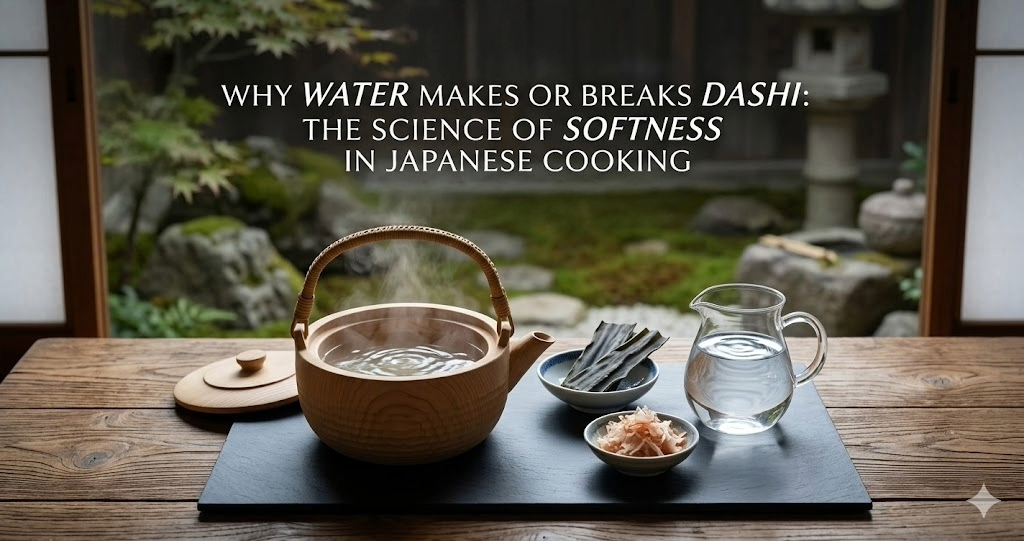
Why Water Makes or Breaks Dashi: The Science of Softness in Japanese Cooking
Japan’s most essential broth is only three ingredients: kombu, katsuobushi, and water. The first two are available anywhere in the world. The third is more complicated than it looks.
The Invisible Ingredient
There is a persistent frustration among people who cook Japanese food outside Japan. They follow the recipe precisely — sourcing good kombu, buying quality katsuobushi, measuring everything carefully — and the dashi they produce is fine. Adequate. Recognizably dashi. But it does not quite taste like what they remember from Japan, or what they tasted at a good Japanese restaurant. Something is subtly missing: a clarity, a softness, a quality of depth that seems to evade them even when they do everything else correctly.
The missing variable is almost always the water.
Water is the medium in which dashi happens — it makes up the vast majority of the finished broth — and its mineral content directly determines how well the umami compounds in kombu and katsuobushi dissolve, how clearly the flavor emerges, and whether the broth tastes clean and deep or slightly flat and faintly bitter. In Japan, the water used for cooking is overwhelmingly soft: low in dissolved minerals, particularly calcium and magnesium. This is not a coincidence. It is a consequence of Japan’s geology — and it may be the single most important environmental factor in explaining why Japanese cuisine developed the way it did.
Understanding why water hardness matters for dashi requires a brief excursion into chemistry. But the practical lesson is straightforward: if you are making dashi outside Japan, the water you use is probably working against you, and knowing why is the first step to fixing it.
What Water Hardness Actually Means
Water hardness is a measure of the concentration of dissolved minerals — primarily calcium and magnesium — present in a given sample. These minerals enter water as it travels through the ground: rainwater is naturally soft, but as it percolates through soil and rock, it picks up calcium and magnesium, particularly from limestone and chalk deposits. The longer the water’s contact with these minerals, and the more abundant those minerals are in the local geology, the harder the water becomes.
Hardness is typically measured in milligrams per liter (mg/L), sometimes expressed as parts per million (ppm). The World Health Organization classifies water below 60 mg/L as soft, between 60 and 120 mg/L as moderately hard, between 120 and 180 mg/L as hard, and above 180 mg/L as very hard. These are not precise categories — the boundaries are somewhat arbitrary — but they provide a useful framework for comparison.
By this scale, Japanese water is overwhelmingly soft. A peer-reviewed survey published in Scientific Reports collected tap water from 665 points throughout Japan and found a mean hardness of approximately 50 mg/L and a median of 46 mg/L — comfortably within the soft range compared with 27 other countries. Japan’s terrain is dominated by igneous rock and marine sediments, both low in minerals, which combined with steep mountains, short rivers, and fast-flowing streams means rainwater has very little time to absorb calcium or magnesium before reaching the sea. The result is water that is, by global standards, exceptionally mineral-light.
Contrast this with the tap water in much of Europe and North America. Tap water supplied from limestone geologies, as in much of Europe, exhibits high calcium content and becomes hard water. London’s water typically runs above 250 mg/L. Paris is around 200 mg/L. Many cities in the American Midwest and Southwest exceed 150 mg/L. A cook in Paris, London, or Phoenix making dashi from tap water is working with mineral concentrations three to five times higher than a cook in Kyoto or Hokkaido. That difference is not merely academic — it is chemically significant in ways that directly affect the flavor of the broth.
“Japan’s steep mountains and short rivers mean water reaches the sea before it can absorb minerals from the rock. The result is water that is, by global standards, exceptionally soft.”
What Happens Inside Dashi
To understand why water hardness matters for dashi specifically, it helps to understand what dashi actually is at a chemical level. Dashi is not a stock in the European sense — it does not involve long cooking, fat rendering, or the extraction of collagen from bones. It is a short, precise infusion, in which specific flavor compounds are drawn out of two dry ingredients — kombu kelp and katsuobushi dried bonito — and dissolved into water. The clarity and intensity of the finished broth depend entirely on how cleanly and completely those compounds dissolve.
Kombu is the source of glutamic acid, the amino acid that is the primary driver of umami in the seaweed. Its surface is coated in the compound as a white powder — that is the pale dust you see on a piece of dried kombu and should not wash off. When kombu is placed in water at the right temperature (around 60–65°C), these glutamates dissolve into the liquid, imparting the deep, savory, clean quality that is the flavor foundation of dashi. The process is exquisitely temperature-sensitive: too cold and the extraction is incomplete; too hot (above about 65°C) and the kombu begins releasing bitter, slimy polysaccharides that cloud the broth and introduce off-flavors.
Katsuobushi, the shaved dried bonito, contributes inosinic acid (IMP), a nucleotide that synergizes with glutamic acid to produce an umami effect far greater than either compound alone. The combination of glutamate and inosinate is biochemically remarkable: the two compounds interact with the same taste receptors in a way that multiplies perceived umami by a factor of seven to eight compared to either ingredient acting independently. This synergy is why traditional dashi uses both, and why the combination tastes so much more deeply savory than the sum of its parts.
Now, here is where water hardness intervenes. When hard water is used to make dashi, the calcium binds with the alginic acid in kombu, forming a film that blocks glutamic acid — the umami jackpot — from infusing the stock. The dissolved calcium ions in hard water react with the cell-wall compounds of the kombu before the glutamates can fully release into the water. Instead of dissolving freely, the umami compounds are partially locked inside a calcium-bound layer that the water cannot penetrate. The result is a cloudier, slightly mineral-tasting dashi that tastes noticeably flat next to the same recipe made with soft water.
Soft water has no such competing minerals. Its relative emptiness of calcium and magnesium means the glutamates face no obstruction — they dissolve freely, completely, and cleanly into the liquid. Soft water throws the doors wide open, drawing out the umami quality of kombu. The difference in a side-by-side comparison is not subtle. Dashi made with soft water is clearer in color, more delicate in aroma, and considerably deeper in umami character. Dashi made with hard tap water from most North American or European cities can taste dull, slightly mineral, occasionally bitter — not because anything went wrong with the technique, but because the water itself is interfering with the chemistry.
“Calcium in hard water binds with kombu’s cell-wall compounds before glutamates can dissolve. The umami is blocked before it reaches the broth.”
Even Within Japan: How Water Shaped Regional Cuisine
The effect of water hardness on dashi is not only relevant to cooks outside Japan. Even within Japan, regional differences in water softness have shaped the country’s two great culinary traditions in ways that food historians and chefs recognize explicitly.
The most significant divide is between the Kansai region (Kyoto, Osaka, and surrounding areas) and the Kanto region (Tokyo and the surrounding plain). Generally, Kanto’s water tends to be harder, containing relatively more minerals, while Kansai’s water is soft, with fewer minerals. Soft water is ideal for efficiently extracting glutamic acid — kombu’s umami component — without introducing off-flavors. Hard water, on the other hand, is less suited for kombu dashi.
Kyoto’s water is particularly celebrated. Kyoto is a valley surrounded by mountains and the water is well known for being clean and soft, with hardness of approximately 30 mg/L. This allows people to make delicate-flavored dashi. The cuisine of Kyoto — kyo-ryori, the refined cooking of the ancient imperial capital — is characterized by an extreme delicacy of flavor, in which the natural sweetness of ingredients is preserved and amplified rather than masked by salt or strong seasoning. This culinary philosophy is inseparable from the water: Kyoto’s exceptional softness allows glutamates to dissolve so cleanly that kombu dashi can stand nearly alone as a foundation, requiring very little supporting seasoning to feel complete.
The preferential supply of high-quality kombu to Kansai via the historical trading route called the Kitamaebune, combined with an environment blessed with soft water suitable for kombu dashi, allowed a kombu-centric dashi culture to take deep root in Kansai. In Kanto, where the water is harder — Tokyo averages around 65 mg/L, considerably above Kyoto’s 30 mg/L — the cuisine developed differently. The Edo period’s dashi tradition relied more heavily on katsuobushi and niboshi (dried sardines), whose inosinic acid is somewhat less affected by water hardness than kombu’s glutamates. The result was a richer, darker, more assertive broth culture — flavorful and satisfying, but with a different character from the clean, luminous quality that defines Kansai dashi at its best.
This is not a story of one tradition being better than the other. It is a story of how the physical environment directly shaped the food that grew within it. Kansai cooks reached for kombu because their water let it shine. Kanto cooks leaned toward katsuobushi and sardines because their slightly harder water responded to those ingredients differently. The cuisine emerged from the geology.
Temperature: The Other Variable That Works With Water
Water hardness does not operate in isolation. Temperature is the other critical variable in dashi extraction, and the two interact in ways that compound their individual effects.
Glutamate extraction from kombu begins in earnest around 60°C — below this temperature, the process is too slow to be practical. The optimal range is 60–65°C, held for around 30 minutes to an hour, during which the kombu releases its glutamates cleanly into the water. Above 65°C, the kombu also starts releasing slimy, bitter compounds. This narrow window — approximately 60 to 65°C, not a degree more — is why traditional dashi instruction specifies removing the kombu when the first small bubbles begin to rise from the bottom of the pot, before a full simmer develops. It is temperature control as flavor control: the entire character of the dashi depends on holding precisely within this range.
Inosinic acid from katsuobushi behaves differently: it requires higher heat to dissolve, but boiling makes the broth cloudy and destroys volatile aromatic compounds. The traditional practice of bringing the water (already infused with kombu) to near-boiling, removing it from the heat, and then adding the bonito flakes for a brief steep of 30 to 60 seconds before straining, is engineered to sit exactly between these two constraints: hot enough to extract the inosinate, cool enough not to boil off the aroma.
When hard water is used, temperature becomes even more critical. The calcium interference with glutamate extraction is worse at lower temperatures, where the binding reaction has more time to occur. Using very soft water gives you a wider margin — the glutamates dissolve more freely across the temperature range. Using hard water demands even more precision, and may still produce a broth that is somewhat compromised regardless of technique. The chemistry of the water sets the ceiling of what is achievable.
What This Means If You Cook Outside Japan
The practical implications of all of this are clear and actionable. If you are making dashi in a region where the tap water is moderately or heavily mineralized — which includes most of Europe, large portions of North America, and many other parts of the world — the single most effective improvement you can make to your dashi is to change the water.
The most reliable solution is to use commercially bottled soft water with a hardness below 60 mg/L, ideally below 30 mg/L for kombu-forward preparations. In Japan, the water hardness is typically printed on the label of bottled water — a practice that reflects how seriously Japanese consumers take this variable. Outside Japan, you can find the mineral content on most bottled water labels, expressed as mg/L of calcium and magnesium. Aim for brands with combined calcium and magnesium below 20–30 mg/L total. Many still mineral waters from volcanic regions or soft-rock geologies meet this threshold.
A standard activated carbon filter — the type used in pitcher filters — will remove chlorine and some organic compounds from tap water, improving aroma. It will not, however, significantly reduce mineral hardness. For meaningful hardness reduction, a reverse osmosis filter is the most effective home option, producing near-distilled water that can be used for dashi with excellent results. If neither option is practical for large-batch cooking, mixing filtered tap water with commercially bottled soft water to dilute the mineral concentration is a reasonable compromise.
The difference in the finished broth is not marginal. A kombu dashi made with properly soft water will be clearer, more fragrant, and noticeably deeper in umami than the same recipe made with hard tap water. If your dashi has ever tasted correct in technique but somehow flat or slightly off in flavor, this is almost certainly the explanation. The water is not a neutral carrier. It is an active participant in every step of the extraction — and in Japan, it has always been treated as such.
The Japanese culinary tradition did not consciously design itself around soft water. It grew within it — the way any food culture grows within the conditions of its landscape. The delicacy of Kyoto dashi, the clarity of a properly made suimono clear soup, the particular depth of miso soup in a Kansai kitchen — all of these are in part expressions of the water that flows through the mountains surrounding the city and into the pots of the people who live there. Understanding this is not a technical footnote. It is a reminder that the most fundamental ingredients in a cuisine are not always the ones that come from the market. Sometimes the most essential thing in the pot is something that falls from the sky.
Ready to experience the depth of properly made Japanese dashi at home? UMAMIBAKO delivers carefully selected Japanese pantry essentials — including premium kombu and katsuobushi — straight to your door, wherever you are. Pair them with soft water, and the rest is time and patience.Explore the UMAMIBAKO BOX →
Comment