How Tempura Became Japanese: A Five-Hundred-Year Story of Transformation
Tempura did not begin in Japan. What Japan did with it — over centuries, and with extraordinary deliberateness — is the story worth telling.
The Most Japanese of Dishes
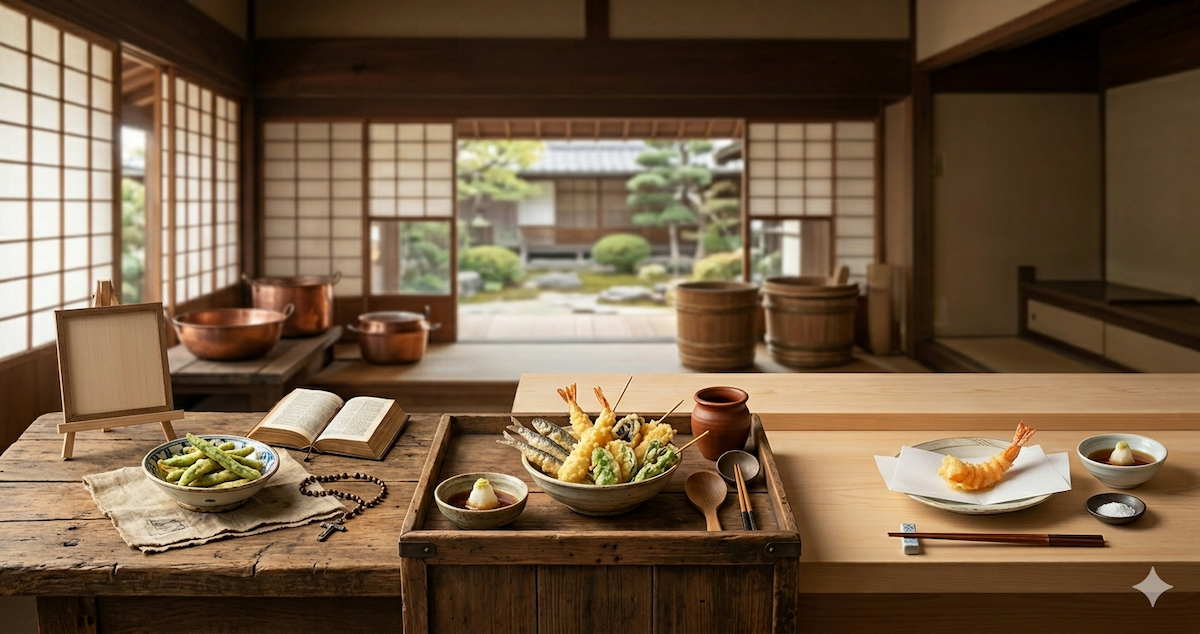
If you sit at a tempura counter in Tokyo — one of the intimate, hinoki-wood bars where a single chef presides over a copper pot of shimmering sesame oil — the experience feels unmistakably, irreducibly Japanese. The chef lifts a single prawn from a tray of ice. Dips it into batter so thin it is nearly transparent. Lowers it into oil at precisely the right temperature, angles it to prevent sticking, and places it on a folded sheet of paper in front of you thirty seconds later — golden, gossamer-light, exhaling a thread of fragrant steam. You eat it immediately, in one or two bites, perhaps with a dip into tentsuyu broth and a scrape of grated daikon. Then the next piece arrives.
This ritual, this particular combination of precision and simplicity and seasonality, is one of the clearest expressions of Japanese culinary philosophy that exists. And yet tempura did not originate in Japan. Its ancestor was a Catholic fasting dish carried across the ocean by Portuguese missionaries in the sixteenth century. The story of how a European fritter became one of Japan’s most refined culinary arts — passing through street stalls and samurai kitchens, through fire regulations and Buddhist vegetarianism, through the Meiji era’s ambitions and the Edo period’s street food culture — is one of the most instructive stories in the history of how food travels, transforms, and eventually belongs entirely to the people who claim it.
The Missionaries and Their Fasting Dish
In 1543, three Portuguese navigators became the first Europeans to reach Japan, making landfall on the island of Tanegashima, off the southern coast of Kyushu. Their arrival was accidental — they had been blown off course while bound for Macau — but the contact that followed was anything but incidental. Portugal was at the height of its age of discovery, and Japan quickly became one of the most significant destinations of what the Japanese called the Nanban trade: commerce with the “Southern Barbarians,” as Europeans were then collectively known. Along with firearms, tobacco, and Christian doctrine, the Portuguese brought food.
Among the culinary traditions they introduced was a dish called peixinhos da horta — literally “little garden fish,” a name given to green beans battered in a flour-and-egg mixture and deep-fried until golden. The name was partly whimsical (the battered beans supposedly resembled small fish) and partly explanatory: the dish was eaten during periods of Catholic fasting when meat was forbidden but vegetables and fish were permitted. These fasting periods were observed four times a year on days the Latin Church called quattuor tempora — “the four times,” or Ember Days, seasonal periods of prayer and abstinence marking the transitions between the liturgical seasons. On Ember Days, and during Lent, batter-frying vegetables was a practical way to make meatless food satisfying and filling.
The word tempura almost certainly derives from this Latin term tempora, meaning “times” or “seasons.” The same root gives us tempo, temporary, and contemporary in English — all words tied to the concept of time. Whether the Japanese adopted the word directly from the missionaries’ practice of eating fried food during the tempora, or from the Portuguese word tempero (seasoning) or the verb temperar (to season), is a matter of ongoing scholarly discussion. What is not disputed is the etymology’s European origin — a linguistic trace that remains embedded in the most Japanese of dishes.
In their earliest form in Japan, the fried preparations the Portuguese introduced were made with a thick batter of flour, eggs, water, and salt, deep-fried in lard, and eaten without dipping sauce. The batter was seasoned, and it was heavy — the opposite of what tempura would eventually become. The ingredients, too, were modest: primarily vegetables and fish, reflecting both the fasting restrictions and the practical limits of what was available along the Nagasaki coastline where the Portuguese were based. This was not yet a refined dish. It was survival food made palatable, carried across an ocean by people with no culinary ambitions beyond their own religious obligations.
“The word tempura comes from the Latin tempora — the fasting seasons of the Catholic calendar. A word about time, preserved in the name of Japan’s most iconic fried dish.”
What Japan Did With What It Received
Japan’s initial encounter with the Portuguese batter-frying technique coincided with the country’s exposure to deep-frying more broadly. Earlier Japanese cooking had involved frying — age-mono (揚げ物), or fried things, existed in Japanese cuisine before the Portuguese arrived — but the specific technique of coating food in a wheat-flour batter before frying was genuinely new. Japan, which did not have its own established tradition of batter-frying at the time, absorbed the method rapidly.
The absorption was not passive. As Japanese cooks began working with the technique, they started systematically altering it in ways that reflected entirely different culinary priorities. The thick, heavily seasoned Portuguese batter was too dense — it masked the flavors of the ingredients inside rather than amplifying them. Japanese cooking had always prioritized the natural character of an ingredient: its freshness, its seasonal quality, its intrinsic taste. A batter that dominated rather than deferred to the fish or vegetable it enclosed was, in Japanese culinary terms, a category error.
The solution that emerged over the following decades and century was one of extraordinary elegance. Japanese cooks replaced the dense, flavored batter with a mixture of wheat flour, egg, and cold water — barely stirred, to avoid developing gluten, which would make the coating tough and chewy. The cold water was the crucial innovation: by keeping the batter temperature low, cooks inhibited the formation of gluten networks, producing a coating that stayed light, loose, and airy. The characteristic lumpiness of tempura batter — which strikes first-time makers as a sign of carelessness — is in fact deliberate. The unmixed lumps fry quickly and unevenly, producing the lacey, irregular surface structure that gives tempura its distinctive shatter when bitten.
Lard was replaced with vegetable oil, then increasingly with sesame oil, which added fragrance without heaviness. The batter’s seasoning was stripped away entirely, leaving the coating flavorless so that the ingredient inside could be tasted on its own terms. The dipping sauce — tentsuyu, a blend of dashi, mirin, and soy sauce served with grated daikon — replaced the internal seasoning that the Portuguese batter had carried. This was not a modification of a foreign technique. It was a reinvention guided by a coherent, pre-existing philosophy about what food should taste like and how it should be presented.
Two Cities, Two Tempuras
As the technique spread from Nagasaki northward and eastward through Japan during the late sixteenth and early seventeenth centuries, it encountered two very different culinary cultures and was shaped differently by each.
In the Kyoto and Osaka region — the Kansai heartland of aristocratic and Buddhist culinary tradition — tempura was absorbed into the vegetarian discipline of shojin ryori (精進料理), Buddhist temple cuisine that forbade meat and emphasized the spiritual qualities of simple, seasonal plant ingredients. In a region where Buddhism’s prohibition of meat had already made vegetable cookery a serious art, batter-frying vegetables became known as shojin tempura. The Kansai version used no eggs in the batter, was fried slowly at lower temperatures in plain vegetable oil, and was often eaten with salt rather than dipping sauce — a practice that reflects both the region’s preference for subtlety and its proximity to the salt trade of the Seto Inland Sea. The result was a paler, softer preparation than what Edo would eventually develop, with an emphasis on the natural sweetness of the vegetables themselves.
In Edo — the rapidly growing city that would become modern Tokyo — tempura encountered a different world entirely. Edo in the seventeenth and eighteenth centuries was a city of merchants, craftsmen, and laborers, surrounded by the fresh seafood of Tokyo Bay. It was also a city with a fire problem: its densely packed wooden and paper buildings meant that cooking with large quantities of hot oil indoors was simply too dangerous. This practical constraint shaped tempura’s destiny in ways that could not have been predicted. Since deep-frying could not safely happen inside, it happened outside — at the yatai, the food carts and stalls that lined the riverbanks and market streets of Edo, where tempura was cooked in the open air and sold immediately.
This street food context transformed the dish in specific ways. Sesame oil was used because it reduced the fishy smell of the fresh seafood that was Edo’s primary ingredient — shrimp, smelt, conger eel, and whatever the bay had produced that morning. Skewers were used so customers could eat without getting their hands greasy. And the batter — mixed minimally with cold water, fried quickly at high temperature — was developed into the crisp, immediate, non-greasy form that defines tempura today. Tempura joined soba and sushi as one of what later food historians would call the Edo no sanmi — the three great delicacies of Edo street food. The modern tempura recipe was first published in a cookbook in 1671, capturing the Edo-style preparation that had emerged from this street food culture.
“Because hot oil indoors was a fire hazard in Edo’s paper-and-wood city, tempura was cooked outside. A practical constraint became the condition for a culinary art.”
From the Street to the Counter
The transformation of tempura from fast food to fine dining happened gradually across the Meiji era (1868–1912) and the decades that followed. As Japan opened to the world following the end of its long period of isolation, the country’s culinary culture underwent a rapid reclassification. Foods that had been democratically available at street stalls began to acquire reputations as art forms, their preparation studied and systematized and elevated into disciplines requiring years of training. Tempura was among the most significant beneficiaries of this shift.
Dedicated tenpura-ya — tempura restaurants — emerged in Tokyo, where specialist chefs developed approaches to oil temperature management, ingredient selection, and batter calibration that turned the dish into a study in controlled precision. The oil must be maintained at specific temperatures — typically between 160°C and 180°C — that vary depending on the ingredient being fried: delicate shrimp and white fish require different heat from dense sweet potato or thick-cut lotus root. The batter must be mixed fresh and kept cold throughout service. Each piece must be evaluated individually: its moisture content, its size, its fat content, all influence how it will behave in the oil and how long it must stay.
The counter format — diners seated in front of the chef, each piece of tempura served individually from the oil to the plate with no delay — became the template for serious tempura dining. It encodes a principle that is central to Japanese food culture: the understanding that tempura, like sushi, like ramen, must be eaten at the exact moment it reaches its peak. The coating’s crispness lasts only minutes. The moisture differential between the shatteringly crisp exterior and the tender, steaming interior — the contrast that defines the best tempura — collapses quickly as the coating absorbs moisture from the ingredient within. To eat tempura correctly is to eat it immediately, in the narrow window between the oil and oxidation.
Seasonality and the Ingredients That Define It
One of the most important ways that tempura became fully Japanese — distinct from the European frying tradition it descended from — is through its relationship to seasonality. Japanese cuisine has always organized itself around shun (旬), the peak moment of an ingredient’s season, and tempura absorbed this principle completely. The best tempura menus change with the seasons: in spring, young shoots of taranome (Japanese angelica tree buds) and fresh bamboo; in summer, shiso leaves and sweet corn; in autumn, matsutake mushroom, chestnut, and the first winter squash; in winter, burdock root, carrot, and the fatty white-flesh fish of cold northern waters.
Shrimp — specifically kuruma-ebi, the Japanese tiger prawn — remains the most iconic tempura ingredient, its body curved into a tight arc by the frying process to fit elegantly on a serving plate. But the full range of tempura ingredients across Japan is considerably wider than the prawn-and-vegetable assortment that most non-Japanese diners encounter: small smelts fried whole, kakiage (a loose fritter of mixed tiny shrimp and vegetables bound by batter rather than individually coated), the green shiso leaf whose chlorophyll darkens and intensifies under heat, cherry blossoms in spring, and ice fish so small they are battered in clusters.
The regional diversity that emerged over centuries adds another layer of complexity. In the Kanto region (Tokyo and surroundings), tempura is fried quickly in hot sesame-forward oil and served with tentsuyu and daikon. In the Kansai region (Kyoto, Osaka, Nara), the preference is for lighter oil, lower temperature, no egg in the batter, and salt rather than sauce. In Nagasaki, where the Portuguese influence was most direct and most persistent, a style called deage retains characteristics closer to the original fritter tradition: thicker batter, more robust flavors, reflecting the city’s unique position as Japan’s historical gateway to the outside world.
What Passes Through Time
The Portuguese were expelled from Japan in 1639, banned along with other European traders as the Tokugawa shogunate tightened its policy of national isolation. Their missionaries were executed. Their trade posts were closed. Their religion was suppressed. But their fasting dish remained — so thoroughly absorbed into Japanese cooking by that point that its foreign origin was functionally invisible. The technique had been transformed beyond recognition, the word had been remade in Japanese phonology, and the dish had acquired an entirely new identity rooted in seasonal ingredients, Buddhist restraint, and Edo street culture. What was originally Portuguese was now, in every meaningful sense, Japanese.
This is, in many ways, the complete story of how culinary transmission works across cultures. A technique is introduced, taken up, stripped of its original context, and rebuilt according to the receiving culture’s own priorities and philosophy. The Portuguese batter-frying method was a tool — effective at making food satisfying during fasting. Japan had no interest in fasting. What it had was a philosophy of seasonal ingredients, a reverence for natural flavors, a preference for restraint over abundance, and a street food culture that rewarded speed and precision. Into these conditions, the Portuguese technique was dropped. What grew from it was something the missionaries would not have recognized, but something that has become one of the most studied, most emulated, and most enduring preparations in world cuisine.
Today, tempura appears across the full range of Japanese cooking — on the menus of three-Michelin-starred counter restaurants in Ginza, in the bento boxes of convenience stores, in bowls of tempura udon and tendon rice bowls, as a topping for cold soba, as a street food during summer festivals. Each of these expressions traces back through the same lineage: the Edo yatai, the Kyoto Buddhist kitchen, the Nagasaki trading post, the Jesuit mission, the Catholic Ember Days, the Latin word for time. Five hundred years of transformation, one bite of shatteringly crisp batter, and something that is irreversibly itself.
Tempura is sometimes described as a foreign dish that Japan made its own. But this undersells the nature of what happened. Japan did not simply adopt tempura — it dismantled it and rebuilt it according to its own culinary logic, keeping only the underlying gesture of batter and oil while replacing everything else: the weight of the coating, the character of the fat, the philosophy of seasoning, the relationship between food and time. What resulted is not a Japanese version of a Portuguese dish. It is a Japanese dish that carries, somewhere in its etymology, the memory of a foreign encounter — a trace of Latin in the word, and nothing else that was not already Japanese.
Comment