Types of Miso: White, Red & Awase Explained
Everyone learns the shorthand: white miso is sweet, red miso is salty. It’s true enough to be useful — and it explains nothing. The interesting question is why the same three ingredients divide into pale and dark, mild and deep, in the first place.
Stand in front of the miso section of a Japanese grocery and the first thing you notice is color. Some tubs hold a paste so pale it is nearly ivory; others hold something the deep red-brown of old wood, or darker still, approaching black. The pale ones are labeled white, the dark ones red, and a third kind — a blend — sits somewhere in between. The rule everyone repeats is that white is sweet and red is salty, and as a rough guide it works.
But it’s worth pausing on how strange that rule actually is. All miso is made from the same three things — soybeans, salt, and koji — so where does the difference come from? Why should one paste turn out pale and sweet while another, from the same raw materials, turns dark and savory? The color and the flavor are not chosen the way you’d choose a paint. They are the visible result of a set of decisions made before fermentation even begins, and of the slow chemistry that unfolds afterward. Understanding those decisions is what turns “white is sweet, red is salty” from a memorized fact into something you actually understand.
If you’re new to miso itself — what it is, how it’s made, why it tastes the way it does — it’s worth starting with our foundational piece, The Living Art of Miso: How Time Becomes Flavor. This article picks up one specific thread from that story: not what miso is, but why it comes in white, red, and everything between.
The Lever That Decides Everything: Koji and Salt
The single most important variable in how a miso turns out is the ratio of koji to soybeans — and, closely tied to it, the amount of salt. Nearly everything else, including color and sweetness, follows from these two choices.
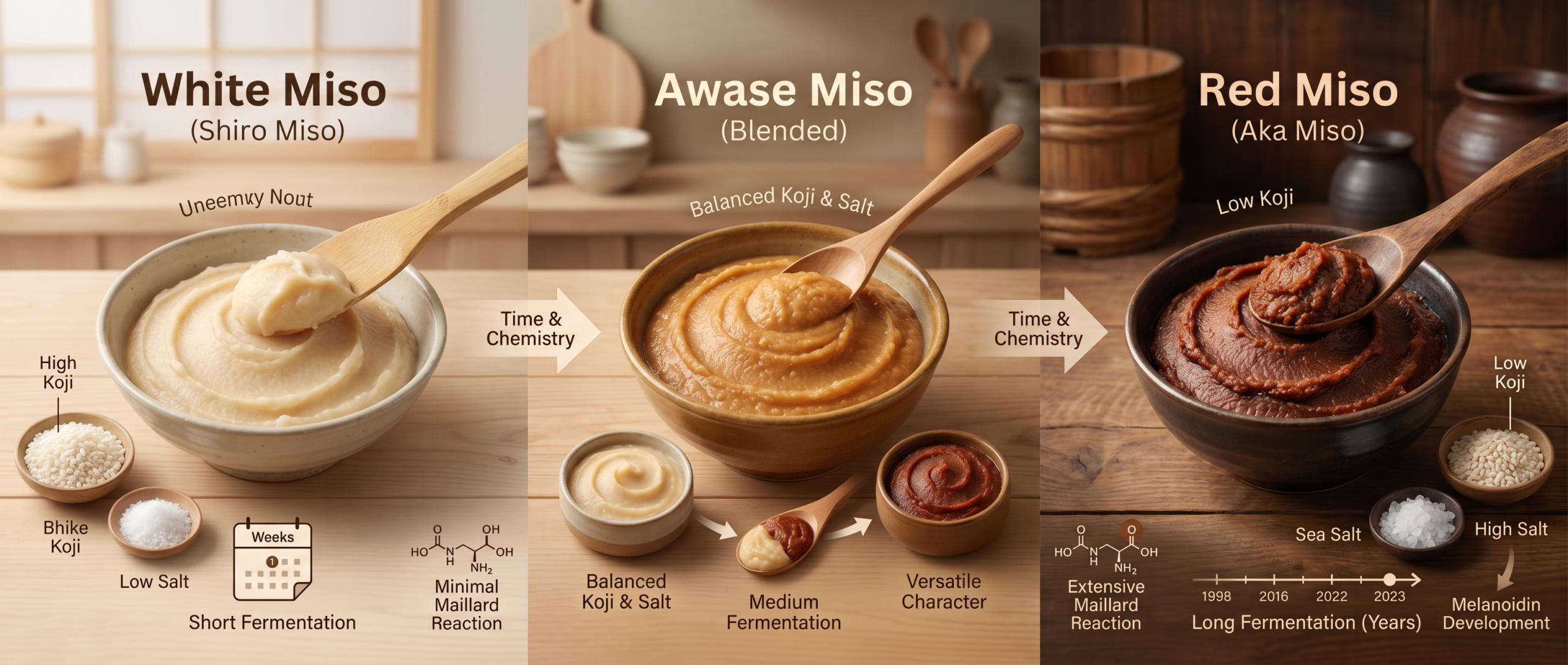
Recall that koji is grain — most often rice — cultivated with a mold that produces powerful enzymes. When there is a high proportion of koji relative to soybeans, those enzymes have a great deal of grain starch to work on, and they convert that starch into sugars. If the miso is not fermented for long, much of that sugar remains in the finished paste, unconsumed — and the result tastes sweet. A high-koji miso is, in effect, a paste with a lot of leftover sweetness built into it from the start.
Salt is the counterweight. Salt slows fermentation, because it restrains the microorganisms doing the work. A miso made with less salt ferments faster and can be finished quickly; a miso made with more salt ferments slowly and must be aged for a long time to develop. And crucially, these choices tend to travel together in two coherent packages. High koji plus low salt gives you a paste that ferments fast, finishes sweet, and stays pale. Low koji plus high salt gives you a paste that ferments slowly over months or years, turns deeply savory, and darkens. Those two packages are, essentially, white miso and red miso.
White and red miso are not two recipes so much as two coherent packages of the same choices: high koji and low salt on one side, low koji and high salt on the other. Everything else follows.
Why Red Miso Is Red: The Slow Maillard Reaction
The color is the part people most often take for granted, and it is the most revealing. The darkening of miso is not added and not incidental — it is the visible signature of time.
As miso ages, the koji enzymes break the soybean proteins down into amino acids, and the grain starches into sugars. Amino acids and sugars in the same warm environment, given long enough, react with one another through a process called the Maillard reaction — the same family of reactions responsible for the brown crust of bread or a seared steak. That reaction produces brown pigments called melanoidins, and it is these that steadily deepen the color of the paste from cream to amber to brown to near-black.
There is an important nuance here. The Maillard reaction is most familiar as something that happens fast, under high heat — the browning of a roast. In miso, the same reaction occurs, but slowly, at ordinary temperatures, over the months and years of aging. It is the Maillard reaction stretched out in time rather than driven by heat. This is why the length of fermentation and the color of a miso track each other so closely: a miso aged for weeks has barely browned and stays pale, while a miso aged for two or three years has undergone far more of this slow reaction and comes out dark. The color of a miso is, quite literally, a reading of how long it has been aging. Red miso is red because it is old.
And because that same long aging is what develops depth of flavor, color and taste move together. The extended fermentation that darkens a red miso also breaks down more protein into savory amino acids and builds the hundreds of aromatic compounds that give it its deep, complex, robust character. The color you see and the savoriness you taste are two expressions of the same thing: time.
White Miso: The Taste of Soybeans, Barely Changed
With that mechanism in mind, white miso — shiro miso — makes complete sense. It is made with a high proportion of rice koji and a low salt content, often in the range of five to seven percent, and it is fermented only briefly, sometimes just days to a few weeks.
Every one of those choices points in the same direction. The high koji ratio floods the paste with sugar; the short fermentation means little of that sugar is consumed and little of the slow Maillard browning occurs, so the paste stays pale and sweet. And because it spends so little time fermenting, white miso retains much of the original character of the soybeans themselves, only gently transformed — mild, soft, and delicately sweet rather than deeply fermented. It is mild enough, in fact, to be eaten more or less as is.
This is the miso most associated with Kyoto, where its pale sweetness suited the refined, understated cooking of the imperial court and the tea ceremony. It dissolves readily into a light, delicate broth, and it is the natural choice wherever subtlety is the goal — in gentle miso soups, in dressings, in the sweet marinades used for fish. It tastes, more than any other miso, like restraint.
White miso barely ferments at all. That is its secret: it stays close to the soybean itself, pale and sweet, the taste of an ingredient only gently transformed rather than deeply changed by time.
Red Miso: The Taste of Time
Red miso — aka miso — is white miso’s opposite in every variable. It is made with a lower proportion of koji and a higher salt content, and that higher salt allows — and requires — a long fermentation, often a year or more, sometimes several years.
Over that long aging, the slow Maillard reaction darkens the paste steadily, and the extended breakdown of protein builds a deep reservoir of savory amino acids. The result is assertive where white miso is gentle: saltier, richer, more complex, with a robust, sometimes almost bitter depth and a pronounced umami that intensifies further when the miso is cooked. Where white miso whispers, red miso speaks plainly.
This makes red miso the natural choice for hearty, strongly flavored dishes — robust miso soups, long-simmered braises, rich stews, glazes for grilled meats and vegetables. It has the depth to stand up to strong company rather than being lost beside it. It rewards a heavier hand and a longer cooking than the delicate white varieties could survive.
The two are best understood not as separate products but as the two ends of a single continuum, with the same three ingredients pushed in opposite directions — toward youth, sweetness, and pallor at one end, and toward age, savoriness, and darkness at the other. Between those poles lies every shade of amber and rust, and it is across that spectrum that Japan’s regions each staked out their own preferences, from the pale sweetness of Kyoto to the near-black intensity of Aichi. That regional map — the story of how geography and history shaped miso into a whole gallery of distinct identities — is the subject of A Country in a Jar.
Awase: The Miso That Is a Decision, Not a Type
Which brings us to the third label on the shelf, and the one most often misunderstood. Awase miso — “combined miso” — is not a distinct variety of miso in the way that white and red are. It is a blend of the two.
That might sound like a compromise, or a lesser thing, but it is neither. Blending white and red miso is a deliberate and practical act, one that Japanese home cooks and restaurants perform constantly, because the blend captures the strengths of both ends of the spectrum at once: the mellow sweetness and roundness of white, and the depth, salinity, and savory backbone of red. The result is balanced and highly versatile — miso that is neither too delicate for a hearty dish nor too assertive for a gentle one, and that consequently suits an enormous range of everyday cooking.
Awase can be bought pre-blended, sold as its own product, but it is just as much something you can make yourself: keep a white and a red miso in the refrigerator, and mix them in the bowl to taste, leaning sweeter or deeper as the dish demands. Understood this way, awase reveals something true about the whole subject. White and red are not really rival products to choose between; they are the two primary colors of a palette, and awase is the act of mixing them. Once you understand what each end of the spectrum is doing — and why — you are no longer just choosing a tub off a shelf. You are composing.
The shorthand was never wrong: white miso is sweeter, red miso is saltier. But behind that simple rule lies a quietly elegant piece of cause and effect — a high koji ratio and a little salt that keep a paste pale and sweet and close to the bean; a low koji ratio and more salt that send a paste on a years-long journey of slow browning into darkness and depth. The color in the tub is time made visible; the flavor is that same time made edible. To see white and red not as fixed categories but as two directions along a single continuum — and awase as the freedom to move between them — is to understand miso the way the people who cook with it every day already do.
Read, then Taste
This article is part of Waden’s Fermentation series — exploring Japan’s living culture of miso, soy sauce, sake, and beyond. Read more at waden.umamibako.com.
Comment