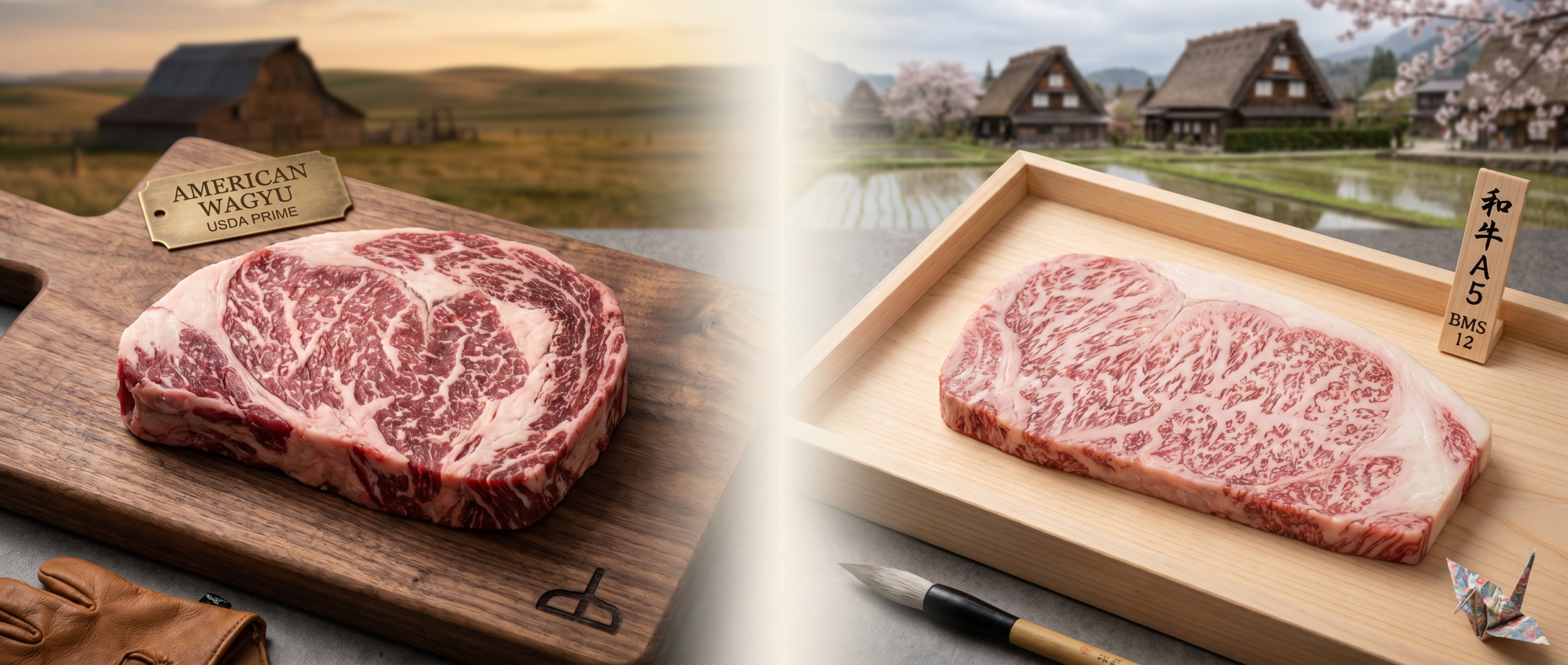
American Wagyu vs Japanese Wagyu: What’s the Difference?
They share a name, a genetic ancestry, and a reputation for extraordinary marbling. But one is a purebred animal raised within a closed national system, and the other is a hybrid born of an export that Japan eventually moved to stop. The difference begins with the cattle themselves.
On menus and in butcher cases across the world, two products now compete for the same word. One is labeled “Japanese Wagyu” — often with a grade like A5 attached, and a price to match. The other is labeled “American Wagyu,” typically less expensive, and frequently presented as a more approachable, everyday version of the same luxury. The names suggest they are two varieties of one thing. The reality is that they are two genuinely different products, separated by genetics, by law, by feeding, and by the eating experience itself.
Understanding the difference requires understanding what “wagyu” actually means, and what happened when a small number of Japanese cattle left Japan in the 1970s — before the door was closed behind them. To get the full picture of how Japanese wagyu came to be what it is — the breeds, the grading, the long history that shaped its qualities — it is worth reading our dedicated guide first: The Cattle That Changed Everything: A Guide to Japanese Wagyu. This article focuses on the specific question of how the American product diverged from its Japanese origin.
What “Wagyu” Means — and Why It Travels Differently
The word wagyu (和牛) means, literally, “Japanese cattle.” In Japan, the term is tightly defined: it refers to four specific native breeds — Japanese Black, Japanese Brown, Japanese Shorthorn, and Japanese Polled — with Japanese Black accounting for the overwhelming majority of production and nearly all of the intensely marbled beef the world associates with the name. Within Japan, an animal called wagyu is a purebred member of one of these breeds, raised under a comprehensive system that tracks each animal from birth.
Outside Japan, the word loosened. When wagyu genetics reached other countries, the term began to be applied not only to purebred Japanese cattle but to their crossbred descendants. This is the root of the entire distinction. “Japanese Wagyu” and “American Wagyu” are not regional styles of the same animal in the way that two wine regions might grow the same grape. They frequently refer to genetically different cattle — and that difference is not an accident of geography but a consequence of a specific history.
“Japanese Wagyu” and “American Wagyu” are not two regions growing the same grape. They are, in most cases, genetically different cattle — and the gap traces directly back to a handful of animals that left Japan before the export door closed.
The Export, and the Ban That Followed
The story of American wagyu begins with a narrow window. Beginning in 1976, a small number of Japanese wagyu cattle were exported to the United States, with further limited exports following over the next two decades. These animals — a few hundred in total across the entire history of exports — became the genetic foundation for every wagyu breeding program outside Japan.
Then the window closed. In 1997, the Japanese government designated wagyu a national treasure and banned the export of live cattle and genetic material — semen, embryos, and the animals themselves. From that point on, no new wagyu genetics could legally leave Japan. Every wagyu-related animal raised abroad today descends from that limited pool exported before the ban, while Japan’s own herds continued to develop within a closed, protected system.
This is the structural reason the two products diverged. Japan retained a large, purebred population and an unbroken breeding tradition. The rest of the world was left to build on a small founding population — and the most practical way to expand that population quickly, and to adapt it to local conditions and markets, was crossbreeding.
Purebred vs Crossbred: The Heart of the Difference
This is where “American Wagyu” becomes a genuinely different category — and where buyers most need to pay attention, because the label covers a wide range.
The most common form of American wagyu is a crossbreed, most often between wagyu and Angus, the dominant beef breed in the United States. A first-generation cross between a fullblood wagyu and an Angus is known as F1, and is genetically 50% wagyu and 50% Angus. In the United States, a product can be sold under the wagyu name with roughly half wagyu genetics — so a large share of beef marketed as “American Wagyu” is, by composition, half Angus. Successive generations of breeding wagyu back into the line can raise the wagyu percentage; the industry uses terms like purebred (animals with a very high proportion of wagyu genetics, often cited around 93% and above) and fullblood (animals with 100% verifiable Japanese wagyu ancestry and no crossbreeding at all). Fullblood American wagyu exists, and represents the closest the American product comes to the Japanese animal — but it is a small fraction of what is sold under the wagyu name.
Japanese wagyu, by contrast, is purebred by definition. There is no crossbred category sold domestically as wagyu in Japan. When you buy genuine Japanese wagyu — Kobe, Matsusaka, Miyazaki, and the rest — you are buying beef from a purebred animal of a Japanese breed, raised in Japan, with traceability back to its birth.
The crossbreeding of American wagyu is not a flaw — it is a deliberate strategy, and it produces a specific and intentional result. Crossing wagyu with Angus combines wagyu’s extraordinary marbling capacity with the larger frame, robustness, and pronounced beefy flavor of Angus. The goal is a beef that offers much of wagyu’s richness while remaining closer to the familiar character — and the price — of high-end American steak.
What This Means on the Plate
The genetic difference translates directly into a difference in eating experience, and the contrast is real and consistent.
Japanese wagyu, particularly the most intensely marbled Japanese Black at the highest grades, is defined by fat that is exceptionally high in monounsaturated fatty acids — especially oleic acid — woven through the muscle in fine, dense networks. This fat has a notably low melting point, beginning to liquefy near body temperature, which produces the signature sensation of Japanese wagyu: fat that seems to dissolve rather than chew, coating the mouth with richness. The flavor is intensely rich and the texture is soft to the point of being almost buttery. It is, for most people, a beef to be eaten in small quantities, because its richness is so concentrated.
American wagyu, with its Angus contribution, lands in a deliberate middle ground. It is far more marbled than ordinary beef, but generally less densely marbled than top-grade Japanese wagyu — and crucially, it retains more of the assertive, savory, “beefy” flavor that Angus brings and that the most intense Japanese wagyu can subdue. The fat is rich but firmer, the texture more substantial, and the result is a steak you can eat in a larger portion — closer to the experience of a premium American ribeye elevated by extra marbling, rather than the melt-away delicacy of A5. Neither is superior in any absolute sense; they are aiming at different experiences. Some diners find top-grade Japanese wagyu almost overwhelmingly rich and genuinely prefer the balance of a good crossbred American wagyu.
Japanese wagyu at its peak dissolves rather than chews. American wagyu, shaped by Angus, keeps more of the assertive beefy flavor — and gives you a steak you can eat by the steakhouse portion rather than the slice.
Two Grading Systems, Two Languages
The difference extends even to how the two beefs are measured, which is a frequent source of confusion for buyers.
Japanese wagyu is evaluated under Japan’s own system, administered by the Japan Meat Grading Association. It produces a two-part grade combining a yield letter (A, B, or C) and a quality number (1 to 5), with marbling assessed on the twelve-point Beef Marbling Standard (BMS). The familiar designation A5 means the highest yield grade and the highest quality grade — a system built specifically to measure the extreme marbling that Japanese wagyu is bred to produce. We explain this grading system in full in our guide to Japanese wagyu.
American wagyu is graded under the United States Department of Agriculture (USDA) system, whose top tier for ordinary beef is Prime. The problem is that the USDA scale was designed for conventional American cattle and effectively “tops out” below the marbling levels that wagyu can reach — the highest American wagyu is more marbled than the USDA Prime category was built to describe. As a result, the two systems are not directly comparable: a Japanese A5 and an American “Prime” wagyu are being measured by entirely different rulers, and “Prime” on an American wagyu label tells you it cleared the top of the conventional scale, not that it matches A5. Some American producers reference the Japanese BMS scale voluntarily to communicate marbling more precisely, but there is no single shared standard across the two countries.
How to Read a Label — and What to Expect
For a buyer, a few practical principles follow from all of this. If a product is labeled “Japanese Wagyu” or “Wagyu” with a specific Japanese regional brand (Kobe, Matsusaka, Miyazaki, Omi) and a JMGA grade like A5 or A4, you are looking at purebred Japanese beef, with the corresponding price and the melt-away character to match. Genuine Japanese wagyu also carries traceability documentation, and certified brands like Kobe have strict verification — worth checking, since the volume of “Kobe” sold worldwide has historically exceeded the certified supply.
If a product is labeled “American Wagyu,” the key question is the genetics behind it. Most is crossbred — often F1, roughly half Angus — which is a legitimate and intentional product, but a different one. The terms fullblood or purebred indicate a much higher proportion of wagyu genetics and a result closer to the Japanese animal, usually at a higher price than F1 crossbred wagyu. The label “Prime” indicates USDA grading, not equivalence to Japanese A5.
None of this makes one product authentic and the other fake. American wagyu is a real and deliberate response to a real constraint: a country that received a few hundred founding animals before 1997 and built a beef industry on them by crossing them with its own cattle. Japanese wagyu is the purebred original, developed within a closed system over a far longer history. They share an ancestor and a name. What separates them is everything that happened after a small number of cattle boarded ships out of Japan — and the door that closed behind them.
Read, then Taste
Comment