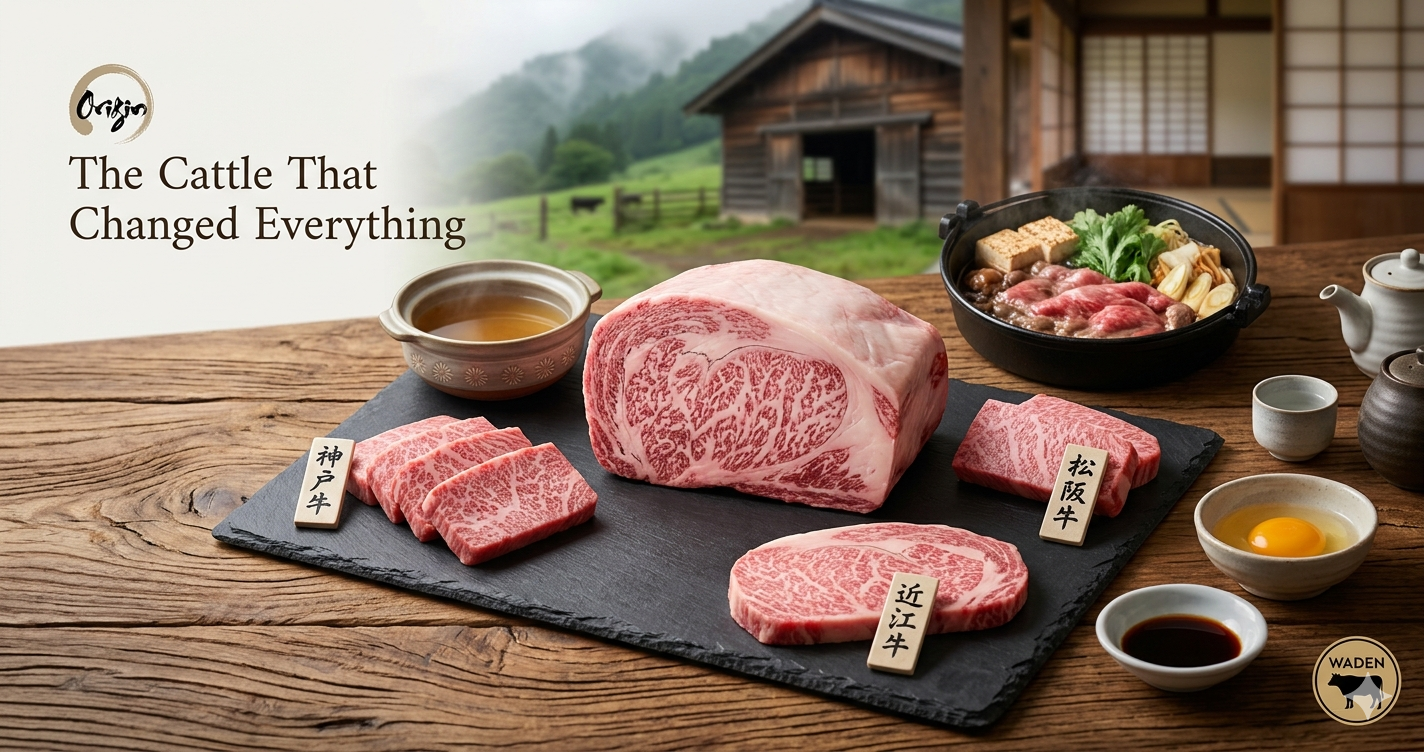
The Cattle That Changed Everything
A Guide to Japanese Wagyu
The word appears on menus around the world now, often attached to a price that makes diners pause. Wagyu. In many places it has come to mean simply “expensive beef with visible fat.” But wagyu is something more specific than that — a family of Japanese cattle breeds with an unusual genetic history, an unusual fat composition, and an unusual story of how they came to be considered among the finest beef in the world. Understanding what wagyu actually is makes eating it a different experience entirely.
What the Word Means
Wagyu (和牛) is a compound of two words: wa (和), meaning Japanese, and gyū (牛), meaning cattle. Literally: Japanese cattle. The term refers to four specific breeds native to Japan — Japanese Black (Kuroge Washu), Japanese Brown (Akage Washu), Japanese Shorthorn (Nihon Tankaku Washu), and Japanese Polled (Mukaku Washu). These are the only breeds that carry the official wagyu designation.
Of the four, Japanese Black accounts for approximately 97% of all wagyu cattle raised in Japan. It is the breed behind almost every piece of wagyu beef you have encountered — Kobe, Matsusaka, Omi, Miyazaki — and it is the only breed capable of consistently producing the extreme intramuscular marbling that defines the wagyu experience at its most intense. The other three breeds produce excellent beef with their own distinct characters, but they are rarely encountered outside Japan.
Outside Japan, the term is used more loosely — sometimes applied to crossbred cattle with only partial Japanese genetics, or to beef that resembles wagyu in appearance but was raised under different conditions. This matters when purchasing. True wagyu, from purebred Japanese cattle, is a specific thing. What is often sold as “wagyu” internationally may be something considerably different.
A History Shaped by Isolation
The extraordinary qualities of wagyu beef are not accidental. They are the product of a very specific and largely unintended history — one that begins with the arrival of cattle in Japan, continues through more than a thousand years of Buddhist prohibition against eating meat, and arrives at the modern world via a period of rapid transformation in the late 19th century.
Cattle were present in Japan by the Yayoi period, arriving from the Asian continent alongside rice cultivation. For most of the next two thousand years, they were used almost exclusively as draft animals — pulling carts, plowing rice fields, carrying loads through mountain terrain. Under the influence of Buddhism, the consumption of animal flesh was officially prohibited in Japan from the seventh century onward. Eating cattle, which were valued working animals and closely associated with agricultural life, was particularly restricted. For well over a millennium, Japanese cattle were bred not for the quality of their meat but for their capacity for sustained physical labor.
This has a paradoxical consequence that shapes everything that follows. Cattle bred for endurance and hard labor in mountainous terrain develop large stores of intramuscular fat — energy reserves built into the muscle itself rather than accumulated as external body fat. The same physical trait that made these draft animals capable of working long hours on difficult ground is precisely what we now recognize as shimofuri (霜降り) — the snowflake-like marbling of fat within the muscle. The marbling was not bred for. It was a byproduct of breeding for work.
The Meiji Restoration of 1868 changed the situation completely. The new government, intent on rapid Westernization, lifted the ban on eating meat, and began a crossbreeding program that introduced European breeds — Brown Swiss, Shorthorn, Devon, Simmental, Ayrshire, and others — into Japan’s native cattle population. This continued until around 1910, when the government closed Japan’s borders to further genetic importation and began to develop the resulting bloodlines in isolation, segregated by prefecture.
From 1910 onward, each prefecture developed its own lineage. The forced geographic segregation produced what we now know as regional wagyu — Tajima cattle in Hyogo, the genetic source of Kobe beef; Tottori and Shimane cattle in western Honshu; and dozens of other prefecture-specific strains. After World War II, the geographic barriers came down, and inter-prefectural breeding resumed — but by then, each region had developed a character distinct enough to survive as its own branded identity.
The final chapter in wagyu’s modern development came with the liberalization of beef imports to Japan in 1991. Suddenly, Japanese ranchers faced competition from cheaper foreign beef. Their response was to intensify the focus on shimofuri — the one quality that foreign beef could not replicate. The result was a dramatic narrowing of Japanese wagyu production toward the Japanese Black breed and its extraordinary marbling capacity, and the emergence of a grading system designed to measure and certify that quality with precision.
Why Wagyu Melts the Way It Does
The texture that defines high-grade wagyu — that sensation of fat dissolving almost at body temperature, coating the mouth with richness before the beef flavor follows — has a specific biochemical explanation.
Japanese Black cattle are genetically predisposed to produce fat that is unusually high in monounsaturated fatty acids, particularly oleic acid — the same fatty acid that gives olive oil its smooth, mild character. The melting point of ordinary beef fat is between 40 and 50 degrees Celsius. Wagyu fat, rich in oleic acid, has a melting point below that of butter — around 30 degrees Celsius. This means it begins to liquefy at temperatures close to the surface temperature of human skin, long before the heat of cooking has fully reached the meat itself. The result is the distinctive sensation of wagyu at its best: fat that does not require chewing, that seems to dissolve rather than break down, releasing its flavor gradually and completely.
This is what shimofuri actually is, at a molecular level. The white threads and networks visible in a cross-section of high-grade wagyu are not simply fat — they are fat of a particular composition, distributed through the muscle fibers in a way that produces a specific and unusual eating experience.
How Wagyu Is Graded
Japan operates one of the most rigorous beef grading systems in the world. Every beef carcass processed through Japan’s commercial distribution undergoes standardized evaluation by certified graders from the Japan Meat Grading Association (JMGA). The result is a two-part grade — a letter followed by a number — that communicates both the economic yield and the eating quality of the beef.
The letter (A, B, or C) is the yield grade — how much usable retail meat the carcass produces relative to its total weight. Grade A means the yield exceeds 72%, B falls between 69–72%, and C falls below 69%. For the consumer, this number has less direct relevance — it is primarily used by producers and distributors.
The number (1 through 5) is the quality grade — the measure that matters most to anyone eating the beef. It is assessed across four criteria, each scored on a scale of one to five: marbling, meat color, fat color, and firmness and texture. The final quality grade is determined by whichever of the four scores is lowest — a piece of beef must be excellent in all four categories to achieve a grade of 5.
Marbling is assessed using the Beef Marbling Standard (BMS), a 12-point scale that measures the amount and distribution of intramuscular fat. BMS 1 indicates essentially no marbling; BMS 12 is the theoretical maximum — an extraordinary density of fat woven through the muscle. A quality grade of 5 requires a BMS score of 8 or higher. The grade designation most familiar to diners globally — A5 — means the beef has achieved the highest yield grade and the highest quality grade, with marbling at BMS 8 or above.
Only around 3% of all Japanese wagyu achieves A5 designation. Each graded carcass receives a unique identification number that allows its origin — breed, farm, prefecture — to be traced through the supply chain. This traceability system, formalized after a BSE scare in Japan in the early 2000s, is now considered one of the most comprehensive beef tracking systems in the world.
A note for the careful reader: A5 is not an absolute guarantee of the optimal eating experience for every palate. Some Japanese connoisseurs prefer A4 wagyu — BMS 5 to 7 — which offers rich marbling alongside a more pronounced beef flavor that the most intensely marbled cuts can sometimes obscure. The grade is a precise measure of quality; preference is a different matter.
The Regional Brands
Japan has more than 200 named regional wagyu brands, each defined by the prefecture and specific conditions of their production. Three are considered, by most accounts, the pinnacle: Kobe, Matsusaka, and Omi — collectively called “Japan’s Big Three Wagyu.” All three come from the Kansai region of Japan, and all three share bloodlines tracing back to Tajima cattle, the strain of Japanese Black native to northern Hyogo Prefecture.
Kobe Beef (神戸牛) — Hyogo Prefecture
Kobe beef is the most internationally famous wagyu brand, and outside Japan the word “Kobe” is often used interchangeably with wagyu itself. It comes from Tajima-strain Japanese Black cattle born, raised, and slaughtered in Hyogo Prefecture, and must meet rigorous certification requirements before earning the Kobe label. The beef is characterized by its melt-in-your-mouth marbling and a clean, refined flavor. Kobe beef is best approached as steak, teppanyaki, or shabu-shabu, preparations that honor the quality of individual cuts. It is worth noting that the volume of “Kobe beef” sold internationally has historically far exceeded the actual certified supply — if purchasing outside Japan, provenance verification matters.
Matsusaka Beef (松阪牛) — Mie Prefecture
Matsusaka beef comes exclusively from virgin female Japanese Black cattle raised in the Matsusaka region of Mie Prefecture. The standards are arguably stricter than Kobe: each cow is tracked from birth to slaughter, and the cattle are raised longer than standard wagyu, deepening the quality of the fat. The result is beef with an exceptionally high fat-to-meat ratio and a velvety, rich texture that many Japanese connoisseurs consider superior to Kobe. Matsusaka is particularly celebrated for sukiyaki — the sweet, soy-based hot pot preparation whose richness complements and amplifies the fat’s natural sweetness. Within Japan, Matsusaka is often cited as the connoisseur’s choice; its lower international profile is largely a matter of supply.
Omi Beef (近江牛) — Shiga Prefecture
Omi beef holds a distinction that its fame does not fully reflect: it is the oldest wagyu brand in Japan, with a history of over 400 years. Before the widespread consumption of beef became culturally acceptable in the 19th century, miso-marinated Omi beef was presented to the ruling shogun as a medicinal preparation — one of the very few forms in which beef was considered acceptable under Buddhist dietary norms. Omi beef has a lighter, more elegant profile than either Kobe or Matsusaka — refined and subtly sweet rather than intensely rich — making it particularly suited to shabu-shabu, where its delicate texture and aroma are most clearly expressed.
Beyond the Big Three, other regional brands are worth knowing. Miyazaki beef from Kyushu has won Japan’s national wagyu competition — the “Wagyu Olympics” — four consecutive times. Hida beef from the mountain prefecture of Gifu is a local favorite, often encountered as “Hida beef sushi” in the historic city of Takayama. Yonezawa beef from Yamagata is deeply prized within Japan, rarely seen internationally, and considered by many specialists among the finest wagyu produced.
How Wagyu Is Eaten
The richness of wagyu calls for preparation methods that do not overpower it. Several traditional Japanese cooking styles are particularly well-suited to the fat content and texture of high-grade wagyu, and understanding them changes how the beef is experienced.
Sukiyaki (すき焼き) is one of Japan’s oldest beef preparations — thin slices of wagyu simmered in a cast iron pot with a sweet, soy-based sauce of sugar, sake, and mirin, alongside tofu, mushrooms, and vegetables. After cooking, the meat is dipped in raw beaten egg before eating. The sweetness of the sauce amplifies the natural sweetness of wagyu fat; the egg softens and enriches each bite. Sukiyaki is the traditional vehicle for Matsusaka beef in particular, and the combination has been considered canonical in Japanese beef culture for over a century.
Shabu-shabu (しゃぶしゃぶ) is a more restrained preparation: very thin slices of wagyu are briefly swished through a pot of simmering kombu broth — the name comes from the sound the meat makes in the water — then dipped in a sesame sauce or ponzu before eating. The brevity of cooking preserves the texture and aroma of the beef, making it the preferred method for more delicate wagyu like Omi. The word “shabu-shabu” refers to that specific swishing gesture; the cooking time is measured in seconds, not minutes.
Yakiniku (焼肉) — Japanese grilled meat — is the most casual and widely encountered format, with diners grilling their own cuts over charcoal or gas at the table. Wagyu at yakiniku is typically served in small portions that allow comparison across cuts and grades. For the most marbled cuts, the key is restraint: sear the surface briefly over high heat, allow the fat to begin melting, and eat immediately. Overcooking wagyu wastes what makes it exceptional.
Teppanyaki (鉄板焼き) — cooking on a large iron griddle, typically by a chef working in front of the diners — is the preparation most associated with wagyu internationally. A skilled teppanyaki chef handles wagyu with precision: working quickly, allowing the fat to baste the meat as it cooks, finishing with minimal seasoning.
One principle applies across all methods: portion size. High-grade wagyu, particularly A5, is extraordinarily rich. The traditional Japanese approach is to eat it in smaller quantities than one might eat ordinary beef — three to four thin slices of A5 sirloin in sukiyaki delivers more flavor and satisfaction than a full steak would. This is not scarcity as a luxury posture. It is genuinely the optimal way to experience what the beef is offering.
Quick Reference: Japan’s Big Three Wagyu
| Kobe (神戸牛) | Matsusaka (松阪牛) | Omi (近江牛) | |
|---|---|---|---|
| Prefecture | Hyogo | Mie | Shiga |
| Breed / Strain | Tajima-strain Japanese Black | Virgin female Japanese Black | Japanese Black |
| History | 19th century, Meiji era | 19th century, Meiji era | Over 400 years; oldest wagyu brand |
| Flavor profile | Clean, refined, melt-in-mouth marbling | Intensely rich, velvety, deeply sweet fat | Lighter, elegant, subtly sweet |
| Best preparation | Steak, teppanyaki | Sukiyaki | Shabu-shabu |
| International availability | Widest, but counterfeits exist | Limited; mostly within Japan | Rare outside Japan |
Wagyu arrived at its current form through a long accumulation of circumstance — draft animals bred for endurance, a Buddhist prohibition that lasted a millennium, a period of deliberate isolation, and a moment of competitive pressure that sharpened everything into focus. The result is beef that tastes the way it does not because of luxury breeding programs aimed at producing luxury food, but because of the particular path that Japanese cattle took through history. Knowing that path does not change the flavor. But it makes the experience of eating wagyu something more than expensive. It makes it specific.
Comment