How to Serve Sake: Temperature, Cups & Pairing
No other drink in the world is enjoyed across so wide a range of temperatures, in so many vessels, with so few fixed rules. To serve sake well is to make a series of small, deliberate choices — and each one changes what is in the glass.
Most drinks have a correct serving temperature. White wine is chilled, red is served near room temperature, whisky is poured neat or over ice — and to deviate is to make a mistake. Sake is different. The same bottle can be served anywhere from well below refrigerator temperature to hotter than a cup of coffee, and at each point along that range it becomes, in effect, a different drink: its aromas open or recede, its sweetness expands or tightens, its texture softens or sharpens. There is no single right temperature for sake. There is only the right temperature for this sake, with this food, at this moment.
This versatility is one of sake’s quiet glories, and it can also be intimidating. With so few fixed rules, how do you know what to do? The answer is that serving sake well is a craft built on a handful of understandable principles — about temperature, about the vessel, and about what the sake is being drunk alongside. This article lays out those principles.
It assumes you already know roughly what kind of sake you are holding. If the words junmai, ginjo, and daiginjo are unfamiliar, it is worth starting with our guide to the categories first: A First Map of Sake: How to Read the Glass in Front of You. And if you want to understand why sake carries the cultural weight it does — why it appears at weddings, shrines, and New Year — our piece The Drink That Belongs to the Gods tells that story.
Temperature: The Variable That Changes Everything
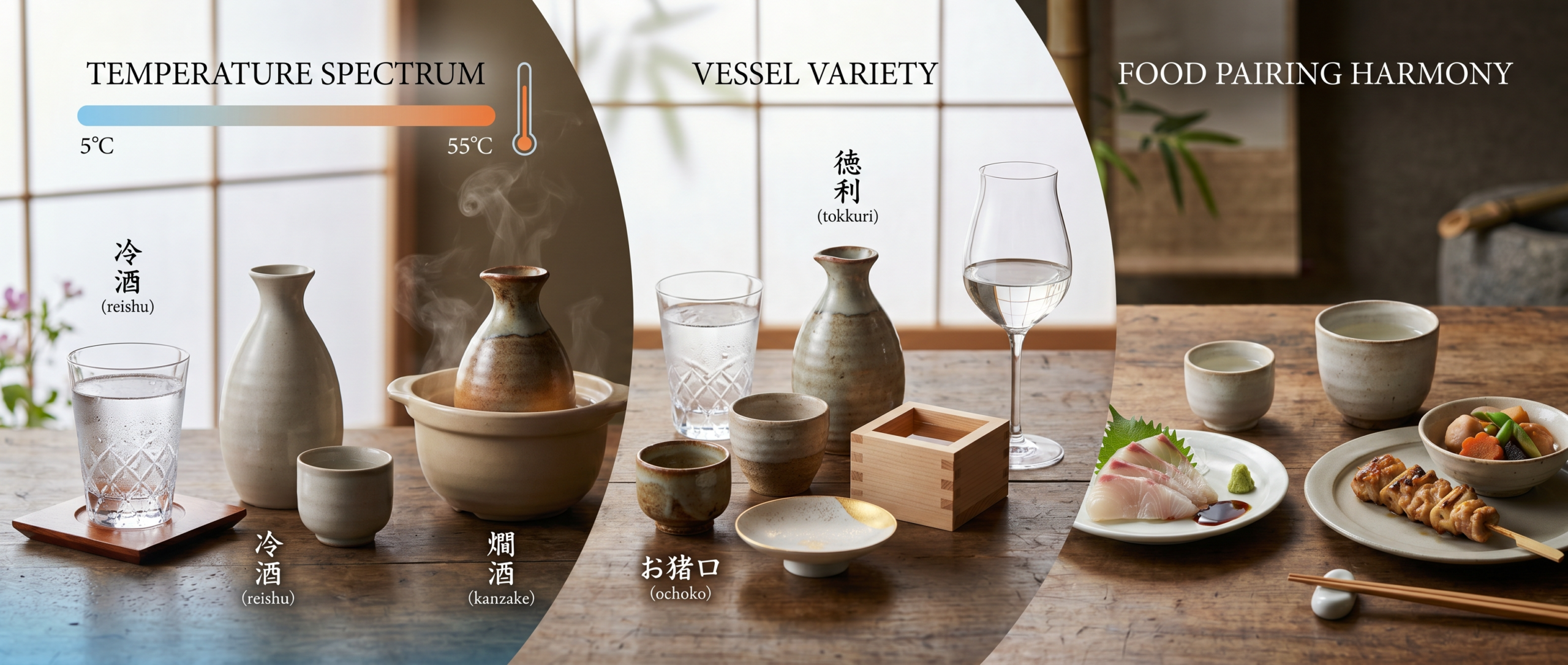
Sake can be served across a remarkably wide range — from around 5°C (41°F) up to about 55°C (131°F) — and the Japanese language has a whole vocabulary for the gradations in between, because each step is considered worth naming. Warmed sake is broadly called kanzake (燗酒), and chilled sake reishu (冷酒), but the precise terms are more poetic and more specific.
Moving up the scale: hinata-kan (日向燗), “sun-warmed,” sits around 30°C — barely warm, just above room temperature. Hitohada-kan (人肌燗), “skin-warm,” is around body temperature, 35–37°C. Nuru-kan (ぬる燗), “lukewarm,” is around 40°C. Jo-kan (上燗), “upper warm,” is around 45°C. And atsukan (熱燗), “hot,” is around 50°C, with the hottest service, sometimes called tobikiri-kan, reaching about 55°C. At the cool end, reishu is typically served around 8–12°C, while room-temperature sake is called jōon or, in older usage, hiya.
What does temperature actually do? Warmth volatilizes aromatic compounds and softens a sake’s structure, drawing out savory, umami depth and rounding off sharp edges — which is why fuller, more savory sakes can become richer and more comforting when warmed. Cold tightens a sake, sharpens its acidity, and preserves delicate, fragrant aromas that heat would simply drive off and destroy. This is the key principle: heat reveals body and umami; cold preserves fragrance and crispness.
There is no single right temperature for sake. Heat reveals body and umami; cold preserves fragrance and crispness. The same bottle, served warm or chilled, becomes two different drinks.
Matching Temperature to the Sake
From that principle, a practical guide follows. The most delicate and aromatic styles — ginjo and daiginjo, whose entire appeal lies in their fragile, fruity, floral aromas — are generally best served chilled, around 8–12°C, where that fragrance is most vivid. Warming them tends to blow off the very aromas you paid for; heat and a fine daiginjo are usually a poor match.
Fuller, richer, more savory styles behave differently. A robust junmai, with its body and umami rather than its fragrance as its main attraction, can be excellent at room temperature or gently warmed, where warmth expands its savory depth. Honjōzō, the lighter style with a small amount of added distilled alcohol, is often considered to warm particularly well, its clean profile opening into a gentle, comforting roundness. As a rough rule, the more a sake’s appeal rests on aroma, the cooler it wants to be; the more it rests on body and savoriness, the more it can reward warming.
None of this is rigid. Many sakes are genuinely enjoyable across a range, and exploring a single bottle at several temperatures — a sip chilled, then again at room temperature, then gently warmed — is one of the best ways to understand what temperature does. The categories and what each one is built to express are covered in our companion guide, A First Map of Sake.
How to Warm Sake Properly
If you do warm sake, how you do it matters. The traditional and most reliable method is a warm-water bath: sake is poured into a tokkuri (the small serving flask), and the flask is partially submerged in a vessel of hot water — a gentle bain-marie that warms the sake slowly and evenly. The usual practice is to heat the water first, often removing it from the heat source before placing the flask in, so the sake warms gradually rather than cooking.
This gentleness is the point. Warming sake too aggressively — and microwaving is the common culprit — heats it unevenly and can drive off aromatics and introduce a harsh, flat character. A slow water bath warms the liquid uniformly and preserves its balance. It is a small amount of patience that makes a real difference, and it is the difference between warm sake that is rounded and comforting and warm sake that is simply hot.
The Vessel: Why the Cup Is Not Incidental
Sake is traditionally served from a tokkuri (徳利), the narrow-necked flask, into small cups — and the choice of cup is not merely decorative. The shape and size of the vessel change how the sake is experienced, both practically and sensorially.
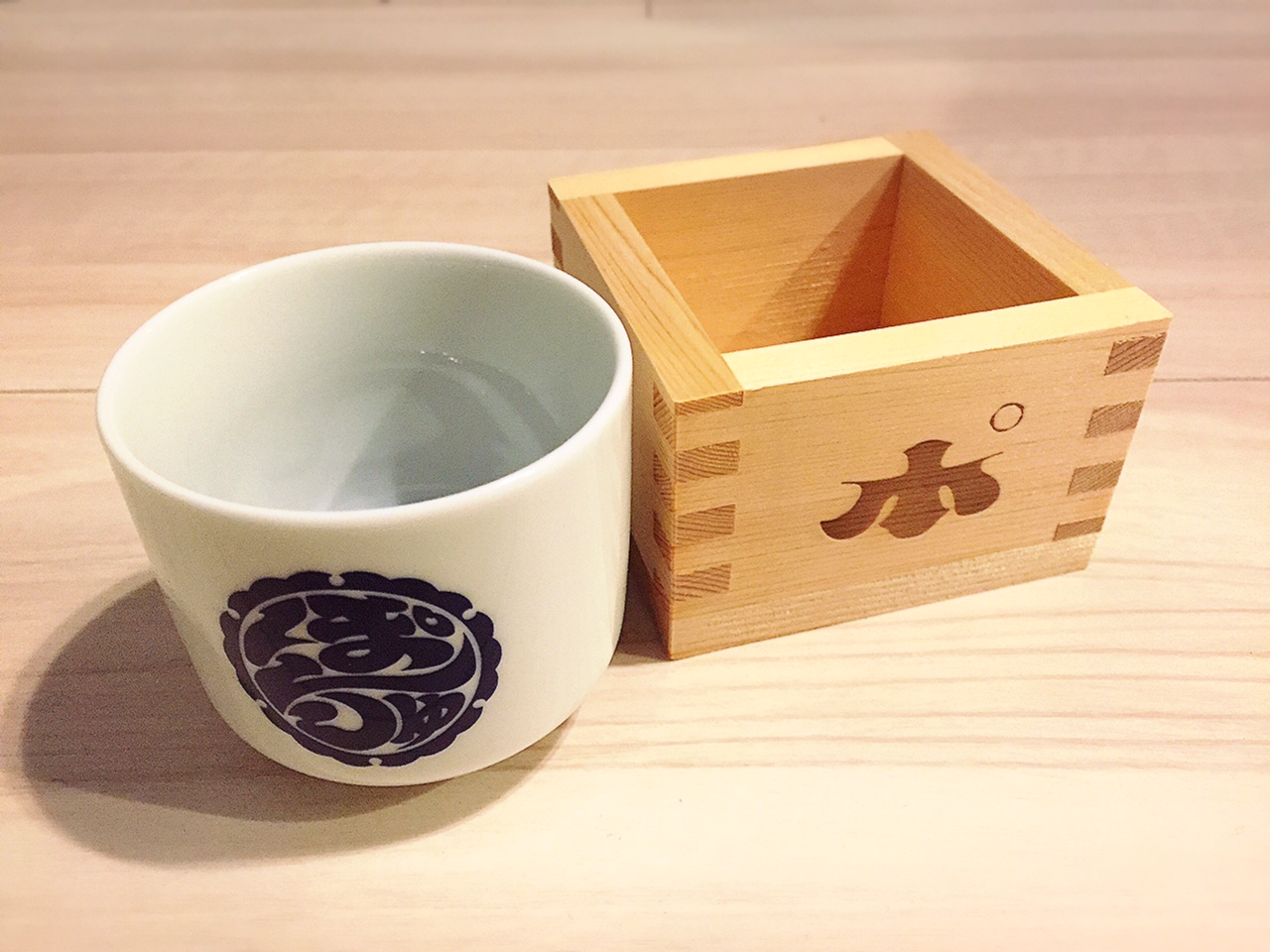
The most familiar cup is the ochoko (お猪口), a small cylindrical cup. Its smallness is functional: it holds only a mouthful or two, which keeps the sake fresh in the cup, keeps it close to its served temperature, and encourages the social ritual of frequent small refills — pouring for one another rather than for oneself. The guinomi (ぐい呑み) is a slightly larger cup for more generous sips. The sakazuki (盃) is a flat, shallow, saucer-like cup, traditionally used on formal and ceremonial occasions — it is the vessel of weddings and rituals, and its wide brim is suited to ceremony more than to capturing aroma.
The masu (枡) is a square wooden box, originally a measuring vessel, that lends a faint cedar fragrance to the sake — atmospheric and traditional, though that woodiness can compete with a delicate sake’s own aromas. And for the most aromatic styles, a development of recent decades: a tulip-shaped wine glass. For a fine ginjo or daiginjo, a deeper glass that narrows toward the rim concentrates and channels the fragrance toward the nose, much as a wine glass does — often the best vessel for appreciating exactly what makes those styles special.
There is also the question of material. The cool, fragile, hand-cut glass vessels prized in Japan — including the geometric cut glass known as kiriko — are matched to chilled sake, where their clarity and the way they catch the light suit the crispness of a cold pour. Warm sake calls for ceramic, which holds heat. The vessel, in other words, is chosen to serve the temperature.
The small cup is not an accident of tradition. Its size keeps the sake fresh and near its temperature, and it turns drinking into an act of pouring for one another rather than for oneself.
Pairing Sake with Food
Sake is, above all, a drink of the table — made to accompany food rather than to dominate it, and unusually accommodating in what it can sit alongside. A few principles make pairing approachable.
Match intensity to intensity. Delicate, aromatic ginjo and daiginjo pair beautifully with delicate, clean dishes — sashimi, white fish, lightly seasoned vegetables, tofu — where their fragrance can be appreciated and the food does not overwhelm them. Fuller, savory junmai, with its body and umami, stands up to richer and more strongly flavored dishes — grilled fish, soy-braised meats, fried foods, dishes with depth and fat. The umami in a robust junmai also makes it a natural partner for other umami-rich foods, the savoriness of each amplifying the other.
Sake’s relationship with umami is, in fact, one of its defining strengths as a table drink. Where wine can clash with the savory, glutamate-rich flavors at the heart of Japanese cooking — dashi, soy sauce, miso, aged and fermented ingredients — sake harmonizes with them, which is precisely why it evolved alongside this cuisine. A bowl of miso-seasoned food, a plate of grilled eel, a piece of well-aged sushi: these are foods that sake was, in effect, made to accompany.
Temperature plays into pairing as well. A warmed junmai can be a wonderful match for a hot winter dish — a simmered hot pot, grilled meat — its warmth and savory expansion meeting the food where it is. A chilled ginjo cuts cleanly against something fried or rich. The full picture of sake’s place at the table, and the centuries of food culture that shaped it, is part of the larger story we tell in The Drink That Belongs to the Gods.
To serve sake is to make a series of quiet decisions — the temperature that suits the bottle, the cup that suits the temperature, the food that suits them both. None of these choices is governed by a rigid rule, and that is exactly what makes sake such a rewarding drink to learn: it asks you to pay attention, to taste, to adjust, and to notice how a single liquid transforms as you change the conditions around it. Pour a fragrant daiginjo cold into a glass; warm a savory junmai gently and drink it from ceramic alongside something hot. The sake will tell you, each time, whether you have chosen well.
Read, then Taste
This article is part of Waden’s Technique series — exploring the craft, philosophy, and practice behind Japanese culinary methods. Read more at waden.umamibako.com.
Comment