The Noodle That Asks Nothing of You: Udon and the Comfort of Wheat
Soba is defined by what it lacks — gluten, and the difficulty that absence creates. Udon is defined by the opposite: gluten is its whole reason for being, and everything worth knowing about it flows from that one fact.
There is a particular kind of comfort in a bowl of udon that is hard to find anywhere else in Japanese cooking. The noodles are thick, pale, and soft-edged, sitting in a clear, gently savory broth; the flavors are quiet, the seasoning restrained, the whole thing warm and undemanding. Where a bowl of ramen shouts and a plate of sashimi asks for your full attention, udon simply offers itself. It is the food you eat when you are tired, or unwell, or cold, or just want something that will not argue with you. It asks nothing of you at all.
And yet this most undemanding of noodles is, beneath its softness, the product of a surprisingly forceful craft — one built entirely around a single substance that its close cousin soba does not have. To understand udon is to understand gluten: what it is, how it is coaxed into being, and why its presence gives udon the one quality the Japanese prize above all others in a wheat noodle. Everything else — the regional styles, the ways of serving, the very texture that defines a good bowl — follows from there.
Three Ingredients, One Protein
Udon is made from just three things: wheat flour, water, and salt. There is nothing else in it — no egg, no alkaline solution, none of the additions that distinguish other noodles. Its entire character comes from how those three ingredients are handled, and specifically from what happens when wheat flour meets water.
When water is worked into wheat flour, two proteins in the flour link together and form gluten — an elastic, interconnected network that gives dough its stretch and strength. The more the dough is worked, the more extensive that network becomes, and the firmer and chewier the resulting noodle. This is the substance at the heart of udon. Its thick, springy, satisfying bite is gluten made edible; the noodle is, in a real sense, a delivery system for a well-developed protein network.
This is exactly where udon and soba stand in perfect opposition. Buckwheat, the flour behind soba, contains no gluten at all, which makes soba dough fragile, crumbly, and famously difficult to work — a difficulty that shapes the entire craft of soba-making, as we explore in The Craft of Soba: What the Ratio Reveals. For the soba maker, the absence of gluten is a problem to be solved. For the udon maker, the presence of gluten is the entire point — the thing to be developed, encouraged, and maximized. Two noodles, from two grains, defined by the same protein: one by having it, one by not.
For the soba maker, the absence of gluten is a problem to be solved. For the udon maker, its presence is the entire point. Two noodles defined by the same protein — one by having it, one by not.
Kneading with the Feet
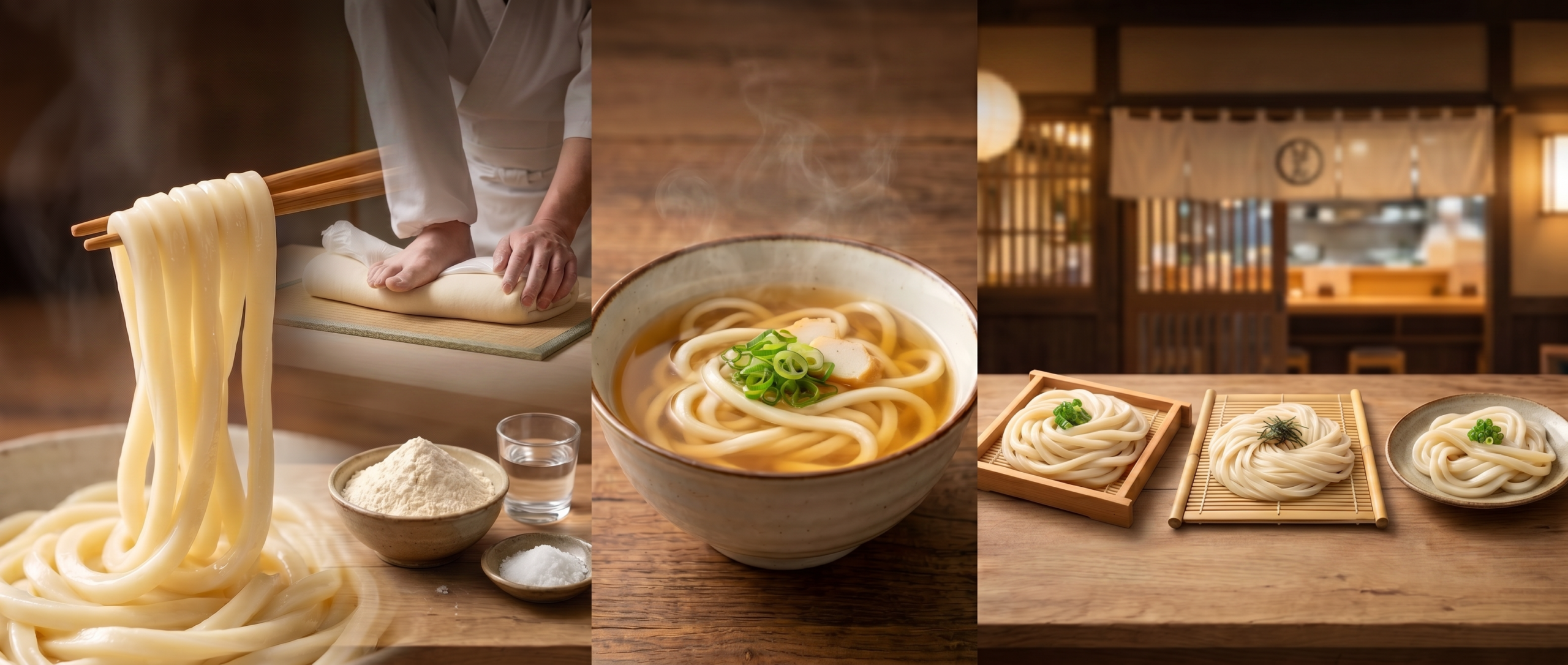
Because gluten is what gives udon its character, developing it thoroughly is the central task of making the noodle — and udon dough is stiff, low in water relative to its flour, and genuinely hard to work by hand. This is the reason behind one of the most surprising practices in Japanese cooking: traditional udon dough is kneaded with the feet.
The dough is wrapped in plastic or cloth, placed on the floor, and stepped on — trodden and folded repeatedly. It sounds crude, but there is precise logic to it. The stiffness of the dough makes hand-kneading impractical, and the body’s weight applies far more force than the arms can. More importantly, stepping on the dough from many different angles works the gluten network in every direction, interweaving the protein strands into a strong, three-dimensional structure rather than aligning them along a single axis. That multidirectional development is what produces udon’s characteristic springiness — a chewiness that resists the teeth and then yields, the same in every direction you bite. The feet are not a rustic shortcut. They are the most effective tool for building the exact structure the noodle needs.
Koshi: The Quality Everything Aims At
All of this — the gluten, the kneading, the force — is in service of a single quality that has a name in Japanese and no clean equivalent in English: koshi (腰).
Koshi is the word for the ideal texture of a noodle — a firm, springy, resilient chewiness, a satisfying resistance to the bite followed by a tender yielding. It is not mere firmness, and it is not toughness; it is a specific, prized quality of elastic bounce that a great udon noodle has and a poor one lacks. When Japanese eaters praise a bowl of udon, koshi is almost always what they are praising. A noodle with good koshi feels alive against the teeth; a noodle without it feels slack and dull, no matter how good the broth around it.
And koshi comes directly from gluten. It is the eating sensation of that well-developed, three-dimensional protein network — which is why the entire craft of udon, from the choice of flour to the trodding of the dough to the resting and rolling, is really the craft of building koshi. Here again the contrast with soba is illuminating: soba is prized for a delicate, slightly rough, fragrant quality precisely because it cannot have koshi in the udon sense; it lacks the gluten to produce it. The two noodles pursue opposite textural ideals because their grains permit opposite things.
Koshi — that springy, resilient bite — is the sensation of gluten itself. The whole craft of udon, from flour to footwork, is really the craft of building it.
Three Regions, Three Textures
Udon is made across Japan, but three regional styles are especially celebrated, and they show how the same three ingredients can be handled toward strikingly different results.
Sanuki udon, from Kagawa Prefecture on the island of Shikoku, is the most famous of all. Kagawa is so associated with the noodle that it is sometimes called “Udon Prefecture,” and Sanuki udon is the benchmark against which other udon is measured. Its defining feature is exceptional koshi — a notably firm, dense, powerfully chewy noodle with a squared cross-section and a resilient bite. For many people, Sanuki udon simply is udon, the fullest expression of everything the noodle is supposed to be.
Inaniwa udon, from Akita Prefecture in the north, is its refined opposite. Made by a hand-stretching and thinning process, Inaniwa noodles are thinner, flatter, and smoother than Sanuki udon, with a more delicate, silky, slippery texture rather than a robust chew. It is often considered a more elegant, even luxurious style — udon that emphasizes smoothness and finesse over sheer koshi.
Mizusawa udon, from Gunma Prefecture, sits between the two. Made with local wheat and pure water, its noodles are firm and slightly translucent when cooked, springy but not as densely chewy as Sanuki — a middle path between robust bite and delicate smoothness. Traditionally it is served simply, cold with a dipping sauce, in a way that lets the quality of the noodle itself come forward.
Three regions, three textures, all from wheat, water, and salt — the differences arising from the flour, the water, the working of the dough, and the accumulated preferences of each place. It is the same lesson soba teaches through geography, seen from the other side of the gluten divide.
The Many Ways to Eat It
If the making of udon is exacting, the eating of it is generous and various. The noodle’s mildness makes it a willing partner to an enormous range of preparations, hot and cold, simple and elaborate.
The simplest and most fundamental is kake udon — hot noodles in a warm, light, dashi-based broth, seasoned with soy sauce and mirin, perhaps topped with nothing more than a scattering of green onion. It is udon at its most elemental and most comforting, the bowl that best expresses the noodle’s undemanding warmth. Bukkake udon takes a different approach: a smaller amount of concentrated, stronger broth is poured directly over the noodles (often chilled), with toppings added on top, producing a more intensely flavored, more texture-forward dish where the koshi of the noodle is front and center.
Kamaage udon serves the noodles straight from the pot they were boiled in, still in their hot cooking water, with a separate cup of dipping sauce — a preparation that showcases the freshly boiled noodle at its softest and most fragrant. Zaru udon serves them cold on a bamboo tray with a dipping sauce, the summer counterpart, where cold tightens the noodle and sharpens its bite. And beyond the broth-based dishes entirely, yaki udon stir-fries the noodles with vegetables, meat, and a savory sauce, while curry udon drowns them in a thick, Japanese-style curry broth — heartier, richer expressions of the same accommodating noodle.
What unites all of these is the noodle’s willingness to be whatever the dish needs. Because udon asserts so little flavor of its own — offering texture rather than taste as its main contribution — it adapts to hot broth and cold sauce, to delicate dashi and heavy curry, without complaint. Its neutrality is not a weakness. It is precisely what makes it so endlessly useful, and so endlessly comforting.
There is something fitting in the fact that Japan’s most comforting noodle is also, in its making, one of its most physically demanding — that the softness in the bowl is the product of a stiff dough trodden underfoot until its gluten yields exactly the right spring. Udon asks nothing of the person eating it, but it asks a great deal of the person making it, and that quiet transaction is the whole of it: force and patience on one side of the counter, ease and comfort on the other. Where soba is defined by the challenge of a grain that resists becoming a noodle, udon is defined by a grain that wants to — and by the craft of drawing out, fully and deliberately, everything wheat has to give.
Read, then Taste
This article is part of Waden’s Technique series — exploring the craft, philosophy, and practice behind Japanese culinary methods. Read more at waden.umamibako.com.
Comment