Frying as Restraint: Tempura and the Art of the Light Touch
Deep-frying is usually an act of addition — batter, richness, weight. Japanese tempura is the opposite: a technique whose entire purpose is to take moisture away and leave the ingredient more itself than before.
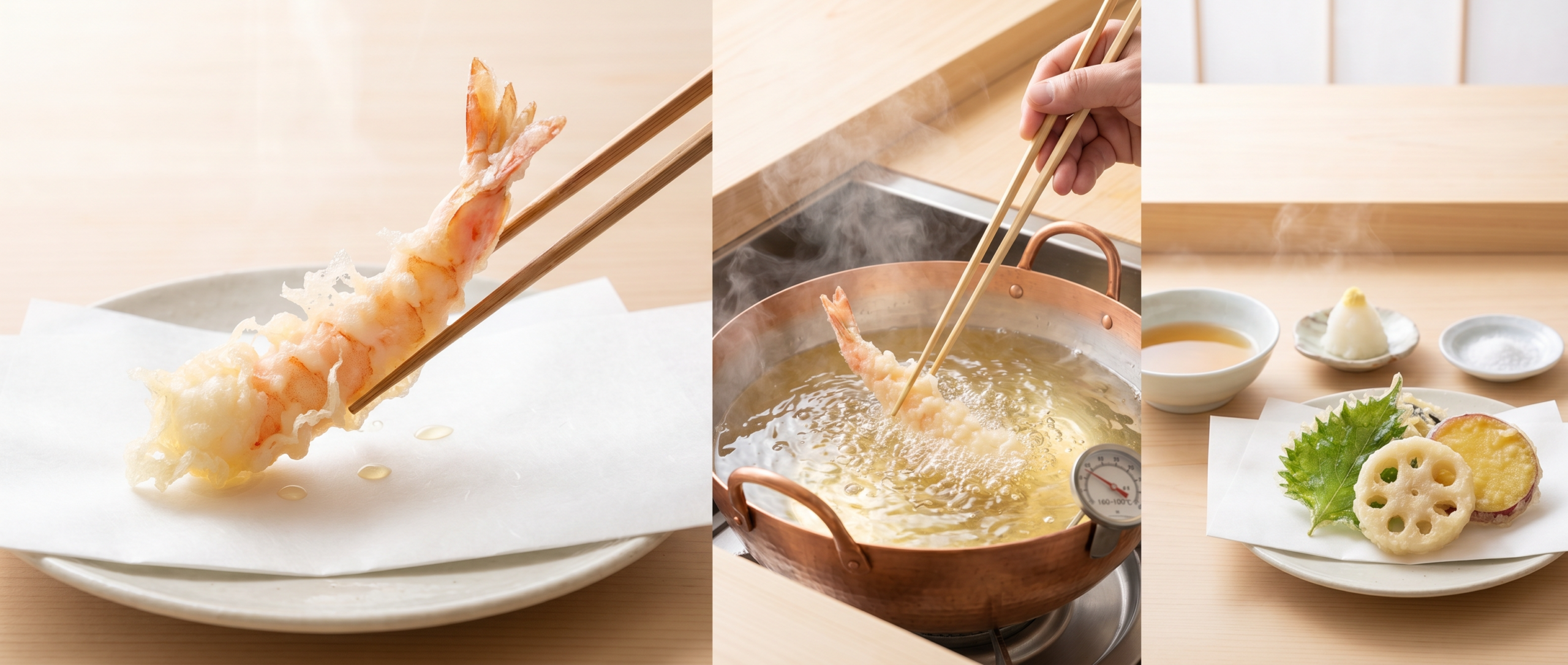
There is a moment, at a good tempura counter, when the chef lifts a single prawn from the oil and sets it in front of you, and you realize the thing on the paper before you is almost weightless. The coating is pale gold, thin, lacy at the edges, and when you bite it, it shatters — a brief, dry crispness giving way to the sweet, barely cooked prawn inside. It is fried food, unmistakably, and yet it is not heavy, not greasy, not rich in the way fried food usually is. It tastes, more than anything, like a very good prawn.
This is the paradox at the heart of Japanese tempura, and it is worth sitting with, because it runs against everything deep-frying usually means. In most culinary traditions, to fry something is to add to it — to give it a thick, flavorful crust, to enrich it, to make it more. Tempura does something stranger. It uses hot oil not to build something onto the ingredient but to strip something out of it, and to reveal what was already there. It is, improbably, a technique of subtraction. To understand how a bath of hot oil can be an act of restraint is to understand why tempura tastes the way it does.
Tempura arrived in Japan from Portugal in the sixteenth century and was transformed, over five hundred years, into something wholly its own — a story we tell in full in How Tempura Became Japanese. This article isn’t about that history. It’s about the technique that history produced, and the single, counterintuitive idea at its center: that the lightest fried food in the world is light on purpose, by design, and by chemistry.
The Batter That Tries Not to Be Batter
Everything begins with the coating, and the coating is defined by what the cook works to prevent. A tempura batter is little more than low-protein wheat flour and very cold water, sometimes with an egg — and the entire skill lies in stopping that mixture from behaving the way flour and water normally want to behave.
When wheat flour meets water and is worked, it forms gluten — the elastic protein network that gives bread its chew and udon its bounce. In most contexts that is exactly what you want. In tempura it is the enemy. A batter with developed gluten fries up thick, heavy, and chewy, forming a dense shell that clings to the ingredient and dominates it. The whole aim of tempura batter is to have as little gluten as possible, so that the coating stays thin, brittle, and light.
The tempura cook fights gluten on three fronts at once. First, the flour: a low-protein, low-gluten flour (cake flour, or a specialized tempura flour) simply has less of the protein available to form gluten in the first place. Second, the water: it is kept ice-cold, because cold slows the formation of gluten dramatically — a cold batter develops far less structure than a warm one. Third, and most tellingly, the mixing: the batter is stirred as little as possible, mixed only briefly and left visibly lumpy, because every extra stroke of the whisk works the flour and builds more gluten. The lumps that a Western cook would instinctively smooth away are, in tempura, a sign of correctness. A perfectly smooth batter is an overmixed one.
The lumps a Western cook would smooth away are, in tempura, the mark of a batter made right. A perfectly smooth batter is an overmixed one — and it will fry heavy.
There is a discipline in this that captures the whole philosophy of the dish. The batter is not built up; it is held back. The cook’s job is not to make the coating do more, but to keep it from doing too much — to intervene as little as possible so that the coating remains a whisper rather than a wall. Even the practice of mixing the batter fresh, moments before frying, and keeping it cold throughout, exists to prevent gluten from quietly forming while the batter sits. Restraint is not a metaphor here. It is the literal method.
Frying That Is Really Steaming
Now comes the part that reveals why tempura is subtraction rather than addition. When a piece of cold, thinly battered food is lowered into hot oil, something specific and beautiful happens, and it is not quite what “frying” suggests.
The oil, held between roughly 160 and 180°C, is far hotter than the boiling point of water. The moment the batter and the moisture inside the ingredient hit that heat, the water begins to boil and turn to steam. That steam cannot simply escape — the food is submerged in oil — so it forces its way out through the batter, erupting in the vigorous bubbling you see around each piece. In a real sense, the interior of a piece of tempura is not being fried at all. It is being steamed, gently, in its own moisture, inside a shell that the oil is simultaneously crisping from outside.
This is the key to the whole technique. The oil’s job is twofold and precise: to drive the water out of the batter and the surface of the ingredient as steam, leaving the coating dry and crisp, while the escaping steam cooks the ingredient within just enough — no more. The bubbling is the sound of moisture leaving. When the bubbling slows and quiets, it signals that most of the water has gone, the crust has set, and the piece is done. The chef is, quite literally, listening for the moment the water is spent.
Understood this way, tempura is a technique for removing water and adding almost nothing. The oil contributes surprisingly little to the interior — a properly fried piece absorbs remarkably little of it — because the constant outrush of steam keeps the oil from soaking in. What the oil leaves behind is not richness but crispness, and an interior that has been cooked so briefly and so gently that it retains its natural sweetness, color, and character. The prawn tastes intensely of prawn; the shiso leaf stays green and fragrant; the piece of fish is barely set. Nothing has been masked. Something has been taken away, and what remains is the ingredient, heightened.
Tempura is, at its core, a kind of steaming. The oil drives the water out as steam and adds almost nothing back — leaving crispness on the outside and an ingredient, barely cooked, more itself than before.
The Precision of Heat
Because everything depends on that exchange of water for crispness, oil temperature is the variable a tempura cook watches most closely — and it is not a single number but a judgment made piece by piece. The working range runs roughly from 160 to 180°C, and where within that range the cook aims depends on what is being fried.
The logic is a balance between two failures. If the oil is too cool, the water leaves too slowly, the batter has time to absorb oil before it crisps, and the result is greasy and heavy — the very opposite of what tempura should be. If the oil is too hot, the batter browns and hardens before the interior has cooked and before enough moisture has escaped, leaving a dark shell around an underdone center. Between those extremes lies the window where the steam drives out cleanly and the crust sets at just the right moment. Delicate items with high water content and quick cooking times — a shiso leaf, a thin slice of fish — want different handling from dense, slow ones like sweet potato or lotus root, which need lower heat and longer time to cook through without burning. A skilled cook reads each ingredient and adjusts, treating the oil not as a fixed setting but as an instrument.
What Goes Alongside — and Why So Little
The restraint of the frying is matched by the restraint of what tempura is served with. It arrives with one of two accompaniments, and both are chosen to support the ingredient rather than to cover it.
The first is tentsuyu — a light dipping sauce of dashi, soy sauce, and mirin, often served with a mound of grated daikon radish stirred in. It is savory and gently sweet, but thin and clean rather than rich, and its backbone is dashi, the kelp-and-bonito stock that is itself the purest expression of Japanese umami. That tentsuyu is built on dashi is fitting: both the sauce and the frying technique share the same underlying goal of drawing out and supporting an ingredient’s natural flavor rather than smothering it. The second accompaniment is simpler still — just salt, sometimes flavored with green tea or citrus zest, which adds nothing but seasoning and lets the ingredient stand almost entirely alone. At the most refined tempura counters, a good piece is often best with nothing more than a few grains of salt.
And there is one final piece of the discipline, one that unites tempura with sushi and so much of Japanese cooking: it must be eaten immediately. The shattering crispness that the frying created lasts only minutes. As the piece sits, the moisture still inside the ingredient migrates outward and softens the coating from within, and the crust that the oil worked to dry out begins, slowly, to go limp. Everything the technique achieved — the dryness, the lightness, the contrast between crisp shell and tender interior — is fragile and fleeting. This is why serious tempura is served piece by piece, straight from the oil to the plate, and why it rewards being eaten the moment it arrives. The lightness is not only made with care; it must be caught in time.
It is a strange and lovely thing that one of the world’s lightest foods is made by submerging it in hot fat — that frying, of all techniques, should become in Japanese hands an art of restraint. But the paradox dissolves once you see what is actually happening: a batter held deliberately weak, an oil used to remove water rather than add richness, an interior steamed rather than truly fried, a sauce that supports rather than covers, and a piece eaten before its lightness can fade. Tempura is not the exception to the Japanese instinct for subtraction and revelation — the conviction that the cook’s highest task is to draw an ingredient out rather than bury it. It is one of its most surprising expressions: proof that even in a pot of hot oil, the goal can be to take away, and to let the thing itself come through.
Read, then Taste
This article is part of Waden’s Technique series — exploring the craft, philosophy, and practice behind Japanese culinary methods. Read more at waden.umamibako.com.
Comment