Katsuramuki: The Cut That Measures a Cook
A single daikon, peeled into one continuous, paper-thin sheet longer than a person is tall. It sounds like a party trick. In a Japanese kitchen, it is closer to a verdict.
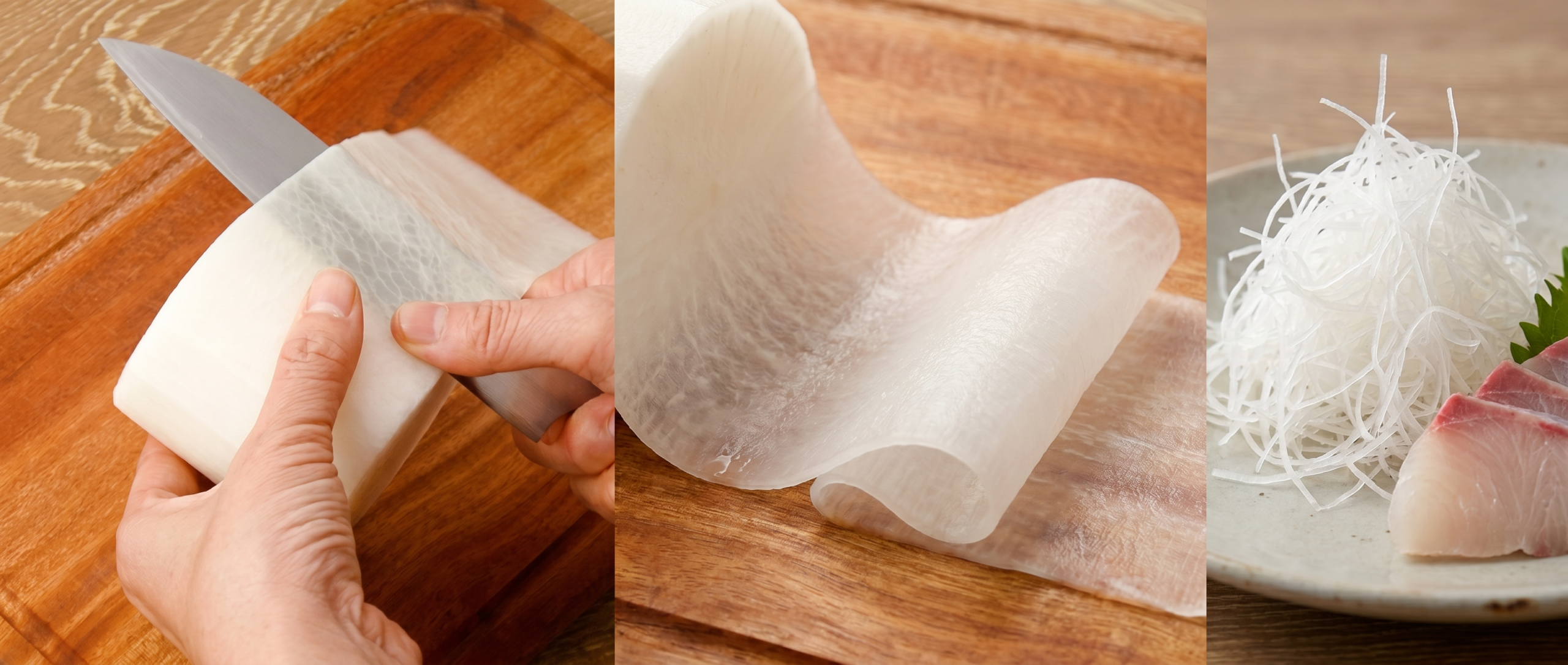
Watch a trained Japanese cook perform katsuramuki and the first thing you notice is how little seems to be happening. A cylinder of daikon radish, peeled of its skin, sits held lightly in the left hand. A wide, flat blade rests against it, almost still. The radish turns slowly against the edge, and from it unspools a sheet of white so thin you can read through it — continuous, unbroken, coming off in one endless ribbon that pools on the board. There is no visible drama. The hands barely move. And that stillness is precisely the point: katsuramuki is one of the hardest things a cook in this tradition ever learns to do, and it is hard in a way that hides itself.
The technique is simple to describe. You take a firm, evenly shaped vegetable — daikon above all, sometimes cucumber or carrot — and you shave it, rotating, into a single sheet of uniform thickness, as if unrolling the vegetable into a scroll. The word itself carries the image: katsura, a wrapping or a wig, and muki, to peel. A skilled cook can take a whole daikon down to a thin core, producing a sheet a meter or more in length, and hold that thinness so consistently that light passes through every part of it equally. Done well, it looks effortless. That appearance of ease is the whole difficulty.
Why It Is So Hard
The reason katsuramuki defeats beginners is that nothing about it is intuitive. Ordinary cutting is a series of decisions: place the blade, press, lift, move, repeat. Katsuramuki is a single sustained state. Both hands must work in continuous, opposed motion — the right hand holding the blade almost stationary, moving it in tiny vertical increments, while the left hand rotates the vegetable and feeds it steadily against the edge, the left thumb riding the emerging sheet to gauge its thickness by touch alone. The blade does not really travel through the vegetable. The vegetable travels past the blade.
Everything must hold constant at once. If the angle drifts, the sheet thickens on one side and thins on the other until it tears. If the rotation outpaces the blade, the ribbon snaps. If the pressure wavers, the thickness ripples. There is no place to hide a mistake, because the mistake is immediately visible — a hole, a break, a thick seam running through the translucent white. A cook cannot fake katsuramuki. Either the sheet comes off whole and even, or it does not, and anyone watching can see which.
“The blade does not travel through the vegetable. The vegetable travels past the blade. Everything must hold constant at once — and there is no place to hide a mistake.”
The Blade That Makes It Possible
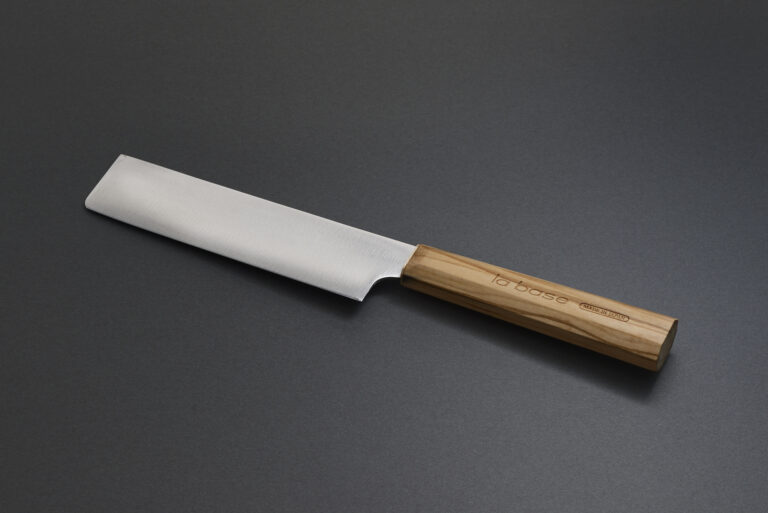
The cut is inseparable from the tool, and the tool tells its own story about Japanese technique. The knife for katsuramuki is the usuba — literally “thin blade” — the traditional vegetable knife of the professional Japanese kitchen. Two features define it. First, it is exceptionally thin behind the edge and cut with a flat, straight profile, which lets it move cleanly through a vegetable without wedging it apart. Second, and more importantly, it is single-beveled.
This is one of the deepest divides between Japanese and Western knives. Most Western blades are ground on both sides, meeting in a symmetrical V. Traditional Japanese knives like the usuba — and the yanagiba for slicing fish, and the deba for breaking it down — are kataba, sharpened on one side only, flat or slightly hollow on the other. A single bevel can be honed to an extraordinarily fine, low angle, sharper than a symmetrical edge can safely go, and it releases a slice cleanly from the flat back. For katsuramuki this is essential: only a single-beveled edge can shave a sheet this thin without crushing the cells, and a cook must learn to read and correct the way that asymmetry naturally steers the blade. The knife even splits by region — the squared-off Kantō, or Edo, form of the usuba against the rounded, sickle-shaped kamagata favored in Kansai — a small reminder that Japanese technique is regional all the way down to the shape of the steel.
To do katsuramuki, then, is to command not just a motion but a tool that demands respect: a blade so sharp and so unforgiving that it will reveal any unsteadiness in the hand holding it.
What the Sheet Becomes
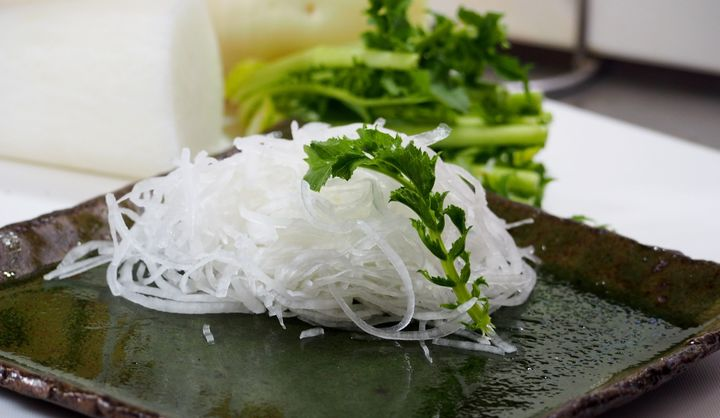
All of this labor produces something that most diners never consciously register. The classic destination of a katsuramuki sheet is ken — the fine, hair-thin shreds of daikon piled beside a serving of sashimi. The cook rolls the translucent sheet, then cuts it crosswise into threads so fine they seem to float, mounded up to give the fish height and a clean white backdrop. Cut along the grain and stood upright, these threads are called tate-ken; against the grain, yoko-ken. They belong to the broader family of tsuma, the garnishes that accompany sashimi.
And here the technique connects to something larger, because tsuma is written with the character for “wife.” The name comes from an old understanding of the garnish as the supporting partner to the fish — the sashimi as the household head, the tsuma as the one who quietly makes the whole thing work. It is a telling piece of language. In this cuisine, even the shredded radish beside the fish has a name that assigns it a role, a relationship, a dignity.
Nor is that role merely decorative, which is the detail that redeems the whole enormous effort. Daikon, when its cells are cut and exposed to air, generates isothiocyanates — the pungent compounds behind its bite — which carry genuine antibacterial properties. In an age before refrigeration, a mound of freshly cut daikon ken beside raw fish was a real safeguard, and daikon was long trusted as an aid to digestion besides. The garnish that looks like ornament is also function: it refreshes the palate between bites, it holds the fish up off the plate, and it was, once, a quiet line of defense against spoilage. Nothing on the plate is only for show. The most beautiful thing a cook can do with a daikon is also the most useful.
“The garnish is written with the character for ‘wife’ — the supporting partner to the fish. In this cuisine, even the shredded radish beside the sashimi is given a name, a role, and a dignity.”
The Cut as a Verdict
Why, then, does a technique that yields a humble pile of shredded radish carry such weight in the training of a Japanese cook? Because katsuramuki is not really about the daikon. It is about what the daikon reveals.
The path of the traditional Japanese cook — the itamae — is famously long. The old saying that it takes ten years to become a fully formed cook is not nostalgia; it describes a real apprenticeship, one built on years spent at the bottom of the kitchen doing preparatory work before ever being trusted with the fish or the guests. Within that long ascent, katsuramuki occupies a particular place. It is one of the foundational disciplines, practiced over and over, precisely because it cannot be rushed and cannot be faked. A cook does not master it in a week or a month. The sheet gets a little longer, a little more even, a little thinner, over years — and the record of that progress is written in the vegetable, plainly, for anyone to read.
This is why the technique functions as a kind of measure. Hand a cook a daikon and an usuba, and the sheet they produce will tell you almost everything about the state of their training — the steadiness of the hands, the calibration of the eye, the patience, the years. There is no talking around it. The Japanese kitchen tends to trust demonstrated skill over stated skill, and katsuramuki is skill you cannot claim, only show. It is, in the most literal sense, a cut that measures a cook.
And there is a philosophy folded into that. What katsuramuki asks for is not force, or speed, or flourish, but control so complete that it disappears — the ability to hold a hundred variables perfectly still while the vegetable turns, and to make the extraordinary look like nothing at all. That ideal runs through the whole of Japanese cuisine: the sense that the highest technique is the one that draws no attention to itself, that mastery is measured not by what is added but by how little is left to chance. A translucent sheet of daikon, unspooling in silence from a still blade, is a small thing. It is also, for those who understand what they are looking at, one of the clearest statements a cook can make about who they are.
Read, then taste.
Waden is an editorial journal exploring the depth and beauty of Japanese food culture — its history, ingredients, artisans, and traditions. Story first, always. waden.umamibako.com
Comment