What Japan Actually Registered: Washoku and the UNESCO Misunderstanding
In 2013, “washoku” joined UNESCO’s list of humanity’s intangible heritage. Almost everyone assumes this means sushi, tempura, and ramen were honored. What was actually inscribed is something quieter, stranger, and far more interesting.
On December 4, 2013, a UNESCO committee meeting in Baku, Azerbaijan, added an entry to the Representative List of the Intangible Cultural Heritage of Humanity. The entry was Japanese, and the news traveled fast and cheerfully around the world: Japanese food had been recognized by UNESCO. In restaurants and headlines, the shorthand was immediate — sushi is a world heritage now, tempura is protected, ramen has been honored.
Almost none of that is what happened. The most common belief about the 2013 inscription is a misunderstanding, and correcting it opens up something genuinely worth understanding about how Japan thinks about its own food. UNESCO did not register a cuisine. It did not register any dish. What it registered was a way of living in relation to food — and the official title tells you so, if you read it carefully.
Read the Title Slowly
The full inscribed name is not “washoku” alone, and not “Japanese cuisine.” It is: “Washoku, traditional dietary cultures of the Japanese, notably for the celebration of New Year.” Every part of that phrase is doing work.
Start with “dietary cultures” rather than “food.” UNESCO’s own description is explicit: washoku is defined as “a social practice based on a set of skills, knowledge, practice and traditions related to the production, processing, preparation and consumption of food.” A social practice — not a menu. The heritage being protected is the whole web of behavior and knowledge around eating: how ingredients are grown and sourced, how meals are prepared and seasoned at home, how food is shared, and how that knowledge is handed from one person to the next. A plate of sushi is not heritage under this definition. The transmitted knowledge of how a family cooks and eats together is.
Then notice the strangest part: “notably for the celebration of New Year.” Of all the moments in the Japanese food year, UNESCO’s title singles out one. That was a deliberate choice, and it is the key to the whole inscription.
“UNESCO did not register a cuisine. It did not register any dish. It registered a social practice — a way of living in relation to food.”
Why New Year
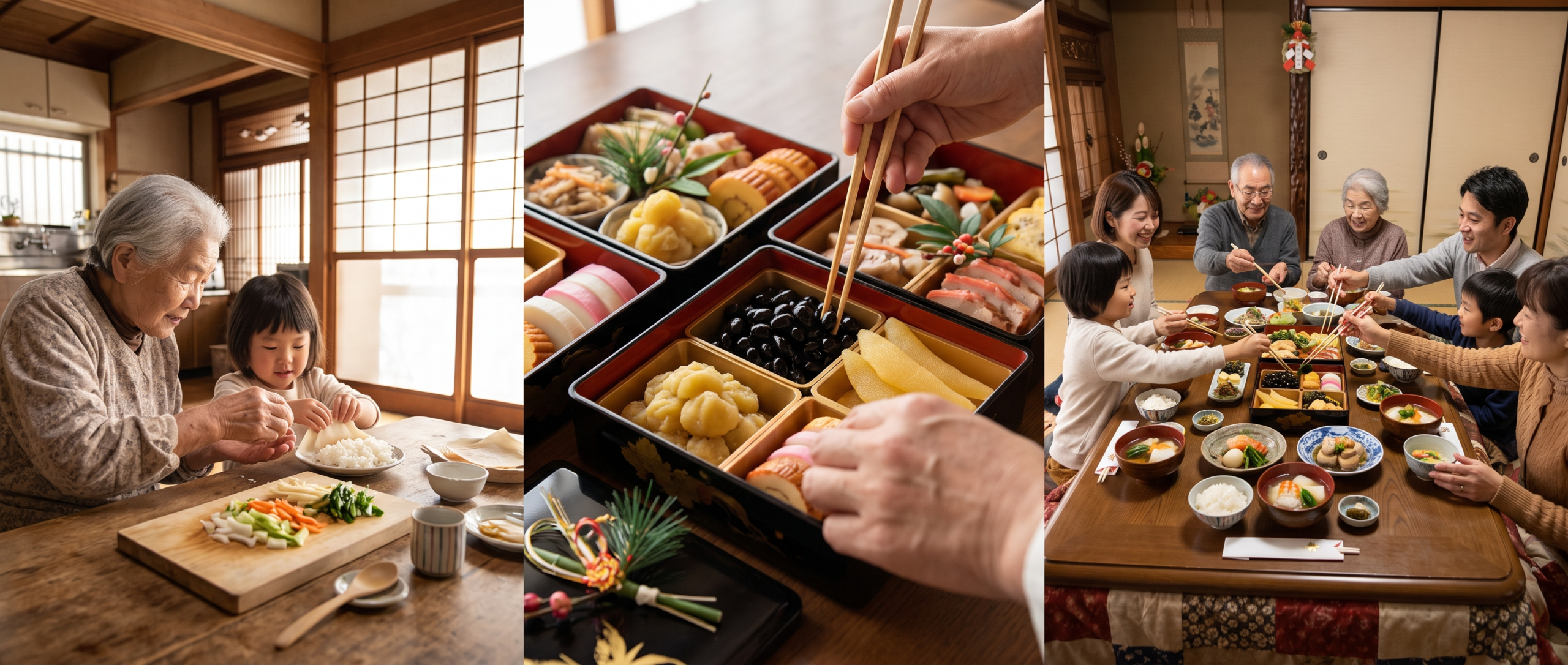
New Year was chosen because it is where the entire logic of washoku becomes visible in a single, concentrated event. The UNESCO description dwells on it directly: at the turn of the year, Japanese families make preparations to welcome the deities of the incoming year, pounding rice cakes and preparing special meals — beautifully arranged dishes of fresh ingredients, each of which carries a symbolic meaning, served on special tableware and shared among family or community.
Look at everything that is bundled into that description. There is respect for nature and the gods embedded in the seasonal timing. There is the use of fresh, local, natural ingredients. There is symbolism — every dish in the New Year spread means something, from black beans standing for health and diligent work to herring roe for fertility. There is beauty and the deliberate arrangement of food. There is the special vessel. And there is sharing, the strengthening of family and community bonds through a meal eaten together. New Year is not one custom among many; it is a stage on which all the defining features of washoku perform at once. UNESCO chose it as the clearest single window onto the whole tradition.
The Four Pillars Japan Presented
Behind the inscription lies a specific case the Japanese government built, and it rests on four characteristics that Japan itself defined as the essence of washoku. They are worth stating plainly, because they are the actual content of what was recognized.
The first is a respect for diverse, fresh ingredients and their intrinsic flavors. Japan is a long, narrow country of sharply distinct regions and pronounced seasons, and its food culture is built on drawing out the natural taste of local ingredients rather than masking it — supported by cooking techniques and tools developed for exactly that purpose. The second is a healthy nutritional balance, embodied in the ichijū-sansai structure of “one soup, three dishes,” and above all in the skilled use of umami, which allows deeply satisfying food to be made with very little animal fat — a pattern long linked to Japanese longevity. The third is the expression of natural beauty and the changing seasons at the table, through seasonal garnishes, vessels, and arrangements that let a meal carry the feeling of a particular moment in the year. And the fourth is the close connection to annual events — the New Year, and the cycle of seasonal festivals — through which sharing food becomes the thread that binds families and communities together.
Nowhere in these four pillars is there a single named dish. This is the crucial point. What Japan asked the world to recognize, and what the world recognized, was not the food itself but the values and practices that produce it: reverence for nature, seasonality, balance, beauty, and communal sharing.
“Nowhere in the four pillars is there a single named dish. What was recognized was not the food but the values that produce it.”
How the Registration Actually Happened
The path to Baku was more deliberate — and more strategic — than the celebratory headlines suggested. The push began in earnest around 2011, when the Japanese government convened panels of experts to study the UNESCO system and shape a proposal. The application was formally submitted in March 2012 under the name “Washoku, traditional dietary cultures of the Japanese,” backed by the endorsement of some 1,593 organizations across the country, from producer groups to culinary associations. After review, the intergovernmental committee approved the inscription in December 2013.
The choice to frame washoku as a “social practice” tied to nature and the New Year was not accidental; it was calibrated to fit what UNESCO’s convention actually protects. UNESCO’s intangible heritage list is not a ranking of the world’s best cuisines — it does not work that way, and it explicitly resists that reading. It safeguards living practices considered at risk of being lost. Framing washoku as a threatened body of everyday knowledge, rather than as a great cuisine deserving of a prize, was both more honest to the convention and more likely to succeed. Notably, France’s “gastronomic meal of the French” had been inscribed in 2010 on similar grounds, and Japan’s proposal followed that logic closely: the heritage is the practice of the shared meal, not the recipes on the plate.
The Uncomfortable Questions
That framing, elegant as it was, also opened up genuine problems — and an honest account of the inscription has to include them. The first is the awkwardness of the word “washoku” itself. What, precisely, does it include? Is a bowl of ramen washoku, given its Chinese origins? Is curry rice, or the tonkatsu cutlet, both thoroughly domesticated foreign imports? The UNESCO description leans on an image of traditional home cooking and New Year ritual, but the actual eating life of contemporary Japan is far broader and more hybrid than that image. Scholars have pointed out that “washoku” as a tidy, unified national tradition is to some degree a modern construction — a category assembled and polished, in part, for the very purpose of presenting it to the world.
There is a deeper tension, too, in the gap between the honor and the reality. The inscription was justified on the grounds that washoku is a living practice at risk — and in important ways, it genuinely is. Home cooking is declining; convenience foods and Western-style meals occupy more of the everyday diet; the transmission of cooking knowledge “in the home at shared mealtimes,” which UNESCO’s text names as the primary channel of inheritance, is weakening as household patterns change. The registration was, in this sense, less a victory lap than an alarm. It recognized washoku precisely because the ordinary daily practice of it was slipping — and a UNESCO title, however prestigious, does not by itself reverse that. There is a real question of whether global recognition of washoku-as-heritage can coexist with the quiet erosion of washoku-as-everyday-life.
What Was Really Honored
Set the misunderstanding fully aside, then, and the 2013 inscription becomes something more thoughtful than a trophy for Japanese cuisine. What Japan asked the world to protect was not its most impressive dishes but its most ordinary ones — the seasoning of home cooking passed from parent to child, the shared table, the New Year spread with its small symbolic foods, the habit of arranging a meal to reflect the season. It is a claim that the most valuable thing about Japanese food is not any single flavor but a whole way of relating to eating: with respect for nature, attention to the season, care for balance and beauty, and the understanding that a meal is something you make with others and pass on.
That is why the entry lives on a list of intangible heritage, alongside songs and rituals and crafts, rather than among the tangible World Heritage sites of temples and mountains. You cannot put a social practice in a display case. It survives only for as long as people keep doing it — cooking at home, eating together, teaching the next person how. The real meaning of 2013 was not that the world finally noticed how good Japanese food is. It was that Japan formally recognized, and asked others to help protect, the fragile everyday knowledge that makes such food possible in the first place. The heritage is not on the plate. It is in the hands that prepare it, and in whether those hands pass the knowledge on.
Read, then taste. This article is part of Waden’s Heritage series — exploring the history, rituals, and traditions carried within Japanese food culture.
Waden is an editorial journal exploring the depth and beauty of Japanese food culture — its history, ingredients, artisans, and traditions. Story first, always. waden.umamibako.com
Comment