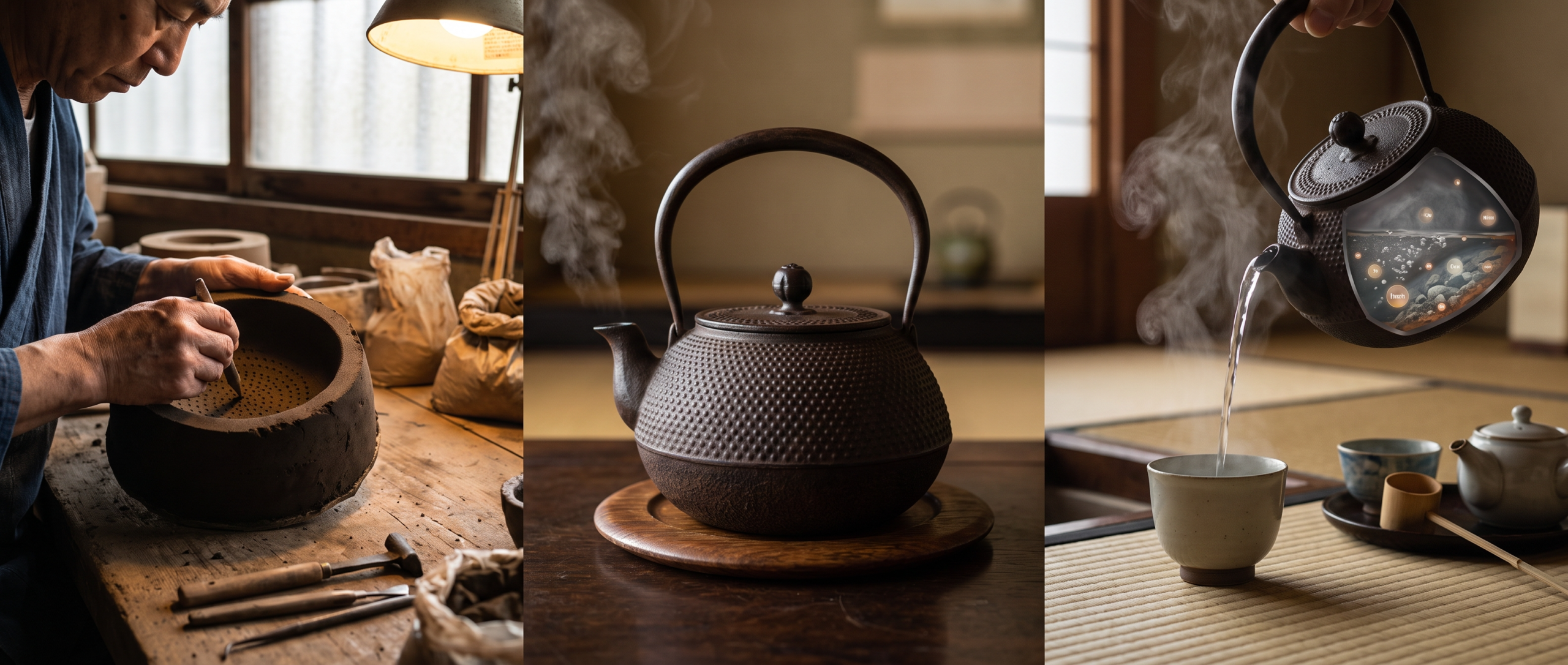
Nanbu Tekki: The Cast Iron That Changes the Water
Boil ordinary tap water in a Japanese iron kettle and it comes out tasting different — softer, rounder, cleaner. The reason is partly chemistry, partly four hundred years of a northern craft that treats a kettle as an heirloom.
There is a claim that sounds like folklore until you taste it for yourself: water boiled in a cast-iron kettle is better than water boiled in anything else. Tea made from it is rounder, the harsh edge of the tap gone, a faint mineral warmth in its place. People who own one of these kettles tend to speak about it the way others speak about a good knife or a cast-iron pan — as an object that quietly improves everything it touches and asks only to be looked after in return.
The kettle in question is a tetsubin, and the tradition behind it is Nanbu tekki — the cast ironware of Iwate Prefecture, in Japan’s cold northeast. It is heavy, dark, often dimpled with a pattern of raised dots, and built to last generations. And the story of why it changes the water turns out to be two stories braided together: one of chemistry, and one of a craft old enough to have started before the samurai age ended.
A Kettle, Not a Teapot
First, a distinction that trips up almost everyone, because it matters enormously. Nanbu tekki produces two similar-looking objects that do opposite jobs, and confusing them will ruin one of them.
A tetsubin is a kettle: a vessel for boiling water over direct heat. Its interior is bare cast iron, which is exactly the point — the iron is meant to be in contact with the water. You put it on the flame, boil water in it, and pour that water over tea leaves in a separate pot. You do not steep tea inside it.
A tetsu-kyūsu — an iron teapot — looks like a small tetsubin but is lined on the inside with enamel to keep it from rusting, and it is made for steeping already-boiled water with tea leaves. Because of that enamel lining it must never go on direct heat, and it does not release any iron into the tea. The bare-iron kettle changes the water; the enamel-lined teapot does not. Everything interesting about Nanbu tekki’s effect on flavor happens inside the tetsubin, on the fire.
The tetsubin boils water on the flame with bare iron inside; the iron teapot only steeps and is lined to keep it from rusting. One changes the water. The other does not.
Why the Water Comes Out Different
So what actually happens when water boils in bare cast iron? Three things, and none of them is magic.
The first is the one you taste most immediately. Municipal tap water carries residual chlorine, added to keep it safe, and that chlorine is much of what gives tap water its faintly flat, chemical edge. When water is boiled in a bare iron kettle, the iron reacts with that residual chlorine and helps drive it off, so the water emerges noticeably softer and rounder — the Japanese word people reach for is maroyaka, mellow. Boiling alone removes some chlorine; boiling in iron removes more.
The second is that a trace of the iron itself dissolves into the water, and the kind of iron matters. The iron that leaches from Nanbu ironware is largely ferrous iron — divalent iron, the form the human body absorbs most readily; studies of Nanbu ironware have found the great majority of the dissolved iron to be this absorbable form. It lends the water a very slight mineral character and offers a modest dietary benefit. Here honesty is important: the amount of iron involved is small, a supplement measured in traces, not a cure for anything. The flavor effect is real; the health claims should be kept modest.
The third is simply heat. Thick cast iron holds and distributes warmth exceptionally well, so a tetsubin reaches a stable, vigorous boil and holds its temperature — the kind of steady, fully rolling boil that good tea, especially, rewards. Between the softened water, the trace of absorbable iron, and the even heat, the cup that results genuinely is different from one made with an electric kettle. It is a small difference, but it is not imaginary.
Two Cities, Two Histories
“Nanbu tekki” is a single name covering two production centers with two quite different pasts, and understanding them explains a lot about the craft.
Morioka, the seat of the old Nanbu domain, is the source of the name itself. Around the middle of the seventeenth century the Nanbu lord — ruling a region unusually rich in iron sand, river sand, clay, charcoal, and lacquer, everything an ironworker needs — invited master kettle-makers from Kyoto to cast chanoyu-gama, the large kettles used in the tea ceremony. From that courtly, aesthetic origin the smaller everyday tetsubin was eventually developed, and Morioka’s tradition grew up oriented toward tea ware and objects of beauty.
Mizusawa, to the south in what is now Ōshū — historically part of a different domain — has an even older and more workmanlike lineage. Casting there is said to reach back some nine hundred and fifty years, to the Heian period, when a local lord is said to have brought foundry workers from the Ōmi region. Mizusawa built its reputation not on tea kettles but on the iron pots and cooking vessels of daily life. One region refined the art object; the other perfected the household tool. Today both are gathered under the single name Nanbu tekki, and together they earned recognition as one of Japan’s designated Traditional Crafts.
Made of Sand and Fire
A cast-iron kettle is made in almost the opposite way to a forged blade or a turned wooden bowl: nothing is carved or hammered into shape. Instead, a mold is built, molten iron is poured into it, and the metal takes the mold’s form as it cools. The whole character of the finished piece is decided before the iron ever arrives, in the making of the mold.
The finest tetsubin are made with the yaki-gata, the “baked mold” — a mold of sand and clay, patterned on its inner face, then fired hard. It is exacting, slow work: a single yaki-gata yields only a handful of kettles before it is destroyed, and a traditional piece can pass through eighty or more separate steps and take roughly a month to complete. Higher-volume ware uses a reusable sand mold instead, but the prized objects still come from the baked mold, one small batch at a time.
It is on that mold’s inner surface that the tetsubin’s most recognizable feature is born: arare, the “hailstone” pattern of tiny raised dots covering the body of the kettle. Each dot is impressed into the mold by hand, one by one, so that a densely, evenly dotted tetsubin is a quiet advertisement of the caster’s patience and control. After casting, the kettle is fired again and finished — often colored with lacquer and tea — both to bring up its deep black-brown surface and to protect the raw iron against rust. That final lacquer coat is a small point of kinship with another of Iwate’s neighboring crafts, and with the wider Japanese instinct, familiar from the world of urushi, to seal and protect a surface so an object can survive generations of use.
An Object You Tend
Like the best lacquerware, a tetsubin is not finished when you buy it; it is finished, and re-finished, by being used. Bare iron rusts, so the kettle has to be dried after every use — a small daily discipline that quickly becomes second nature. In return, over months and years, a pale mineral scale called yu-aka builds up on the inside from the boiled water, and far from being a fault, this coating is prized: it protects the interior and is said to make the water taste even better. A well-kept tetsubin does not wear out so much as it matures, its inside slowly conditioned by every kettle of water it has ever boiled.
This is the thread that ties Nanbu tekki to the rest of the Japanese table. A tetsubin is not a disposable appliance to be replaced when a newer model appears. It is a heavy, dark, patient object made from local sand and iron by hands doing what their predecessors did four centuries ago, and it is designed to be handed down — improving the water a little more with each passing year, growing its protective skin, waiting to be dried and set back on the shelf. To own one is to take on a small, daily relationship with a piece of metal, and to be rewarded, every single morning, with a cup that tastes quietly and unmistakably better.
Read, then taste. This article is part of Waden’s Vessel series — exploring the art of serving and the objects that shape the Japanese table. For another material made to be used, mended, and passed down, read The Sap That Becomes an Heirloom: Urushi and the Long Life of Lacquer.
Waden is an editorial journal exploring the depth and beauty of Japanese food culture — its history, ingredients, artisans, and traditions. Story first, always. waden.umamibako.com
Comment