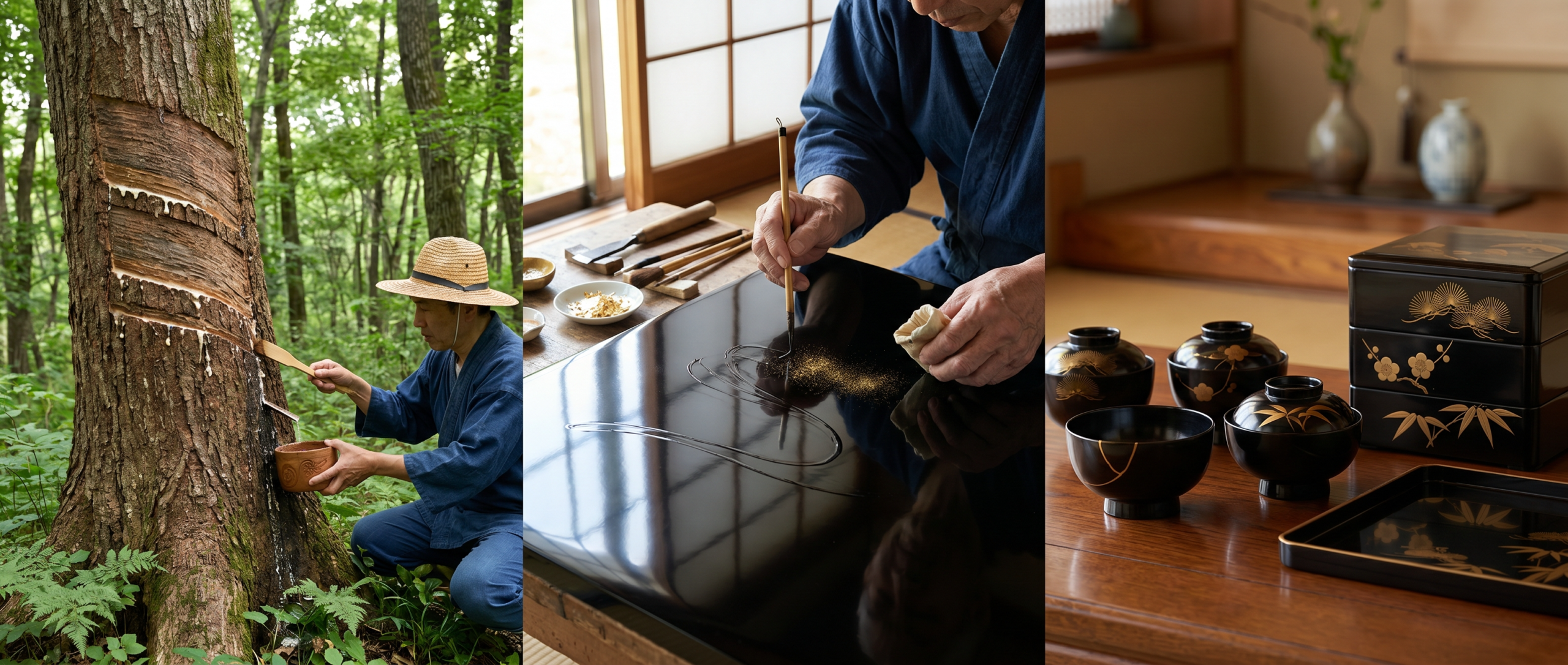
The Sap That Becomes an Heirloom: Urushi and the Long Life of Lacquer
A tree bleeds a poisonous resin. A carver shapes wood. A painter draws in gold dust no thicker than pollen. And an object is made that is meant to outlive the person who made it — if the tree survives at all.
There is a particular kind of object that a Japanese family keeps not for a few years but for generations: a set of lacquered soup bowls, a tiered box brought out only at New Year, a single tray whose black surface has deepened to something like still water. These are not treated as disposable, and they are not treated as museum pieces either. They are used, washed, put away, brought out again — and, when they are chipped or worn, they are repaired rather than replaced. The object is understood to have a lifespan measured in human generations, not seasons.
That expectation — that a bowl is an heirloom in waiting — is possible because of a single remarkable material: urushi, Japanese lacquer. We have written elsewhere about why cooks reach for lacquerware in the first place, the warmth and lightness and the way a black bowl frames the food it holds, in Why Japanese Chefs Still Choose Lacquerware. This article follows a different thread: not why the material is chosen, but what human hands do with it — how a poisonous tree sap is turned into an object that can carry gold pictures, survive a century of daily use, and be handed down. And why that whole tradition is quietly more fragile today than it has ever been.
A Gift the Tree Gives Slowly
Everything begins with a wound in a tree. Urushi is the sap of Toxicodendron vernicifluum, a relative of poison ivy, and in its raw state it is exactly as hostile as that lineage suggests: the active compound, urushiol, causes severe rashes on contact with skin. The people who harvest it — the urushi-kaki, the lacquer tappers — work in high summer, scoring shallow horizontal cuts into the bark of a mature tree and returning to collect the milky resin that seeps out, a few grams at a time, cut by cut, over a season.
The arithmetic of this harvest is sobering. A single tree yields only a small cupful of usable sap across an entire summer. In the method practiced in Japan today, called koroshi-gaki — literally “killing tapping” — the tree is bled steadily through the season and then felled, its life given entirely to that one harvest. It takes something like a decade or more of growth to produce a tree worth tapping, and the tapping ends it. Every lacquered object, then, sits on top of a slow, deliberate exchange: years of a tree’s life, converted into a substance measured in grams. Before a single tool touches the wood, urushi is already precious.
“A single tree yields only a small cupful of usable sap across an entire summer — and in Japan, the tapping ends the tree. Every lacquered object sits on top of that exchange.”
The Places That Speak Through Lacquer
What that sap becomes depends enormously on where it is worked, because Japanese lacquer is not one tradition but a federation of regional ones. The most celebrated is Wajima-nuri, from the Noto Peninsula, whose reputation rests on an almost obsessive commitment to durability: a wooden core reinforced at its weak points with cloth soaked in lacquer, then undercoated with urushi mixed with a local powdered diatomaceous earth, ji-no-ko, found only around Wajima. That mineral base, built up and hardened layer by layer through a process that can run past a hundred distinct steps, gives Wajima ware a structural toughness that lets a piece survive a century of daily use. Wajima is what durability looks like when it is pursued without compromise.
But it is far from alone. Aizu-nuri, from what is now Fukushima Prefecture, tells a different and quieter story of survival. The tradition began in 1590, when a newly installed lord, Gamō Ujisato, brought woodworkers and lacquerers with him from his former domain near Lake Biwa and set the region on a course of producing lacquer from the growing of the trees to the final decoration. Aizu was devastated as a battlefield in the civil war of the late 1860s, its lacquer industry all but destroyed, and then rebuilt itself by the middle of the Meiji era into one of Japan’s leading producers again — a craft that has twice had to come back from near-ruin. Its decoration carries its own regional vocabulary, including the auspicious Aizu-e patterns of pine, bamboo, and plum. Each producing region — Wajima, Aizu, Echizen, Tsugaru, Kishū and more — is recognizable to a trained eye, the visible accent of a particular place.
Drawing in Gold: Maki-e and Chinkin
It is on that cured, mirror-dark surface that the most extraordinary work happens — the decoration that turns a vessel into a picture. Two great families of technique dominate, and they are opposites: one builds the image up onto the surface, the other cuts it down into it.
The first is maki-e, literally “sprinkled picture.” The artisan draws a design in wet lacquer with a fine brush and then, before it hardens, sprinkles metal powder — gold, silver, sometimes colored dusts — onto the tacky lines, so that the powder adheres exactly where the lacquer was laid. The result is an image made of metal, fused permanently into the surface as the lacquer cures. There are, broadly, three levels of ambition. In hira maki-e, the flat kind, the design sits nearly level with the surface. In togidashi maki-e, the whole surface is coated over the sprinkled design and then painstakingly polished back down until the image re-emerges, flush and glass-smooth, as if suspended within the lacquer itself. And in taka maki-e, the high kind, the design is built up in relief so that it stands proud of the surface, giving depth, shadow, and dimension. A single elaborate piece can take months of this — brush, sprinkle, cure, polish, repeat.
The second family works in the opposite direction. In chinkin — “sunken gold” — the artisan takes a fully finished, hardened lacquer surface and carves into it, incising fine lines and dots with a chisel or knife, then presses gold leaf or fine gold powder into those cut grooves. The metal sinks into the recesses and stays there, so that the design reads as lines of gold drawn beneath the polished surface rather than upon it. It is a technique of engraving rather than painting, and it is a signature of Wajima. Between them, maki-e and chinkin represent two entire philosophies of ornament — addition and subtraction, the picture raised and the picture cut — practiced on a material that punishes any hesitation, since neither the sprinkled powder nor the carved line can be undone.
“Two philosophies of ornament: maki-e builds the gold picture up onto the surface, chinkin cuts it down into it. Addition and subtraction, on a material that forgives no hesitation.”
The Object That Refuses to End
All of this labor is invested in objects that are, remarkably, designed not to be finished. A ceramic bowl, once fired, is fixed forever; break it and it is gone. Lacquer is different, and the difference is the heart of why the tradition survives. Urushi keeps changing after it leaves the workshop — deepening in color and gaining lustre with age and handling — and, crucially, it can be renewed. A scratched, chipped, or worn piece can be taken back to a lacquerer, the damage filled and recoated, the surface restored. A well-made and well-cared-for Wajima bowl can pass through a hundred years of use precisely because it is expected to be mended along the way.
This repairability shades into one of Japan’s most recognizable aesthetic ideas. The related art of kintsugi — mending broken ceramics with lacquer dusted with gold, so that the repair becomes a visible golden seam rather than a hidden flaw — depends on exactly the same material, urushi acting as the adhesive that binds the pieces. The logic is the same in both cases: damage is not the end of an object’s life but an episode within it, and the record of that damage can be made beautiful. A lacquered vessel is not a static thing you own so much as a living one you tend. The bowl your grandmother used is not merely old; it is, in some literal sense, made partly of every meal and every repair it has passed through.
The Fragile Foundation
Which makes the tradition’s present situation quietly alarming, and it is the part of the story that rarely gets told. The whole edifice — the regional styles, the gold pictures, the century-long bowls — rests on the supply of that slow, painful, tree-killing sap. And Japan barely produces it anymore. Something on the order of ninety-seven percent or more of the lacquer used in Japan today is imported, the overwhelming majority of it from China. Domestic urushi has dwindled to a tiny fraction of what the country consumes, sustained by a shrinking handful of tappers concentrated in a few areas.
The consequences are subtle but real. A craft that carries the deepest continuity of any in Japan — the use of urushi reaches back thousands of years, into the prehistoric Jōmon period — now stands on a foundation of material it largely does not make itself. When even the highest-tier restoration of national cultural treasures requires domestic lacquer, that scarcity becomes a question of whether the tradition can reproduce itself at all. The problem is not, for now, a shortage of lacquer to buy. It is the thinness of the human chain that produces the native article: the tappers, the tree-growers, the knowledge of the killing-tap and the summer harvest. A technique measured in millennia can be broken in a generation, simply by no one being left to do the first, hardest step.
And so the humble bowl carries more than it appears to. Lift it and you hold the end of a very long line: a tree bled and felled in a summer decades ago, a core turned and reinforced, dozens of coats cured in warm damp air, perhaps a design of gold sprinkled or carved into the darkness, and the expectation — written into the material itself — that it will be repaired and used and handed on long after you have set it down. That is what an heirloom is: not an object that lasts because it is never touched, but one that lasts because it is used, tended, and passed forward. Urushi is the rare material that makes such a thing possible. The open question, now, is whether the tradition that turns sap into heirlooms will itself be handed on.
Read, then taste. This article is part of Waden’s Vessel series — exploring the art of serving and the objects that shape the Japanese table. To understand why cooks reach for lacquer in the first place, read Why Japanese Chefs Still Choose Lacquerware.
Waden is an editorial journal exploring the depth and beauty of Japanese food culture — its history, ingredients, artisans, and traditions. Story first, always. waden.umamibako.com
Comment