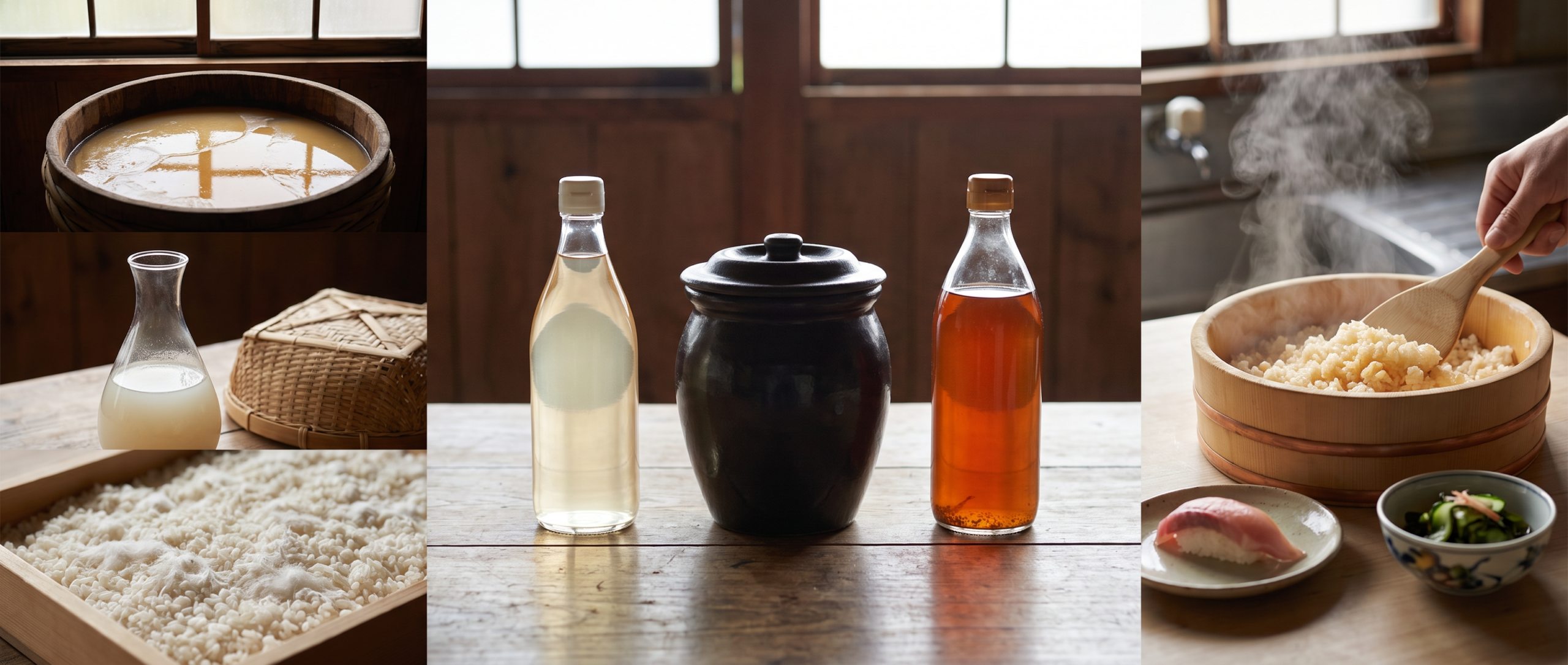
Rice Vinegar: The Sourness That Was Once Sake
Every bottle of Japanese rice vinegar is a wine that went the wrong way on purpose. Before it ever touches a grain of sushi rice, it is the end of two fermentations stacked on top of each other — and the quiet foundation beneath half the Japanese table.
Pour a little into a spoon and it is the least impressive thing in the kitchen: a thin, pale-gold liquid, sharp to the nose, with none of the drama of a glistening piece of fish or a dark pool of soy sauce. It asks for no attention. And yet a serious sushi chef will tell you that the vinegar folded into the rice is one of the two or three decisions that define their entire craft — and that the bottle itself, before it ever reaches the counter, is a fermented food with as much depth and history as miso or sake.
The reason hides in how it is made. To produce rice vinegar you must first make something very close to sake, and then invite in the one microorganism a sake brewer spends his whole life keeping out. The sourness at the end is not the goal so much as the residue of two living processes handed off, one to the next. Understand that hand-off and you understand not just vinegar, but why a seasoning this plain became indispensable.
The Wine That Went Sour on Purpose
Rice vinegar is built in two fermentations, and they belong to two different organisms. The first is the same transformation that makes sake. Steamed rice is broken down into sugar by kōji mold — the same Aspergillus oryzae that drives miso, soy sauce, and every other fermented flavor in the Japanese kitchen, and which you will have met in our piece on how miso turns time into flavor — and yeast then turns that sugar into alcohol. What you have at this point is essentially a rough rice wine.
The second fermentation is where vinegar parts ways with sake. Acetic acid bacteria — Acetobacter — consume that alcohol in the presence of oxygen and oxidize it into acetic acid. This is exactly what happens to a bottle of sake left open too long: it turns sour on its own, because these bacteria are everywhere, doing by accident what a vinegar maker does on purpose. A vinegar brewer, in other words, runs a sake fermentation and then deliberately courts the very contamination a sake brewer dreads. Sourness is sake’s fate, chosen deliberately.
To make vinegar you first make something close to sake, then invite in the one microbe a sake brewer fights hardest to keep out. Sourness is sake’s fate, chosen on purpose.
How that second fermentation is run separates the traditional vinegar from the industrial one. In the old Japanese way — seichi hakkō, “still fermentation” — the liquid rests undisturbed in open vats while a living film of acetic bacteria forms on the surface and works slowly downward over months, followed by further months of quiet maturation. The modern factory method forces air through the agitated liquid and finishes the same conversion in under a week. Both make vinegar. Only one makes the rounded, aromatic depth that traditional Japanese cooking was built around.
Komezu: The Clean Default
The everyday vinegar of Japan is komezu, rice vinegar, and Japanese law is unusually specific about what may bear the name. Under the JAS standard, a grain vinegar can be called komezu only if it uses at least forty grams of rice per litre, and its acidity must reach at least 4.2 percent. That forty-gram floor is a legal minimum, not a badge of quality — the good makers use several times more rice, and the difference lands squarely on the tongue.
One distinction is worth carrying to the shop. A vinegar labeled junmai-su, “pure rice vinegar,” is made from rice alone; one labeled simply komezu may have had distilled alcohol added to the mash to stretch the yield and lighten the taste. Pure rice vinegar carries more body and a gentler aroma, because fermentation has filled it with amino acids and organic acids; the alcohol-extended kind is thinner and sharper. Good komezu is pale gold, faintly sweet, and mild — a vinegar built to lift other flavors without announcing itself, which is precisely why it became the backbone of Japanese seasoning.
Kurozu: The Vinegar That Never Stops
If komezu is restraint, kurozu — black vinegar — is patience made visible. Its most famous form, the pot-brewed black vinegar of Fukuyama in Kagoshima, has been made in the same southern town for roughly two centuries, and is protected today as a Geographical Indication. What makes it remarkable is a method that is genuinely rare anywhere in the world.
Instead of separate vessels for each stage, everything happens inside a single earthenware pot left standing outdoors in the sun. Steamed brown rice, rice kōji, and water are layered in, and a final scattering of dried koji — the furi-kōji — is sprinkled across the surface to seed and seal the ferment. The pot’s mouth is covered, and then the maker waits. Inside that one vessel, all three processes at once — kōji turning starch to sugar, yeast turning sugar to alcohol, bacteria turning alcohol to acid — proceed naturally, driven by the region’s mild, stable climate. Fermentation runs at least six months; maturation adds at least six more, and across that year the vinegar darkens from brown toward black and grows its deep aroma.
The long, whole-grain process is what fills the bottle. Fukuyama black vinegar uses something like five times the rice of ordinary vinegar and matures far longer, and as a result carries an unusually high amino-acid content — around 500 milligrams per 100 millilitres. Those amino acids and peptides are the source of its rounded, savory depth, while a trace of lactic acid softens the edge and leaves a clean finish. It is a vinegar with enough character to be drunk diluted, or reduced into a sauce the way an aged balsamic might be.
Akazu: The Vinegar That Made Sushi Cheap
The third of the great Japanese vinegars has the best story, and the deepest tie to the table. Kasuzu — also called akazu, red vinegar — is made not from fresh rice but from sake kasu, the lees left behind after sake is pressed. Those lees still hold roughly eight percent alcohol, so they can be aged two or three years, deepening in color and umami, then mashed with water and fermented straight into vinegar. The result is amber to reddish-brown, mellow and complex, with far less of the raw sting of ordinary vinegar. Folded into rice it leaves the grains a faint gold rather than white — the quiet signature of traditional Edo-style sushi.
It has a name and a date. In 1804, a sake brewer named Nakano Matazaemon, from the town of Handa near present-day Nagoya, traveled to Edo and met the newly fashionable early nigiri being sold in the city’s stalls. Rice vinegar was expensive, and so, therefore, was sushi. Matazaemon saw that a vinegar made from sake lees — a byproduct his own trade threw off in abundance — could season sushi rice at least as well, and far more cheaply. Back in Handa he developed exactly that, taking a real risk in the process, since a sake brewer courting acetic bacteria could ruin his sake. His firm became the company now known as Mizkan, today the largest vinegar maker in the world, and shipped by sailing boat from Handa to Edo, his vinegar helped turn nigiri from a costly novelty into the food of a whole city.
There is a flavor logic here that the most traditional sushi masters still live by: a good akazu reads as gentle sweetness once salt is added, so rice seasoned with it needs little or no sugar at all. How that seasoned vinegar actually becomes sushi rice — the secret blend, the folding, the service at body temperature — is the whole subject of our companion piece, Shari and the hidden half of sushi, which stands on the chef’s side of the counter. This article stays on the other side, with the bottle before it arrives.
What Vinegar Actually Does
Sushi is the loudest use of vinegar but far from the only one, and the quieter ones show what it is really for. In sunomono, the small vinegared dishes of cucumber, seaweed, and seafood that punctuate a meal, the vinegar is usually softened into a blend with soy sauce and mirin so that it refreshes rather than shocks — its job here is contrast, a cool bright counterpoint to richer food. In nanbanzuke, hot-fried fish or vegetables are steeped in a sweet-sour vinegar sauce with chili and scallion; the name itself records history, nanban, “southern barbarian,” pointing back to the Portuguese and Spanish traders who reached Japan in the sixteenth century and brought both deep-frying and the escabeche trick of dressing fried food in vinegar.
Beneath flavor, the acid does older work. It penetrates and it preserves — a mild antimicrobial power that mattered enormously before refrigeration, and the reason humans made vinegar at all. It survives in every quick pickle in the Japanese repertoire. Across all of it runs one principle: vinegar is rarely the flavor you notice, but the structure that holds the others in place, sharpening richness, lifting sweetness, cutting fat, keeping food safe. It belongs to the same family as miso and soy sauce, all of them born of kōji and time, and like them it does its most important work unseen.
Vinegar is rarely the flavor you notice. It is the structure that holds the others in place — and, long before refrigeration, the reason food kept at all.
Choosing the Bottle
For most cooking, a good pure rice vinegar is the right default — clean enough to disappear into rice, dressings, and pickles without taking over. Reach for black vinegar when you want depth and a finishing note rather than a neutral acid, diluted as a drink or reduced into sauce. And seek out a genuine akazu, now carried by specialist importers, when you want to push sushi rice toward the amber, low-sugar profile of old Edo style. The rule is the same one that governs every fermented seasoning: the longer and more traditionally it was made, the less of it you need, and the more it gives back.
There is a habit of treating vinegar as an afterthought — the last splash in a recipe, the cheap bottle by the stove. But a properly made bottle is the end of a long chain of living transformations: rice into sugar into alcohol into acid, each step handed from one organism to the next, sometimes across years. It is the quiet foundation under sushi rice, under the cool bite of a summer salad, under the sweet-sour glaze of fried fish. Like the best things on the Japanese table, it was never meant to be tasted alone — only to make everything around it taste more fully like itself.
Read, then taste. This article is part of Waden’s Fermentation series — exploring Japan’s living culture of miso, soy sauce, sake, and beyond. To see how this vinegar becomes the hidden foundation of sushi, read The Rice Was Always the Point.
Waden is an editorial journal exploring the depth and beauty of Japanese food culture — its history, ingredients, artisans, and traditions. Story first, always. waden.umamibako.com
Comment