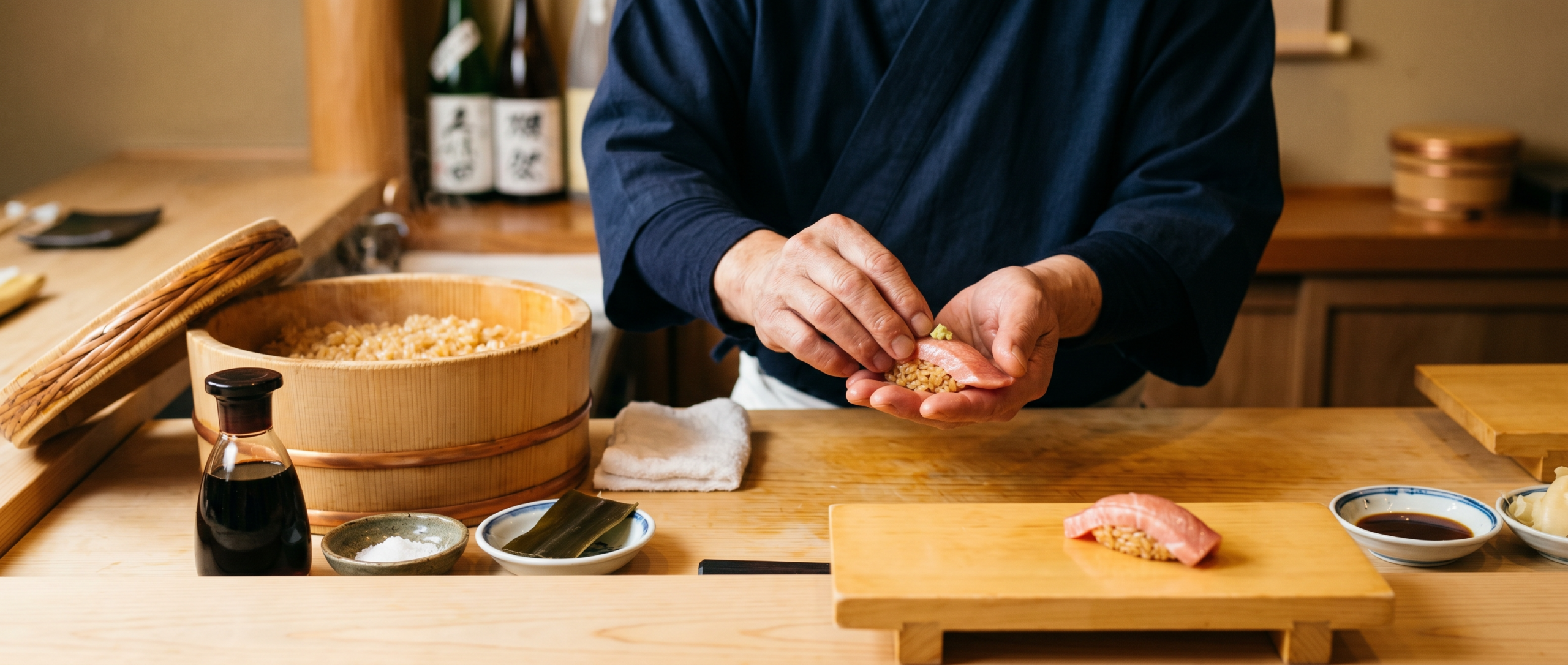
The Rice Was Always the Point: Shari and the Hidden Half of Sushi
Every conversation about sushi begins with the fish. But ask a master what defines their craft, and the answer is almost always the rice — its temperature, its seasoning, and the vinegar that has quietly shaped Edo-style sushi for over two hundred years.
The Misplaced Spotlight
When people talk about sushi, they talk about the fish. The fatty tuna, the sweetness of the scallop, the brief firmness of a slice of sea bream — these are the things that fill the photographs and the conversations. The rice beneath, when it is mentioned at all, is treated as a kind of necessary platform: the thing the fish sits on, white and quiet, doing its supporting work without asking for attention. For most people outside Japan, and for many inside it, sushi is fundamentally a dish about seafood.
The people who make sushi do not see it this way. Among Japanese sushi chefs there is a long-standing understanding that the rice — shari (しゃり) — is the harder part, the more important part, and the part by which a serious craftsperson is actually judged. The fish can be sourced, aged, and sliced with great skill, but it begins as something already excellent. The rice begins as a bowl of grain and water, and everything it becomes is the result of decisions the chef makes: which rice, which vinegar, how much salt, what temperature, how it is mixed, and how long it is allowed to rest before it meets the fish. A diner can taste the difference between competent shari and exceptional shari even if they could not name what they are tasting. It is the foundation on which the entire experience either stands or quietly fails.
This article is about that foundation — what shari actually is, how it is made, and why one particular vinegar, born in a small town near Nagoya in 1804, transformed sushi from a fermented food into the dish the world now recognizes. If our companion piece, One Bite, One Truth, was concerned with what happens after a finished piece of nigiri is placed in front of you, this one is concerned with the half of the work that happens before the fish ever arrives.
What Shari Actually Is
Shari is cooked short-grain rice that has been seasoned, while still warm, with a mixture of vinegar, salt, and — in most but not all cases — sugar. The seasoned result is called sumeshi (酢飯), vinegared rice; shari is the word used at the counter for the rice specifically as a component of sushi. The seasoning mixture itself is called awasezu (合わせ酢) — “combined vinegar” — and it is one of the most closely guarded elements of any sushi restaurant. The precise blend a chef uses is typically a secret, refined over years and passed from master to apprentice only at the completion of training.
A commonly cited baseline ratio for sushi vinegar is roughly four parts vinegar to two parts sugar to one part salt, but this is a starting point rather than a rule, and serious chefs deviate from it significantly according to their own judgment and the style of sushi they make. The mixture is gently warmed to dissolve the salt and sugar and to soften the sharpness of the vinegar, often with a piece of kombu added to contribute umami, then folded into freshly cooked hot rice. The folding is done with a cutting motion using a wooden paddle, never a stirring or mashing one, so that the grains are coated and separated rather than crushed into paste. As the rice is mixed, it is often fanned — not for show, but to drive off surface moisture and bring the rice down to the working temperature at which it will be shaped.
The result, when done well, is rice in which each grain remains distinct and slightly glossy, lightly cohesive so that it holds together under the press of a hand but falls apart cleanly in the mouth, and seasoned so that the acidity, salt, and sweetness are present without any one of them announcing itself. It is not “rice with vinegar on it.” It is a constructed thing, balanced against the fish it will carry, and its quality is bounded entirely by the decisions of the person who made it.
“The fish begins as something already excellent. The rice begins as grain and water — and everything it becomes is the chef’s decision. That is why it is the part by which a craftsperson is judged.”
Akazu and Komezu: Two Vinegars, Two Philosophies
The single most consequential decision in the making of shari is the choice of vinegar, and here the history of sushi divides cleanly into two lineages. Most sushi rice today is seasoned with komezu (米酢) — rice vinegar, made by fermenting rice into alcohol and then fermenting that alcohol into vinegar, a process that takes a matter of months. Komezu is pale, clean, and mildly sweet, with a gentle acidity. It is the vinegar most people associate with sushi, and it produces rice that is light in both color and flavor.
But the vinegar that defines traditional Edo-style sushi — the style developed in nineteenth-century Tokyo that became the template for nigiri everywhere — is something different: akazu (赤酢), red vinegar, made not from rice but from aged sake lees, the solids left behind after sake has been pressed. The story of how akazu came to exist is, in a real sense, the story of how nigiri became a popular food at all.
In the early nineteenth century, rice and the rice vinegar made from it were expensive. The hayazushi — “fast sushi,” the early vinegared sushi that was beginning to take hold in Edo as an alternative to the older fermented styles — was seasoned with rice vinegar, which put it toward the costlier end of street food. In 1804, a sake brewer named Nakano Matazaemon, from the town of Handa in Owari province (in present-day Aichi Prefecture, near Nagoya), traveled to Edo and encountered the popular hayazushi there. He reasoned that a vinegar made from sake lees — a byproduct his industry produced in abundance — could make sushi both more flavorful and more affordable. Returning to Handa, he developed exactly that: a vinegar made from aged sake lees. Matazaemon was the founder of the company now known as Mizkan, today the world’s largest producer of rice vinegar, and his premium kasu vinegar, “Yamabuki,” appeared around 1845.
The chemistry of akazu is what gives it its character. Sake lees are aged for an extended period — in the most traditional production, for years — during which a slow Maillard reaction turns the pale solids dark and develops a complex, sweet, earthy aroma, the same broad family of aging reactions that gives depth to aged cheese, wine, and whisky. The aged lees are then mixed with water into a mash, strained into a reddish-black liquid, and fermented into vinegar. The finished akazu is deep in color and complex in flavor, yet lighter on the palate than its intensity suggests; when folded into rice, it lends the grains a faint golden or amber hue rather than the pure white of komezu-seasoned rice. Matazaemon’s vinegar suited the flavor of nigiri so well that it was adopted by the popular sushi shops of Edo, shipped from Handa’s port to Edo’s by sailing vessel, and became one of the quiet foundations of the city’s sushi culture.
There is a flavor logic to akazu that experienced chefs describe precisely: the sourness of a good red vinegar reads as a gentle sweetness once salt is added — the same way a pinch of salt makes citrus taste sweeter — so that rice made with akazu often needs little or no added sugar. The most traditional Edo-style chefs reject sugar in their shari entirely, on the grounds that overly sweet rice tastes pleasant for the first few pieces and then becomes cloying, while rice with a clean edge of acidity can be eaten from the first piece to the last without fatigue. Today, after a long period in which even Edo-style restaurants leaned toward rice vinegar, akazu has returned to prominence at the high end, prized for exactly the depth and restraint that made it valuable two centuries ago.
“A vinegar invented in 1804 from a brewer’s leftover sake lees did not just season the rice. It made nigiri affordable — and in doing so, helped turn a fermented food into the dish the world now knows.”
Temperature as Design
If the vinegar determines the flavor of shari, temperature determines the experience of it. At a serious sushi counter, the rice is kept close to human body temperature — warm to the touch but not hot — and held there throughout service. This is not incidental. Warm shari releases the aroma of the vinegar seasoning, keeps the grains soft and glossy, and, on contact, gently softens the fat of the fish placed against it so that the two melt together rather than sitting side by side. The contrast between the warm rice and the cool fish is part of the architecture of a single piece of nigiri.
Maintaining this is demanding work. The rice is prepared in small batches through a service rather than cooked once and left to sit, fanned to the correct temperature, and held under a damp cloth — traditionally in a wooden tub, an ohitsu, whose wood helps regulate moisture — so that it neither dries out nor cools below its working range. The moment shari drops too far in temperature, the grains begin to firm and contract, the vinegar aroma fades, and the rice loses the quality that lets it meet the fish as one thing rather than two. Much of the unglamorous labor of running a sushi counter is, in effect, temperature management of the rice.
This is also where the rice and the act of eating connect directly. A finished piece of nigiri exists in a narrow window — the shari at its intended warmth, the fish still cool — and that window is precisely why traditional sushi is meant to be eaten promptly and in a single bite. The temperature design of the rice and the etiquette of how a piece is consumed are the same idea seen from two ends. We treat the eating side of that equation in detail in One Bite, One Truth; what matters here is that the chef builds the temperature contrast into the rice deliberately, knowing exactly how it is meant to be received.
The Rice Is Made for the Fish
Shari is not a neutral base to which any fish can be added. It is designed in relation to the fish it will carry, and in traditional Edo-style sushi this relationship runs deep, because the fish itself is rarely served simply raw. The classic preparations — curing in salt and vinegar (shime), marinating in soy sauce (zuke), curing between sheets of kombu (kobujime), simmering, and brushing with a reduced sweet-savory glaze — are collectively known as the chef’s “work,” shigoto. The seasoning of the rice is calibrated against this work.
A robust akazu shari, with its depth and clean acidity, pairs naturally with red-fleshed fish and with aged or strongly seasoned toppings that would overwhelm a delicate rice. A lighter komezu shari suits the clean flavors of white fish. Chefs who salt their fish before serving — which traditional Edo-style practice does for most toppings, with notable exceptions such as tuna — will balance the salt of the rice against the salt already in the fish, so that the seasoned shari and the seasoned topping arrive at equilibrium only when combined. The rice tastes deliberately assertive on its own precisely because it is not meant to be eaten on its own.
This is why a single restaurant may blend more than one vinegar, and why the awasezu recipe is treated as a secret on the level of an eel restaurant’s decades-old sauce. The rice is the one element present in every piece served across an entire meal, and it must work with each topping in turn while still expressing the identity of the house. To get the rice right is to make a hundred different pairings work at once.
Making Shari Outside Japan
For a cook approaching shari for the first time outside Japan, the most important decisions are the ones a sushi chef obsesses over: the rice, the vinegar, and the temperature. The rice should be a short-grain Japanese variety, whose higher proportion of the starch amylopectin gives it the gentle cohesion that lets it hold together when pressed without becoming gluey. Koshihikari is a widely trusted choice, valued for the way its natural stickiness and sweetness complement the vinegar seasoning rather than competing with it; the question of which short-grain variety suits which purpose is one we explore in detail in Not All Rice Is the Same, and it applies as much to sushi rice as to a plain bowl.
For the vinegar, a good-quality rice vinegar (komezu) is the practical and authentic starting point, seasoned with salt and a small amount of sugar — or, for those who want to taste in the direction of traditional Edo-style sushi, with little to no sugar at all. Genuine akazu is harder to source outside Japan, though it is increasingly available from specialist importers; it is worth seeking out for the way it shifts the flavor of the rice toward depth and away from sweetness. Unrefined sea salt, gently dried in a dry pan before use, contributes a rounder flavor than refined table salt, and a piece of kombu added to the warming vinegar lends quiet umami.
Above all, season the rice while it is hot, fold rather than stir, and serve it warm — close to body temperature — rather than cold from the refrigerator. Cold, firm rice is the single most common failure of home sushi, and it is entirely avoidable. The rice that has been seasoned with care and kept at the right temperature is, in the end, most of what separates a memorable piece of sushi from a forgettable one.
There is a tendency, when admiring something beautiful, to look at the part that asks to be admired. With sushi, that is the fish — and the fish deserves it. But the craft, the difficulty, and the identity of a sushi chef live in the rice: in the choice of a vinegar invented two centuries ago from a brewer’s discarded sake lees, in the discipline of holding a hundred small batches at body temperature through a long service, in the secret balance of acid and salt that must work against every topping in turn. To understand shari is to understand that in Japanese cooking the most important work is often the least visible — that what looks like a quiet white platform for the fish is, in truth, the thing the whole dish was built around all along.
Comment