Summer on the Plate: Coolness as a Thing You Cook
Japanese summer food is not simply food that happens to be cold. It is an engineered response to heat — a vegetable named for the wrong season, a fish eaten at its worst moment for reasons that have nothing to do with flavour, and a table where the bowl is chosen before the dish.
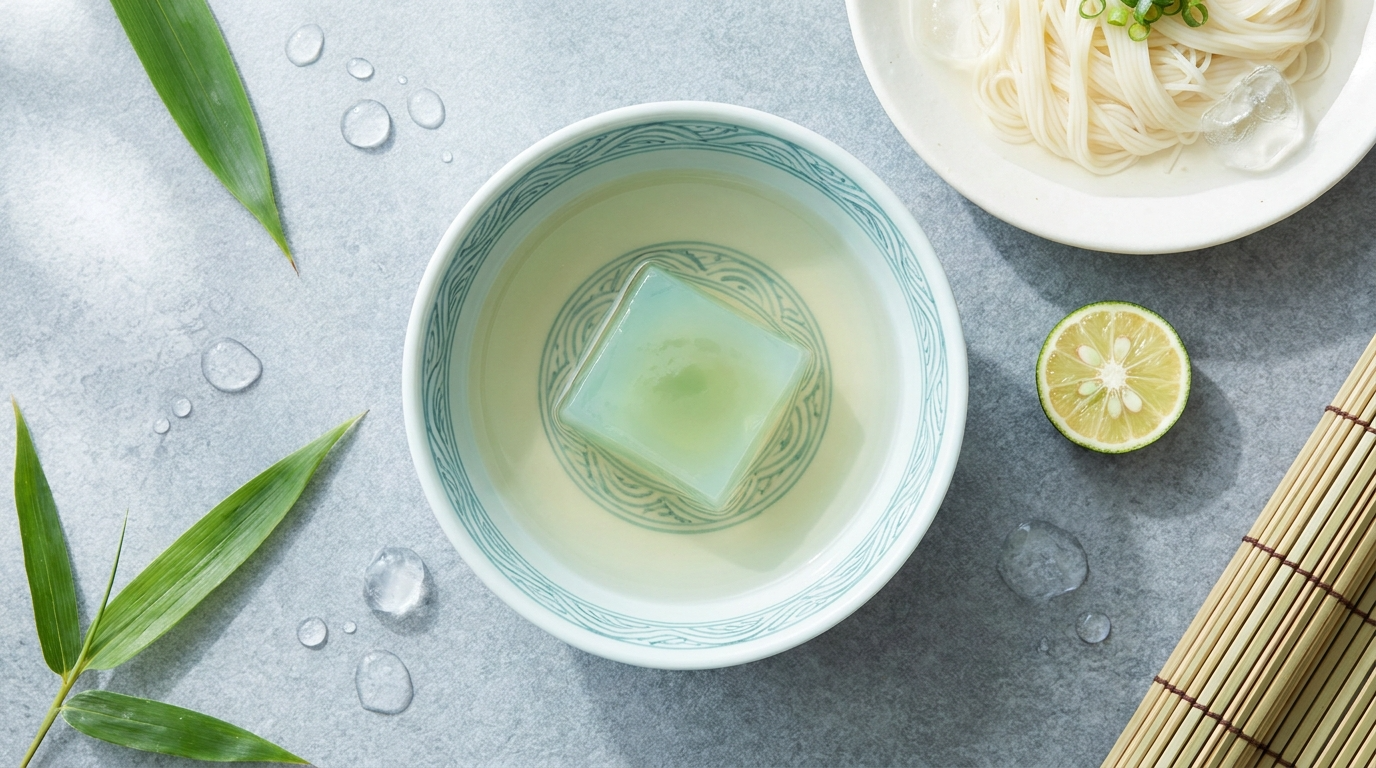
A bowl of clear soup arrives with a pale green cube floating in it, so translucent at the edges that you can see the pattern of the bowl through it. The cube is faintly warm. The broth is faintly warm. Nothing about the dish is chilled, and yet the whole thing reads, unmistakably, as cool.
That is the trick that Japanese summer cooking spent centuries learning. Coolness at the table is not a temperature. It is an effect, produced by colour and translucency and the material of the vessel and the shape of a cut, and it can be assembled out of ingredients that are not cold at all. Where spring reaches for bitterness to wake the body up, summer reaches for the appearance of cold to calm it down — and the appearance, it turns out, does a great deal of the work.
The Melon That Is Named for Winter
The cube in that bowl is tōgan, and its name is a small joke that the Japanese kitchen has been telling for over a thousand years. Written with the characters for winter and melon, it is harvested in the dead of summer, roughly June to September. The name records not when it grows but how long it keeps: left whole in a cool dark place, a tōgan will hold until winter — until around March, by JA Group’s reckoning. It is a summer vegetable named for the season it survives into. Native to India and the tropics of Southeast Asia, it appears in Japanese records as early as the Heian period, in the herbal text Honzō Wamyō.
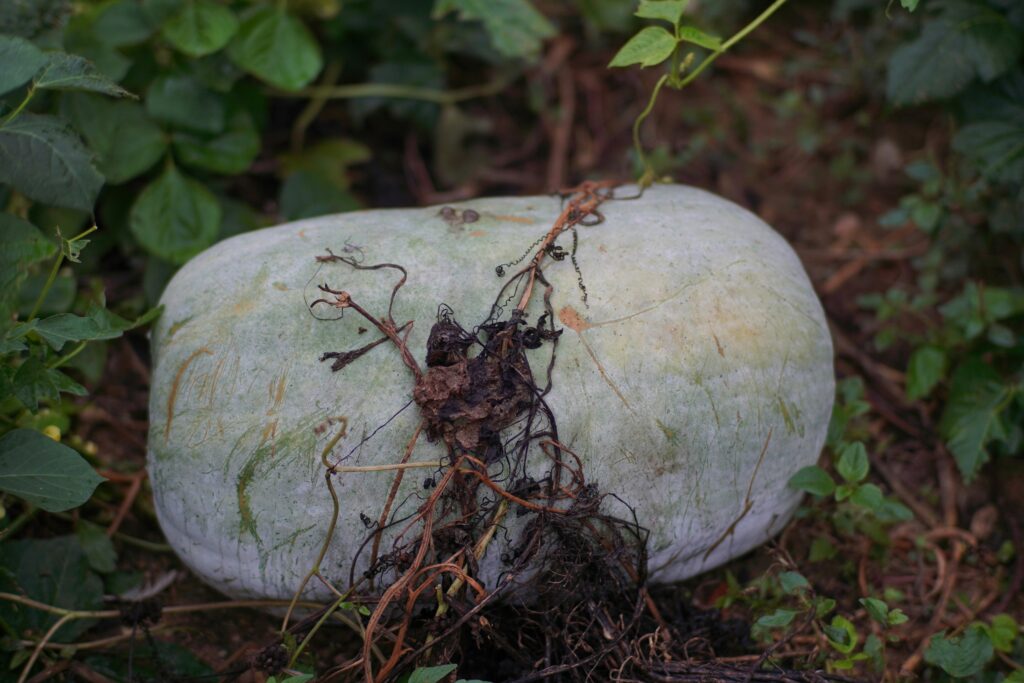
It is also almost nothing. Ninety-five percent water, negligible in calories, and — this is the important part — nearly without flavour of its own. A cook does not use tōgan for what it tastes like. A cook uses it because it will take on dashi completely while contributing only texture and a colour.
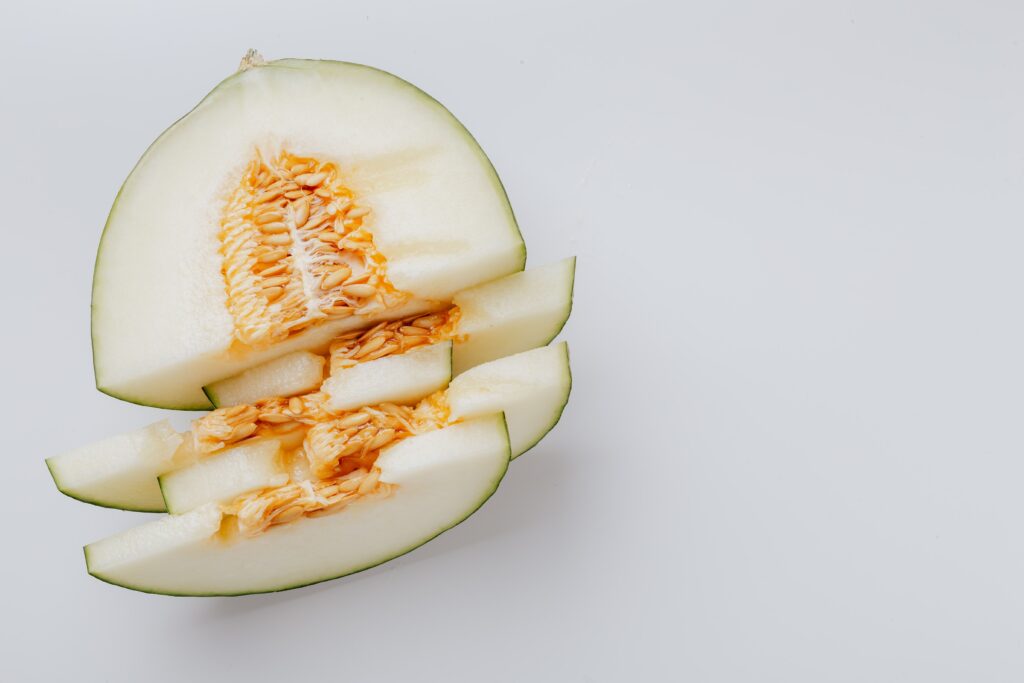
That colour is a deliberate product. The standard instruction is to peel the tōgan thinly rather than deeply, because leaving a trace of the green just under the skin makes the cooked flesh finish in a pale jade — hisui-iro, kingfisher green — and thin peeling also keeps the cube from collapsing as it simmers. The dish that results, tōgan no ankake, is a cube simmered in dashi and served under a thin, translucent kudzu-thickened sauce. The thickening is not for richness. It gives the surface a wet gleam, and a gleaming, semi-transparent pale green object in a dark bowl looks like something cold even when it is served warm.
The medicine agrees with the aesthetics. Tōgan is high in potassium, which helps the body shed excess sodium and fluid, and in Ayurveda it is regarded as cooling and used against fever. It is one of those cases where the traditional classification of a food as body-cooling and the modern nutritional account do not contradict each other.
Coolness at the table is not a temperature. It is an effect — assembled from colour, translucency, and the material of the bowl, and perfectly achievable with food that is served warm.
The Fish Eaten at the Wrong Time
And then there is the exception that swallows the rule. On one appointed day in the hottest part of the year, the entire country eats a hot, fatty, charcoal-grilled fish lacquered in sweet soy — the least cooling meal imaginable — and does so with total conviction.
Doyō no ushi no hi, the midsummer day of the ox, is a date produced by two overlapping old calendars. Doyō refers to the roughly eighteen days preceding each of the four seasonal turning points, so there are four doyō periods a year; days were counted in a twelve-branch zodiac cycle; and where a day of the ox falls inside the summer doyō, you get the day. Because twelve does not divide evenly into eighteen, some years contain two of them. It lands close to Taisho, the term of greatest heat.
Ask anyone in Japan why eel is eaten that day and you will hear about Hiraga Gennai, the Edo polymath, who supposedly rescued a struggling eel vendor by telling him to hang a sign reading “today is the day of the ox.” The story is repeated everywhere and it is almost certainly not true — or at least, there is no contemporary evidence for it. It surfaces only in later writings, and historians treat it as legend rather than record.
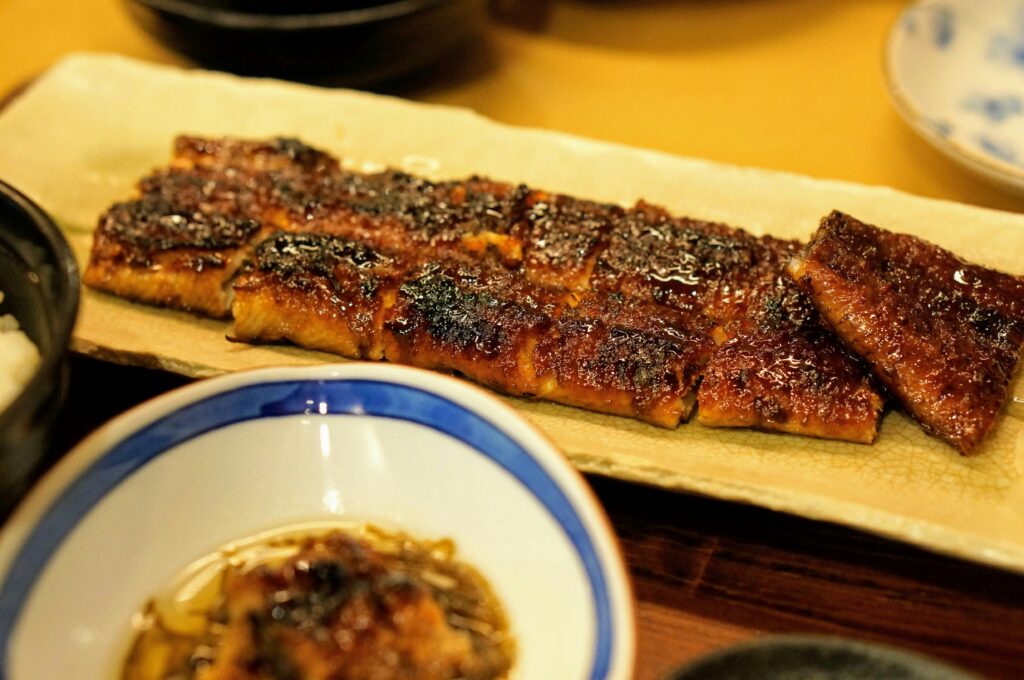
What does survive is duller and more convincing. The food-culture historian Iino Ryōichi points to the 1821 miscellany Meiwashi, which notes that eating eel on the day of the ox during doyō had begun “around the Anei and Tenmei eras” — that is, the 1770s and 80s. The custom, in other words, is documented as an eighteenth-century commercial habit whose originator nobody recorded. Iino is careful to add that among the various explanations there is no decisive one.
Underneath the custom lies a much older folk logic that had nothing to do with eel specifically: on the day of the ox, ushi, one should eat foods beginning with the syllable u to avoid succumbing to the heat. Udon, umeboshi, uri melon — and unagi. Eel simply won the competition, helped by a genuinely old association with summer exhaustion. The Man’yōshū, compiled in the Nara period, contains a poem by Ōtomo no Yakamochi teasing a thin friend: he tells Ishimaro that eel is said to be good for summer wasting, and that he should go and catch some. The nutritional case has held up unusually well — eel is dense in vitamins A, B1, B2, D and E, and the Ministry of Agriculture, Forestry and Fisheries notes that a hundred grams supplies an adult’s daily vitamin A requirement.
The irony is that midsummer is the wrong time to eat one. Wild eel is at its best in autumn and winter, when it fattens before migrating, and the fat and flavour peak in the cold months. Farmed eel, which is what almost everyone actually eats, is raised and marketed to the summer calendar. So the most famous seasonal food in the Japanese year is eaten precisely out of season, at the moment the fish is leanest, because a date on a fifteen-hundred-year-old calendar says so. It is a useful reminder that shun, the doctrine of the one true moment, is not the only force operating on the Japanese table. Ritual timing can override it entirely.
The regional split in how the fish is cut carries its own history. In Kantō the eel is opened along the back; in Kansai, along the belly. The explanation usually given is that in the samurai culture of Edo, cutting open the belly evoked seppuku and was avoided, while in the merchant culture of Osaka, opening the belly suggested speaking frankly — belly to belly. Kantō also steams the eel between grillings, producing a softer result, where Kansai grills it straight through for a crisper edge. The sanshō pepper served alongside is said to have begun as a way of masking the strong odour of older farmed eel, though it also has the practical virtue of cutting the fat.
Fruit, and a Word That Has Drifted
If eel is summer’s violation, mizugashi is its resolution — and the word repays a moment’s attention, because it no longer means what it means.
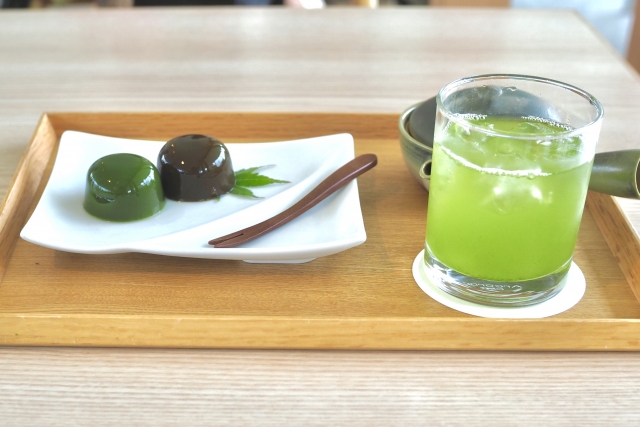
Today many people encounter mizugashi on a restaurant menu and take it to mean a chilled jelly or a soft, watery sweet. Properly, it means fruit. In ancient Japanese, the word kashi — written with characters meaning fruit and seed — referred to fruits and nuts, which were the sweet things available to eat. When sugar and wheat arrived and confectionery became an industry, Japan needed to distinguish the made from the grown: by the Edo period, kashi had come to mean manufactured sweets, and fruit was renamed mizugashi, water-confection. NHK’s language research division notes that the original sense is fruit, and treats the dessert-jelly usage as a drift. The confusion is understandable — higashi, dry confection, is defined by containing under ten percent water, so a “water sweet” sounds like it should be its opposite rather than a peach.
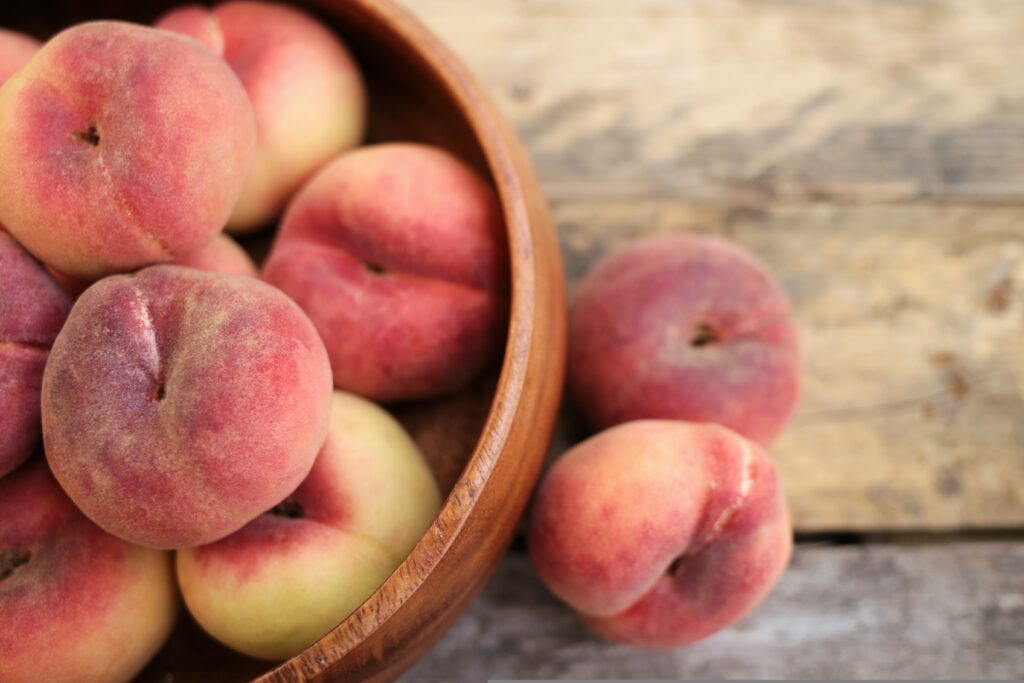
The word matters here because it tells you how the summer meal ends. Not with a constructed dessert but with something cut, chilled, and set down without ceremony: watermelon, peach, nashi pear, muscat grapes. The most refined version does nothing at all to the fruit except present it beautifully — often on glass, often with ice — which is entirely consistent with the season’s logic. Summer is the season in which the cook’s ambition is to be as invisible as possible.
The Bowl Comes First
Here is where Japanese summer cooking departs most sharply from other cuisines: a significant portion of the coolness is delivered by the vessel, and the vessel is chosen before the dish.
For most of the year, the Japanese table runs on ceramic and lacquer — warm, opaque, holding heat. In summer the material changes. Glass appears, and it is not a modern convenience. Researchers of Edo-period kaiseki have documented that although ceramic and lacquer dominated the formal meal, glass played a significant role specifically in summer, valued for the sense of coolness its transparency produced. The Edo townsman’s cut glass, Edo kiriko, was a summer pleasure. A glass vessel does something a ceramic one cannot: it shows you the ice, the water, the translucency of what it holds, and it reads as cold to the eye before anything reaches the tongue.
Shape and arrangement follow the same principle. Summer serving tends toward flat, wide, shallow vessels rather than deep ones, food heaped low and loosely rather than piled, portions deliberately small with generous empty space around them, and a scattering of green — a shiso leaf, a sprig of kinome, a slice of cucumber — for visual relief. Ice appears as a serving surface rather than an ingredient. What all of this shares is an intention to look unburdened, because an overloaded plate feels heavy, and heavy feels hot.
Even the water is theatre. Uchimizu, sprinkling water on the entrance stones and garden before guests arrive, is a summer courtesy that lowers the temperature slightly by evaporation and lowers it considerably by suggestion. The wind chime, the sound of the water, the glass bowl, the pale jade cube — these are all the same technology, applied at different scales.
The bowl is chosen before the dish. A glass vessel shows you the ice and the translucency of what it holds, and reads as cold to the eye long before anything reaches the tongue.
Eating Against Exhaustion
Behind the aesthetics sits a practical anxiety with a name. Natsubate — summer fatigue — is the collapse of appetite and energy in prolonged heat and humidity, and the traditional food year is organised partly around fending it off.
The mechanism the old kitchen understood intuitively is now easy to state. In heat, people sweat heavily and drink constantly, which dilutes digestive secretions and flushes out water-soluble nutrients; appetite falls; and the foods that remain appealing — cold noodles, chilled drinks — are largely carbohydrate. Metabolising carbohydrate consumes vitamin B1, and a diet of little else creates exactly the deficiency that produces lethargy. Which is why the tradition insists on eel, and on pork, both unusually rich in B1, at the precise moment when noodles are all anyone wants. The custom is not superstition dressed as nutrition. It is a correction applied to a predictable seasonal failure of diet.
The rest of the summer table works on the same principle. Cucumber, tomato, eggplant, watermelon and tōgan are all high in water and potassium, replacing what sweat removes. Umeboshi and vinegar restore salt and stimulate a stalled appetite. Ginger, myōga, shiso and sanshō appear everywhere as garnish, doing more than decorating — a sharp aromatic makes food interesting to a body that has stopped being interested in food. And this is where the season’s contradiction resolves: the cooling dishes handle the discomfort, while the fortifying ones handle the depletion, and a properly composed summer meal contains both.
The cold noodle bowl belongs to the first category, and belongs to it completely. Sōmen is the emblematic summer food of Japan and has its own long history of hand-stretching and regional craft, which we followed in our Article of the thinnest thread. What matters here is only its position in the season’s architecture: it is the dish you can still face when you can face nothing, served on glass, over ice, with ginger and myōga alongside — and it is precisely because it is nearly all carbohydrate that the eel has to exist.
Enduring, Beautifully
Set the summer table beside the spring one and the difference in intent is stark. Spring food is about arrival — brief, eager, gone before you are ready. Summer food is about endurance. Nothing about a Japanese summer is fleeting; the heat is long, wet, and wearing, and the cuisine’s response is not to celebrate the season but to make it survivable, and then to make survival elegant.
That is the through-line connecting a melon named for winter, a fish eaten at its leanest on a date set by a zodiac, a word for fruit that means water-confection, and a glass bowl brought out for three months of the year. None of it is decoration. The pale green cube in warm broth, the sprinkled water on the stones, the small portion on the wide shallow plate — each is a small engineering decision aimed at the same problem, which is that it is too hot to eat and one must eat anyway. The Japanese summer table’s real achievement is that it solves that problem without ever appearing to be working. It just looks cool. To follow how this season sits within the full turning year, our walk through the twenty-four sekki puts it in order.
Read, then taste. This article is part of Waden’s Seasons series — following the rhythm of the Japanese culinary year. Read more at waden.umamibako.com.
Waden is an editorial journal exploring the depth and beauty of Japanese food culture — its history, ingredients, artisans, and traditions. Story first, always. waden.umamibako.com
Comment