A Year at the Japanese Table: Eating Through the Twenty-Four Sekki
Japan divides the year into twenty-four seasons, each about two weeks long. Walk through them in order and you are no longer reading a calendar — you are eating one.
Most of the world eats by four seasons, and loosely at that. Japan keeps a finer clock. The traditional calendar divides the year not into four parts but into twenty-four — the sekki, solar terms of roughly fifteen days each — and then subdivides those again into seventy-two microseasons of about five days apiece. It is one of the most precise systems for naming the passage of a year ever devised, and it was never an abstraction. It was a way of knowing what to plant, what to catch, what to pick, and what to eat.
We have written elsewhere about the philosophy underneath all this — the idea of shun, the belief that every ingredient has one true moment, and the finer distinctions of hashiri, sakari, and nagori that divide even a single season into arrival, peak, and farewell. If those concepts are new to you, start with Shun: The Japanese Obsession with Peak Season, which lays out the framework. This article does something different. Instead of explaining the calendar, it walks through it — a single turn around the Japanese year, season by season, following what actually appears on the table as the twenty-four terms go by.
Spring: The Bitter Green Beginning
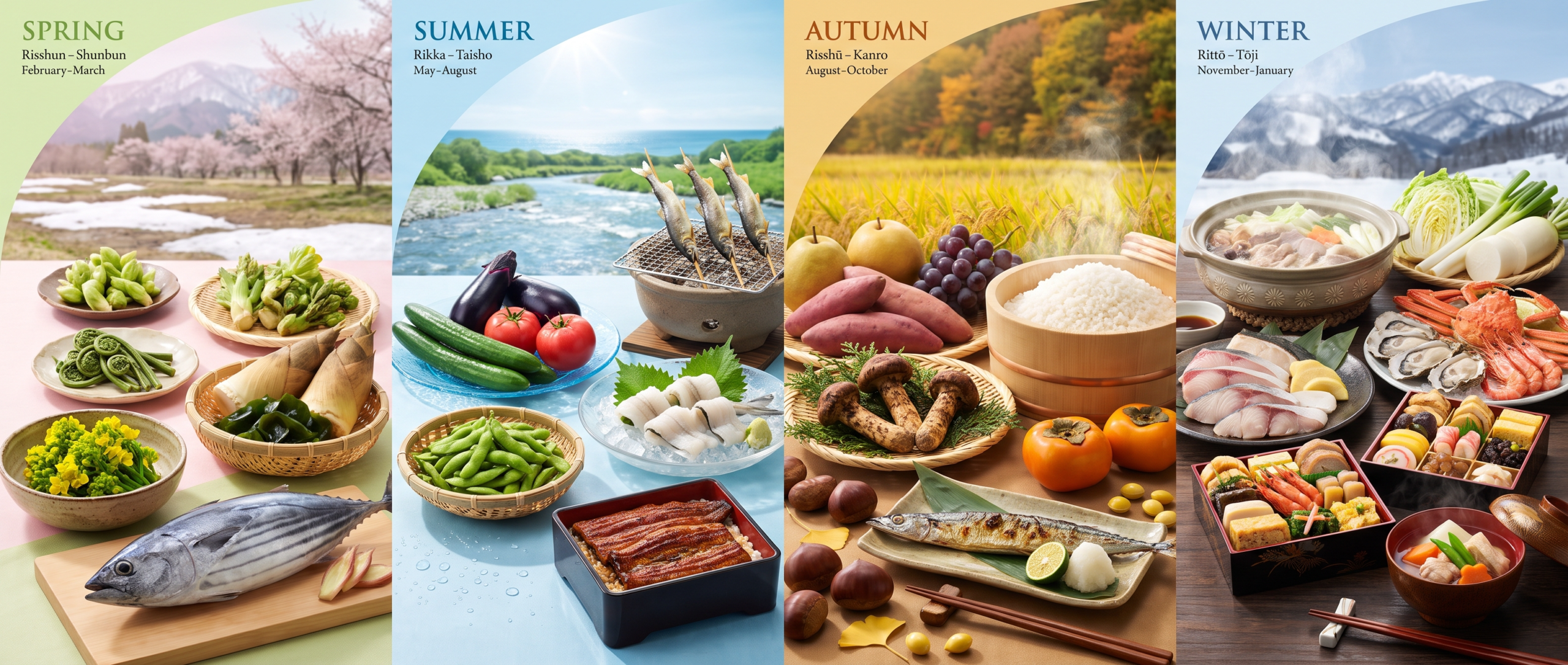
The Japanese year, in this old reckoning, does not begin in the depths of winter but at Risshun — the “start of spring,” falling in early February, while the ground is still cold. It is an act of faith more than observation: spring is declared before it can be felt. And the first foods of the year reflect that in-between quality. This is the season of sansai, the wild mountain vegetables that push up as the snow recedes — butterbur buds, bracken, fiddleheads — prized for a distinct edge of bitterness. There is an old kitchen saying that the spring plate should carry bitterness, and it is taken seriously: after a winter of stored and preserved food, the sharp green astringency of these shoots is understood to wake the body up.
As the terms turn — through Usui, when snow gives way to rain, and Keichitsu, “the waking of insects” — spring gathers force. The great emblem of the season arrives: takenoko, bamboo shoots, dug fresh and cooked simply, often simmered with young wakame seaweed in a dish called wakatakeni that pairs two spring ingredients at their peak. Rape blossoms, nanohana, bring their own gentle bitterness to a quick blanching. And out at sea, riding the warm Kuroshio current northward, comes the first bonito of the year — hatsu-gatsuo, the “first katsuo,” so anticipated that Edo-period city-dwellers were famous for paying absurd sums to taste it early. By Shunbun, the spring equinox, day and night stand equal and the season is fully open.
“The spring plate should carry bitterness. After a winter of stored food, the sharp green edge of wild shoots is understood to wake the body up.”
Summer: Coolness as a Flavor
Summer opens, again ahead of the heat, at Rikka in early May, and as it deepens the whole logic of the table inverts. Where spring reached for bitterness to stir the body awake, high summer reaches for coolness to calm it down. The ingredients that define the season are, above all, refreshing: cucumber, tomato, eggplant, edamame, and the shining garden vegetables that arrive together by Geshi, the summer solstice, the longest day of the year.
The sea offers its own summer answers. Ayu, the sweetfish, is grilled whole over charcoal with a scattering of salt and eaten in season as a marker of the river year. Along the terms of deep summer — Shōsho and Taisho, “lesser” and “greater” heat — comes the celebrated hamo, the pike conger, whose fine bones must be painstakingly severed by a skilled knife before it can be blanched and eaten, a cool white delicacy that is practically the taste of a Kyoto summer. And then there is the year’s most famous eating custom: Doyō no ushi no hi, the “midsummer day of the ox,” when Japan eats grilled eel, unagi, to fortify itself against the heat — a tradition popularized, by legend, as a piece of Edo-period marketing that simply never went away. Summer cooking is engineered to make the heat bearable: light, glistening, served cool.
Autumn: The Season of Abundance
If any season is the emotional center of the Japanese food year, it is autumn — the harvest, and the reward for everything that came before. It begins at Risshū in early August, when the heat still lingers but the light has begun to change, and it builds toward a table so rich it has its own phrase: shokuyoku no aki, “autumn, the season of appetite.”
The signatures come thick and fast. Sanma, the Pacific saury, arrives fat with oil and is grilled whole with grated daikon and a squeeze of citrus — the single most iconic autumn fish. From the mountains comes matsutake, the aromatic pine mushroom so prized it can cost more by weight than almost any other food in Japan, cooked with the lightest possible hand so as not to overwhelm its scent. Chestnuts, persimmons, ginkgo nuts, sweet potatoes, grapes, pears — the whole spectrum of ripeness arrives at once. And above all comes the year’s rice: shinmai, the new-crop rice harvested around the term of Kanro, “cold dew,” in October, fragrant and faintly sweet in a way stored rice can never match. To understand why that single ingredient carries such weight, our piece on how rice made Japan follows the grain to its roots. Autumn, more than any season, is when the calendar delivers on its promise.
“Autumn has its own phrase: shokuyoku no aki, ‘the season of appetite.’ It is the harvest, and the reward for everything that came before.”
Winter: Depth, Warmth, and Waiting
Winter begins at Rittō in early November and carries the year to its close. The cold rewrites the table once more, and the guiding principle now is warmth and depth. This is the season of the nabe, the shared hot pot simmered at the table, and of the vegetables built for it: hakusai (napa cabbage), long green onion, and above all daikon, which grows sweet and dense in the cold and gives itself completely to slow simmering.
The sea turns generous in a different register. Cold-water fish come into their glory — buri, the yellowtail, is at its richest as “cold buri,” kanburi, its fat peaking in the depths of winter; cod, tara, softens into the pot; and oysters reach their creamy best. Snow crab arrives from the northern waters. Sweet shrimp, ama-ebi, sweetens in the cold. Through the terms of Shōsetsu and Taisetsu — “lesser” and “greater” snow — and past Tōji, the winter solstice and darkest point of the year, the food grows deeper, warmer, and more consoling. And winter is when preservation and celebration meet, because the year’s most elaborate meal is waiting at its end.
The Feasts That Punctuate the Year
Threaded through this cycle of ingredients is a second layer: the calendar of festival foods, dishes tied not to what is ripe but to a specific day and its meaning. They give the year its punctuation. At Setsubun in early February, roasted soybeans are thrown to drive out bad fortune. On the third day of the third month, the Doll’s Festival brings its pale, sweet foods; on the fifth of the fifth, Children’s Day brings rice cakes wrapped in oak and bamboo leaves. Tanabata, the star festival of July, is marked by eating sōmen, the thin cold wheat noodles that suit the heat. Autumn’s Chōyō, the chrysanthemum festival, celebrates longevity.
The greatest of these is New Year, and its food is a world of its own. Osechi-ryōri — the tiered lacquer boxes of small, symbolic, largely preserved dishes — is prepared so that the household need not cook during the sacred first days of the year, each item carrying a wish: black beans for health and diligence, herring roe for fertility, sweet chestnut for prosperity. Alongside it comes ozōni, the mochi soup that varies from region to region and household to household. Then, on the seventh day, the table deliberately empties out again: a simple rice porridge with seven spring herbs, nanakusa-gayu, eaten to rest a body worn out by feasting and to reach, once more, toward the coming spring. The circle closes, and begins again.
Eating in a Circle
Walk the whole of it — from the bitter shoots of a spring declared before it arrives, through the cooling foods of summer and the overflowing table of autumn, into the deep warm pots of winter and the symbolic boxes of the New Year — and something becomes clear that no single meal can show you. The Japanese food calendar is not a list of what happens to be available. It is a structure, as deliberate as architecture, in which each ingredient is understood to have a place, a moment, and a meaning in a larger cycle.
This is what the twenty-four sekki really encode: not just agricultural information, but a way of belonging to the year. To eat the first bonito in spring, the eel at the height of summer, the new rice in autumn, the cold yellowtail in the deep of winter, and the herb porridge that resets it all — this is to move through time on purpose, to let the table keep the calendar for you. A year eaten this way is not twelve months long. It is twenty-four seasons, and seventy-two smaller ones inside them, each with its own brief and unrepeatable taste. The meal, in Japan, has always been a way of telling time.
Read, then taste. This article is part of Waden’s Seasons series — following the rhythm of the Japanese culinary year through its twenty-four solar terms and beyond. To understand the philosophy beneath the calendar, read Shun: The Japanese Obsession with Peak Season.
Waden is an editorial journal exploring the depth and beauty of Japanese food culture — its history, ingredients, artisans, and traditions. Story first, always. waden.umamibako.com
Comment