The Thinnest Thread: Somen
An Introduction to Japanese Sōmen
At their finest, sōmen noodles reach a diameter of 0.3 millimeters — thinner than a strand of hair, thinner than most things that could still be called food. To produce a noodle of that dimension by hand, from a dough of only wheat flour, salt, and water, requires more than twenty distinct stretching stages over two days, and a sensitivity to humidity, temperature, and the behavior of gluten under tension that takes years to develop. That the resulting noodle is then served cold, with a simple dipping sauce, and eaten in minutes, is not irony. It is the point.
What Sōmen Is
Sōmen (素麺) are very thin dried wheat noodles, white in color, round in cross-section, and defined by Japanese food standards as measuring less than 1.3 millimeters in diameter. They are made from three ingredients — wheat flour, salt water, and a small amount of vegetable oil — and produced through a process of repeated hand-stretching that is entirely different from the cutting or rolling method used to make most other Japanese noodles. The oil is not a flavoring; it is a technical necessity, applied to the surface of the dough at each stage of stretching to prevent it from drying and tearing before it reaches its final thinness.
The finished dried noodles are bundled into neat portions — typically 50 grams per bundle — tied with colored paper bands, and sold in small boxes or flat packages. They cook in boiling water in two to three minutes, then are rinsed immediately in cold water to stop the cooking and remove surface starch. The result is a noodle that is simultaneously delicate and resilient: thin enough to slip easily through a dipping sauce, firm enough to maintain its texture for the duration of a meal, and mild enough in flavor to carry whatever seasoning accompanies it without asserting itself.
A History Stretched Over Twelve Centuries
The origins of sōmen reach back to the Tang Dynasty in China (618–907 CE). During this period, Japanese imperial envoys made regular missions across the sea to study Chinese culture, technology, and Buddhism. On one such mission, they returned with a knotted pastry called sakubei — made from wheat flour, rice flour, and water, kneaded and stretched into rope-like shapes, then dried. Sakubei was served at the Imperial Court on festival occasions, including the Tanabata star festival, and occupies the early record of Japan’s encounter with the stretched-noodle form.
The transformation from sakubei into what we recognize as sōmen occurred gradually, primarily in the Miwa district of what is now Sakurai City, Nara Prefecture. Two developments catalyzed the change during the Kamakura period (1185–1333): the introduction of stone mills (ishiusu) by Zen Buddhist monks, which made it possible to produce fine, consistent wheat flour, and the adoption of vegetable oil as a stretching lubricant, which allowed the dough to be pulled far thinner than starch-coated methods had permitted. By the late 14th century, the term sōmen appeared in historical records, distinct from its predecessor. The noodle had found its identity.
During the Edo period (1603–1868), production spread beyond Nara to the Setouchi coastal regions — Hyogo, Kagawa, Nagasaki — and the technique refined itself into a regional craft with strict local traditions. Sōmen was initially a food of the aristocracy and Buddhist temples; by the Edo period, it had become available to ordinary people, and the traveling culture of the era — merchants and pilgrims passing through noodle-producing towns — helped spread its reputation across Japan.
One detail worth noting: high-quality hand-stretched sōmen is sometimes aged before sale. Producers believe that storing dried sōmen for up to a year in controlled conditions — cool, dry, dark — allows the oil to penetrate further into the noodle, resulting in a smoother texture and cleaner flavor when cooked. Aged sōmen (hinemono) commands a premium in Japan, and the practice inverts the usual assumption that dried noodles are a convenience food without subtlety.
How Sōmen Is Made: The Tenobe Technique
The word tenobe (手延べ) means “hand-stretched,” and it names the production method that defines premium sōmen. It is a process measured in days, not hours, and in the skill of human hands applied at the right moment, at the right temperature, with the right pressure.
It begins with a dough of wheat flour, salt water, and oil, kneaded until smooth and elastic, then rested. The rested dough is rolled into thick ropes and coiled. Oil is brushed onto the surface, and the ropes are wound onto pairs of wooden rods. The artisan then begins the stretching — pulling the rods gradually apart, allowing the dough to elongate under its own weight and the gentle force of the hands. The noodles are left to rest between stretches, allowing the gluten to relax before the next pull. This cycle of stretch, rest, oil, and stretch again is repeated across multiple stages over the course of a day and a half to two days, the noodles becoming progressively thinner at each pass.
The final stage is drying: the stretched noodles are hung on bamboo sticks and dried in the open air — traditionally in the dry, cold winters characteristic of sōmen-producing regions, where low humidity and clean air produce the best results. Once dry, they are cut to length, bundled, and tied. The entire process — from kneading to packaged noodle — requires the artisan to read the dough continuously, adjusting tension and timing to the temperature and humidity of the day. No two days of production are identical.
Machine-made sōmen exists and is widely sold; it is cheaper, more consistent, and perfectly acceptable for everyday use. But tenobe sōmen, produced by hand in the traditional manner, is a different object. On the packet, look for the word tenobe (手延べ) — it signals that the noodle was made by stretched dough rather than cut or extruded. The difference in texture is perceptible: tenobe sōmen has a slightly more complex, elastic chew, and a surface smoothness that makes it slip cleanly through the dipping sauce.
Sōmen Among Japan’s Noodles: How It Fits
Japan has a remarkably coherent noodle culture, but its noodles are genuinely distinct from one another — different ingredients, different production methods, different textures, different seasons of use. Understanding where sōmen sits within that landscape makes it easier to appreciate what it is.
Udon is the most dramatically different comparison. Udon noodles are thick — between 4 and 6 millimeters — made from wheat flour, salt, and water, and produced by rolling and cutting rather than stretching. Where sōmen is thin, delicate, and quick-cooking, udon is substantial, chewy, and forgiving of long simmering in broth. Udon is a cold-weather noodle in its most characteristic forms: hot in a clear dashi broth, topped with tempura, in a thick miso soup with root vegetables. Sōmen and udon share their basic ingredients but produce entirely different eating experiences — one is suited to summer restraint, the other to winter warmth.
Soba diverges from sōmen in its primary ingredient: soba noodles are made from buckwheat flour — usually mixed with a proportion of wheat flour for binding — which gives them a brown-grey color, a distinctly nutty, earthy flavor, and a firmer, more textured bite. Soba is also served cold in summer (the classic zaru soba on a bamboo tray, dipped in tsuyu) and hot in winter, but its flavor is assertive in a way that sōmen’s is not. Sōmen defers to its accompaniments; soba announces itself.
Hiyamugi (冷麦) is the noodle most easily confused with sōmen. It is made from the same ingredients — wheat flour, salt water — and served in the same contexts: cold in summer, with the same dipping sauce. The technical difference is thickness: hiyamugi falls between 1.3 and 1.7 millimeters, while sōmen is below 1.3 millimeters. Crucially, hiyamugi is made by rolling and cutting, not stretching — the same method as udon, applied at a much thinner scale. The resulting texture is slightly less smooth than tenobe sōmen, and without the oil-assisted stretch. Japanese standards define the boundary precisely: below 1.3 mm is sōmen; between 1.3 mm and 1.7 mm is hiyamugi; above 1.7 mm is udon. The three are the same family of wheat noodle, differentiated by thickness and production method alone.
Ramen shares the thin noodle territory with sōmen but belongs to a completely different culinary world. Ramen noodles are made with kansui — an alkaline solution — which gives them their characteristic springy, slightly chewy texture, yellow tint, and faintly nutty aroma. They are served in hot broth, never cold, and are associated with rich, deeply flavored soups. Sōmen has no alkalinity, no yellow, no chew in that sense, and is almost exclusively a cold or lightly warm preparation. The two occupy entirely separate positions in Japanese food culture.
Sōmen as a Summer Food
In Japan, sōmen is inseparable from summer. The association is not incidental — it is structural. Japan’s summers are hot and humid, and the national appetite shifts accordingly: toward cold, light, easy-to-eat food that does not require prolonged cooking or heavy seasoning. Sōmen fulfills this requirement almost perfectly. It cooks in two to three minutes, chills quickly, and is served at its best with a light dipping sauce, a few garnishes, and plenty of ice.
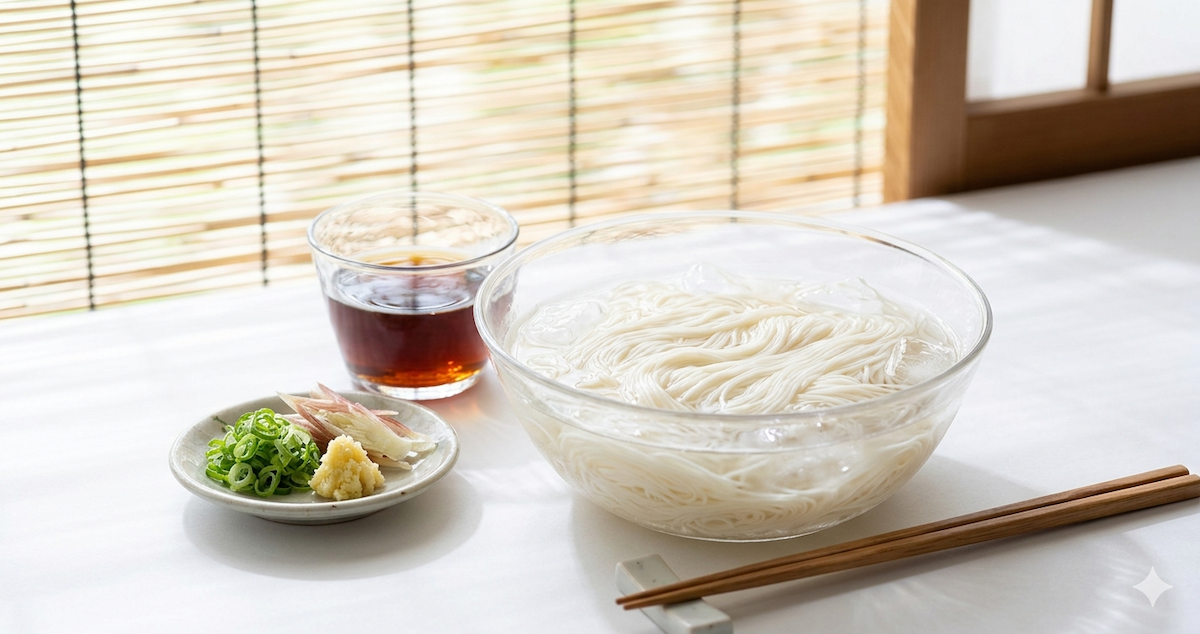
The standard summer presentation is zaru sōmen: cooked noodles arranged on a bamboo tray or in a bowl of cold water with ice, accompanied by a small cup of chilled tsuyu — a dipping sauce made from dashi (typically katsuobushi-based), soy sauce, and mirin. The garnishes are simple: finely sliced green onion, a small mound of freshly grated ginger, sometimes a leaf of shiso or a sliver of myōga (Japanese ginger). You lift a small bundle of noodles with chopsticks, dip, and eat — cool, clean, fast.
The other canonical sōmen experience is nagashi sōmen (流しそうめん) — flowing noodles. Cooked sōmen is placed at the top of a bamboo chute filled with cold running water; diners stand alongside with chopsticks and dipping sauce, catching the noodles as they slide past. The tradition is associated with summer festivals and outdoor gatherings — playful, social, and dependent on speed and chopstick skill. It began in earnest in the 1950s at a restaurant in Miyazaki Prefecture, and has since become one of the more immediately recognizable images of Japanese summer food culture. Its appeal is equal parts culinary and theatrical: the noodles are delicious, but catching them before they vanish past your station is the real event.
Beyond Summer: Nyūmen and Other Uses
Sōmen’s identity as a summer food is strong, but not exclusive. In winter and cold months, the same noodles are served hot in broth — a preparation called nyūmen (煮麺), which originated in the Miwa region of Nara. The noodles are simmered briefly in a light dashi-based soup and served with seasonal toppings: fish cake, shiitake mushrooms, spinach, thin-sliced chicken, green onion. The transformation from cold dipping to warm soup changes the character of the noodle entirely: the delicacy that made it ideal for summer becomes a quality that makes it gentle and easy in winter broth.
Sōmen also appears in salads, stir-fries, and as a substitute for rice noodles in dishes that require a thin, mild noodle capable of absorbing sauce without dominating it. Its versatility is a function of its neutrality: because sōmen has almost no assertive flavor of its own, it adapts to whatever surrounds it.
The Three Great Sōmen Regions
Within Japan’s sōmen culture, three producing regions are considered the canonical standards of quality, each with distinct characteristics shaped by local water, climate, wheat, and tradition.
Miwa Sōmen (三輪そうめん), from the Miwa district of Sakurai City in Nara Prefecture, is the origin — the place where sakubei evolved into the hand-stretched noodle form, and where the tradition has continued unbroken for over 1,200 years. Miwa sōmen is known for its exceptional thinness, strong wheat aroma, and chewy texture. The Omiwa Shrine, whose deity is considered the guardian of sōmen, still conducts annual ceremonies connected to noodle-making. Cottonseed oil is traditionally used for stretching here — a reflection of the cotton production that once characterized the region.
Banshu Sōmen (播州そうめん), from Hyogo Prefecture’s Setouchi coastline, is the most widely distributed sōmen brand in Japan. The most famous label within this category is Ibonoito (揖保乃糸), produced in the former Banshu region and sold nationwide. The region’s dry winters, access to high-quality sea salt from nearby Ako, clean soft water, and centuries of craft tradition produce a noodle renowned for its smooth texture and firm, elastic bite. The Hyogo Prefecture Tenobe Sōmen Association, whose predecessor was established in 1887, continues to protect production standards and maintain a grading system for Ibonoito noodles.
Shodoshima Sōmen (小豆島そうめん), from Shodoshima — an island in the Seto Inland Sea, Kagawa Prefecture — is distinguished by the use of sesame oil in the stretching process, which imparts a faint nutty character and a slightly oily, smooth surface texture that sets it apart from the other two. Shodoshima is also known for its olive production; some producers offer olive sōmen, stretched with locally produced olive oil — a regional variation that places artisanal sōmen within the broader identity of the island.
Quick Reference: Sōmen and Japan’s Wheat Noodles Compared
| Noodle | Diameter | Ingredients | Production | Character | Typical Season |
|---|---|---|---|---|---|
| Sōmen (素麺) | Under 1.3 mm | Wheat, salt, oil | Hand-stretched (tenobe) | Very thin, smooth, mild | Summer (cold); winter (hot as nyūmen) |
| Hiyamugi (冷麦) | 1.3–1.7 mm | Wheat, salt, water | Rolled and cut | Thin, slightly firmer than sōmen | Summer |
| Udon (うどん) | 4–6 mm+ | Wheat, salt, water | Rolled and cut | Thick, chewy, substantial | Year-round; especially winter |
| Soba (蕎麦) | ~1.5–2 mm | Buckwheat + wheat, water | Rolled and cut | Earthy, nutty, firm | Year-round; summer cold, winter hot |
| Ramen (ラーメン) | ~1.5–2.5 mm | Wheat, salt, water, kansui | Rolled and cut / extruded | Springy, chewy, slightly alkaline | Year-round; served hot in broth |
There is something instructive about a food culture that devotes twelve centuries and thousands of artisan lifetimes to the pursuit of the thinnest possible wheat noodle. Sōmen does not arrive on the table announcing its complexity. It arrives cold, white, and arranged with quiet precision. What it asks of the person eating it is simple: notice. Notice the texture against the tongue, the way it carries the tsuyu without disappearing into it, the temperature that makes it exactly what a hot July evening needs. Sōmen is a noodle for attention. Summer in Japan teaches you to pay it.
Taste It for Yourself
UMAMIBAKO curates shelf-stable Japanese pantry essentials — including premium dried sōmen — selected for quality and regional provenance, and ships directly to your door. If this article made you curious, the next step is a bowl. Explore UMAMIBAKO →
Comment