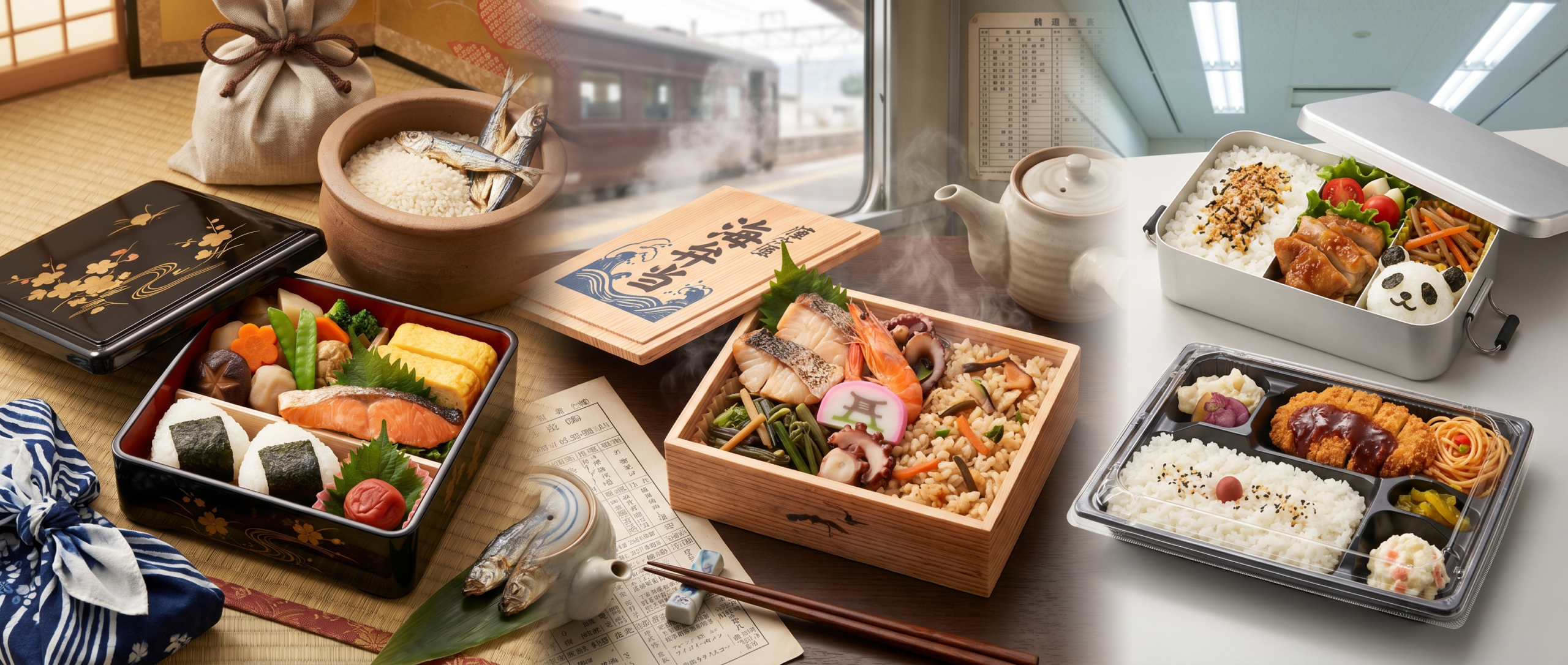
The Box That Traveled: A History of the Japanese Bento
From dried rice carried into medieval battlefields to a convenience-store lunch and a rice ball shaped like a cartoon face, the bento is a thousand-year record of a single, quietly persistent idea: that a meal should be able to go with you.
Almost every culture has a way of carrying food from one place to another — a sandwich, a wrapped parcel, a tin. But few have turned the act of packing a portable meal into something as considered, as continuous, and as culturally embedded as Japan has with the bento. A Japanese bento is not simply lunch in a box. It is a small, composed arrangement — rice in one area, a piece of grilled fish in another, a few simmered vegetables, a bright wedge of pickle — assembled with an attention to balance, color, and division that treats even a meal eaten alone on a train as worthy of care.
What makes the bento genuinely remarkable, though, is not any single version of it but its persistence across time. The same basic idea — a complete meal, portioned and portable — has traveled through nearly a thousand years of Japanese history, adapting to whoever needed to carry a meal and wherever they were going: soldiers on campaign, travelers on foot along the old highways, theatergoers between acts, railway passengers, schoolchildren, office workers. To follow the bento through the centuries is to follow the changing shape of Japanese mobile life itself.
Dried Rice and the First Portable Meal
The story begins, as so many Japanese food traditions do, with rice — and with the problem of how to carry it. The earliest ancestor of the bento is usually traced to the late Kamakura period, roughly the thirteenth to fourteenth centuries, when a form of cooked-and-dried rice called hoshi-ii (糒, or 干し飯) came into use. Hoshi-ii was exactly what its name suggests: rice that had been cooked and then dried, so that it kept without spoiling and could be carried easily. It could be eaten dry or softened with water, and it was carried in small bags or containers by people who needed to eat away from home — those working the fields, hunting, or going to war.
This is the bento in embryo: not yet a beautiful box, not yet an art, but the essential idea already fully formed. A meal, preserved and portioned, made to travel. Everything that follows over the next several centuries is an elaboration of this single practical solution to a simple human need.
The word bento itself has a contested origin, as old words often do. One frequently repeated account connects it to the sixteenth-century warlord Oda Nobunaga, who is said to have distributed simple packed meals to people at his castle — though, as with many such attributions, the tidy story outruns the firm evidence. What is clearer is that by the late sixteenth century, during the Azuchi-Momoyama period, the containers themselves had begun to matter. Lacquered wooden boxes appeared, made specifically to hold portable meals, and the bento began its slow transformation from mere ration into an object made with intention — a meal worth putting in something beautiful.
The bento’s essential idea was fully formed nearly a thousand years ago: a meal, preserved and portioned, made to travel. Everything since has been elaboration.
The Bento Comes of Age: Travel and Theater in Edo
It was during the Edo period, from the seventeenth to the mid-nineteenth century, that the bento flowered into the form we would recognize today. The long peace and rising prosperity of the era gave people something they had rarely had before: leisure, and reasons to travel. And wherever people traveled or gathered, the bento followed.
The Edo period was an age of movement along Japan’s great highways — pilgrims journeying to distant shrines, merchants and officials traveling between provinces, ordinary people making the long walk to famous sights. These travelers needed to eat on the road, and the bento, refined over generations, was the answer: a portable meal to sustain a day’s journey on foot. The old practicality of hoshi-ii had become something more considered, packed into boxes and carried along the routes that stitched the country together.
But the most telling development of the era came not on the road but in the theater. Edo’s kabuki theaters drew crowds for performances that lasted many hours, and audiences needed to eat during the long intervals between acts. Enterprising teahouses attached to the theaters began selling boxed meals designed to be eaten in exactly these gaps — meals that came to be called makunouchi bento (幕の内弁当), literally “between-the-acts bento.” Makunouchi is widely regarded as a foundational moment in bento culture: a boxed meal designed not for survival or travel but for pleasure, for an audience at leisure. Its composition — rice, often formed into small pieces, alongside an assortment of side dishes such as grilled fish, egg, and vegetables — established a template of balance and variety that still defines the classic bento today. Here, for the first time, the bento was unmistakably an aesthetic object as much as a practical one, born of the same Edo popular culture that produced kabuki itself.
The Ekiben: A Meal for the Age of the Train
When Japan modernized in the Meiji era and the railway arrived, the bento adapted almost immediately to the newest form of travel — and produced one of its most beloved and enduring forms. The ekiben (駅弁), the station bento, is the bento reborn for the age of the train.
The most widely accepted origin dates to 1885, at Utsunomiya Station in Tochigi Prefecture, where the first ekiben is said to have been sold: a simple offering, by the standards of what would come — rice balls filled with umeboshi and a piece of pickled daikon, wrapped in bamboo leaves. It was modest, but the idea was potent, and it spread rapidly through the growing railway network. Within a few years ekiben were being sold at major stations across the country, and over the following decades they evolved from that first humble parcel into elaborate, regionally distinctive meals.
What makes the ekiben such a rich expression of the bento tradition is precisely this regional character. As the practice spread, each station and region began to develop its own ekiben, showcasing local ingredients and specialties — the seafood of a coastal town, the beef or the mountain vegetables of an inland province. To travel by rail through Japan became, and remains, a way of eating one’s way across its regional cuisines, one station box at a time. The ekiben married the bento’s ancient function — a complete meal for a journey — to Japan’s deep culture of the local and the seasonal, turning a lunch on a train into a small taste of wherever the train happened to be.
The ekiben turned a lunch on a train into a taste of place. To travel Japan by rail is to eat one’s way across its regions, one station box at a time.
The Everyday Bento: Home, School, and Care
Alongside these public, commercial forms, the bento has always had a quieter and more intimate life — the meal packed at home and carried to work or school. This domestic bento is, for most Japanese people, the most familiar of all, and it carries a particular emotional weight.
The homemade bento is an everyday act of provision and, often, of affection. A parent packing a child’s school lunch, a spouse preparing a partner’s midday meal, a worker assembling their own — these small daily assemblies are governed by the same principles of balance and beauty that shaped the makunouchi centuries earlier. A well-made everyday bento is expected to be nutritionally balanced and visually pleasing: rice as the base, a protein, several vegetable dishes, a spot of color from a pickle or a piece of fruit, all arranged so that nothing runs together and the whole thing pleases the eye when the lid is lifted. The care taken over a lunch that only one person will see, eaten quickly at a desk or a school table, is itself a small expression of the value Japanese food culture places on attention.
Out of this domestic tradition grew one of the bento’s most charming modern forms: the kyaraben (キャラ弁), or character bento. Here the arranging instinct is pushed to a playful extreme, with rice, seaweed, egg, and vegetables shaped and assembled to resemble popular characters, animals, or faces. Kyaraben began largely as a way for parents to make lunch appealing to reluctant young eaters, but it has become a creative pursuit in its own right — an elaborate, affectionate craft that shows how deeply the impulse to compose a bento, rather than merely fill it, still runs.
The Bento Now: Convenience and Continuity
The most recent chapter belongs to the convenience store. Walk into any Japanese konbini and you will find shelves of ready-made bento — hot rice with a fried cutlet, grilled fish with vegetables, a compartmented tray of the familiar components — available at any hour, affordable, and genuinely good. The mass-produced convenience-store bento is, in one sense, the furthest possible point from a lacquered box of makunouchi eaten between acts of kabuki. It is industrial, anonymous, and instant.
And yet it is unmistakably the same thing. The konbini bento is the modern answer to the exact need the bento has always served: a complete, portioned, portable meal for a person on the move, eaten away from home. Its compartmented tray still separates rice from side dish; it still aims for a rough balance of components; it still treats the assembly, even at industrial scale, as something to be composed rather than merely dumped in a container. The medium has changed almost beyond recognition — from dried rice in a cloth bag to a sealed plastic tray under fluorescent light — but the idea has not changed at all.
This is what makes the bento such a clear window onto Japanese food culture. It has never stopped adapting: to the soldier, the traveler, the theatergoer, the rail passenger, the schoolchild, the office worker, the harried commuter grabbing lunch at midnight. Each age has produced its own bento, in its own materials, for its own way of moving through the world. But beneath every version lies the same thousand-year-old conviction — that a meal, even one eaten alone and in transit, deserves to be complete, balanced, and prepared with care.
There is a temptation to see the humble packed lunch as beneath notice — the least ceremonious of meals, eaten on the go, forgotten as soon as it’s finished. The bento quietly refuses that view. For nearly a thousand years, Japan has insisted that the food you carry with you is worth composing, dividing, and making pleasing to the eye, whether it is dried rice for a battlefield, a lacquered box for the theater, a station lunch that tastes of a distant province, or a convenience-store tray at the end of a long day. The container keeps changing. The care does not. And that, in the end, is the bento’s real inheritance: the idea that no meal, however portable, is too small to be done with attention.
Read, then Taste
This article is part of Waden’s Heritage series — documenting the traditions, techniques, and foods that must not be forgotten. Read more at waden.umamibako.com.
Comment