The Izakaya: How Japan Learned to Drink and Eat Together
The word is not a noun for a building. It is a verb for a habit — staying. Everything else about the izakaya, from the small dish you never ordered to the reason the food is named after the drink, grew out of that one act of not leaving.
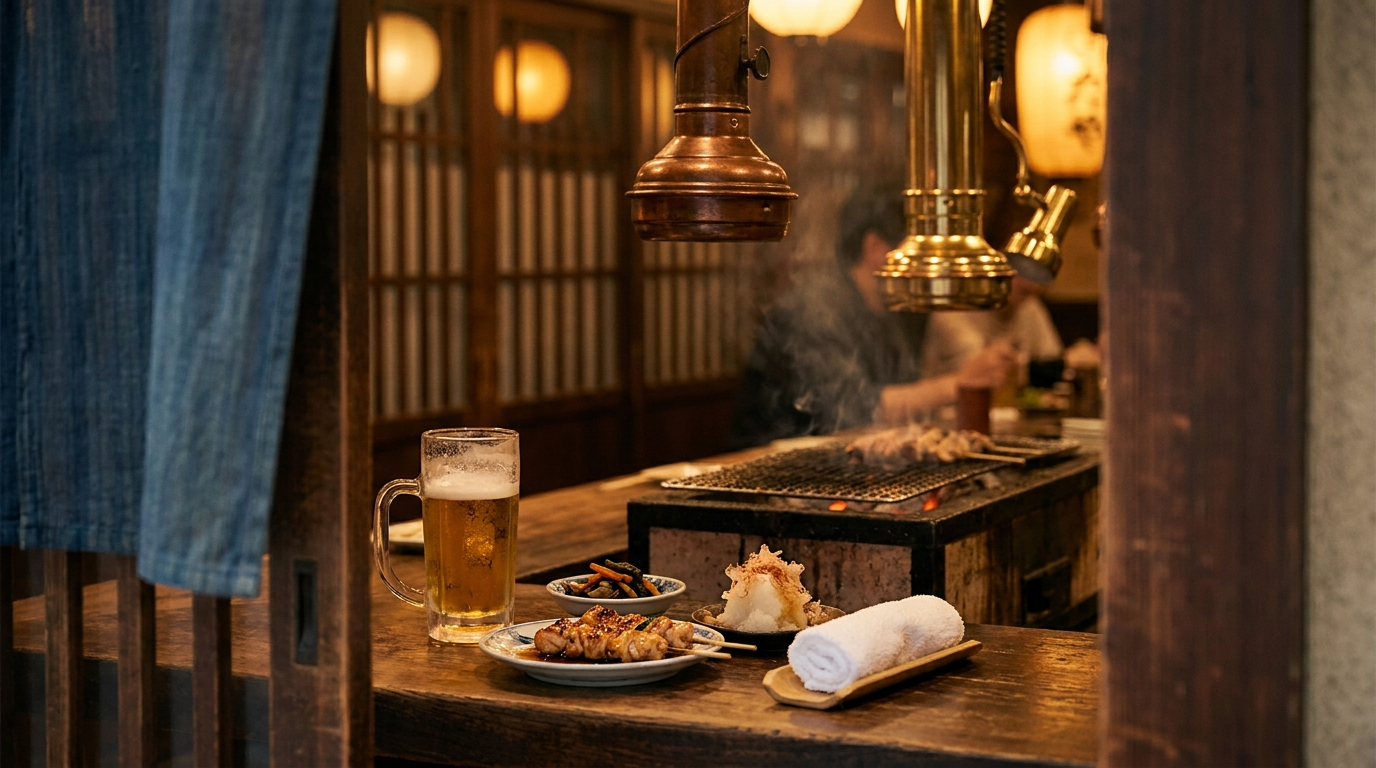
You slide open the door and the room announces itself before anyone greets you: the smell of charcoal and soy tare, the clatter of a cup being set down, a wall of handwritten strips of paper listing things you cannot read fast enough. Someone says irasshaimase. A hot towel arrives. A beer arrives, usually before anyone has decided on anything, because deciding is what the rest of the evening is for. And then — without your having asked — a small bowl of something appears. Simmered vegetables, perhaps. Marinated squid. A single mound of grated daikon with a scattering of dried fish.
You did not order it. You will be charged for it. And it is, in its own quiet way, the oldest thing on the table.
A Verb That Became a Building
Break the word apart and the history falls out. Izakaya is written 居酒屋 — i (居, to stay, to remain seated), zake (酒, sake), ya (屋, shop). It does not mean “drinking house.” It means, almost literally, “the shop where you stay and drink.”
That phrasing survives because it describes something that actually happened. In early Edo, the sakaya was a retailer. It sold sake by measure, poured into whatever vessel the customer brought, to be carried home. But customers — particularly the ones who did not really have a home to carry it to — began drinking it on the spot, standing at the shop front. The practice acquired a name of its own, izake, “staying-drinking,” and shops that were willing to accommodate it advertised the fact with a paper notice pasted by the door: izake itashi sōrō.
居酒致し候 — “Drinking on the premises is done here.”
Somewhere around the middle of the eighteenth century, according to the food historian Iino Ryōichi, the accommodation stopped being a sideline and became the business. Shops appeared whose main trade was letting people stay and drink. The verb had become a building. The name has never been updated since, which is why every izakaya sign in Japan still carries, unnoticed, an argument about what the place is for.
The City That Had Nowhere to Cook
The izakaya was not an inevitable invention. It was a solution to a demographic accident.
After Tokugawa Ieyasu established his government at Edo in 1603, the city swelled at extraordinary speed, and it swelled lopsidedly. Migrant laborers, day workers, construction hands, and the live-in staff of merchant branch houses poured in from the provinces, and nearly all of them were men. A population survey of Edo commoners in 1721 counted 501,414 people: 323,285 men against 178,129 women. Roughly two out of every three townspeople were male, a ratio that held until well into the mid-Edo period. Layer on top of that the samurai posted to Edo under the alternate-attendance system, most of them living without their families, and you have a city of single men in rented rooms with no kitchen worth the name and no one at home to cook.
Fire did the rest. The Meireki conflagration of 1657 destroyed much of the city, and the rebuilding drew in yet another wave of laborers. The eating-out culture that followed — the stalls selling soba, grilled eel, tempura, and early sushi, the niuri-jaya selling simmered dishes by the bowl — was not a lifestyle choice. It was infrastructure. The izakaya was the branch of that infrastructure that handled the drinking.
1,808 Doors
The paper trail is thin but specific. A magistrate’s record from 1752 describes two men petitioning for permission to lease the ground around a fire-damaged hall in Fukagawa and put up niuri-jaya and izakaya there, using the profits to fund the hall’s reconstruction within three years — one of the earliest appearances of the word in an official document. A comic verse from around the same period jokes about men at an izakaya drinking with their dignity thrown away at the door.
Then, in 1811, the city elders of Edo compiled a census of “food-trade businesses” for the magistrate’s office. The total came to 7,604 establishments. The single largest category, by a wide margin, was izakaya: 1,808 of them. Nearly a quarter of everywhere you could buy something to eat or drink in the shogun’s capital was a place designed for staying and drinking.
For scale, consider what was flowing into those shops. At its height Edo received on the order of a million barrels of sake a year, roughly ninety percent of it kudarizake shipped down from the Kansai brewing districts of Nada and Itami. Convert the annual averages and divide by the population and you arrive at something close to 150 millilitres per resident per day — infants, monks and abstainers included. The number is a crude arithmetic estimate rather than a measurement, but no reasonable adjustment makes it a modest one. Edo drank.
No Tables, No Chairs, One Cup
An Edo izakaya would not read as an izakaya to a modern visitor. There was no rope curtain across the entrance; the nawa-noren that now signals “old-fashioned drinking place” only came into use around the very end of the period. Instead, shops hung fish at the storefront — the day’s stock, displayed as advertising.
Inside there were no tables and no chairs. Customers perched on shōgi, long backless benches, or stepped up onto a raised tatami platform, and the tray holding the food and the sake was set directly on the bench or the matting. Sake was not served in the tokkuri flask familiar today. A copper water heater called a dōko sat warming, and the sake was heated in a chirori, a handled copper vessel lowered into it, then poured into small cups. A group might well share one cup, passing it around the circle. The tokkuri as a warming vessel is a later arrival, generally dated to the closing decades of the Edo period.
What you drank depended entirely on what you could pay, and you ordered by naming a price and a quantity rather than a brand. Clear seishu, mid-grade nakagumi, and cloudy nigori sat side by side. Good sake ran somewhere around 20 to 24 mon per gō; the cheap end went for 8 to 10. Dishes clustered around 8 mon, and after a four-mon coin entered circulation in 1768, prices across the cheap food trade organised themselves into multiples of four — an entire class of stall, the shimonya, sold skewers at four mon apiece. The clientele matched the pricing: peddlers, day laborers, palanquin bearers, cart pullers, servants in samurai households, low-ranking retainers. The izakaya was, from the beginning, a working-class room.
The Shop That Sold Sake at a Loss
One address ties the whole story together, and it is still in business.
Toshimaya was founded in 1596 at Kamakura-gashi in Kanda, a canal-side landing where boats unloaded building materials and the men who unloaded them needed feeding. The shop sold kudarizake cheaply — famously, unprofitably — and made the difference back on volume and on the resale of its empty barrels to miso and pickle makers who prized cedar casks seasoned by sake. To keep drinkers drinking it served grilled tofu dengaku, skewered and painted with miso, at two mon a stick. Cheap drink, hot food, standing room, a crowd of laborers. Toshimaya is frequently described as the ancestor of the izakaya, and while “the first” is a claim no single shop can really own, the model it ran is unmistakably the model that spread.
Why the Food Is Named After the Drink
Here is the structural fact that separates an izakaya meal from every other kind of Japanese meal. In the ordinary framework of the Japanese table — one soup and three dishes, arranged around a bowl of rice — everything on the tray exists to accompany the rice. In an izakaya, everything on the table exists to accompany the sake, and the language admits it.
The word for izakaya food is sakana, written 肴. It is generally derived from 酒菜, saka-na: “sake” plus “na,” an older word for the side dish eaten alongside a staple. The food is grammatically subordinate to the drink. The 1603 Nippo Jisho, the Portuguese-Japanese dictionary compiled by Jesuit missionaries, already records Sacana as meaning food such as meat or fish, and anything eaten while drinking. Only later did the same sound attach itself so firmly to fish that Japanese now needs the separate character 魚 to keep the two apart.
Once you notice the inversion, the whole menu makes sense. Salt, vinegar, oil, char, ferment — the flavors that dominate an izakaya list are the flavors that make you want another drink. Rice appears at the end, if at all, as a signal that the evening is closing. To understand what the food is answering to, it helps to know something about sake itself and the regional differences that a map of Japan’s brewing country makes visible.
The Dish You Did Not Order
Which brings us back to the small bowl. Otōshi in Tokyo; tsukidashi or sakizuke in Kansai. Its origin is genuinely uncertain, and the National Diet Library’s reference records reflect that: the leading explanations hold either that the word marks the customer being “passed through” to a seat, or that it marks the order being “passed through” to the kitchen — a small dish sent out as acknowledgement that the ticket has been received and the drinking may begin. Both readings point at the same underlying function. The otōshi is a receipt in edible form, bridging the gap between sitting down and being served.
It is also, unambiguously, a charge. A 2023 industry survey of restaurant operators in businesses where such charges are normal found 38.2 percent billing an otōshi fee, down from 50 percent in a comparable 2018 survey, while 28.7 percent had shifted to an explicit table charge instead. Among those still charging for otōshi, the most common price band was ¥300 to ¥399. The drift from “small dish” to “seat charge” is quietly dissolving a four-hundred-year-old gesture into a line item, largely because visitors — and increasingly Japanese customers too — read an uninvited bowl as an uninvited bill.
Lanterns Out of the Ashes
The izakaya’s second founding happened in the rubble of 1945. Black markets around bombed-out railway stations hardened into alley networks of tiny stalls — Shinjuku’s Omoide Yokochō is the best known survivor — where grilled offal and chicken on skewers were cooked over charcoal and sold to anyone with cash. The red paper lantern hung outside became the universal shorthand for such a place. Accounts of its origin are anecdotal rather than documented, usually crediting an Edo-period shopkeeper who dyed a plain white lantern red to stand out; what is clear is that in the cheap, improvised postwar streetscape a red lantern was easy to make, impossible to miss, and it stuck.
Then the room was rebuilt again, this time deliberately. Yōrō no Taki traces its roots to a 1938 eatery in Matsumoto, Nagano, and opened its first branch under the modern name in Yokohama in December 1956. Tsubohachi opened in Sapporo in 1973, taking its name from the eight tsubo of floor space it started with; Murasakai launched the same year, and its founder is widely credited with popularising the chūhai that defined 1980s drinking. Together the three became known as the izakaya gosanke, the “big three.” Their innovation was social rather than culinary: bright rooms, printed menus, standardised prices, no red lantern, no rope curtain — deliberately stripped of the imagery that told women and young people this was not their room. It worked, and the izakaya stopped being a laborer’s bar and became the default venue for almost every kind of Japanese gathering.
Where the Hierarchy Loosens
That is the function it still performs, and it is the reason the izakaya matters beyond its food. It is the licensed room in Japanese social life where rank relaxes: where a section chief and a first-year hire can sit at the same low table, where the phrase bureikō — “no standing on ceremony” — suspends the day’s protocol, where the thing that could not be said in the meeting gets said over the third round. The shared dishes are load-bearing here. Nobody’s plate is only their own; the ordering is collective; the pouring is done for each other rather than for oneself. The izakaya is a machine for turning a group of colleagues, briefly, into a group of people.
The Count Today
The machine is under strain. Japan’s 2021 Economic Census counted 84,595 establishments in the “bars and beer halls” category, the statistical home of the izakaya — a figure well below the peaks of the boom decades. Annual alcohol consumption per adult peaked at 101.8 litres in fiscal 1992 and stood at 75.6 litres in fiscal 2023, though that last figure represented a second consecutive year of slight increase. Restaurant bankruptcies hit a record 900 in 2025, and the largest single category, at 204 cases, was bars and beer halls — the third straight year above two hundred.
And yet the room keeps reinventing itself at the edges. Standing bars have come back into fashion among people too young to remember them as ordinary. Kakuuchi — drinking in the corner of a liquor shop, a practice named, by one account, for tipping a square wooden measure to your lips — is thriving in Kyushu and spreading. Solo drinking has lost its stigma. Foreign visitors arrive specifically hunting for the counter seat and the handwritten menu.
All of which is the same idea coming back around. What the eighteenth-century sakaya discovered, and what every chain and every alley stall has rediscovered since, is that people will pay for permission to stay. The sake is the reason given. The sakana is the excuse for another round. The otōshi is the receipt. But the product on sale in an izakaya has always been the staying itself — the thing the name has been telling us for two hundred and fifty years, if anyone stopped to read it.
Read, then Taste.
This article is part of Waden’s Heritage series — documenting the traditions, techniques, and foods that must not be forgotten. Read more at waden.umamibako.com.
Waden is an editorial journal exploring the depth and beauty of Japanese food culture — its history, ingredients, artisans, and traditions. Story first, always. waden.umamibako.com
Comment