The Glass That Cuts Light
An Introduction to Kiriko
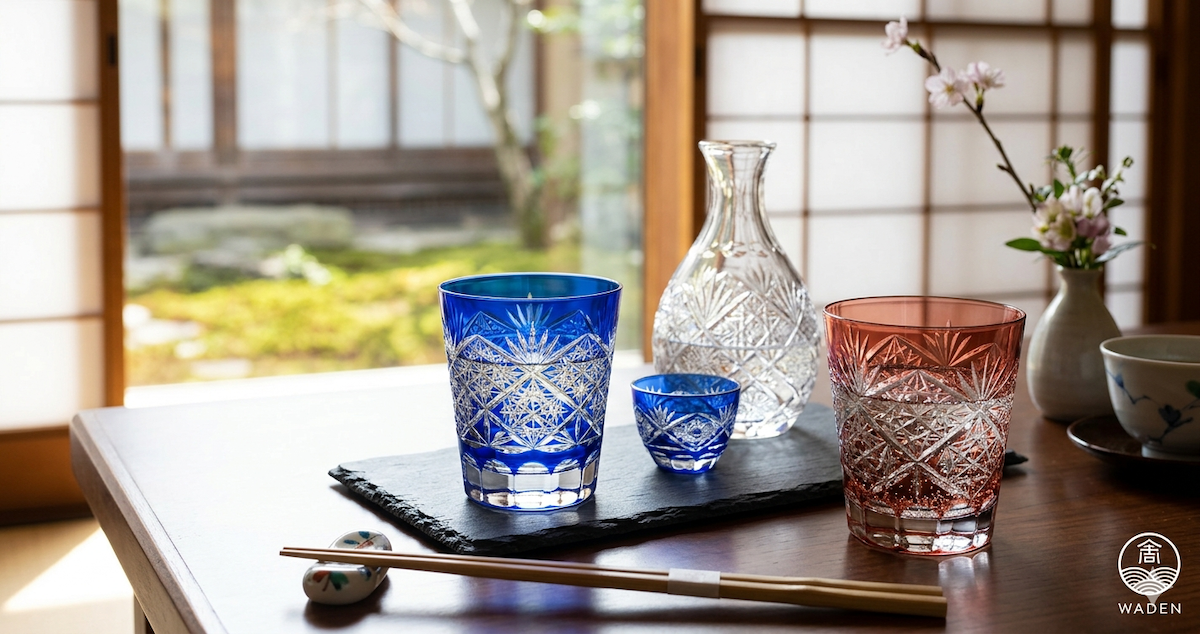
Hold a piece of kiriko up to the light and the room changes. The cut facets fracture the light into geometry — precise lines, overlapping hexagons, rings of tiny squares that shimmer like fish scales. It is not a passive object. It participates in the space around it, scattering and recomposing what falls on it, shifting with every movement of the hand. What you are holding is a drinking vessel — but it is also the result of nearly two centuries of accumulated craft, and of a very specific Japanese conviction that the objects of daily life deserve to be beautiful.
What Kiriko Is
Kiriko (切子) means, simply, “cut glass.” It refers to a category of Japanese glassware in which geometric patterns are carved into the surface of the glass by hand, using grinding wheels and whetstones. The cutting removes material from the glass surface to create facets — flat, angled planes that catch and redirect light in ways that uncut glass cannot. The result is an object that is simultaneously transparent and textured, simple in concept and astonishing in execution.
Kiriko is most commonly encountered as drinking vessels — sake cups, whisky glasses, beer tumblers — but the same technique is applied to vases, carafes, small dishes, chopstick rests, and decorative objects. The craft is closely associated with the table: with the rituals of drinking and eating, with the particular pleasure of a well-made vessel in the hand. In Japan, the distinction between fine art and craft has always been drawn differently than in the West — an object used daily is not diminished by its use, and a drinking glass made with the care of a sculptor is not less serious for being drunk from. Kiriko lives in that tradition.
Where It Began
The origins of kiriko trace back to the late Edo period, in the early 19th century. Glass itself had reached Japan through Nagasaki, the single port open to foreign trade during Japan’s long period of self-imposed isolation (sakoku, 1639–1853). Dutch traders brought glass objects — referred to at the time by the Portuguese-derived word vidro — and Japanese craftspeople began to study and replicate the material.
The technique of engraving designs onto the surface of glass was brought to Nagasaki from the Netherlands, and kiriko was born as a result of attempts to imitate those techniques. Edo kiriko was first produced in 1834 by Kagaya Kyūbei, a glassware merchant in Edo. Working in the Odenmacho district of what is now central Tokyo, Kagaya used a powdered mineral abrasive called kongōsha — a corundum sand — to scratch and carve patterns into glass surfaces. The patterns were simple by later standards, but the principle was established: glass could be made to carry ornament without paint, without glaze, through cutting alone.
The craft’s next major transformation came with the Meiji period (1868–1912), when Japan deliberately opened itself to Western industrial knowledge. In 1881, the government invited Emmanuel Hauptmann, a British cut glass engineer, to Japan. He taught his knowledge and techniques to the Edo kiriko artisans, which led to British cut glass technology merging with Edo kiriko techniques. Dozens of Japanese craftspeople trained under Hauptmann, absorbing European methods — including the use of rotary diamond-wheel tools — and integrating them with the aesthetic preferences already developing in Edo. The result was not a Japanese copy of European cut glass, but something new: a hybrid form that would become distinctly its own.
Two Traditions: Edo and Satsuma
Kiriko developed along two distinct regional lines that remain the defining poles of the craft today. Understanding the difference between them is essential to understanding what kiriko is, because they represent not just different aesthetics but different philosophies of what cut glass can do.
Edo Kiriko (江戸切子)
Edo kiriko originated in Edo (modern-day Tokyo) during the 19th century and is renowned for its clear, intricately cut glass displaying bold geometric patterns. Its characteristic quality is precision and contrast. Typically, a thin layer of colored glass — most commonly a deep cobalt blue or copper red — is fused over a clear base. The cutting removes this colored layer in geometric patterns, revealing the clear glass beneath and creating a sharp, vivid contrast between color and transparency. The cuts themselves are clean, angular, exact.
The colored glass styles of Edo kiriko developed during the Meiji period, when Satsuma kiriko stopped its production, resulting in many unemployed craftsmen migrating to Edo with their Satsuma kiriko traditions. Their technique of using color-coated glass was soon absorbed into the production of Edo kiriko. What had begun as clear-glass work absorbed the color techniques of its southern counterpart, producing the vivid, high-contrast aesthetic that is now iconic.
Today, Edo kiriko is known for its intricate designs cut into blue, red, or other colored glass. It was designated as a traditional craft of Tokyo in 1985, and recognized as a traditional craft of Japan by the Ministry of Economy, Trade and Industry in 2002. Approximately 80% of Edo kiriko production today takes place in the Koto and Sumida wards of Tokyo — the same area of the city where the craft first developed.
Satsuma Kiriko (薩摩切子)
Satsuma kiriko is a style of cut glass manufactured by the Satsuma clan from the final years of the Edo period to the beginning of the Meiji period. It developed under the patronage of the Shimazu lords of Satsuma domain — present-day Kagoshima Prefecture, at the southern tip of Kyushu — who actively sought to incorporate Western manufacturing technology into their domain’s industry.
Where Edo kiriko is defined by sharp contrast, Satsuma kiriko is defined by gradation. Satsuma kiriko features overlaid colored glass, and cutting the glass boldly gives beautiful gradations of color. The colored layer in Satsuma kiriko is considerably thicker than in Edo kiriko — typically 2 to 3 millimeters — and the cuts are deeper, which means the transition from color to clear glass is not a sharp line but a soft fade, known as bokashi. The aesthetic is more painterly, more atmospheric.
After the death of Shimazu Nariakira, the manufacture of Satsuma kiriko was discontinued in the early Meiji period because of financial difficulties, damage to the factory in the bombardment of Kagoshima, and disturbances during the Satsuma Rebellion. The tradition was effectively lost for more than a century. From 1985, a glass factory, an artisan, and a researcher together succeeded in reproducing Satsuma kiriko. The revived craft now produces both faithful reconstructions of historical pieces and new designs developed within the original aesthetic.
How Kiriko Is Made
The making of kiriko involves six broad stages, almost all of which depend on the skilled judgment of the artisan rather than mechanical precision. There is no automated cutting machine that produces authentic kiriko. The hand, the eye, and years of accumulated experience are the essential instruments.
The process begins with the glass itself. The first step happens during the glassblowing process, when a thin layer of colored glass is put on top of the clear base glass. This layered blank — the iro-kise (色被せ), or colored overlay — is the raw material from which the pattern will emerge.
Before any cutting begins, the artisan marks out the design on the glass surface. The design grid is drawn on the glass’s surface using a bamboo stick or brush with red iron oxide. This marking — called sumitsuke — is the map that guides all subsequent work. No two pieces are marked identically; the artisan adjusts for the specific dimensions of each blank.
Cutting takes place in stages: a rough pass (arazuri) establishes the major elements of the pattern, followed by progressively finer cuts that refine and detail each facet. Artisans hold the glass in their hands and carefully grind it against the grinder. The angle and depth of cutting are fine-tuned based on the artisan’s experience, determining the dimensionality of the pattern and light reflection. The artisan pushes the glass against a spinning wheel — not the wheel against the glass — maintaining constant control over pressure, angle, and depth. A single error in this process cannot be undone.
The final stage is polishing. The cuts left by the grinding wheels are initially opaque — the glass surface where material has been removed is clouded and rough. This opaque surface is returned once more to its original transparent state, but now with the attractive shine and sparkle so typical of Edo kiriko. For high-class crystal glass, chemical processing with hydrofluoric acid may be applied. Polishing with wooden wheels, brushes, and cloths restores the clarity and adds the characteristic brilliance of finished kiriko.
The Patterns and Their Meanings
Kiriko patterns are not purely decorative. They carry a vocabulary of meaning that connects the object to the broader world of Japanese visual culture — to textiles, ceramics, lacquerware, and the natural forms that have long organized Japanese aesthetics. Each pattern has a name, and most names carry an intention: a wish for the recipient, an invocation of protection, a reference to longevity or abundance.
Nanako (魚子) — literally “fish eggs” — is perhaps the most recognizable pattern in Edo kiriko. It is composed of numerous fine straight lines that resemble round fish eggs; a closer look reveals the design is actually composed of many small squares arranged side by side. The pattern symbolizes the prosperity of descendants — fish produce eggs in great abundance, and the pattern carries that wish into the object.
Asanoha (麻の葉) is a geometric pattern based on the six-pointed hemp leaf. The hemp leaf pattern, due to the plant’s rapid growth and straight stems, is considered a symbol of wishing for children’s healthy growth. It is a common motif across many traditional Japanese crafts — textiles, lacquerware, ceramics — and its appearance in kiriko connects the glass object to a much larger tradition of auspicious patterning.
Yarai (矢来) takes its name from the bamboo fences that once surrounded traditional buildings. This pattern symbolizes defending against external enemies, protecting oneself from disasters, and warding off evil. Its bold diagonal lines give it a particularly forceful visual character — one of the more striking patterns when cut into deep-colored glass.
Kikutsunagi (菊繋ぎ) — the chrysanthemum chain — represents an interlocking network of chrysanthemum forms. The chrysanthemum is Japan’s imperial flower, associated with longevity and autumn; the tsunagi (linking) aspect implies a continuous, unbroken blessing. Shippō (七宝), the seven-treasure pattern of overlapping circles, represents harmony and perfection — its endlessly interlocking geometry expressing the Buddhist concept of boundless blessings without beginning or end.
Kagome (籠目), the bamboo basket weave, produces a hexagonal mesh that has long been considered a protective talisman in Japan — the “holes” of the weave were believed to allow evil spirits to pass through without settling. And Soko-giku (底菊), the chrysanthemum base, is carved into the bottom of drinking vessels, where it is visible through the glass when the cup is lifted — a moment of hidden beauty revealed only in use.
These patterns are not chosen arbitrarily. The choice of pattern for a particular kiriko piece is often a deliberate act by the artisan, infusing the object with specific intent. A sake cup given as a wedding gift might carry the nanako pattern, wishing prosperity upon the couple’s descendants. A tumbler made for daily use might carry the asanoha, a quiet daily invocation of health. The meaning is present even when the owner does not know it — built into the object by the hand that made it.
Kiriko at the Table
Kiriko is, above all, a craft of the table. Its most natural context is drinking — sake, whisky, beer, water — and the experience of drinking from kiriko is qualitatively different from drinking from ordinary glass. The weight of crystal kiriko in the hand is substantial without being heavy. The cut surface provides grip and texture where smooth glass offers none. And when light passes through the patterned walls, it throws geometric shadows onto the table, onto the hand, onto the liquid inside — a small theater of light that shifts with every movement.
In Japan, kiriko is used for both everyday drinking and for marked occasions — not shut away for special use only, but present in ordinary life with enough frequency to be part of what daily drinking feels like. The distinction between art and craft in Japan comes down to whether an object can be used in daily life. Kiriko is firmly in the latter category. It is not a museum object. It is meant to be filled, handled, washed, and used again.
A kiriko sake cup changes what sake tastes like — not chemically, but experientially. The precision of the vessel shapes the expectation of what is inside it. Drinking sake from a well-made kiriko cup is an act of alignment: the care invested in the drink and the care invested in the glass meet at the moment of drinking, and the total experience is greater than either alone.
The Craft Today
Kiriko remains a living craft. Workshops in the Koto and Sumida districts of Tokyo continue to produce Edo kiriko using the same fundamental methods developed in the 19th century, while craftspeople in Kagoshima carry forward the revived Satsuma tradition. Certification matters in this world: genuine Edo kiriko must be registered with the Edo Kiriko Cooperative Association and produced in the recognized production areas of Tokyo using traditional hand-cutting techniques.
Alongside this tradition, a younger generation of kiriko makers is expanding the craft’s vocabulary — introducing new colors, developing original patterns, and exploring forms that go beyond the drinking vessel into jewelry, lighting, and architectural applications. The core technique remains unchanged: glass, wheel, hand. What changes is the imagination applied to it.
Kiriko occupies an interesting position in contemporary Japanese material culture. It is not an obscure heritage craft preserved by specialists for a dwindling audience. It is genuinely popular — sought as a gift, collected as an object of beauty, and used in daily life by people who simply want their drinking glass to be worth looking at. In a culture that has long refused to separate the beautiful from the useful, kiriko is, perhaps, the clearest expression of that refusal: two hundred years of accumulated skill, applied to the simple act of holding a drink.
Quick Reference: Edo Kiriko vs. Satsuma Kiriko
| Edo Kiriko (江戸切子) | Satsuma Kiriko (薩摩切子) | |
|---|---|---|
| Origin | Edo (modern Tokyo) | Satsuma domain (modern Kagoshima) |
| Established | 1834 | Late Edo period (mid-19th century) |
| Color layer | Thin (approx. 1mm) | Thick (approx. 2–3mm) |
| Cut style | Sharp, precise, high contrast | Deep, bold, soft gradation (bokashi) |
| Visual character | Color meets clear in a hard edge | Color fades gradually into clear |
| Typical colors | Cobalt blue, copper red, others | Red, blue, green, purple |
| Production today | Active; Koto & Sumida, Tokyo | Revived from 1985; Kagoshima |
| Official status | National traditional craft (2002) | Traditional craft of Kagoshima (1989) |
A kiriko glass is not trying to be invisible. It does not efface itself in favor of what it contains. It insists, gently, on being noticed — on the weight in the hand, the geometry catching the light, the pattern that carries a meaning its maker chose deliberately. It is a vessel that asks you to pay attention. In Japan, that is not considered a demand. It is considered a gift.
Comment