The White Block That Feeds a Nation: Tofu
An Introduction to Japanese Tofu
In 1782, one of the bestselling books in all of Japan was a cookbook devoted entirely to a single ingredient. It listed one hundred recipes. The ingredient was tofu. That fact — that a culture could produce a hundred distinct preparations for what looks, at first glance, like an undifferentiated white cube — is as good an introduction to Japanese tofu as any. What appears simple is not. What appears bland is not. What appears to be a single thing is, in Japan, a whole vocabulary.
What Tofu Is
Tofu (豆腐) is made by coagulating soy milk and pressing the resulting curds into blocks. The word itself — written with the characters for “bean” (豆) and “curd” or “ferment” (腐) — comes directly from the Chinese dòufǔ, which entered Japanese as tōfu and subsequently into English as “tofu.” The process is, in structure, closely analogous to cheesemaking: a protein-rich liquid is curdled by the introduction of a coagulant, and the solids are then separated, shaped, and pressed to varying degrees of firmness.
The raw material is the soybean. Dried soybeans are soaked, ground with water, and cooked to produce soy milk — a process that also yields okara, the fibrous soybean pulp left behind after extraction, which is itself used in Japanese cooking as a mild, crumbly ingredient in simmered dishes and salads. The soy milk is then curdled using a coagulant. The traditional and most highly regarded coagulant in Japan is nigari (にがり) — the liquid that remains after salt has been extracted from seawater, consisting primarily of magnesium chloride. Nigari produces a tofu with a subtly complex flavor that draws out the natural sweetness of the soybean; it is fast-acting and requires skill and timing to use well. Calcium sulfate, another common coagulant, produces a milder, creamier result and is often used for silken varieties.
Once the soy milk has curdled into soft curds, what happens next determines everything about the final texture. The single most important variable in Japanese tofu is how much water is removed after coagulation. Press nothing out, and the result is silken tofu — trembling, custard-soft, high in moisture. Press gently through a cotton cloth and add weight, and the result is firm tofu — denser, more resilient, with a slightly grainy surface. Press further still, and the tofu becomes firm enough to slice, dice, fry, or freeze. Every texture distinction in the world of Japanese tofu flows from this one variable: moisture.
A History Carried by Monks
Tofu originated in China. The most widely accepted theory places its invention in the Han Dynasty, around the 2nd century BCE, attributed by legend to Prince Liu An of Huainan — though, as with many ancient food origins, the precise truth is lost. What is clear is that by the Tang Dynasty (7th–9th centuries CE), tofu was well established across China as a versatile, protein-rich food. The word “tofu” is believed to first appear in a Chinese text, Qīng Yì Lù (清異録), written around the 10th century.
The route into Japan ran through Buddhism. During the Nara period (710–784 CE), Japanese envoys and monks made regular missions to Tang Dynasty China to study Buddhist doctrine and absorb Chinese learning. They returned with knowledge of tofu-making, and the ingredient entered Japan as an essential component of shōjin ryōri (精進料理) — the vegetarian cuisine of Buddhist temple cooking, which prohibited the taking of animal life. For Buddhist monks living under a strict meat-free diet, tofu was invaluable: a dense source of plant protein, mild enough to complement the delicate flavors of temple cooking, and adaptable across an enormous range of preparations.
The earliest documented mention of tofu in Japan dates to 1183, when a Shinto priest named Nakaomi Hiroshige recorded it as an offering at Kasuga Taisha shrine in Nara. For several centuries after its introduction, tofu remained the province of monks, aristocrats, and the samurai class — a food of refinement and religious practice rather than everyday sustenance. This changed during the Edo period (1603–1868), as peace and urban prosperity transformed the food culture of Japan’s growing cities. Tofu shops (tōfu-ya) proliferated across Edo (modern Tokyo), Kyoto, and Osaka. Vendors carrying fresh tofu through city streets on shoulder poles, announcing themselves with blows on a small wooden horn, became a characteristic sound of daily urban life.
The measure of tofu’s Edo-period cultural saturation was the publication, in 1782, of the Tōfu Hyakuchin (豆腐百珍) — “One Hundred Tofu Delicacies.” Written under a pen name by an Osaka seal-engraver, the book organized one hundred tofu recipes into six categories ranging from everyday dishes to rare and sophisticated preparations, including modoki — mock dishes in which tofu was shaped and seasoned to resemble fish, shellfish, and meat, an ingenious culinary sleight of hand born of Buddhist dietary constraints. The book became an immediate bestseller, spawning a sequel and a bonus volume. It is often cited as the first Japanese cookbook devoted to a single ingredient, and it established the template for a whole genre of single-ingredient culinary literature that followed.
The Two Foundations: Momen and Kinu
Japanese tofu divides, at its core, into two fundamental types. Understanding the difference between them is the first essential step to understanding how tofu actually works in Japanese cooking.
Momen Tōfu (木綿豆腐) — Cotton Tofu
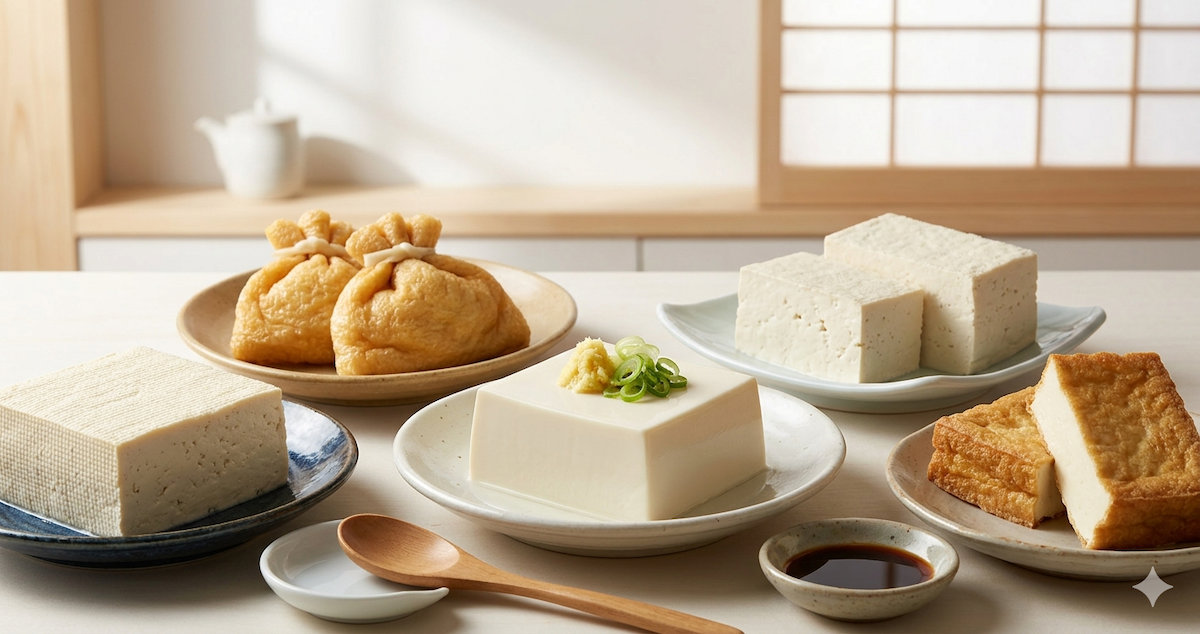
Momen means cotton, and momen tōfu takes its name from the cotton cloth used to drain and press it. After the soy milk coagulates into curds, the mixture is transferred into a mold lined with cotton cloth, and weighted to press out the whey and excess water. The result is a firm, slightly grainy-surfaced block with a resilient texture that holds its shape under heat. The surface impression left by the cloth is often visible on a freshly pressed momen tōfu — a subtle textile pattern on a food product, one of those small details that makes Japanese craft sensibility visible even in ordinary ingredients.
Because it holds its structure, momen tōfu is the practical choice for dishes that involve heat, movement, or extended cooking time. It survives in a simmering miso soup without dissolving; it can be cubed and stir-fried, crumbled into dishes as a protein component, or grilled on both sides until the exterior is golden and slightly caramelized while the interior remains soft. Its flavor is slightly more concentrated and assertive than silken tofu, with a pleasant earthiness from the soybean.
Kinu Tōfu / Kinugoshi Tōfu (絹ごし豆腐) — Silken Tofu
Kinu means silk. Kinugoshi tōfu — silk-strained tofu — is produced by coagulating soy milk directly in its final container, without any cutting, straining, or pressing of the curd. The entire liquid sets as a single, unbroken mass, retaining all of its moisture. The result is a tofu of extraordinary delicacy: smooth as custard, trembling at the touch, white and almost luminous. It breaks at the slightest pressure — not a flaw, but the point.
Silken tofu first appeared in the middle of the Edo period — a refinement developed after momen tofu had already been in common use for centuries. Its emergence reflects the broader Edo-period tendency toward culinary elegance and the cultivation of subtle flavors. Kinugoshi tōfu is not for cooking that involves heat or handling. It is for preparations where its texture is the experience: eaten cold, barely dressed, at the height of summer; set gently into a clear broth; blended into smooth sauces and dressings. Its flavor is the purest expression of the soybean — mild, faintly sweet, without the additional depth that pressing and firming introduces.
A note on regional character: in Japan, the softness of local water plays a significant role in which type of tofu predominates. Kyoto, blessed with exceptionally soft groundwater, became the heartland of kinugoshi tōfu — its water producing a particularly delicate and smooth result. The Kantō region around Tokyo, with slightly harder water, favors the firmer momen style. The same ingredient, made differently because the water says so.
The Transformed Forms
Beyond the two foundational types, Japanese culinary tradition has developed a remarkable range of tofu forms through additional processing — frying, freezing, grilling, and drying — each producing a distinct texture and culinary application. These transformed tofus are not secondary or lesser; they are their own things, with their own roles and their own pleasures.
Aburaage (油揚げ) — Thin-Fried Tofu Pouches
Momen tōfu is sliced thin and deep-fried twice — first at a lower temperature to cook through, then at a higher temperature to develop the golden, slightly blistered skin — until the interior becomes almost entirely hollow, creating a pouch. Aburaage is one of the most versatile ingredients in the Japanese kitchen. Cut open and stuffed with seasoned sushi rice, it becomes inarizushi — sweet, yielding rice pouches that are among Japan’s most beloved everyday foods. Simmered in soup stock with soy sauce and mirin, it becomes a deeply savory topping for kitsune udon (fox udon, named for the mythological foxes said to love fried tofu). Blanched briefly to remove excess oil, it absorbs broth and seasoning with remarkable efficiency.
Atsuage (厚揚げ) — Thick-Fried Tofu
Where aburaage is fried to hollowness, atsuage is fried thick — a substantial block of momen tōfu deep-fried to produce a crisp, golden exterior while the interior remains white and soft. The contrast between the textured outside and the yielding inside is the whole point. Atsuage is often simmered in dashi-based broth, grilled and topped with grated ginger and soy sauce, or added to oden — Japan’s cold-weather hot pot.
Kōya Dōfu (高野豆腐) — Freeze-Dried Tofu
Kōya dōfu is tofu that has been frozen, aged, and then dried — a preservation technique said to have been discovered by Buddhist monks on Mount Kōya in Wakayama Prefecture, who left tofu outdoors during winter and found that the freeze-thaw cycle had transformed its texture entirely. Rehydrated in dashi and simmered with soy sauce and mirin, kōya dōfu becomes spongy and porous — a structure that absorbs cooking liquid with extraordinary efficiency, soaking up all the flavor of whatever broth it is placed in. It has almost no flavor of its own; it exists to carry the flavors of its surroundings. In shōjin ryōri, where the broth is kombu-based and clean, kōya dōfu is an exercise in how texture and absorption can create satisfaction without richness.
How Tofu Is Eaten in Japan
Tofu appears in Japanese cooking in such a wide range of contexts that cataloguing them completely would require something approaching the Tōfu Hyakuchin itself. But a few essential preparations convey the range of what tofu can do — and why its apparent simplicity has sustained a whole cuisine.
Hiyayakko (冷奴) — cold tofu — is perhaps the most direct expression of what high-quality tofu is. A block of kinugoshi tōfu, served cold, topped simply with finely grated fresh ginger, a few strands of green onion, a pinch of katsuobushi (dried bonito flakes), and a splash of soy sauce. Nothing is cooked. Nothing masks the tofu’s flavor. The dish is an argument that tofu at its best requires no transformation — only the right cold, the right garnish, and the right quality of bean. It is a summer dish in particular, served as the heat of the season sharpens the pleasure of cold, silky food.
Agedashi Dōfu (揚げ出し豆腐) occupies a different register entirely. Silken or soft tofu is dusted in potato starch and carefully deep-fried — the starch forming a translucent, barely-there crust that holds the tofu together while keeping its interior custardy. The fried tofu is placed in a dashi-based sauce (tentsuyu) and topped with grated daikon, grated ginger, and finely sliced green onion. The contrast between the crisp exterior and the yielding interior, between the hot tofu and the cool broth it sits in, between the clean dashi and the grassy, starchy crust — this is precision cooking with humble materials.
Yudōfu (湯豆腐) — simmered tofu — is a Kyoto specialty, closely associated with the temple precincts around Nanzen-ji. Blocks of kinugoshi tōfu are simmered gently in a pot of kombu broth until just warmed through — not cooked, precisely, but brought to temperature. They are lifted from the pot and dipped in ponzu or a light soy sauce dressing. The entire preparation is restraint made edible: a dish whose quality depends entirely on the quality of the tofu and the water it simmers in. In Kyoto, where soft water and centuries of temple cooking tradition converge, yudōfu at a good restaurant is among the most quietly extraordinary things Japanese food culture has to offer.
And then there is miso soup — perhaps the most widespread and daily context for tofu in Japanese life. Cubes of momen or silken tōfu float in a bowl of dashi-based miso broth alongside wakame seaweed and green onion. The tofu absorbs the savory miso as it sits; by the time the bowl reaches the table, its outer layers are seasoned, while the center remains clean and mild. It is a small and everyday pleasure — the kind of thing that is easy to overlook and, when it is gone, surprisingly missed.
The Logic of Tofu
Tofu does not assert itself. It does not arrive in a dish with strong flavors demanding attention. It absorbs; it yields; it provides texture and body where others provide flavor. This quality — the capacity to receive and transmit rather than dominate — is exactly what makes it so useful, and exactly what has made it so central to a cuisine built on balance and restraint.
In shōjin ryōri, tofu carries the responsibility of providing substance in the absence of meat, fish, or any animal product. In a kaiseki meal, a single perfect cube of yudōfu can anchor a course entirely. In everyday home cooking, it does the work of protein quietly, without requiring the attention and expense that meat would demand. It is, in the terminology of Japanese food culture, a food of ma — of the space between stronger elements, which defines their relationship to each other.
The color matters too. White, in Japanese aesthetics, carries associations of purity, simplicity, and openness — washi paper, fresh rice, snow. Tofu’s whiteness is not incidental. It is part of what the ingredient communicates, before it is tasted, about the philosophy of the meal it belongs to.
Quick Reference: Key Japanese Tofu Types
| Type | Japanese Name | Texture | Best Used For |
|---|---|---|---|
| Firm / Cotton Tofu | Momen tōfu (木綿豆腐) | Dense, slightly grainy, resilient | Miso soup, stir-fry, simmered dishes, grilling |
| Silken Tofu | Kinugoshi tōfu (絹ごし豆腐) | Trembling, custard-soft, very delicate | Hiyayakko, yudōfu, agedashi, cold dishes |
| Thin-Fried Tofu | Aburaage (油揚げ) | Hollow pouch, golden exterior | Inarizushi, kitsune udon, miso soup |
| Thick-Fried Tofu | Atsuage (厚揚げ) | Crisp outside, soft interior | Simmered dishes, grilled with soy sauce, oden |
| Freeze-Dried Tofu | Kōya dōfu (高野豆腐) | Spongy, porous when rehydrated | Nimono (simmered dishes), shōjin ryōri |
A culture that could write a hundred recipes for a single white block is telling you something. It is telling you that simplicity is not the same as poverty of possibility — that an ingredient without insistent flavor is not an ingredient without depth, but one that requires a different kind of attention. Tofu, at its best, asks you to notice what you are tasting rather than what is being done to you. That is, in Japan, considered a higher form of cooking.
Comment