Sushi vs Sashimi: What’s Actually the Difference?
The short answer is one word: rice. But the more interesting question is why Japan gave a name — and the status of a complete dish — to something as apparently simple as a slice of raw fish.
Ask ten people what the difference between sushi and sashimi is, and most will say something about raw fish — that sushi has it, or that sashimi is the raw one. Both answers are wrong, and the confusion is worth clearing up, because the real distinction is simpler than people expect and points to something far more interesting than a menu category.
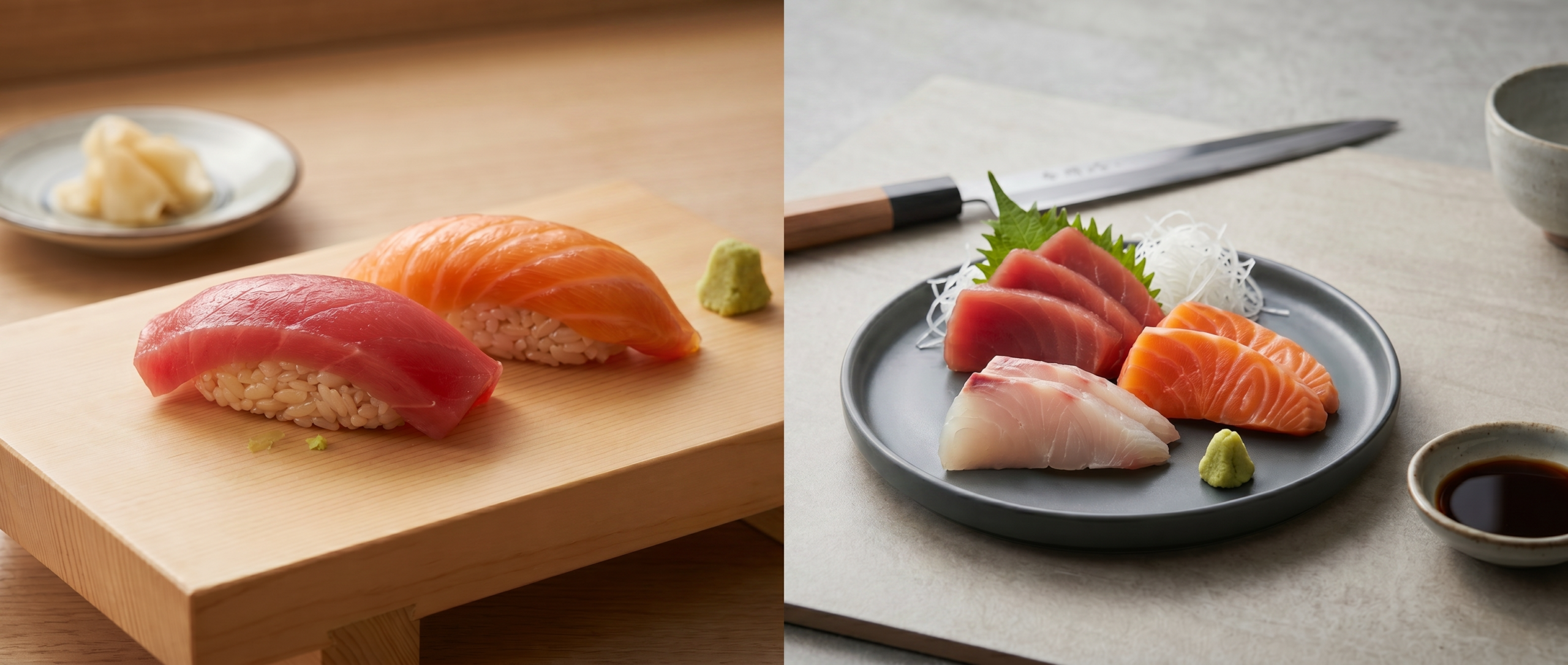
Here is the whole of it, in a sentence: sushi is a dish built on vinegared rice, while sashimi is sliced raw fish or seafood served with no rice at all. That’s the difference. It has nothing to do with whether the fish is raw — plenty of sushi is topped with raw fish, and plenty is topped with cooked shrimp, egg, or simmered eel. The word sushi refers to the seasoned rice; sashimi has no rice, and so, strictly speaking, sashimi is not a type of sushi at all. It is its own thing entirely.
If that surprises you, you are in good company, and it’s the single most common misunderstanding about Japanese food. We unpack the full family of sushi — nigiri, maki, and the rest, and where sashimi does and doesn’t fit — in Types of Sushi Explained. But once you’ve accepted that the difference comes down to rice, a better question opens up, and it’s the one this article is really about: why does a slice of raw fish, served alone, deserve its own name and its own reverence? Why is cutting fish treated in Japan as an act of cooking?
What Sashimi Actually Is
Sashimi (刺身) is raw fish or seafood, sliced and arranged with care, and served with little more than soy sauce, a dab of wasabi, and a garnish. There is no cooking in the conventional sense — no heat, no seasoning worked into the flesh, no sauce reduced over a flame. And yet to call it “just raw fish” badly misses the point, because everything that makes sashimi good happens in the handling: the freshness and quality of the fish, the angle and thickness of each slice, the direction of the cut relative to the grain of the flesh, and the arrangement on the plate.
This is why sashimi is considered, in Japan, a serious dish rather than a non-preparation. When the only thing standing between the raw ingredient and the diner is the knife, the knife becomes everything. There is nowhere to hide a mistake — no sauce to mask a dull slice, no heat to rescue a poorly chosen fish. Sashimi is cooking stripped down to a single, unforgiving act: the cut.
When the only thing between the raw ingredient and the diner is the knife, the knife becomes everything. Sashimi is cooking stripped down to a single, unforgiving act: the cut.
A Word That Means “Pierced Flesh”
The name itself carries a small mystery that tells you a great deal. Sashimi is written with characters meaning, roughly, “pierced body” or “pierced flesh” — sashi, to pierce or stick, and mi, flesh or body. This is odd, because the dish involves slicing, not piercing, and the more logical name would have been something built on the verb kiru, “to cut.” So why “pierced” rather than “cut”?
The most widely cited explanation is that the word emerged in an era when kiru — “to cut” — carried unlucky, ominous associations, tied as it was to the language of violence and the sword. To name a refined dish after cutting would have been inauspicious, so an alternative was chosen. One traditional account holds that, because slicing a fish removed its identifying features, small skewers or fins were once pierced into the arranged flesh to mark what fish it was — literally sticking a marker into the body — giving rise to the “pierced flesh” name. Whether or not that origin is literally true, the linguistic swerve is revealing: even the naming of the dish was an act of care, choosing a word that honored the food rather than the blade.
That instinct — that how you handle and name fish is a matter of respect — runs through the whole of sashimi culture. The dish is old, its eating traceable back centuries in Japan, and its elevation from mere raw fish to an art of the knife is one of the clearest expressions of a broader Japanese conviction: that the highest cooking is often the least interventionist, the kind that reveals an ingredient rather than transforming it.
The Knife Is the Cooking
If sashimi has a defining tool, it is the yanagiba (柳刃) — the “willow blade,” a long, slender, single-beveled knife made for exactly one purpose: slicing raw fish. Its design encodes the entire philosophy of sashimi.
A yanagiba is ground on only one side (single-bevel), which lets it part the flesh cleanly and asymmetrically, and it is long — often 270 to 330 millimeters — for a specific reason. Unlike a Western knife, which is typically used with a back-and-forth sawing motion, the yanagiba slices in a single, smooth pull, drawing the full length of the blade through the fish in one unbroken stroke. The goal is to sever the flesh in one pass, without sawing, because sawing tears and bruises the delicate cell structure at the cut surface, dulling both texture and flavor. A single clean draw leaves a surface so smooth it catches the light — and that smoothness is not merely cosmetic. It changes how the fish feels against the tongue and how cleanly its flavor reads.
This is the heart of why cutting is cooking. The slice determines the sashimi’s texture, its mouthfeel, the way it holds soy sauce, even the way light plays on the plate. A skilled sashimi chef reads each fish — its firmness, its fat, the direction of its muscle fibers — and adjusts the angle, thickness, and stroke accordingly. Firm white fish may be sliced paper-thin; soft, fatty fish cut thicker to hold together. There is a whole vocabulary of cuts. None of it involves heat, and all of it is technique of the most exacting kind.
The yanagiba slices in a single smooth pull, never a saw — because sawing bruises the flesh. One clean draw leaves a surface that catches the light and changes how the fish tastes.
The Plate Around the Fish
Sashimi is rarely served bare. It arrives with a small, considered set of accompaniments, each of which has a purpose beyond decoration. There is soy sauce for dipping and a small mound of wasabi, whose sharp heat both complements the fish and was historically valued for its antimicrobial properties with raw seafood. And there is tsuma (つま) — the garnish, most often finely shredded daikon radish, sometimes shiso leaves or other elements — heaped alongside the fish.
Tsuma is easy to dismiss as mere plate-filler, but it does real work. It plays an aesthetic role, framing the fish and giving the arrangement its clean, composed look; a practical one, helping to keep the slices separated and fresh; and a palate role, its crispness and mild bite offering a refreshing counterpoint between pieces. It is a small illustration of the same principle that governs the whole dish — that in sashimi, nothing is arbitrary, and even the shredded radish beside the fish has been thought about.
So Why Does the Distinction Matter?
Return, now, to the difference we started with. Sushi is a dish of vinegared rice; sashimi is fish without rice. On the surface this is a trivial distinction, the kind of trivia that clears up a menu misunderstanding. But look closer and the two dishes turn out to sit on opposite sides of an interesting line.
Sushi, at least in its nigiri form, is fundamentally about a relationship — the marriage of fish and seasoned rice, two elements calibrated to complete each other, which is precisely why a piece of nigiri is built to be eaten in one bite. (The rice in that relationship is far more than a base, and it’s the subject of its own article: The Rice Was Always the Point.) Sashimi is about the opposite — not relationship but isolation. It removes everything else so that the fish, and the cut, can be experienced entirely on their own terms. A piece of nigiri asks you to taste a harmony; a slice of sashimi asks you to taste a single thing, perfectly handled.
That is the real difference between them, and it is more than the presence or absence of rice. It is a difference in intention. One dish is an act of composition; the other is an act of revelation. Understanding that is worth far more than knowing which one has the rice — though now, at least, you know that too.
The next time someone tells you sashimi is a kind of sushi, you’ll be able to gently correct them — but the better thing you’ll carry is the reason the distinction exists at all. Japan drew a line between a dish built on rice and a dish built on nothing but the fish and the knife, and gave each its own name, its own tools, and its own standards. That a culture would treat the simple act of slicing raw fish as worthy of a specialized blade, a careful vocabulary, and centuries of refinement says something essential about how it thinks of food: that the greatest skill is not always in what you add, but in how completely you can let an ingredient be itself.
Read, then Taste
This article is part of Waden’s Technique series — exploring the craft, philosophy, and practice behind Japanese culinary methods. Read more at waden.umamibako.com.
Comment