The Grain at the Center: How Rice Made Japan
Before it was a food, rice was a reason to organize a landscape, a calendar, a religion, and a state. To understand Japan, you have to start in the flooded field.
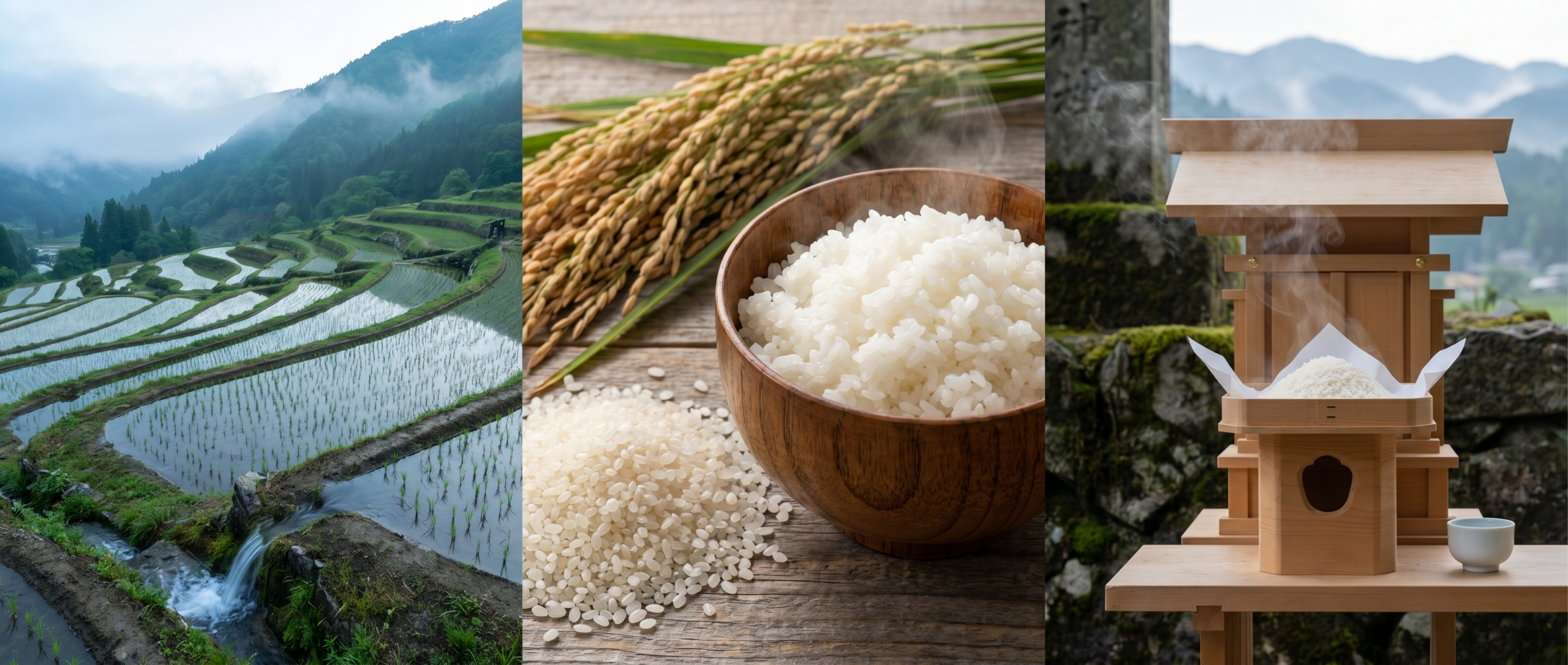
Fly over rural Japan in early summer and the country reveals its oldest logic from the air. Between the mountains and the sea, wherever the land will allow it, the ground has been divided into flooded rectangles that catch the sky and hold it — thousands of shallow mirrors laid across the valleys, climbing the hillsides in steps, curving to follow every contour. It is one of the most heavily engineered landscapes on earth, and it was built for a single plant.
That plant is rice, and the relationship between Japan and rice runs deeper than the relationship between most countries and any single crop. Rice is not simply what Japan eats. It is what shaped where people settled, how they measured wealth, what they worshipped, and even the words they use for a meal. To ask where Japanese rice comes from is not only a question about fields and varieties. It is a question about how a grain became the organizing principle of a civilization.
This article is about that — the origins, in the fullest sense: the land, the water, the history, and the meaning. If you want to know which variety to buy or how to cook it, we have written about those elsewhere, and we will point the way as we go. Here, we begin further back, in the field itself.
A Grain Built to Cling
Start with the plant, because its character explains a great deal of what follows. The rice grown across Japan belongs to the japonica subspecies of Oryza sativa — a short, round, relatively hard grain, distinct from the long, slender indica rices that dominate South and Southeast Asia. The difference is not cosmetic. It is written into the starch.
All rice starch is made of two molecules: amylose, a straight chain that keeps cooked grains dry and separate, and amylopectin, a branched molecule that makes them cling. Japonica rice is comparatively low in amylose and high in amylopectin, and that single fact is the reason Japanese rice behaves the way it does — why it turns glossy and cohesive rather than fluffy and loose, why it can be pressed into a rice ball or shaped beneath a piece of fish and hold together, why it yields softly against the tongue instead of falling apart. The stickiness that a cook raised on basmati might read as a defect is, in Japan, the entire point.
That physical character is not incidental to Japanese cuisine; it is foundational to it. The differences between japonica varieties — and there are hundreds cultivated in Japan — are subtle by comparison, but they matter enormously to how the rice is used. We explore that full spectrum in Not All Rice Is the Same, and the craft of turning the raw grain into a perfect bowl in How to Cook Rice Like It Matters. What concerns us here is something prior to both: how this particular grain came to grow in this particular land at all.
“The stickiness that a cook raised on basmati might read as a defect is, in Japan, the entire point.”
The Grain That Arrived
Rice is not native to Japan. It came from the Asian mainland, part of a lineage of wet-field cultivation that is thought to have originated far to the southwest — in the river valleys of southern China — and spread eastward over millennia, reaching the Japanese archipelago most likely by way of the Korean peninsula. Traces of dry-field rice may reach back further, into the late Jōmon period, but the transformative arrival was wet-field rice — paddy cultivation — which took hold around the transition into the Yayoi period, roughly two and a half thousand years ago.
It is difficult to overstate what this introduction set in motion. Paddy rice was Japan’s first form of intensive crop production, and it changed everything downstream of it. A flooded field, tended well, produces a great deal of food from a small area, and it can do so on the same ground year after year without exhausting the soil the way dry farming does — the water renews it. That reliability allowed populations to grow, to settle permanently, and to accumulate a surplus. And surplus, for the first time, meant that some people could own more than others, that stored grain could be counted and taxed, and that whoever controlled the rice controlled the means of power. The flooded field did not just feed early Japan. It gave it a structure.
Water, Terrain, and the Making of the Terraces
Growing paddy rice in Japan, however, meant contending with the land Japan actually has. This is a mountainous country; genuinely flat, easily farmed plains are scarce. To grow a crop that must stand in a controlled depth of still water, on terrain that mostly slopes, demanded one of the most remarkable acts of collective landscape engineering in the world: the tanada, the terraced rice fields that step up the hillsides in stacked, level shelves.
Each terrace is a small feat of hydraulic design. Mountain water — often clean snowmelt and spring water from above — is led into the highest field, then allowed to descend from one level to the next, so that a single source irrigates the whole staircase in sequence. The level of each field must be held precisely, its earthen banks maintained, its inflow and outflow adjusted through the season, because the depth of the water is itself a tool: raised to protect the young plants and warm their roots, lowered when the crop needs to firm and ripen. Rice farming in Japan has never been simply planting and harvesting. It is, above all, the management of water.
And that management produced benefits far beyond the harvest. Terraced fields act as a vast distributed system of small dams: they catch and hold rainwater across the slopes, releasing it slowly, softening floods, recharging the groundwater, and holding the hillsides in place against erosion. A landscape covered in tanada is a landscape that manages its own water — a piece of civil infrastructure disguised as farmland. The terraces are beautiful, and they are photographed endlessly for that beauty, but the beauty is a by-product of function. They are the visible record of a thousand years of people learning to make an unforgiving terrain yield.
“A landscape covered in terraces is a piece of civil infrastructure disguised as farmland: a vast, distributed system for holding water and holding the hills in place.”
A Grain, a Region, a Name
Because the crop is so bound to water, terrain, and climate, Japanese rice is intensely regional — and the varieties that define the modern table carry the names of the places that made them. The most celebrated of all, Koshihikari, was bred in the mid-1950s and selected for flavor and texture rather than for high yield, an unusual priority for a country still recovering from war. It succeeded so completely that it now accounts for roughly a third of all the rice grown in Japan, and most of the other leading varieties are its descendants.
But even a single variety is not one thing everywhere it grows. Koshihikari raised in the cool air and clean mountain water of Niigata’s Uonuma district is prized above nearly any other rice in Japan — a difference attributed not to the seed but to the place: the water, the temperature swing between day and night, the soil. This is the logic of origin in its purest form, the same logic that governs where the best kombu or tea or sake comes from. The grain is the same. The land is not. And in Japan, the land is understood to speak through the crop.
Nowhere is that attention to place and time more visible than in the reverence for shinmai — the new-crop rice of the autumn harvest. When the year’s rice comes in from the fields in October, still holding more of its moisture, more fragrant and more alive in the mouth than stored grain, it is treated as a genuine seasonal event, sought out and celebrated. That a country should mark the arrival of new rice the way others mark a new wine says something about how deeply the rhythm of the paddy is woven into the rhythm of the year itself.
The Grain That Became Sacred
If rice organized Japan’s land and economy, it did something equally profound to its inner life. In the native religious tradition that became Shinto, rice was understood to carry a spiritual force of its own, and the cultivation cycle — praying for a good crop in spring, giving thanks for the harvest in autumn — became one of the central armatures of religious observance. Rice was the food offered to the gods, the substance through which the human and divine worlds met.
That connection reaches all the way to the top of the state. Each November, in the Niiname-sai — one of the oldest and most important rites in the imperial calendar — the Emperor offers the season’s newly harvested rice to the deities and then partakes of it himself. In its grandest form, performed once at the start of a new reign, this rite of the first rice is bound up with the very legitimacy of the throne. The Emperor’s most ancient ceremonial role is, in essence, that of the nation’s first farmer, standing between the people, the gods, and the harvest. A grain does not become the centerpiece of a coronation by accident.
The Grain in the Language and the State
The deepest evidence of rice’s centrality, though, is the quietest. The ordinary Japanese word for cooked rice, gohan, is also the ordinary word for a meal itself. To eat is, linguistically, to eat rice; to cook for someone is to cook their rice. This is not a metaphor anyone consciously reaches for — it is simply built into the language, so thoroughly assumed that most speakers never notice it. A whole civilization’s understanding of what it means to be fed is folded into a single everyday word.
And that centrality has never been merely cultural; it has always been political. For centuries, wealth and rank in Japan were reckoned in rice — domains were measured by the volume of rice their land could produce, and that measure, not coinage, expressed a lord’s power. In the modern era the state took the crop directly under its wing: through much of the twentieth century the government formally controlled rice production and distribution, protected the domestic crop behind strict limits on imports, and defended that protection in the name of food security and cultural identity alike. The argument, made again and again, was that rice cultivation is not just agriculture but part of what Japan is — an argument that only makes sense in a country where a grain and a national self-image had long since grown into the same thing.
That story is not finished, and not untroubled. The average Japanese rice farm today is astonishingly small — often less than a single hectare — the farming population is aging, and the fields that took a thousand years to carve into the hills are, in places, being abandoned faster than they can be maintained. The terraces that once represented the reach of human effort now also represent its limits: each fallow field is a small unravelling of that ancient infrastructure of water. The grain that made Japan is now bound up with hard questions about what rural Japan will become.
But stand at the edge of a flooded paddy in June, with the young rice showing green above the water and the far mountains doubled in the still surface, and the older truth is plain enough. This is where the country begins. Every bowl of glossy short-grain rice set on a table — before it is a variety to choose or a thing to cook well — is the end point of this: a grain carried across the sea, planted in water on land that resisted it, tended through a calendar of prayer and labor, and made, over two and a half thousand years, into the center of everything. The rice is not the accompaniment to the meal. In Japan, it never was.
Read, then taste. This article is part of Waden’s Origin series — tracing Japan’s foods back to the land, water, and history that made them. From here, learn how Japan matches each variety to each dish in Not All Rice Is the Same, and how to cook the grain with the attention it deserves in How to Cook Rice Like It Matters.
Waden is an editorial journal exploring the depth and beauty of Japanese food culture — its history, ingredients, artisans, and traditions. Story first, always. waden.umamibako.com
Comment