How to Cook Rice Like It Matters
In Japan, rice is not a side dish. It is the center of the meal, the measure of a cook’s attention, and a living expression of respect — for the ingredient, for the season, and for the people at the table.
There is a Japanese word — gohan — that means both “cooked rice” and “meal.” The two concepts are inseparable. To eat is to eat rice. To cook for someone is, at its most fundamental level, to cook their rice. This conflation of grain and nourishment is not linguistic accident. It is the residue of two and a half thousand years in which a grain became the organizing principle of a civilization — embedded so deeply into the culture that most Japanese speakers no longer notice it.
In much of the Western world, rice is a background ingredient — a neutral starch, a vehicle for sauce, something that fills the plate around the main event. In Japan, the hierarchy is reversed. The fish, the vegetables, the pickles, the miso soup: these exist in relation to the rice. They are the accompaniments. In the traditional structure of a Japanese meal — one soup and three dishes — the rice is not counted among the dishes at all. It sits outside the count, because it is the thing the count is arranged around.
This difference in philosophy produces a difference in practice. And the practice of cooking rice well, in the Japanese sense, turns out to be one of the most instructive windows into how Japanese culinary culture thinks about cooking itself.
The Right Rice
Japanese rice — japonica rice — is a short-grain variety, and what sets it apart is not how much starch it contains but which kind. All rice starch is a mixture of two molecules: amylose, a straight chain that keeps cooked grains dry and separate, and amylopectin, a branched molecule that makes them cling. Japonica is comparatively low in the first and high in the second. That single fact is why the grains hold lightly to one another when cooked, tender but distinct, each keeping its shape while contributing to a cohesive whole. This quality, called nebari in Japanese, is not a flaw to be managed. It is a feature to be cultivated.
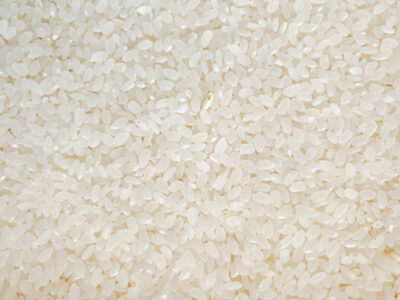
Within that category, the variation is considerable — Japan cultivates hundreds of varieties as table rice. Koshihikari, bred in Fukui Prefecture in 1956 and selected for flavor rather than yield, is the most celebrated, and now accounts for roughly a third of the country’s rice-growing area. Hitomebore, from Miyagi, is slightly cleaner in taste and highly versatile. Akitakomachi, from Akita, is a little less sticky, which makes it hold up better at room temperature. These are not interchangeable, and Japanese cooks do not treat them as such — which variety belongs in which dish is a quiet, practiced form of attention that goes largely unspoken because it is so deeply assumed.
Timing matters as much as variety. The October harvest brings shinmai, new rice, fresh from the field, holding more moisture and more fragrance than stored grain — and it is treated as a genuine seasonal event, sought out and celebrated the way other countries mark a new wine. That instinct, the pursuit of the peak moment of an ingredient’s life, runs through the whole of Japanese cooking, but nowhere is it applied to something quite so ordinary.
To cook Japanese rice well, you begin by choosing Japanese rice. This sounds obvious, but it matters more than any technique that follows. Long-grain rice cooked by Japanese methods will not produce Japanese rice. The method and the grain were designed for each other.
Washing: The First Conversation
Before water and heat, there is washing. In Japan, washing rice — togu, a verb that also means to sharpen or hone — is the first act of cooking, and it is treated with corresponding seriousness.
The purpose is to remove the residual bran and surface starch left over from milling. Left on the grain, these turn the cooking water cloudy and give the finished rice a slightly gluey, muted quality. Washing clarifies. It allows the flavor and aroma of the grain itself to come forward.
One detail governs everything else, and it is rarely mentioned outside Japan: the first water must be poured off immediately. Dry rice absorbs water fastest in the first moments it meets it, faster than at any later point in the process. Whatever is dissolved in that initial rinse — bran, dust, the smell of the storage bag — goes straight into the grain and stays there. So the practiced sequence is to add cold water, stir once, and drain at once, before the rice has had time to drink. Only then does the actual washing begin.
From there, the cook works quickly, agitating the grains gently with one hand and draining the cloudy water before it can be reabsorbed. Three or four repetitions is usually enough, until the water runs nearly clear — a slight milkiness is acceptable and expected. Water that runs perfectly transparent generally means the rice has been overworked.
It is worth being honest about the verb here. Togu — to hone — comes from an era when milling was cruder and a real abrasive action was needed to strip what the mill had left behind. Modern Japanese rice is milled precisely enough that vigorous scrubbing does more harm than good: grains crack under rough handling, and cracked grains cook unevenly, releasing too much starch and losing their individual texture. The word has outlived the technique it describes. What remains correct is the attitude behind it — firm but careful, like handling something you intend to treat well.
That attitude has a written history. In 1237, the Zen master Dōgen composed the Tenzo Kyōkun, a set of instructions for the monk responsible for cooking. Much of it concerns rice: pick out the sand grain by grain, watch the water, waste nothing, and do all of it with your full attention rather than your mind elsewhere. It is the earliest detailed account in Japanese of how to wash rice, and it appears not in a cookbook but in a manual of religious practice. Eight hundred years later, the instructions have barely changed.
Soaking: The Argument for Patience
After washing, the rice is left to soak. Many modern cooks skip this step — electric rice cookers have largely automated the decision — but it remains one of the most meaningful differences between rice that is good and rice that is exceptional.
Soaking allows water to penetrate gradually and evenly to the center of each grain. Without it, the outside cooks faster than the inside, producing rice with a slightly overcooked exterior and a core that retains a faint chalkiness. The numbers are more precise than the folklore suggests. Japanese agricultural research puts the saturation point of ordinary short-grain rice at around twenty to twenty-five percent of its weight in water; absorption is rapid for the first thirty minutes and then slows, reaching near-saturation at roughly two hours. Which is why the traditional guidance — thirty minutes in summer, forty-five to sixty in winter, when colder water slows absorption — turns out to be a reasonable approximation of a curve. Beyond two hours there is nothing further to gain, and at room temperature there is something to lose.
The water itself matters. Japanese cooks have long held that soft water produces better rice than hard, and the chemistry supports the instinct: dissolved calcium and magnesium interfere with the swelling of the starch granules, producing a firmer, less cohesive grain. In regions with hard tap water, some cooks filter it before it ever touches the rice. This is not fussiness for its own sake. Water is an ingredient — a conviction that runs deep enough in Japan that an entire craft tradition in the north grew up around a kettle that changes how it tastes.
The Ratio and the Heat
Japanese rice is measured in gō (合), a traditional unit equal to 180 millilitres by volume, or about 150 grams of uncooked grain — roughly one generous serving. The plastic cup that comes with every Japanese rice cooker is a one-gō measure, which is why it looks slightly too small to anyone expecting a standard 200 ml kitchen cup.
The water-to-rice ratio runs between 1:1.1 and 1:1.2 by volume — slightly more water than rice. By weight, which is easier to reproduce accurately, that works out to about 1.4 to 1.5 times the weight of the dry grain: roughly 210 to 225 grams of water for one gō. New-harvest rice, holding more moisture already, needs a little less. Older rice, dried out in storage, needs a little more. This calibration, once automatic for experienced cooks, is one of the small forms of attention the practice demands.
The cooking itself follows a specific rhythm of heat, and there is a rhyme that carries the instructions: hajime chorochoro, naka pappa, akago naite mo futa toru na — “first a trickle, then a roar; don’t lift the lid even if the baby cries.” The instructions were set to a rhyme because they had to be remembered under pressure, in front of a wood-fired kamado where the heat was never fully under the cook’s control.
On a modern stove, the rhyme needs translating rather than obeying. Its opening phase — the trickle — was doing the work that soaking now does, bringing the grain slowly up to temperature so the water could reach the core before the surface set. If the rice has already soaked, that stage is redundant. What remains is: bring it to a boil over medium-high heat, then drop immediately to the lowest possible simmer, covered tightly, for twelve to fifteen minutes.
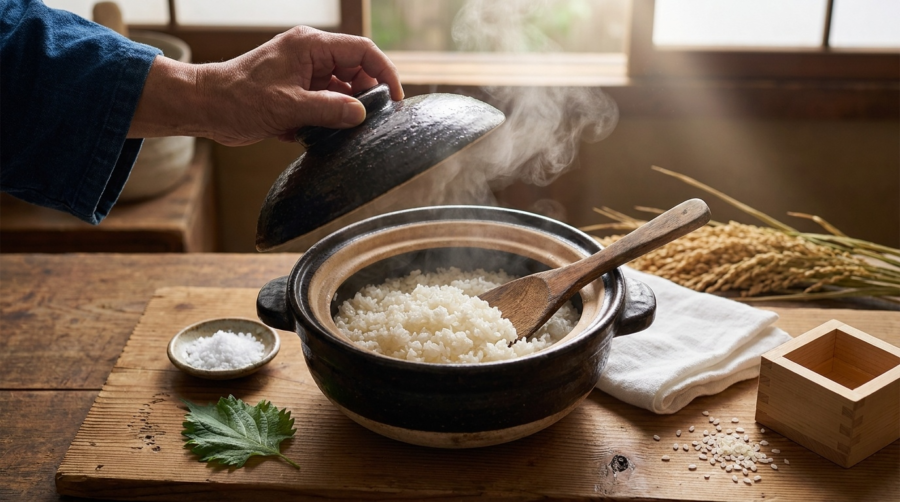
The final line of the rhyme, though, is not negotiable. Once the lid is on, it stays on. Steam is the medium through which the upper layers of rice cook; releasing it prematurely disrupts the process and produces unevenly cooked results. A heavy lid helps, which is part of the reason a donabe — a thick-walled earthenware pot — remains the vessel of choice for cooks who have gone back to cooking rice by hand. Clay heats slowly and holds that heat long after the flame is out, which turns out to matter a great deal for what happens next.
Murashi: The Discipline of Resting
Murashi (蒸らし) — the resting or steaming stage — is the final step, and the one most often neglected outside Japan. After the heat is turned off, the rice sits, covered and undisturbed, for ten to fifteen minutes. During this time the residual steam continues to move through the grains, evening out the distribution of moisture and allowing the starches to fully set.
Rice lifted from the pot immediately after cooking is edible but unfinished. The grains at the bottom are wetter than those at the top. The texture is less uniform. The flavor has not fully cohered. Resting completes what heat began. It is the difference between food that is technically ready and food that is actually done.
One practical caveat: if you are using an electric rice cooker, this has already been done for you. Virtually every modern Japanese cooker builds a murashi phase into its programme, which is part of why the cycle takes longer than the cooking alone would require. Waiting an additional fifteen minutes after the cooker signals is not devotion. It is just cold rice.
After resting, the rice is turned gently with a wooden paddle — a shamoji — using a folding, cutting motion that separates the grains without crushing them and lets the excess steam escape. This last step is what gives properly cooked rice its glossy, lightly separated surface. Traditionally the rice was then transferred to an ohitsu, a lidded tub of unfinished cedar, which absorbs surplus moisture as the rice cools and keeps it from turning heavy. The same principle — cedar that breathes — is the reason a wooden bento box keeps rice worth eating hours after it has gone cold.
Where the Bowl Goes
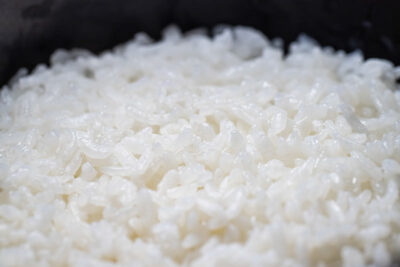
A bowl of plain white rice is a finished thing, and in Japan it is very often eaten exactly that way. But it is also a starting point, and a surprising amount of the cuisine begins at the moment the lid comes off.
Fanned, cooled to body temperature and seasoned with vinegar, it becomes shari — the half of sushi that most people never think about and every sushi chef thinks about first. Pressed into a triangle and packed cold into a box, it becomes the meal that travels. Alongside it, almost always, sit two things: a bowl of soup drawn from kombu and katsuobushi, and something pickled and sharp to reset the palate between mouthfuls. Rice, soup, pickles — the irreducible minimum of a Japanese meal, and the arrangement everything more elaborate is built on top of.
And then there is the branch that leads away from the table entirely. Steam the same grain, cool it, and let it be inoculated with koji, and it stops being food and becomes a tool — the starting material for sake, for miso, for soy sauce, for mirin, for vinegar. Nearly every foundational flavor in the Japanese kitchen begins as a bowl of cooked rice that was sent somewhere other than the mouth.
What All of This Is Really About
Taken together — the choice of grain, the washing, the soaking, the water ratio, the heat management, the resting — the practice of cooking Japanese rice looks like a considerable amount of attention directed at something most of the world treats as a background ingredient. And it is. That is the point.
Japanese culinary culture has a concept, teinei, that translates roughly as care, or attentiveness. It describes a quality of attention applied not only to complex or important tasks but to ordinary ones. The ordinary tasks, in fact, are where teinei is most meaningful: in the act of washing rice, in the decision to soak it properly, in the discipline of not lifting the lid. These are not grand gestures. They are the accumulated texture of a practice undertaken with respect — which is, more or less exactly, what Dōgen was telling his temple cook eight centuries ago.
There is a broader philosophy embedded here that goes beyond rice. Japanese cooking, at its best, is built on the conviction that ingredients deserve to be understood before they are used, handled carefully once they are in your hands, and given the time they need to become what they are capable of becoming. Rice is simply where this philosophy is most clearly legible, because rice offers so little to hide behind. There is no rich sauce, no elaborate technique, no strong seasoning to compensate for carelessness. The rice either was cooked with attention or it wasn’t. You can taste the difference immediately.
Cook rice like it matters, and it will taste like it does.
Read, then Taste.
This article is part of Waden’s Technique series, exploring the craft, philosophy, and practice behind Japanese culinary methods. It completes a trilogy: begin with The Grain at the Center for where the rice came from, and Not All Rice Is the Same for which one to choose. Read more at waden.umamibako.com.
Comment