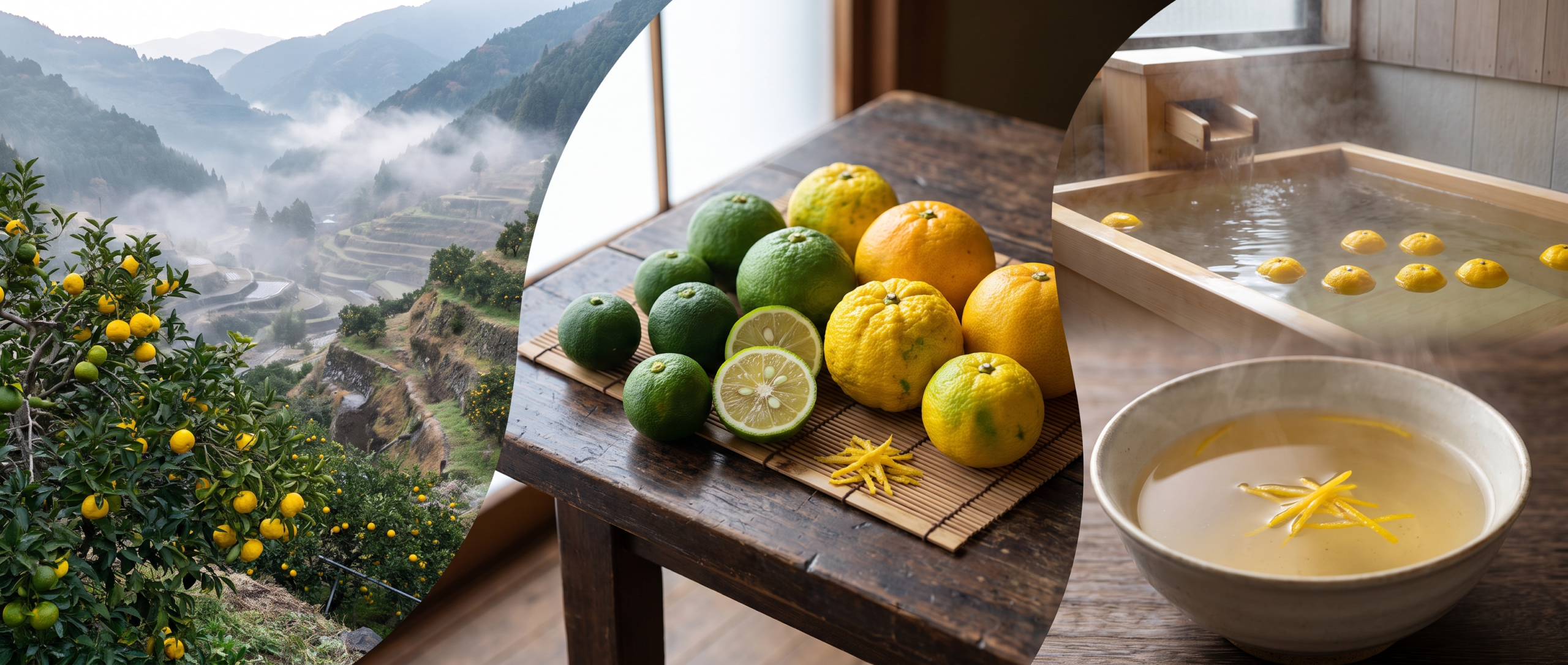
Yuzu and the Citrus That Refuses to Be a Fruit
No one bites into a yuzu. Japan’s most beloved citrus is grown not to be eaten but to be smelled — its aromatic peel, its sharp cold-weather juice, and a family of green cousins that between them flavor an entire cuisine without ever appearing whole on the plate.
Here is a fact that reorders how you think about citrus: almost no one eats a yuzu. The fruit is intensely sour, full of seeds, and short on flesh — try to eat it like an orange and you will regret it. And yet yuzu is arguably the most treasured citrus in Japan, present in kitchens from the humblest home to the most exacting restaurant. It earns that place without ever being eaten whole, because the Japanese prize it for something most cuisines treat as a footnote: its smell.
This is the key that unlocks the entire family of Japanese citrus. Yuzu, and its green cousins sudachi, kabosu, and daidai, belong to a category Japan gives its own name — kōsan-kankitsu, the “aromatic-sour citruses,” fruits grown specifically for fragrance and acidity rather than sweetness. They are used as a splash of juice, a scattering of grated peel, a single slice floating in a bowl. To understand them you have to stop thinking of citrus as a fruit you eat and start thinking of it as a seasoning you smell — and then follow it back to the specific mountains and rivers that made each one what it is.
A Fruit That Came a Long Way, Slowly
Yuzu is not originally Japanese. It is believed to have come from the upper basin of the Yangtze River in China, where it grew wild — probably as an ancient natural hybrid — and it reached Japan by way of the Korean Peninsula sometime before the Nara period, flourishing here for roughly 1,300 years. It arrived, tellingly, as a medicine before it was a flavoring, valued in western Japan for its supposed power to ward off illness.
The name itself records how the fruit was used. Among several theories, the most cited holds that yu comes from the Chinese character for the fruit, while zu (su) means vinegar — because yuzu juice was so often used in place of vinegar that the two words fused. Long before Japan had cheap rice vinegar in every kitchen, the sour juice of this citrus was the acid you reached for. The fruit is, in a real sense, named after its job.
What makes it so difficult a plant is the same thing that makes it so prized. Yuzu is slow — famously, punishingly slow. A yuzu grown the traditional way, from seed (the mishō method), takes fifteen to twenty years before it will bear a single fruit. Japan has a rueful proverb for this, a list of how long fruit trees make you wait: “peach and chestnut, three years; persimmon, eight; and the great fool of a yuzu, eighteen.” Because almost no farmer can afford to wait eighteen years, most yuzu today is grafted onto fast-growing trifoliate-orange rootstock, which brings fruit in only a few years. But a handful of the most traditional growers still raise seed-grown trees, accepting the two-decade wait in exchange for a fruit whose fragrance and depth, they insist, the grafted trees never quite match.
Peach and chestnut, three years; persimmon, eight; and the great fool of a yuzu, eighteen. To grow one the old way is to plant for a harvest two decades off.
Why the Mountains Matter
Japan grows about 27,000 tonnes of yuzu a year, and more than half of it — around 52 percent — comes from a single prefecture: Kōchi, on the Pacific side of Shikoku. Tokushima and Ehime, the two prefectures beside it, supply most of the rest. It is no accident that Japan’s yuzu heartland is a cluster of steep, cold, mountainous country in western Shikoku, because the fruit’s quality is made by terrain.
Yuzu is grown mostly in inland mountain valleys, and the reason is the daily swing in temperature — the wide gap between warm days and cold nights that mountain basins produce. That swing is what drives the peel to develop its intense, complex aroma; a yuzu grown in a mild, even coastal climate is a fainter thing. The trees themselves are armored with vicious thorns that scar the fruit in winter winds, which is part of why yuzu is reckoned a demanding crop. This is the Origin principle in miniature: the fruit tastes of the specific place — the altitude, the cold nights, the mountain air — as much as of the species. Tokushima’s Kitō region has leaned into exactly this, registering its “Kitō yuzu” as a protected Geographical Indication, a legal acknowledgment that where a yuzu grows is inseparable from what it is.
The Cousins: Three Green Citruses and a Division of Labor
Yuzu does not work alone. Japan’s aromatic citruses divide the country and the calendar between them, and knowing which is which — and where each comes from — is part of eating knowledgeably.
Sudachi is the small one, roughly the size of a golf ball, green-skinned and sharply fragrant. It is almost entirely a product of one prefecture: Tokushima grows something like 98 percent of Japan’s sudachi, to the point that the fruit is effectively the region’s emblem. Its bright, clean acidity is the classic partner for grilled fish, for the prized matsutake mushroom, and for soba, squeezed over the top at the last moment.
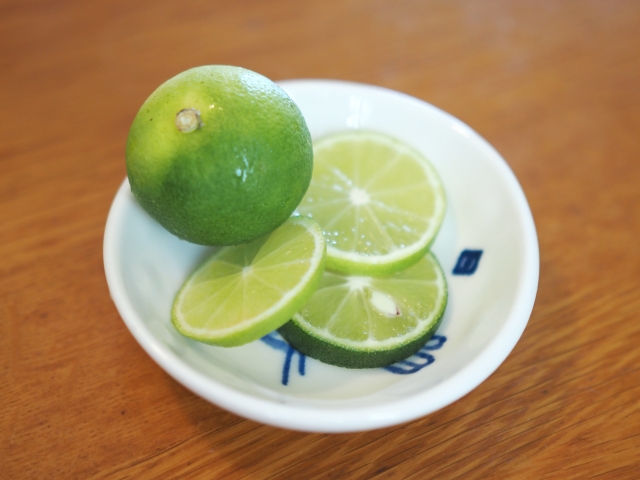
Kabosu is the larger green cousin, closer to a tennis ball, and it belongs just as overwhelmingly to neighboring Ōita Prefecture, which dominates its production. Its juice is a little more rounded and mellow than sudachi’s, and in Ōita it is the traditional accompaniment to fugu, the pufferfish, and to other delicate seafood — a regional pairing so established it is almost a rule.
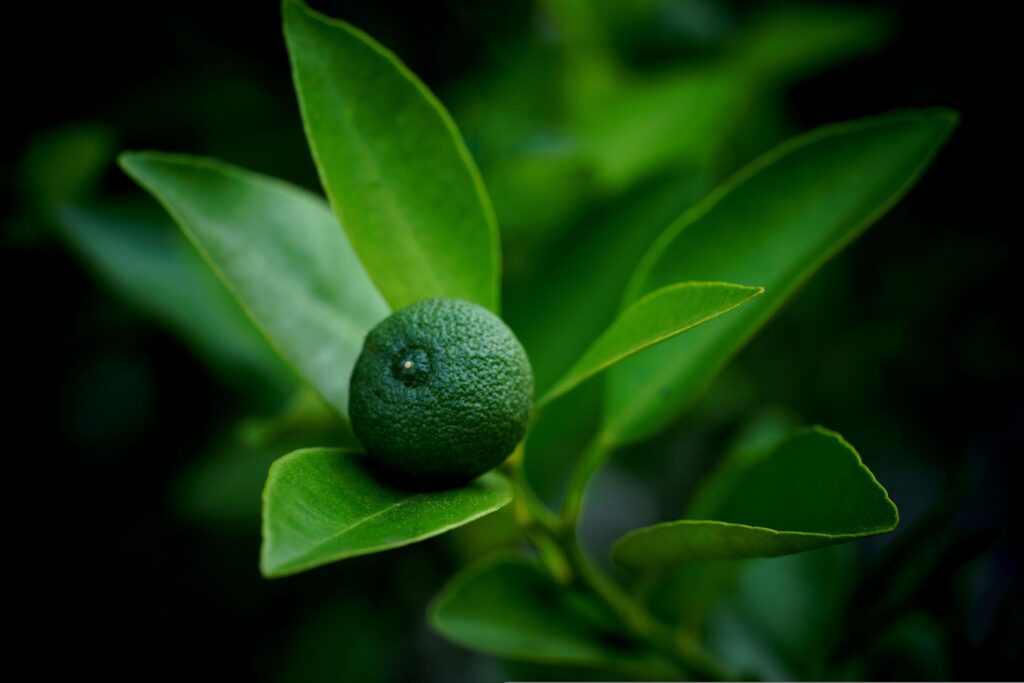
Daidai is the odd one out, and the most interesting culturally. A bitter orange, its juice goes into ponzu, but its real fame is symbolic. The word daidai is a homophone for “generation after generation” (代々), and because the fruit clings stubbornly to the branch rather than dropping — sometimes staying on the tree for years, old fruit and new hanging together — it became a symbol of an unbroken family line. This is why a daidai sits atop the kagami-mochi, the stacked New Year rice cakes, and hangs in the shimekazari door decoration: a wish, encoded in a fruit, that the household will flourish for generations. Here a citrus is valued for neither flesh nor even fragrance, but for a pun and a habit of not letting go.
Green in Summer, Gold in Winter
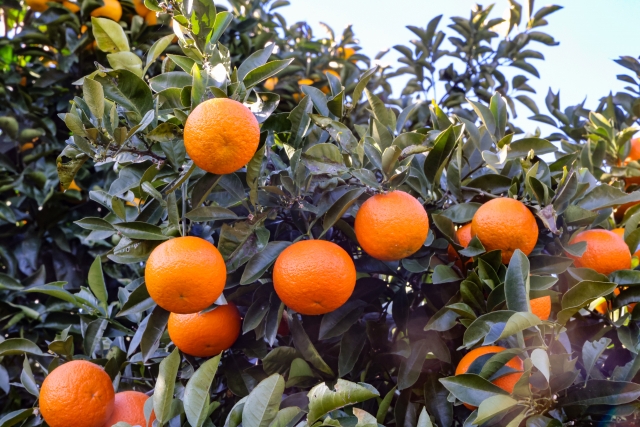
Yuzu itself keeps two seasons, and cooks treat them as almost different ingredients. The ao-yuzu, or green yuzu, is the immature fruit picked in late summer and early autumn, when its peel is still green and its aroma is sharp, fresh, and slightly bitter. The ki-yuzu, the yellow yuzu, is the ripened fruit that comes from late autumn into winter, its peel turned gold, its juice more abundant and its scent sweeter and rounder. The fruit’s true peak, and the bulk of its harvest, falls between November and January — which is precisely why yuzu reads, to a Japanese cook, as the taste of the cold months.
You can watch this seasonality play out in a single condiment. Yuzu-koshō — a paste of yuzu peel, chili, and salt — comes in two colors: a green version made from green yuzu and green chili, sharp and fresh, and a red-gold version from ripe yellow yuzu and red chili, sweeter and deeper. Same idea, two seasons, two entirely different flavors. And in almost every use, it is the peel that carries the prize. A few threads of grated yuzu zest dropped onto a clear soup or a bowl of simmered vegetables is one of the defining gestures of Japanese cooking — the fruit contributing nothing you can chew, only a lift of fragrance that signals, unmistakably, the season.
A Bath Full of Citrus
The clearest proof that yuzu is loved for something other than eating is what Japan does with it on the year’s longest night. On the winter solstice — tōji — households and public baths float whole yuzu fruit in hot water for a yuzu-yu, a yuzu bath. The custom is thought to date to the Edo period, when public bathhouses spread, and it rests on a small pile of wordplay and folk medicine: tōji, the solstice, puns on tōji, “hot-spring cure,” and yuzu suggests yūzū, “to be flexible” or in good health. The saying that condensed it all — “take a yuzu bath on the solstice and you won’t catch cold” — became one of the most durable in the Japanese calendar.
There is real substance beneath the pun. Yuzu peel is remarkably rich in vitamin C — around 150 milligrams per 100 grams, several times the juice — along with aromatic oils and pectin, and the warm bath releases those oils into the water, where they are believed to aid circulation and soften the skin. Whether or not it prevents a cold, a room full of the scent of yuzu on the darkest evening of the year is its own kind of medicine. And it is the purest expression of the whole idea: on the most important yuzu day of the calendar, no one eats a single one.
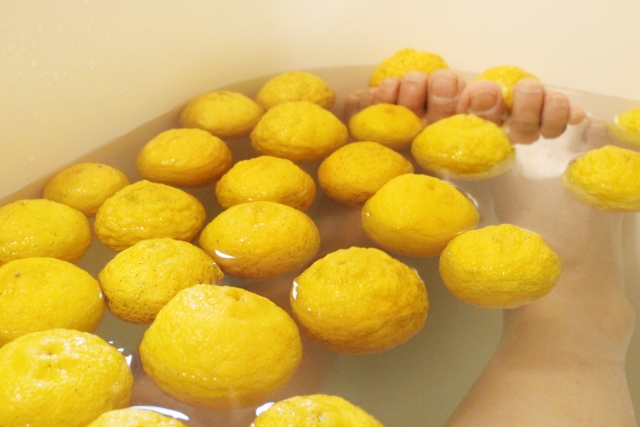
On the longest night of the year, Japan fills its baths with a citrus no one intends to eat — and lets the smell do the work. It is the whole philosophy of yuzu in a tub of hot water.
The Fruit Goes Abroad
For most of its 1,300 years in Japan, yuzu stayed there. The turn outward is startlingly recent. In the late 2000s and early 2010s, French chefs — always alert to a new aromatic — discovered yuzu, and it began appearing in sauces, dressings, macarons, and desserts across high-end European kitchens. Kōchi’s Kitagawa Village, one of the great yuzu-growing towns, set its sights on France, hosting a tasting event there in 2011; after showing at a food fair the following year, a village producing only a few tonnes found itself fielding orders from buyers in some twenty countries. Within a few years Kōchi yuzu was reaching twenty-five nations, from the United States to Singapore.
The obstacle was never demand but quarantine: exporting fresh yuzu into the strict phytosanitary regime of the European Union took years of work to clear, which is part of why so much yuzu still travels abroad as juice or paste rather than whole fruit. But the trajectory is unmistakable. A slow-growing, thorn-armored, barely-edible mountain citrus, grown for over a millennium in the valleys of western Japan for its smell alone, is now one of the most sought-after aromatics in the world’s most demanding kitchens — recognizable enough that “yuzu” needs no translation on a Paris menu.
What the Nose Knew
It would be easy to file all this under novelty — the strange citrus you smell instead of eat. But there is a deeper logic in it, and it runs through the whole of Japanese cooking, the same instinct that prizes the fleeting aroma of freshly grated real wasabi over mere heat, or that builds an entire cuisine on the seasonal timing of shun, the peak moment of an ingredient. Flavor, in this tradition, is not only what lands on the tongue. It is aroma, season, symbol, and place, all at once.
A yuzu holds all of them. Its scent is the smell of a Japanese winter. Its two seasons, green and gold, mark the turning of autumn into cold. Its cousins divide the map — sudachi to Tokushima, kabosu to Ōita, daidai to the New Year altar — so that a squeeze of citrus can tell you where you are and what time of year it is. And its slow, thorned, seed-grown difficulty is the reason a truly good one is treasured. No one bites into a yuzu. They lift it to the nose, grate a few threads of its peel over a bowl, float it in a winter bath — and take, from a fruit they will never actually eat, one of the most vivid flavors in the whole of the cuisine.
Read, then Taste.
This article is part of Waden’s Origin series — tracing Japan’s ingredients back to the land, water, and history that produced them. Read more at waden.umamibako.com.
Waden is an editorial journal exploring the depth and beauty of Japanese food culture — its history, ingredients, artisans, and traditions. Story first, always. waden.umamibako.com
Comment