Wasabi: The Plant That Almost No One Actually Eats
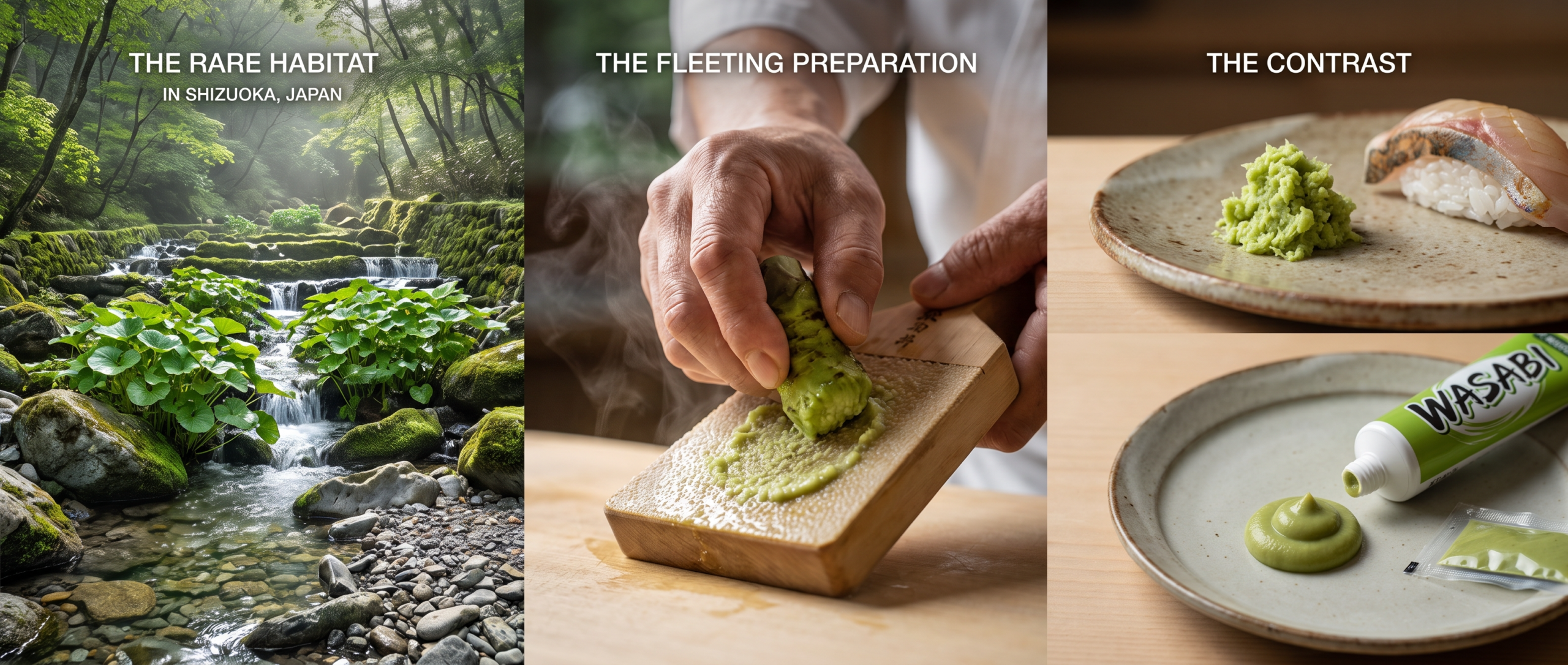
Real wasabi grows only in cold, running mountain water — which is why the green paste beside your sushi is, overwhelmingly, something else entirely.
Here is an uncomfortable fact to begin with: the little green mound you have almost certainly eaten alongside sushi was, in all likelihood, not wasabi. Depending on the estimate, somewhere between ninety-five and ninety-nine percent of the “wasabi” served outside Japan — and a great deal of it inside Japan too — contains no wasabi at all. It is dyed horseradish, sharpened with mustard and tinted green.
This is not quite the scandal it sounds like. It is, more than anything, a consequence of botany. Real wasabi is one of the most difficult food plants in the world to grow, one of the most perishable to prepare, and one of the most fleeting to taste. Understanding why is really the story of a plant that refuses to be convenient — and of the clear mountain streams that are the only places it will consent to grow.
A Plant That Demands a Mountain Stream
True wasabi — hon-wasabi, the species Wasabia japonica — is a member of the brassica family, a cousin of mustard, cabbage, and horseradish, and it is native to Japan, where it grows wild along the cold, shaded margins of mountain streams. The part we eat is the rhizome, the thick green stem at the base of the plant, grated into paste.
The finest wasabi is grown by a method called sawa-wasabi — “stream wasabi” — cultivated directly in flowing spring water rather than in soil. And the plant’s demands are exacting to the point of tyranny. It wants water that is cold but never freezing, clean, oxygen-rich, and constantly moving. The ideal water temperature sits between roughly 8 and 18°C, and — this is the difficult part — the plant grows best where that temperature barely changes across the entire year. In Shizuoka, Japan’s premier wasabi region, spring water emerges from the ground at around 13°C in summer and winter alike, and that year-round constancy is precisely what wasabi requires.
Very few places on earth offer such water in abundance. This is the whole reason wasabi is rare and expensive: not fashion, not marketing, but the simple fact that the plant will only thrive in a narrow band of pristine, cold, running water that most of the planet cannot provide.
Wasabi is not expensive because it is fashionable. It is expensive because it will grow almost nowhere — only where cold, clean water runs at the same temperature all year.
The Gift That Was Forbidden to Leave
Cultivated wasabi has a birthplace, and it is a small mountain village called Utogi, in what is now the city of Shizuoka. Sometime in the Keichō era — the years around 1600 — villagers there took wild wasabi growing on the slopes and planted it near a spring source. That act is generally regarded as the beginning of wasabi cultivation anywhere in the world.
The plant’s early history reads almost like a legend, and the villagers of Utogi still tell it. In 1607, wasabi from the village was presented to Tokugawa Ieyasu — the shōgun who had unified Japan — who was living out his final years at nearby Sunpu Castle. Ieyasu is said to have been so taken with it that he praised it as a peerless delicacy and forbade the plant from being taken out of Utogi. For a time, wasabi cultivation stayed sealed within that single village, a controlled treasure.
It escaped eventually. By the middle of the eighteenth century the technique had spread to the Izu region, and in 1892 stonemasons there developed the cultivation method that still defines the best wasabi today: the tatami-ishi, or “layered-stone,” system. In it, large stones are laid at the bottom of a terraced bed, then progressively smaller ones, topped with a layer of fine gravel. Spring water poured through this structure is filtered clean, held at a steady temperature, and delivered with a constant supply of oxygen and nutrients to the roots. It is, in effect, a piece of hydraulic engineering disguised as a garden — and it works so well that Shizuoka’s traditional wasabi cultivation is now recognized as a Globally Important Agricultural Heritage System.
Two Wasabis, Grown Two Ways
Not all real wasabi is grown in water. There is a second kind, hatake-wasabi — “field wasabi,” sometimes called oka-wasabi, “land wasabi” — grown in soil rather than streams. It is hardier and faster to raise, but its rhizome stays small; field wasabi is cultivated mainly for its leaves and stems and for processing, rather than for the prized rhizome that stream cultivation produces.
Beyond Shizuoka, the other great wasabi region is Nagano, and in particular the Azumino basin, where wasabi is grown in a distinctive flat-field water cultivation fed by groundwater from the melting snows of the Northern Alps. Different terrain, same fundamental requirement: cold, clean, ceaselessly moving water. Wherever real wasabi grows well in Japan, you will find a mountain and a stream behind it.
Why the Flavor Vanishes
Wasabi’s rarity is only half its strangeness. The other half is that even genuine wasabi barely exists as a flavor before it is eaten. An intact wasabi rhizome is almost mild. Its famous sharp heat — the clean rush that shoots up the nose rather than burning the tongue — does not exist in the plant at rest. It has to be created, at the last moment, by damage.
The mechanism is a small piece of chemistry. Inside the cells of the rhizome sit two things kept apart: a compound called sinigrin and an enzyme called myrosinase. When you grate the wasabi, you rupture the cell walls, the two meet, and the enzyme converts the compound into allyl isothiocyanate — the volatile molecule responsible for wasabi’s aroma and pungency. The finer you grate, the more cells you break, the more of this reaction occurs, and the more intense the flavor. This is why serious wasabi is grated on a sharkskin grater (samegawa oroshi), whose extremely fine surface ruptures the maximum number of cells, and why it is worked in slow circles rather than scrubbed back and forth.
But “volatile” is the operative word. Allyl isothiocyanate evaporates readily — it drifts off even at room temperature — which means freshly grated wasabi is already losing its flavor from the moment it is made. Its peak lasts only minutes; within a quarter of an hour, much of the aroma is simply gone into the air. Real wasabi is not an ingredient you can bottle and keep on a shelf with its character intact. It is something closer to a performance, most alive in the instant it is grated, at the counter, in front of you.
Wasabi’s heat does not exist until the plant is grated, and it begins vanishing the moment it does. Real wasabi is less an ingredient than a fleeting event.
So What Is in the Tube?
Now the “scandal” resolves into simple logic. A plant that grows only in rare mountain water, and whose flavor lives for only minutes after grating, is impossible to serve cheaply or at scale. So the food industry reached for a substitute that is abundant, hardy, and stable: horseradish — Western wasabi’s brash relative — ground up, blended with mustard, and dyed green to look the part. It delivers a comparable nasal burn, keeps for months, and costs a fraction as much.
It is not fraud so much as substitution born of necessity, and much of the world has genuinely never tasted the real thing. If you read a Japanese tube’s label carefully you can even find the hierarchy spelled out: some products note hon-wasabi iri (“contains real wasabi,” meaning less than half) versus hon-wasabi shiyō (“made with real wasabi,” meaning more than half) — an admission, in fine print, that the green paste is usually mostly something else.
The difference on the palate is not subtle once you know it. Real wasabi is aromatic and faintly sweet beneath its heat, its sharpness clean and quick to fade; horseradish is blunter, hotter in a flatter way, and lingers. The gap between them is exactly the gap between a fresh ingredient and a shelf-stable imitation of one.
The Point of the Real Thing
All of this explains why, at a serious sushi counter, wasabi is not squeezed from a tube but grated fresh and tucked between the fish and the rice — and why it was traditionally valued for more than heat. Wasabi carries mild antimicrobial properties, a genuine practical benefit alongside raw seafood, which is one reason it settled so naturally into the world of sushi and sashimi in the first place. It is not a condiment bolted onto raw fish; it is part of how the dish was made to work.
Understanding wasabi changes how you read a plate. The same care that a chef gives to the cut of the fish and the shaping of the rice — the attention that runs through every form of sushi, from nigiri to maki — extends to that small green mound, when it is real. Freshly grated hon-wasabi is a mountain stream translated into flavor, alive for only a few minutes, grown in one of the few places on earth cold and clean enough to hold it.
Most of us have eaten the imitation our whole lives without knowing. The real thing is worth seeking out at least once — not for the heat, which the imitation supplies well enough, but for the fleeting, aromatic sweetness underneath it, and for the quiet astonishment of tasting something that so nearly refuses to be tasted at all.
Read, then Taste.
This article is part of Waden’s Origin series — tracing Japan’s ingredients back to the land, water, and history that produced them. Read more at waden.umamibako.com.
Comment