Two Sticks, Four Hundred Years: The Making of Japanese Chopsticks
Japan is the only chopstick culture that made the tool personal, tapered it to a point, and then built an entire industry around throwing it away. A small town on the Sea of Japan produces most of the country’s lacquered pairs. A different tradition insists the best chopsticks be used once and burned.
Pick up a pair of Japanese chopsticks and a pair from China and hold them side by side. The difference is immediate and slightly absurd once you notice it. The Chinese pair is longer, blunt at the working end, squared or rounded along its whole length like a pencil that never met a sharpener. The Japanese pair is shorter, and it narrows — steadily, from a thick grip down to a tip sometimes no wider than a needle.
That taper is the whole argument. It exists because of what it has to do: lift a slippery cube of tofu without crushing it, strip flesh from the pin bones of a grilled fish, separate a single grain of rice from the mass. Chinese cooking sends food to the table already cut, and its chopsticks reach across a shared round table to do it. Japanese cooking hands the diner a whole fish, and expects the tool to finish the butchery. The instrument was shaped by the plate it serves.
And in Japan alone, that instrument became personal property. A Japanese household keeps my-hashi — my chopsticks, an individual’s own pair, distinguished by length or colour or pattern, not to be used by anyone else. The father’s pair, the mother’s pair, the child’s pair. No other chopstick culture does this. Elsewhere the utensils in the drawer are interchangeable. Here, they are yours the way a toothbrush is yours.
Measured Against the Hand
If chopsticks belong to a person, they should fit that person, and Japan has a unit for it. The measure is hito-ata: open your thumb and index finger to a right angle and take the straight-line distance between the two fingertips. The correct length of a chopstick is traditionally one and a half times that span — hito-ata-han. It is a measurement no ruler is involved in, taken from the body of whoever will use the thing, and it produces roughly twenty-one to twenty-three centimetres for most adults, with women’s chopsticks conventionally shorter than men’s for no reason more mysterious than the average size of a hand.
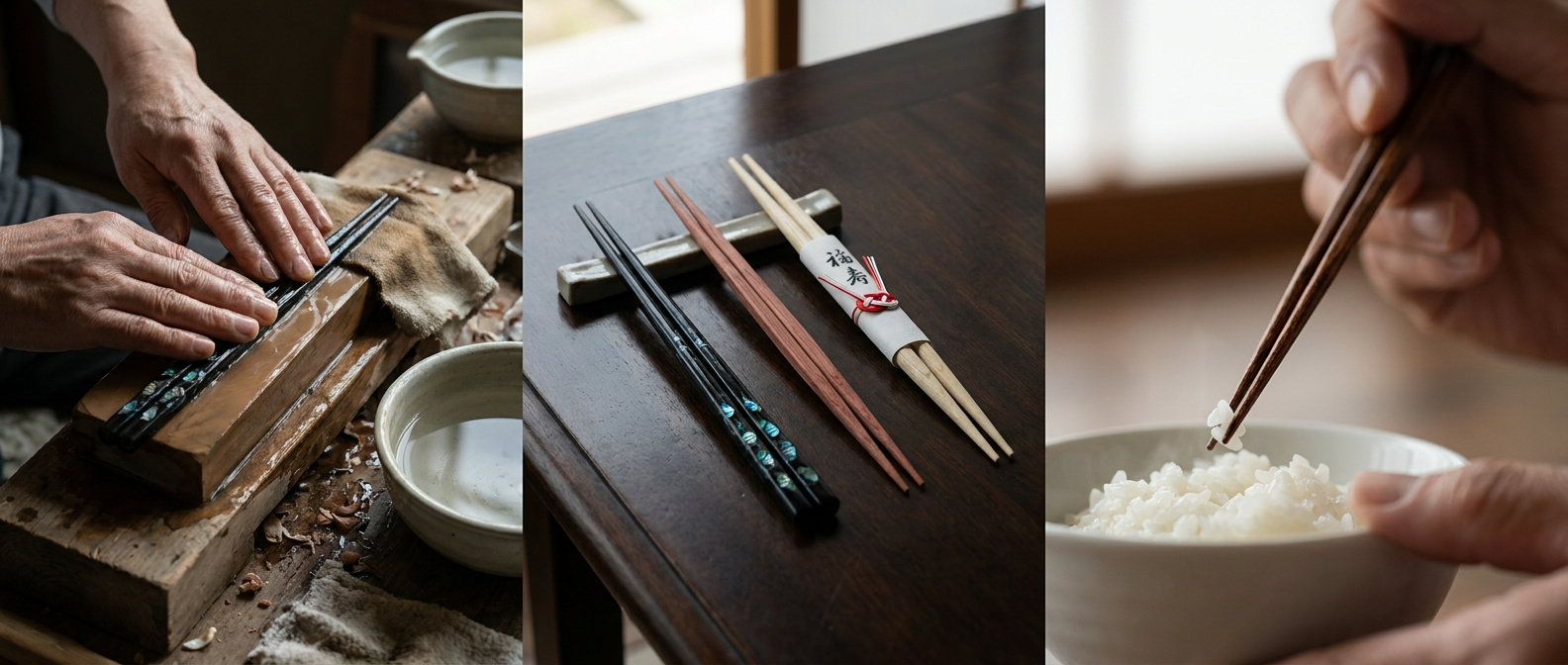
The grip section is where the maker’s decisions become visible. A round shaft is the simplest to turn and the least willing to stay still; it rolls off the bowl rim and rotates in the fingers. Square stops rolling but bites. Between them sit the compromises that most good chopsticks actually use: the hexagon, which seats the three contact points of thumb, index, and middle finger almost automatically, and the octagon, which rounds the hand-feel further while still resisting the roll. There is even a five-sided form, the pentagon, which cannot be gripped symmetrically and so quietly forces the hand into a single correct orientation. These are not decorative choices. A chopstick is a lever operated by three fingers, and the cross-section decides whether the lever stays where it was put.
The taper is the whole argument. Chinese cooking sends food to the table already cut. Japanese cooking hands the diner a whole fish, and expects the tool to finish the butchery.
The Town That Makes Almost All of Them
Now the strange fact. If you own a pair of lacquered Japanese chopsticks, they very probably came from one small city on Wakasa Bay. Obama, in Fukui Prefecture, produces the overwhelming majority of Japan’s lacquered chopsticks — the local chopstick industry cooperative claims more than eighty percent of national output, and the city’s own figures have run to around ninety. A single town, facing the Sea of Japan, holds a near-monopoly on the everyday chopstick of an entire country.
The tradition it works in is Wakasa-nuri, and its origin story is unusually specific. In the early Edo period a lacquerer in the service of the Obama domain, Matsuura Sanjūrō, took inspiration from imported Chinese lacquerware and set out to render something local: the look of the seabed of Wakasa Bay. Shells, seaweed, the scattered debris of the shallows. That marine image is the design’s foundation. The domain lord Sakai Tadakatsu, who arrived in Wakasa in 1634, gave the style its name and protected it so jealously that he forbade the technique from leaving the domain, and the craft was encouraged as piecework for the lowest rank of samurai. Fukui Prefecture’s own account dates the origin to roughly four hundred years ago and notes that by the middle and late Edo period — the golden age — more than two hundred distinct decorative methods had been perfected.
What makes it recognisable is a technique called togidashi, polishing-out, and it works in reverse from most decoration. The artisan does not paint a pattern on. Instead, natural materials — eggshell, abalone and other shell, pine needles, rice chaff — are laid onto the undercoated wood to create a texture. Then lacquer is applied over the top, coat after coat, dozens of times, burying everything. Then it is ground back down: first with whetstones in ascending fineness, a step called ishi-togi that the prefecture notes is unique to Wakasa among Japanese lacquer traditions, then with charcoal, then polished with oiled powder and finally with the fingertips. The pattern that emerges was never drawn. It was excavated. What you see is a cross-section through layers, which is why the surface has a depth that printing cannot imitate — the pattern is genuinely inside the lacquer rather than on it.
The full process runs past sixty steps, and apart from the initial woodwork it is not divided among specialists. One artisan carries a piece from undercoat to final polish, which is why individual hands remain legible in the finished work. The timing is dictated by weather: the pattern-laying stage requires lacquer that hardens neither too fast nor too slow, so it is done between December and March. Wakasa-nuri was designated a national traditional craft in 1978.
There is a telling gap in the historical repertoire. Wakasa-nuri produced trays, boxes, tea utensils — but essentially no soup bowls. Under Tokugawa frugality codes, work this ornate was restricted to court nobles, samurai households, and wealthy merchants, and so the ordinary vessels of ordinary life were simply never made in it. The tradition survived into the modern era by concentrating on the one object everyone needs and everyone can justify owning something beautiful of. It became a chopstick town partly by exclusion. Those layered coats also explain why the craft belongs to a longer story about a tree and its sap, which we followed in our account of urushi and the long life of lacquer.
The Chopstick Made to Be Destroyed
Set against four hundred years of polishing is the opposite conviction: that the finest chopstick is one used once and never again.
This is not a modern convenience argument. It is a purity argument, and it is old. Freshly split wood has touched no other mouth, and in Shinto sensibility the act of breaking something open marks a beginning. Formal occasions and rites therefore call for chopsticks that are new, plain, and unlacquered.
Its most refined expression is the rikyū-bashi, attributed to Sen no Rikyū and used in the meal that precedes tea. The form is distinctive: tapered at both ends, thicker through the middle, cut from the red heartwood of Yoshino cedar. The story attached to it is that Rikyū would, on the morning of a gathering, take fresh cedar and whittle a pair for each guest by hand with a small knife — chopsticks made that day, for that person, for that single meal. Whether or not the account is literally true, it is a precise statement of what the object is for. The wood is fragrant when cut and the fragrance fades within hours, so a rikyū-bashi genuinely is at its best only once. Merchants, disliking the character used for Rikyū’s name, sometimes write it with a different second character meaning “to rest profit” — a small superstition preserved in the spelling.
From that ceremonial root grew an industry. The disposable chopstick, waribashi, appears in the late Edo period as the hikisaki-bashi used by the better teahouses and restaurants of the pleasure districts. Its real expansion, though, came from thrift. In the Yoshino district of Nara, cedar was being worked into sake barrels, and the offcuts were being thrown away. In 1862 a pilgrim monk named Sugihara Sōan, seeing the waste, proposed making chopsticks from the scrap. The disposable chopstick was invented as a way of not wasting wood — a fact that sits oddly against its modern reputation.
The shapes that followed are a small catalogue of incremental problem-solving, and Yoshino’s own chronology dates them closely. Around 1877 a village schoolteacher in Shimoichi devised the plain rectangular chōroku and the oval-edged koban, easier on the hand. Adding a groove down the middle of the koban so it would split cleanly produced the genroku, the ubiquitous convenience-store chopstick. Around 1907 came the rikyū form, tapered at both ends after the tea original. And around 1916 the tensoge — “heaven-shaved,” cut at a steep diagonal across the head to expose the grain — developed out of the barrel-making waste stream, and remains the formal disposable chopstick of restaurants and inns.
The disposable chopstick was invented in order to avoid wasting wood — cedar offcuts from sake barrels that were otherwise burned. Its modern reputation is almost the exact inversion of its origin.
That origin makes the present situation ironic. Japan’s Forestry Agency reports that roughly ninety-seven percent of disposable chopsticks consumed domestically are imported, overwhelmingly from China, with Vietnam now a growing second source. Domestic production collapsed under price competition — a Japanese chopstick made from thinnings costs around three times its Chinese equivalent — and the number of Japanese waribashi factories fell from 359 in 1993 to 99 by 2009. Nara still accounts for most of what remains. So the object conceived to use up Japanese scrap wood is now, in the main, made from trees felled abroad for the purpose. Researchers have also pointed out that the total wood consumed by chopsticks amounts to well under one percent of Japan’s timber use, which suggests the long public argument over disposable chopsticks and deforestation was aimed at a rather small target.
The Pair the Gods Also Use
One form stands apart from both traditions. The iwai-bashi, the celebration chopstick, appears at New Year, at weddings, at a baby’s first-meal ceremony, and it looks wrong at first glance: tapered at both ends, like a serving implement.
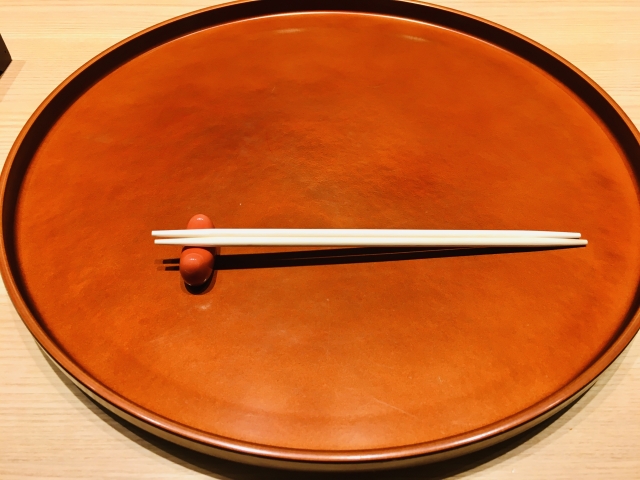
It is not a serving implement, and using it as one is a genuine breach. The second point is not for you. One end is for the diner and the other is for the toshigami, the deity of the incoming year — the belief being shinjin-kyōshoku, gods and people eating together from the same instrument. Osechi food is offered to the deity first and then taken down and eaten, and the two-ended chopstick is the physical expression of that sharing. Turning it around to serve from the communal dish puts your food where the god’s end is.
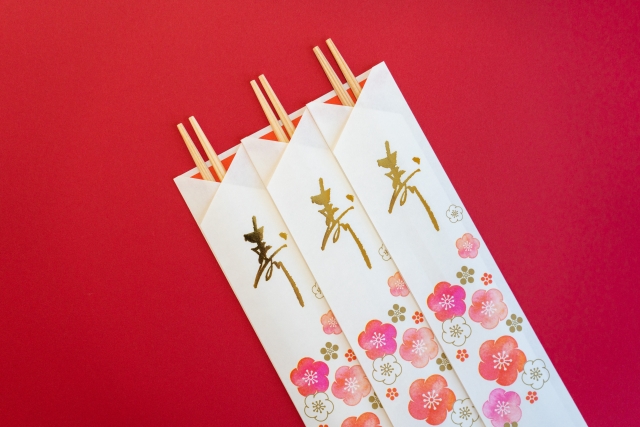
Every other feature is similarly loaded. The length is fixed at eight sun, about twenty-four centimetres, because the character for eight widens toward its base and reads as prosperity broadening into the future. The wood is willow, chosen for two reasons at once: it is tough and resists snapping, and a chopstick breaking at a celebration is a bad omen, while willow is also regarded as a purified, sacred wood and the first tree to bud in spring. The name is sometimes written with characters chosen for sound rather than sense to mean “house full of joy.” The swelling at the middle gives the alternative name tawara-bashi, rice-bale chopsticks, a wish for a good harvest, and that same belly earns the name harami-bashi — pregnancy chopsticks — a wish for descendants.
The New Year custom completes the picture. On the last night of the old year, the head of the household writes each family member’s name on their paper sleeve and sets the chopsticks on the household altar. They are used from the first day of the new year, and each person washes their own — not, traditionally, handed to anyone else to clean — and keeps using that same pair through the seventh of January. For one week a year, the disposable chopstick becomes the most personal object in the house.
What the Object Knows
Three traditions, then, pulling in different directions. A lacquer town that spends sixty steps and four months of winter on a pair meant to last for years. A tea master whittling cedar at dawn for a pair meant to last one meal. A willow pair with a name written on its sleeve, shared with a god for seven days and then finished.
What unites them is that none treats the chopstick as generic. It is fitted to a hand, or to an occasion, or to a single guest on a single morning. Even the cheapest grooved waribashi carries a fragment of the logic: it is split, in front of you, and that splitting is the guarantee that it is yours and no one else’s. The etiquette that grew up around these two sticks — the elaborate vocabulary of what must never be done with them, which we set out in the unspoken language of chopsticks — makes far more sense once you know that the object itself was never neutral to begin with. You do not stand them in rice or pass food between them because they were already, in their making, more than a pair of sticks.
Hold a well-made pair and the taper is the thing to notice. Somewhere at the end of that narrowing is a point fine enough to lift one grain of rice, and someone decided it needed to be.
Read, then taste. This article is part of Waden’s Vessel series — exploring the art of serving and the objects that shape the Japanese table. Read more at waden.umamibako.com.
Waden is an editorial journal exploring the depth and beauty of Japanese food culture — its history, ingredients, artisans, and traditions. Story first, always. waden.umamibako.com
Comment