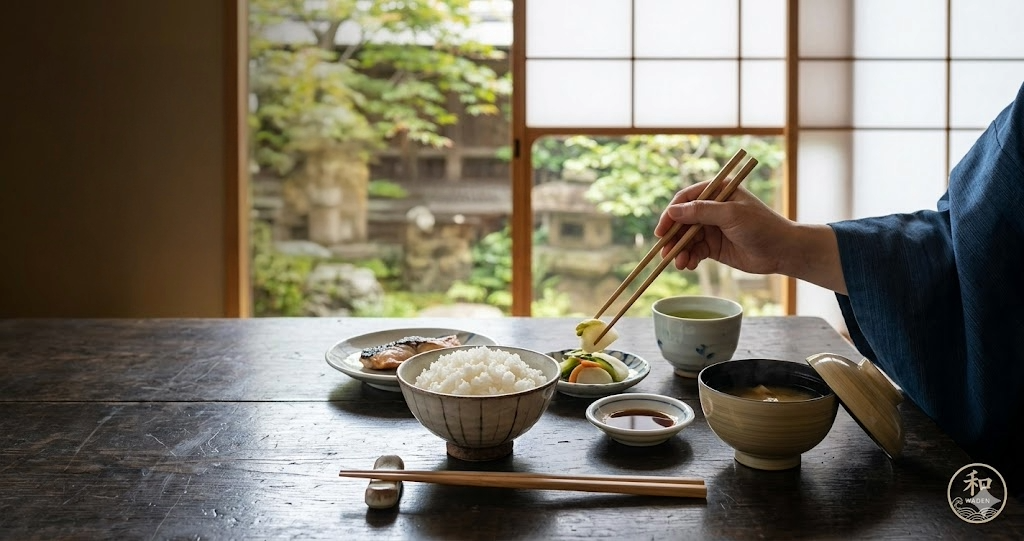
The Unspoken Language of Chopsticks
Etiquette Rules Every Japan Food Lover Should Know
Two slender sticks. No moving parts. No instructions. And yet, in Japan, how you hold them, rest them, and use them communicates something profound about who you are — and how much you understand about the culture on your plate.
More Than a Utensil
In the West, cutlery is largely functional. A fork lifts food; a knife cuts it. The rules around them are mostly practical — which fork goes on the left, how to signal you have finished eating. In Japan, chopsticks (hashi, 箸) carry a different weight. They are tools, yes, but they are also carriers of social meaning, ritual significance, and cultural memory.
The chopstick etiquette practiced at Japanese tables today is not arbitrary. It evolved over centuries, shaped by Buddhism, Shinto sensibility, and the particular way Japanese society has long linked daily life with spiritual care. Many of the rules that seem puzzling to outsiders — why you must never pass food directly from chopstick to chopstick, why you cannot stand them upright in rice — are, in fact, rooted in the rituals surrounding death and ancestral reverence.
Understanding these rules does not just help you avoid embarrassment at a Japanese table. It gives you a window into how Japanese culture understands life, death, community, and respect.
The Rule That Surprises Everyone: No Chopsticks Standing in Rice
If you remember only one rule from this article, make it this one.
Never stand your chopsticks upright in a bowl of rice. To a Western diner, this might seem like a convenient way to set them down — the rice holds them steady, hands are free. But in Japan, this gesture is immediately associated with sōshiki (葬式), funeral rites. At Buddhist funerals and memorial services, incense sticks are stood upright in an offering bowl. Standing chopsticks in rice mimics this image exactly, and doing so at a meal table is considered deeply inauspicious — a reminder of death at a moment meant for nourishment and community.
The connection runs deep. Rice itself occupies a sacred position in Japanese culture — it has long been associated with the gods, with abundance, and with the core of Japanese agricultural identity. To recreate a funerary image within a bowl of rice is, on multiple levels, a transgression of what the meal table represents.
When you need to set your chopsticks down, rest them horizontally across the rim of your bowl, or on a hashioki (箸置き), a chopstick rest. Most traditional restaurants and home settings in Japan will provide one. If none is available, a folded piece of paper or the edge of your tray will do.
Passing Food: The Rule With the Deepest Roots
Here is another rule that surprises many visitors: never pass food directly from your chopsticks to another person’s chopsticks. This act — where two people hold their chopsticks together to transfer a piece of food — is called hashi-watashi (箸渡し), and it is avoided at all ordinary dining occasions.
The reason, again, is rooted in funeral practice. During a Japanese cremation ceremony, the bones of the deceased are passed between family members using chopsticks, in a ritual called kotsuage (骨上げ). Two people hold chopsticks simultaneously, and bones are transferred from one pair to another. This is one of the most solemn acts in Japanese grief ritual. Replicating that gesture at a dinner table — even casually, even between friends — echoes something that should only occur in the context of mourning.
The correct approach is simple: place the food on a small dish or on the edge of the other person’s bowl, and let them pick it up themselves. This small detour carries the weight of considerable cultural thoughtfulness.
The Art of Not Pointing
Pointing at people or objects with your chopsticks is considered rude. This rule is not unique to Japan — many cultures consider pointing impolite regardless of the implement — but at a Japanese table it carries particular weight because chopsticks, as eating utensils, are closely associated with the personal and the intimate.
Related to this is sashi-bashi (刺し箸): spearing food with a chopstick as though it were a fork. This is avoided both because it is considered inelegant, and because it treats the food — and by extension, the person who prepared it — with a lack of care. Chopsticks are designed to grip, to lift, to cradle. Learning to use them properly is itself a form of respect toward the meal.
Searching, Hovering, and Digging: What to Avoid
Several chopstick behaviors are considered poor form specifically because they disturb the meal and those sharing it.
Mayoi-bashi (迷い箸) — hovering your chopsticks over the dishes while you decide what to eat — is seen as indecisive and slightly inconsiderate. It communicates to others that you are not ready to eat, which can disrupt the rhythm of a shared meal. Decide before you reach.
Saguri-bashi (探り箸) — digging or rummaging through food in a shared dish to find a preferred piece — is similarly frowned upon. In a culture that places considerable value on shared dishes and communal eating, picking through the food is considered selfish and unhygienic. Take what presents itself from the top or edge of a dish.
Neburi-bashi (舐り箸) — licking or sucking on the tips of your chopsticks — is considered unclean and impolite. Chopstick tips are used to touch shared food; keeping them clean is a basic courtesy to everyone at the table.
Serving Others: The Reverse Chopstick Courtesy
When serving food from a shared dish to someone else’s plate, the courteous approach is to use the opposite end of your chopsticks — the clean, untouched end that has not been in your mouth. This practice is called gyaku-bashi (逆箸) when done with one’s own chopsticks, and it reflects a deep concern for hygiene and consideration of others.
In more formal settings, shared serving chopsticks (tori-bashi, 取り箸) will often be provided alongside the dish for exactly this purpose. If they are present, use them. If not, reversing your chopsticks is the polite alternative.
This small act — flipping your chopsticks before offering food to a companion — is one of the quieter, more elegant expressions of Japanese attentiveness at the table.
Cross-Chopstick Taboo and the Bowl
Crossing your chopsticks (tasuki-bashi, 襷箸) when resting them on a bowl or dish is considered untidy and, in some interpretations, inauspicious — the crossed form is associated with the funerary context. Always lay them parallel.
Similarly, using chopsticks to move entire bowls or plates around the table (yose-bashi, 寄せ箸) is poor form. Chopsticks are for food, not furniture. If a dish is out of reach, ask for it to be passed.
Why These Rules Matter Beyond Japan
You may never dine at a formal kaiseki restaurant in Kyoto. You may simply be eating Japanese food at home, or at a Japanese restaurant in your city, or cooking from a cookbook inspired by Japanese tradition. And still, these rules have value.
Food, in Japan, has never been merely nutrition. The table is understood as a space of mutual respect — between the diner and the cook, between the people sharing the meal, between the living and the traditions that shaped the food on the plate. Chopstick etiquette is one expression of that understanding. When you follow it, even imperfectly, you are participating in a practice that has shaped Japanese table culture for more than a thousand years.
And when you do sit down to a meal of properly made Japanese food — miso soup whose fragrance rises as you lift the lid, rice whose grains are distinct and yielding, a piece of grilled fish that was seasoned with attention — the way you hold your chopsticks becomes part of how fully you receive it.
Quick Reference: Chopstick Etiquette at a Glance
| Japanese Term | What It Means | Why It Matters |
|---|---|---|
| Tatebashi (立て箸) | Standing chopsticks upright in rice | Mimics incense at Buddhist funerals |
| Hashi-watashi (箸渡し) | Passing food chopstick-to-chopstick | Echoes cremation bone-passing ritual |
| Sashi-bashi (刺し箸) | Spearing food with chopsticks | Considered inelegant and disrespectful |
| Mayoi-bashi (迷い箸) | Hovering undecidedly over dishes | Disrupts the rhythm of shared eating |
| Saguri-bashi (探り箸) | Digging through a shared dish | Selfish and unhygienic |
| Neburi-bashi (舐り箸) | Licking chopstick tips | Unhygienic when using shared dishes |
| Tasuki-bashi (襷箸) | Crossing chopsticks when resting them | Untidy; inauspicious associations |
| Yose-bashi (寄せ箸) | Using chopsticks to move bowls or plates | Chopsticks are for food, not tableware |
The table, in Japan, is never simply a surface. It is a stage for care — care in cooking, care in serving, care in eating. Chopsticks are the smallest instrument of that care. Learn to use them well, and you are not just eating Japanese food. You are entering the conversation it carries.
Comment