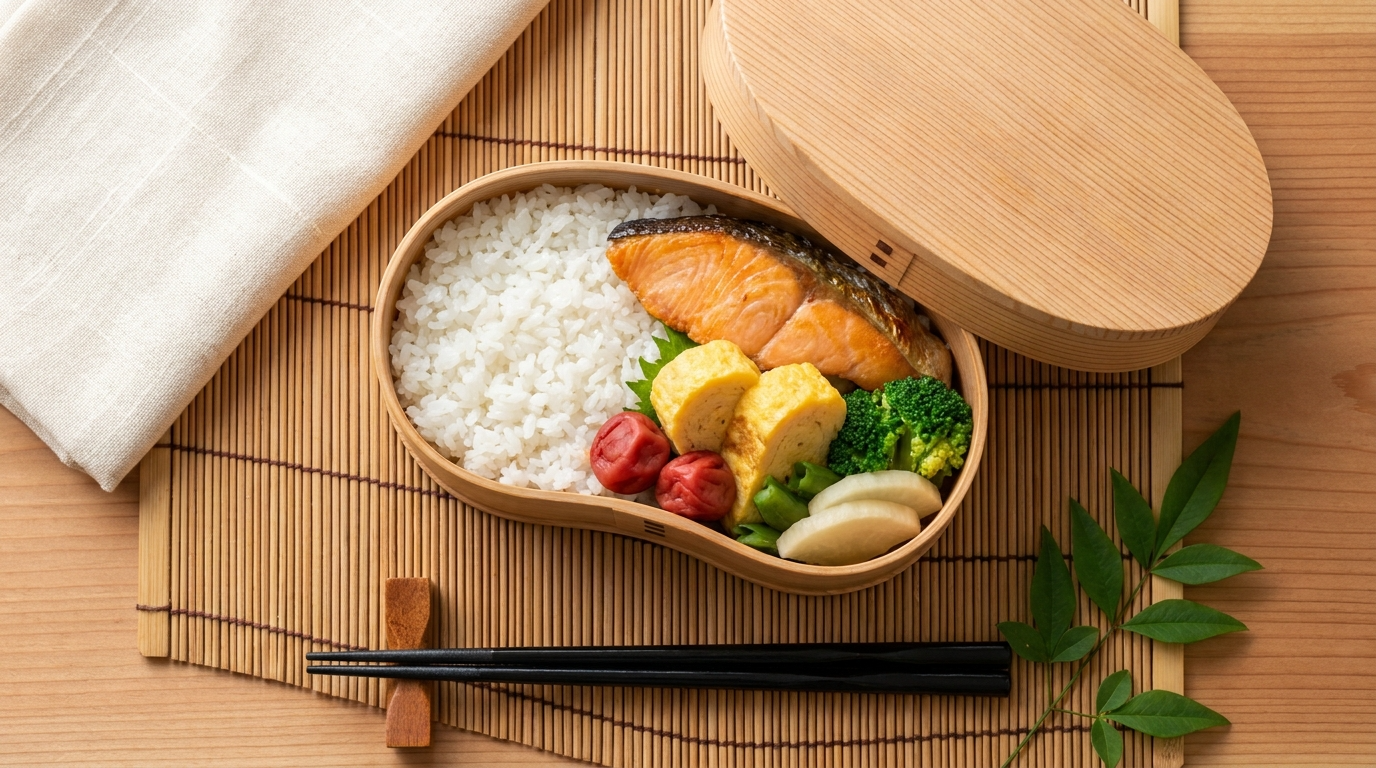
The Bento Box as Object: Magewappa, Lacquer, and the Design of a Meal Eaten Cold
Almost every container in the world exists to move food from one place to another. The Japanese bento box was designed to do something harder — to keep a bowl of rice worth eating four hours after it stopped being hot, without a lid that seals, a coating that blocks, or a single nail.
Lift the lid off a cedar bento box that has been sitting in a bag since seven in the morning and the first thing you notice is that nothing has gone wrong. No fog of condensation on the underside of the lid. No slick of water pooled around the rice. No sour smell. The rice is cool, separate, still slightly glossy, and the pickle beside it has not bled into anything.
Do the same with a sealed plastic box and you get the opposite: a wet lid, a compacted mass, a faintly steamed quality to everything. Same rice, same morning, same four hours. The only variable is the container.
This is the argument of this article, and it is a narrow one. We have written elsewhere about the bento as a cultural form — a thousand-year history of the portable meal, from dried rice carried to battlefields to the convenience-store tray. Here we are interested only in the box: what it is made of, how it is made, and why its design decisions are not decorative at all.
The Problem the Box Solves
Start with the constraint that makes Japanese lunch different from most others. A bento is eaten at room temperature. Not reheated, not kept warm — cold, or at best cool, some hours after it was packed. Japanese cooking accommodates this deliberately: the seasoning of bento dishes runs saltier and more vinegared, grilled fish is preferred over sauced fish, and rice is packed once it has stopped steaming.
The physics problem is water. Freshly cooked rice releases a great deal of vapor. In a sealed impermeable container, that vapor has nowhere to go: it condenses on the cool inner surface, runs back down, and re-wets the surface grains. The result is rice that has gone from fluffy to pasty, in a warm damp environment that also happens to be excellent for bacteria.
The traditional Japanese answer was not to seal the box better. It was to build the box out of something that drinks.
Bending Wood
The technique is old enough to predate almost everything else in the Japanese kitchen. Archaeological surveys of wooden food vessels in Japan distinguish two ancient families: kurimono, hollowed out of a solid block, which dominate in the Jōmon period, and magemono, made by bending a thin sheet of wood into a ring, which appear from the Yayoi and Kofun periods onward. Bending is the more sophisticated of the two — it uses far less wood, produces a far lighter object, and requires understanding how a species behaves under heat and moisture.
Wappa is simply the colloquial name for the result, generally derived from wa, a ring or circle. The same objects are called menpa or meppa in other regions, and versions of the craft survive across Japan. But one place became synonymous with it.
The story of Odate magewappa begins with a political defeat. After Sekigahara, the Satake clan was relocated by the Tokugawa from Mito to Akita — a transfer to a poorer, colder domain where, by the official account of the craft’s own trade association, some residents struggled to eat. What Akita did have was forest. The Satake branch house governing Odate Castle looked at the domain’s enormous stands of cedar and directed lower-ranking samurai to make bent-wood vessels as a sanctioned side income, while farmers were made to haul raw logs down from the mountains in place of part of their rice tax. By the late seventeenth century it had consolidated into an industry, and the finished goods were shipped out through Sakata and Niigata to the Kantō markets.
It is worth pausing on that origin, because it is unusual. Magewappa was not invented by a guild of specialists or commissioned by a temple. It was a poverty-relief program run by a defeated clan using the one asset it had, executed by impoverished samurai in their spare hours. The object’s austerity is not a style choice. It is a memory of the circumstances that produced it. Japan formally recognised the craft as a Designated Traditional Craft on 16 October 1980.
Nine Steps, No Nails
The making sequence, as described by the craft’s official documentation, is short enough to list and hard enough to take a decade to learn.
Natural Akita cedar is split by hand or sawn into thin boards, chosen for masame — the straight, parallel grain you get by cutting radially rather than tangentially, which bends without splitting and stays dimensionally stable. The boards are soaked, often overnight, then boiled in hot water for a few minutes until they turn pliable. While still hot they are rolled around a wooden form called a koro, wrapped into a cylinder or the characteristic oval, and the overlap is clamped and left to dry into its new shape. Once dry, the seam is glued. Then holes are drilled through the overlap and the joint is sewn shut with strips of wild cherry bark — sakura-kawa-toji, cherry-bark stitching. Finally a base board and a lid board are fitted and secured.
There is no metal anywhere in the object. The seam that holds the box together is bark, threaded through wood, tied by hand.
That cherry-bark stitch is the single most recognisable feature of a magewappa, and it is a good example of a repeated pattern in Japanese craft: the structurally necessary detail becomes the decorative signature. The dark glossy bark against pale cedar is the closest thing the object has to ornament, and it is there because the box would otherwise come apart.
Why Cedar, Specifically
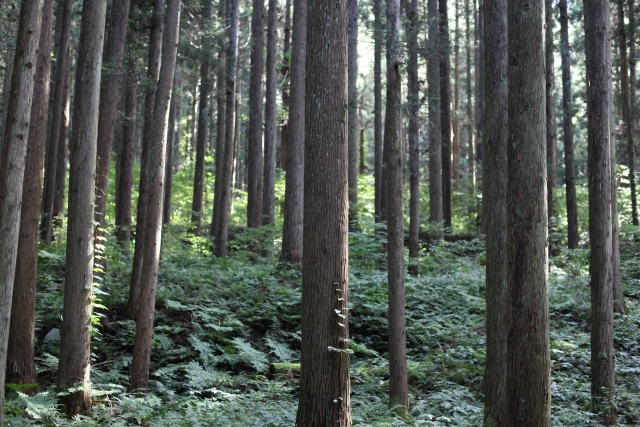
Akita cedar has an unusual reputation among Japanese timbers, and the qualities that made it valuable for architecture are the same ones that make it good for lunch. Slow growth in a cold northern climate produces very fine, very even annual rings; the straight grain is elastic enough to survive bending; the wood is light; and it carries a clean resinous scent.
The functional property, though, is hygroscopicity. Unfinished cedar absorbs moisture from air more humid than itself and releases it back when conditions dry — the same principle behind the ohitsu, the wooden rice tub that a traditional kitchen transfers cooked rice into precisely so that excess steam is drawn out of it. A wooden bento box is an ohitsu you can carry. It does not stop rice from releasing water; it takes the water somewhere.
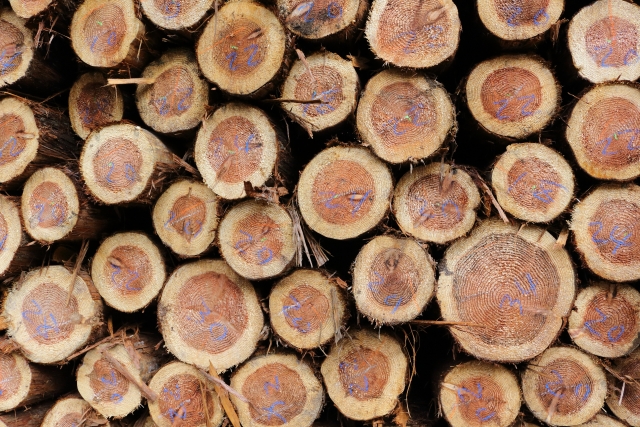
Producers also commonly cite the antibacterial effect of phytoncides, the volatile compounds cedar and hinoki release. This is a real class of compounds and a plausible contribution, but it is worth being clear that the moisture-buffering behaviour is the well-established mechanism and the antibacterial claim is the more loosely evidenced one. A cedar box in July is not a refrigerator.
Three Finishes, Three Bargains
Buy a magewappa today and you choose between three surfaces, and the choice is a genuine engineering trade-off rather than a matter of taste.
Shiraki, bare unfinished wood, delivers the full moisture-regulating effect and the cedar scent. It also stains, absorbs oil, cannot go near a dishwasher, must be washed quickly and dried thoroughly, and will darken over years of use. It is the highest-performing and least forgiving option.
Urushi-lacquered boxes seal the wood. They resist oil and staining, tolerate detergent, and gain depth of colour with age; the lacquer itself carries meaningful antibacterial properties, which is a significant part of why Japan has been putting food in lacquered vessels for millennia. What they give up is breathability — a coated box regulates humidity far less than a bare one. The compensation is that lacquer is repairable in a way plastic never is, a property we look at closely in our article on urushi and the long life of lacquer.
Urethane coating is the modern compromise: durable, cheap, easy, and largely inert. It keeps the shape and the cherry-bark stitching and the look, and quietly discards the reason the object was made of cedar in the first place.
When the Box Became Furniture
Running parallel to the bent-wood tradition is the lacquered one, and it developed in the opposite direction — not toward lightness but toward architecture.
The jūbako, the tiered stacking box, appeared in the Muromachi period and spread through commoner households from the middle of the Edo period. Its logic is spatial: stacked, several full meals occupy the footprint of one; unstacked, they become a spread. Cherry-blossom viewing and long theatre days made it indispensable, and the boxes were normally lacquered, both for the waterproofing and because a picnic in Edo was a performance.
The form’s extreme expression is the sagejū or nobentō — a portable lacquered case, sometimes carried on a pole, containing everything a party needed: tiered boxes nested exactly into the frame, sake flasks, cups, small plates, chopsticks, and in the grandest daimyo versions a full set of tea implements. Surviving examples in Japanese museum collections include maki-e cases the better part of forty centimetres in each dimension, decorated with family crests in gold. These are not lunchboxes. They are cabinets designed to be carried into a field.
Somewhere in this tradition the Japanese container stopped being a wrapper for the meal and became an equal partner to it — the shift explored from the cook’s side in why Japanese chefs still choose lacquerware.
The Box That Invented a Cuisine
The clearest case of a vessel producing a food, rather than the other way round, is the shōkadō bentō. Its history is unusually well documented, and it runs through two men separated by three hundred years.
Shōkadō Shōjō (1582 or 1584 – 1639) was a shrine-monk at Iwashimizu Hachimangū in Yawata, south of Kyoto — a Shingon priest who reached the rank of ajari, and a cultural figure of the first order, counted with Konoe Nobutada and Hon’ami Kōetsu among the Kan’ei Sanpitsu, the three great calligraphers of the era. Among his possessions was a square lacquered box divided into four compartments by a cross-shaped partition. According to Yawata City’s account, he took the idea from the plain wooden boxes farmers used to hold seed, had it made properly in lacquer, and used it as a tea utensil.
Three centuries later, in the 1930s, Yuki Teiichi — the founder of the restaurant Kitchō, and one of the defining figures of twentieth-century Japanese cuisine — attended a tea gathering at the Shōkadō site in Yawata. Stacked in the corner of the room were the four-compartment boxes. He looked at them and asked whether they could be used to serve food.
What he had seen in the cross partition was a solution rather than a shape. Four sealed quadrants mean four dishes that cannot touch: no sauce migrating, no aroma transferring, no visual muddle. A grilled item, a simmered item, sashimi, and rice can occupy the same box and remain four distinct experiences. Yuki spent years refining what went into the quadrants, named the result in homage to Shōjō, and the shōkadō bentō became one of the standard formats of Japanese restaurant dining — the default vessel for a mid-price kaiseki lunch anywhere in the country today.
The sequence matters. The compartments were not designed for the cuisine. The cuisine was written to fill the compartments.
Division as Grammar
Which points at the general principle underneath every box in this article. Japanese food presentation is organised around separation — the same instinct that produces the one-soup-three-dishes tray, where each element sits in its own vessel in its own fixed position. A Western plate lets things share a surface and, often, deliberately merge: sauce pools, jus runs. A bento does the reverse. Its dividers, its baran leaves, its paper cups, its silicone cases and its cross partitions all perform one job, which is to keep boundaries intact while the box is shaken sideways in a bag for four hours.
This is why the convenience-store bento tray — moulded plastic, injection-formed compartments, film lid — reads as recognisably Japanese despite sharing no material with anything above. It inherited the grammar. It simply cannot do the other half of the job, the moisture half, which is precisely what the cedar box was for.
What Is Left of the Trade
The Odate craft that anchors all of this is now very small. The producers’ association lists five member companies; regional METI figures put the workforce at roughly thirty people with annual output in the region of two hundred million yen and around a dozen certified traditional craftsmen. An academic survey published a little over a decade ago counted nine companies, sixty-three workers and output near three hundred and fifty million yen — figures vary with the year and the counting method, but the direction is not ambiguous, and Akita Prefecture’s own craft-industry plan states plainly that production value, company numbers and employment across its designated crafts continue to decline.
The material is under more pressure than the workforce. The natural Akita cedar that gave the craft its name — old-growth timber from national forest, with the fine even rings that made the wood famous — was supplied under a managed cutting programme that ended in 2012, as the remaining resource shrank. Makers have moved to high-age plantation cedar, which is good wood and is not the same wood. A craft named for a specific forest has outlived the specific forest.
None of which changes what the object is. Pick up a magewappa and it weighs almost nothing; the seam is sewn with bark; the wood is doing quiet thermodynamic work on your lunch; and the whole thing was worked out by people who had no refrigeration, no plastic, and no way to reheat anything, solving the problem of how to eat well at noon somewhere else.
That is the case for treating the box as seriously as what is in it. It is not packaging. It is the oldest piece of functional design still in daily use on the Japanese table, and it was engineered, entirely, around cold rice.
Read, then Taste.
This article is part of Waden’s Vessel series — exploring the art of serving and the objects that shape the Japanese table. Read more at waden.umamibako.com.
Waden is an editorial journal exploring the depth and beauty of Japanese food culture — its history, ingredients, artisans, and traditions. Story first, always. waden.umamibako.com
Comment