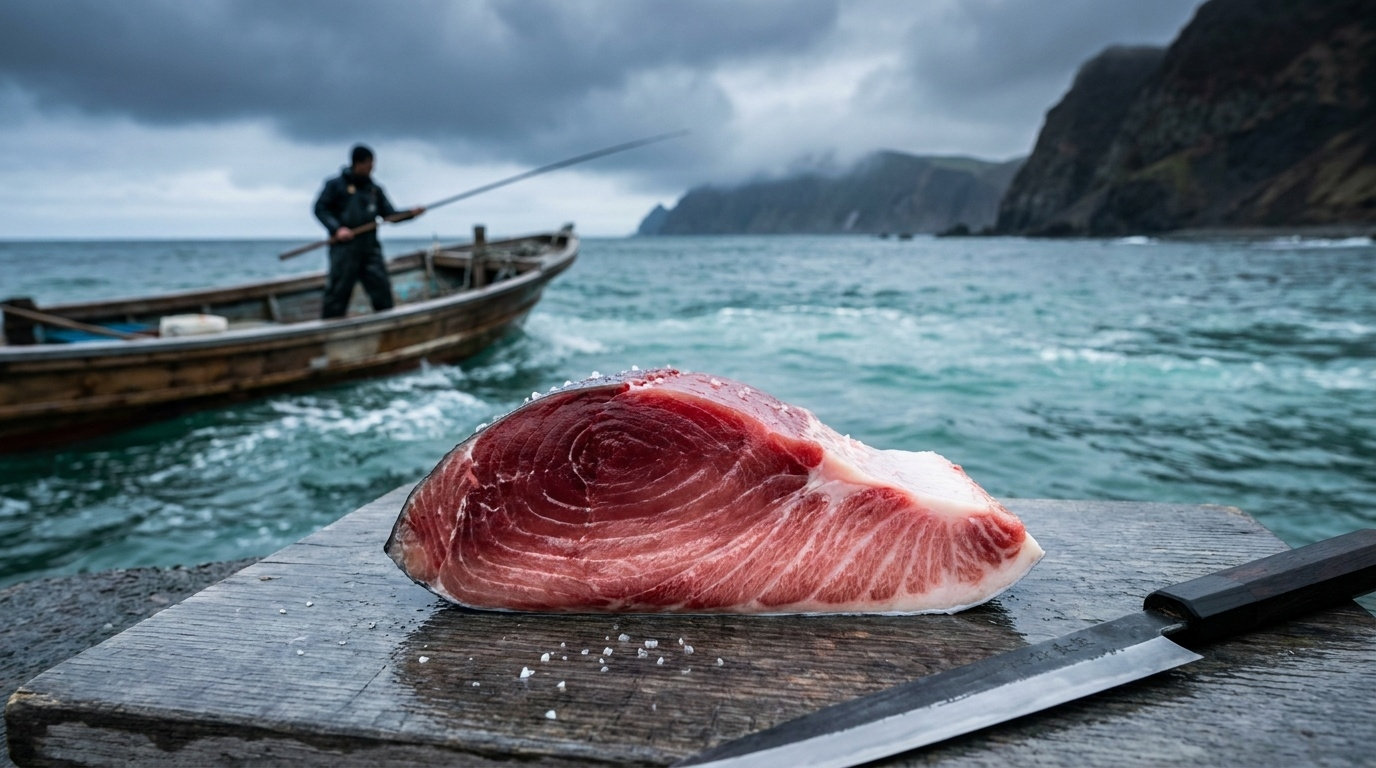
Where the Strait Narrows: Oma and the Making of Japan’s Most Valuable Tuna
A single tuna sold for 510.3 million yen in January 2026. It came from a town of five thousand people at the northern tip of Honshu, caught by one man alone in a small boat, on a line he held in his hands.
The Tsugaru Strait is nineteen kilometres across at its narrowest point, and everything that passes between the Sea of Japan and the Pacific has to squeeze through it. Warm water from the south accelerates as it funnels into that gap and collides with cold water pushing down from the north, and the whole channel turns into a churning, unstable, nutrient-rich mess of current. Sardines and squid gather in it. Mackerel gather in it. And the tuna arrive to eat all three.
Standing on the Oma waterfront at the very tip of Honshu you can see Hokkaido clearly on the other side, close enough to feel like a mistake in the geography. This is where Japan’s most expensive fish is caught, and the reason is visible from the shore.
The Fish That Runs Warm
Pacific bluefin — Thunnus orientalis — is built like nothing else in the sea. It reaches three metres and five hundred kilograms, lives past twenty years, and crosses the Pacific and back, a round trip measured in thousands of kilometres.
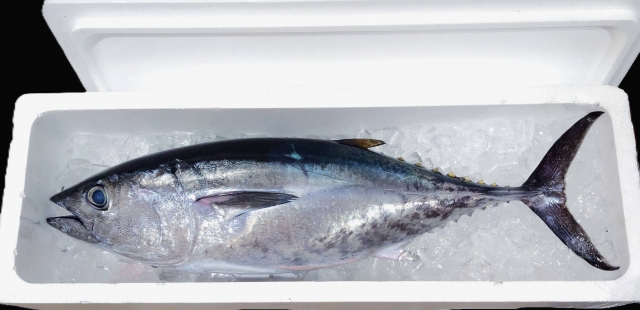
Most of what makes it remarkable comes down to temperature. Bluefin are endothermic, which almost no fish are. Inside the body sit dense lattices of intertwined arteries and veins called rete mirabile, wonderful nets, which work as countercurrent heat exchangers: outgoing arterial blood, warmed by the swimming muscles, transfers its heat to the cold venous blood returning from the gills before that heat can be lost to the water. The result is a fish that holds its core well above the surrounding sea. Work at the University of Tokyo has shown that this capacity is not present from birth but develops as the fish grows, with young bluefin generating disproportionately high metabolic heat during the juvenile stage.
This is why the Tsugaru Strait works. A tropical spawner has no business feeding in northern water in October, and a purely cold-blooded fish could not — its muscles would slow and its digestion would stall. Bluefin can go where the food is and stay warm doing it. And the food in that strait is exceptional.
The migration is genuinely tidal in its regularity. Spawning happens in warm water: from Japan’s southern waters to the seas east of Taiwan between April and July, and in the Sea of Japan in July and August. The fish then move north through the summer and autumn, following squid and sardine, fattening as they go. Around the Tsugaru Strait the northward run turns and the fish begin to head back south. They arrive at Oma in autumn and early winter, at maximum weight, at the last possible moment before they leave.
A fish that spawns in subtropical water and feeds in subarctic water is not an anomaly. It is an animal that carries its own weather with it.
The pattern will be familiar to anyone who has read our account of katsuo and the two seasons of a migrating fish: Japanese cooking has always paid close attention to where in its journey a fish is intercepted. With bluefin the principle is the same, but the geography is sharper. There is essentially one point on the map where the fish is heaviest, and Oma sits on it.
One Man, One Line
What distinguishes Oma is not only the fish but the method — and the method is almost perverse in its inefficiency.
There are four ways to catch bluefin commercially. Purse seining encircles a school with a net and hauls the lot. Set nets, fixed traps anchored offshore, take whatever swims in. Longlining strings baited hooks across kilometres of water. And then there is ippon-zuri, pole-and-line, which means catching them one at a time.
Oma boats do the last of these, and they do it small. The fishery is overwhelmingly vessels of three to five tonnes — of the town’s 313 fishing operations recorded in the 2018 census, roughly half fell into that class — and they typically go out with one person aboard. A day begins before dawn. Live bait comes first: squid or mackerel caught the previous evening, since a live bait is what a large bluefin will take. The fisherman finds the fish, drops the line, and waits.
What happens when a two-hundred-kilogram animal takes the hook is a contest between a single person and something that outweighs their boat’s usable deck space. It can run for an hour or more. The line is held by hand, or worked off a reel with the boat manoeuvred to follow, and every decision is made by one exhausted individual with no crew to consult.
The inefficiency is quantifiable, and Oma fishermen say it themselves: a large seiner takes in a single day what a pole-and-line fisherman catches in a year. But the quality argument is real rather than romantic. A fish caught in a net thrashes inside it for a long time, and because bluefin are endothermic, sustained struggle heats the flesh from within. The muscle cooks slightly, the texture degrades, and the condition known as burnt tuna sets in. A line-caught fish is landed faster, bled and gutted at sea within minutes, and iced immediately. The premium is not paid for the story. It is paid for the temperature history of the meat.
All of which means the highest-value fishery in Japan is conducted by individuals in small boats, in a town whose fishing workforce has halved in fifteen years and where nearly half the male fishermen are over sixty-five.
The Auction as Theatre
And then there is the first auction of the year, which is a genuinely strange institution.
On the fifth of January 2026, at Toyosu Market in Tokyo, a 243-kilogram bluefin from Oma sold for 510.3 million yen — the highest price recorded since documentation began in 1999, and a per-kilogram price of about 2.1 million yen. The buyer was Kiyomura, which runs the Sushizanmai chain, taking the top fish for the first time in six years. The previous record, 333.6 million yen for a 278-kilogram Oma fish in 2019, had also been theirs.
Nobody involved pretends this is a market price. The 2025 top fish went for 207 million yen; in 2020 the figure was 193.2 million. A restaurant that pays half a billion yen for a single tuna and then serves it at ordinary prices is buying the front page of every newspaper in Japan, and does so knowingly. The ichiban maguro, the year’s first fish, is an advertising slot that happens to be edible.
But the ritual rests on something real. To be eligible the fish must be wild rather than farmed, fresh rather than frozen, and landed in the narrow window that allows it to reach Tokyo for the fifth of January — which in practice means caught at the very end of the season, at peak fat, in the north. Oma has taken the top slot in a striking number of years, and that is the source of the town’s brand, protected since 2007 as a registered regional collective trademark under the name Oma Maguro.
The brand has had its difficulties. In 2021, Aomori Prefecture investigated the Oma fishery over unreported catch, and 8.3 tonnes of bluefin were found to have gone unrecorded — a problem created directly by the quota system, since roughly 130 of the cooperative’s 670 members fish for bluefin and individual allocations ranged from 300 kilograms to seven tonnes. A fisherman with a small allocation who hooks a large fish faces an unpleasant arithmetic. This is an uncomfortable thing to note in an article about a celebrated place, but it is part of the honest picture of what quota management on a wild, unpredictable, extremely valuable animal actually looks like on the water.
Reading a Fish From the Outside
The buyers on the Toyosu floor have a few minutes and a small piece of tail to work from.
Before the bidding, each tuna has a cross-section cut near the tail. Buyers examine the exposed muscle with a hook-shaped tool, take a sliver, rub it between their fingers, and judge fat content, colour, the fineness of the grain, and how the flesh feels at low temperature. From that thumbnail of meat they extrapolate the entire animal — a two-hundred-kilogram fish whose interior they will not see until it is cut down hours later. It is an inference under uncertainty, performed at speed, with millions of yen at stake, and the skill takes decades to acquire.
What they are pricing is fat, and where it sits.
A bluefin is divided broadly into three grades of flesh. Akami, the lean red meat, sits along the back and the interior of the fish and makes up most of the body: firm, iron-tinged, with fat in the region of one to two percent. Chūtoro, medium fatty, comes from the belly and the outer back where the marbling begins, running roughly ten to fifteen percent fat. Ōtoro, the fattiest cut, comes from the forward belly — the small section closest to the head, thick with connective tissue and marbling, and often above twenty percent fat, sometimes far above.
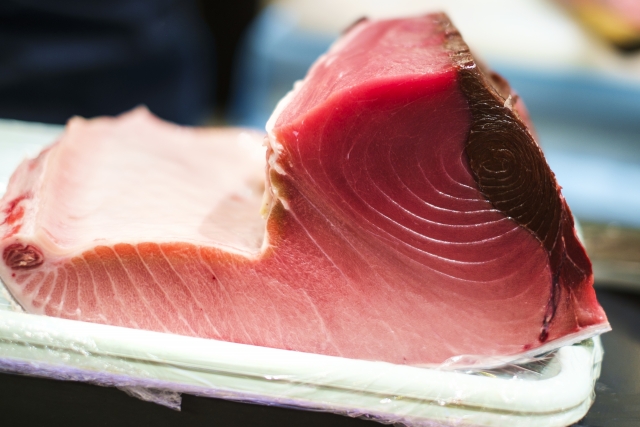
The proportion matters. A tuna is mostly akami. Ōtoro is a limited cut from a limited area of a fish that has to have been fattening in cold water, which is precisely why an Oma fish landed in December is worth what it is.
The most expensive cut of the most expensive fish in Japan was, two hundred years ago, thrown away. Not overlooked — actively discarded, as the part not even a cat would touch.
The Part the Cat Stepped Over
In Edo, tuna was cheap and toro was garbage.
The Japanese phrase is neko-matagi, cat-step-over: food so unappealing that a cat would walk past it. It was applied to the fatty belly of the tuna. Without refrigeration, fat is a liability — it oxidises fast, and in a hot Edo summer the belly of a large tuna would turn before anyone could sell it. The lean akami, more stable, could be salvaged by marinating it in soy sauce, and that preparation, zuke, is how tuna entered the sushi repertoire at all.
There was also an aesthetic verdict layered on top of the practical one. Edo taste ran to the clean and the restrained, and heavy fat was regarded as coarse. The belly went to the poor, or to cat food, or into the fields as fertiliser.
What changed was the cold chain. Mechanical refrigeration, ice, and eventually deep-freezing made it possible to keep fat from spoiling, and over the twentieth century — accelerating sharply after the war, as Japanese palates absorbed a taste for richness — the discarded cut became the prized one. Today ōtoro can command many times the price of akami from the same fish, and the ranking of the cuts has completely inverted within living memory.
It is a useful corrective to any notion that traditional Japanese taste is fixed. The hierarchy that seems most self-evident at a sushi counter is about a century old, and it was created by a machine. The counterweight to it is the argument that the rice was always the real subject of sushi — a view that many traditional sushi chefs would say has been obscured by exactly this fascination with fat.
The Arithmetic Behind the Spectacle
Which brings us to the part of the story that the auction headlines tend to bury.
Pacific bluefin came very close to disappearing. Stock assessments by the International Scientific Committee for Tuna and Tuna-like Species put spawning stock biomass at about 12,000 tonnes around 2010 — a historic low, and a small fraction of what the population had been. Total Pacific catch had fallen from roughly 35,000 tonnes in 1981 to about 11,000 tonnes by 2015. The central problem was identified early: the fishery was taking mostly juveniles, fish of zero to two years old, which meant removing animals before they had ever spawned.
Management followed, slowly and then seriously. From 2010 the Western and Central Pacific Fisheries Commission capped effort and limited catch of small fish under thirty kilograms; the limits were subsequently tightened, with small-fish catch halved and caps imposed on large fish as well. Japan brought bluefin under statutory total-allowable-catch management in 2018, moved it under the new Fisheries Act in 2021, and in June 2021 extended reporting requirements to recreational anglers.
It worked, and faster than anyone projected. The 2024 assessment estimated spawning stock biomass at about 144,000 tonnes as of 2022 — roughly 23.2 percent of unfished biomass, above the 20 percent recovery target, and reached some thirteen years ahead of schedule. The ISC concluded the stock was neither overfished nor experiencing overfishing.
With recovery confirmed, the commissions loosened the reins. Measures adopted in 2024 and applied from January 2025 raised the small-fish cap by ten percent and the large-fish cap by fifty, bringing the Pacific-wide limit to around 24,000 tonnes, of which Japan’s allocation is about 13,000 — 4,407 tonnes of small fish and 8,421 tonnes of large. Total Pacific catch in 2024 came to roughly 18,000 tonnes, with Japan taking about 9,700.
The recovery is a genuine and unusual success, and it deserves to be described as one. It is also, as the WWF and others have pointed out, exactly the moment at which a fishery is most likely to relax and undo its own achievement, which is why a management strategy evaluation process was set in motion for 2025. And there is a further wrinkle: Kindai University in Wakayama achieved the world’s first complete farming cycle for bluefin in 2002, closing the loop from hatchery-reared fish to spawning adults to a new generation, and farmed bluefin now supplies a substantial share of the market. Farming relieves pressure on the wild stock in principle. In practice, much of the industry still relies on wild-caught juveniles for stocking, which is why registration of farms and limits on their expansion form part of Japan’s control measures.
What a Place Contributes
Set the pieces beside each other and Oma turns out to be a fairly precise answer to a question about geography.
A strait narrow enough to accelerate two opposing currents into each other. A collision that concentrates squid, sardine and mackerel. A fish physiologically equipped to feed in cold water and timed to arrive at that spot at the end of its northern run, carrying the maximum fat it will hold all year. A fishing method that takes those fish one at a time and gets them onto ice before their own body heat can damage them. And a market in Tokyo with the expertise to read the result off a sliver of tail muscle and price it accordingly.
Remove any one element and the thing collapses. A fish of the same species from the same population, taken by a seiner two months earlier in warmer water, is a different product entirely — not fraudulent, not bad, simply not the same. The word Oma does a great deal of work on a menu, and what it is really encoding is a set of coordinates, a date, and a technique.
That is what Origin means in the end. Not a label of authenticity but a description of conditions: this fish, at this weight, at this moment, because of the way the water moves through a nineteen-kilometre gap at the top of Honshu. The town’s fishing fleet is ageing and shrinking, and the fish is recovering from a collapse it very nearly did not survive. Both of those facts sit underneath the auction number, and neither of them makes the headline.
Read, then Taste.
This article is part of Waden’s Origin series — travelling to the landscapes that shape Japan’s finest ingredients, and meeting the people who tend them. Read more at waden.umamibako.com.
Waden is an editorial journal exploring the depth and beauty of Japanese food culture — its history, ingredients, artisans, and traditions. Story first, always. waden.umamibako.com
Comment