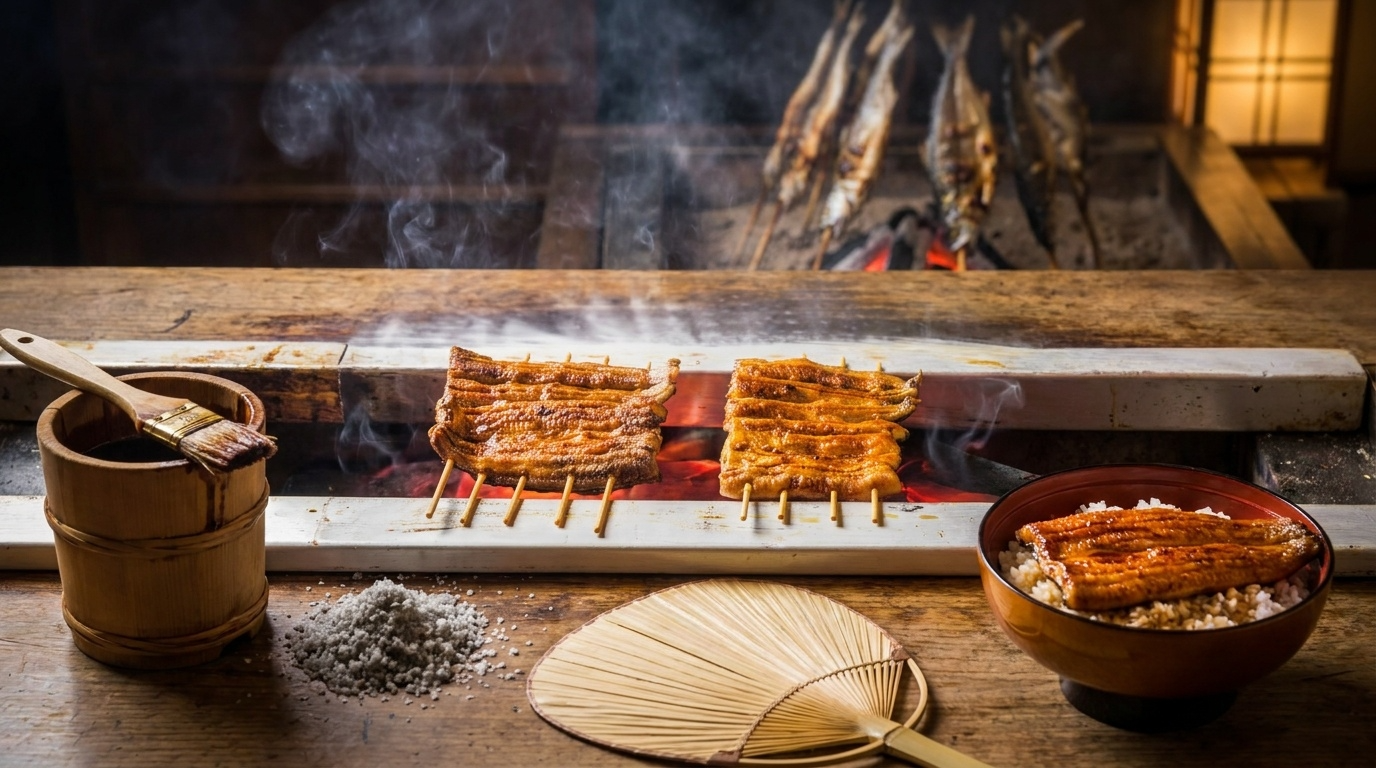
The Distance to the Fire: Japanese Grilling, Binchōtan, and the Rule Every Method Shares
Grilling is the one Japanese technique with nothing to hide behind. No broth, no sauce, no long marination — a piece of fish, some salt, and a heat source, and every decision you made shows up on the plate. Which is why the tradition around it — forty named methods, two kinds of charcoal, and a skewer with a grammar of its own — is so unreasonably detailed.
There is an old line among eel cooks: kushi-uchi san-nen, saki hachi-nen, yaki isshō. Three years to learn how to put a skewer through an eel. Eight years to learn how to split one. A lifetime for the grill.
Read casually it sounds like the usual apprenticeship folklore. Read carefully it is a ranking, and the ranking is strange. Splitting an eel — the part involving a knife, a live animal and a spine — takes eight years. The part where you hold the thing over hot coals never finishes. The implication is that fire is the hardest variable in the kitchen, harder than the blade.
Japanese cooking has a whole category for this: yakimono, grilled things. It sits at the centre of a kaiseki meal and at the centre of an ordinary weeknight dinner, and its literature runs to something over forty named methods. What follows is an attempt to explain why so much machinery grew up around an operation that appears to consist of putting food near heat.
Forty Names, and Where They Came From
The category divides first into direct and indirect. Jikabi-yaki means the food meets the radiant heat of the fire with nothing in between: salt-grilled fish, skewered ayu, yakitori. Indirect grilling puts something between them — a ceramic plate (tōban-yaki), a sheet of cedar (sugiita-yaki, which perfumes the fish as it cooks), foil or paper (tsutsumi-yaki, which is really steaming under another name).
Within direct grilling, the naming follows two different logics. Some methods are named for what goes on the surface, and these are the ones you meet on any menu: shioyaki (salt), teriyaki (a sweetened soy glaze), misoyaki, kabayaki. Read the name and you know what you are getting. The rest are named for something with no relation to cooking at all — a dance, a province, a bird, a length of cloth — and those are the ones worth reading slowly, because each is a piece of social history that happens to have survived as a word on a menu.
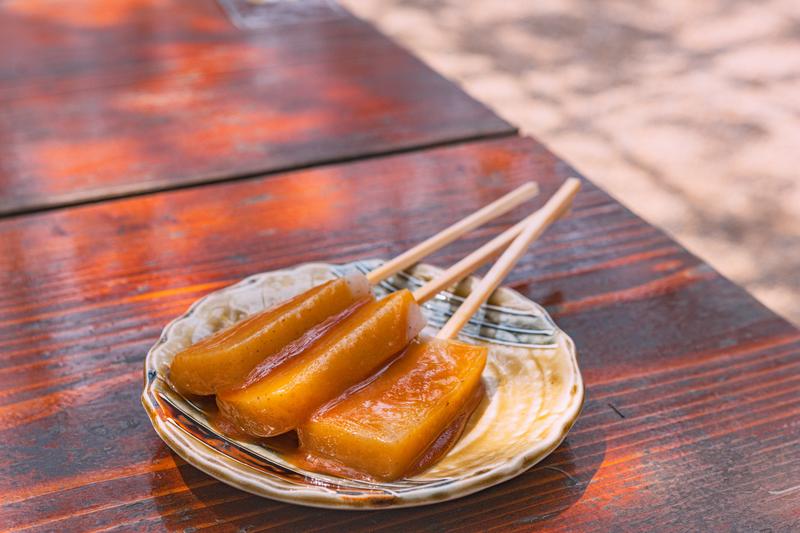
The oldest of them is dengaku: miso spread on skewered tofu or aubergine and held over coals. It is named after a dance. From the Heian period onward, dengaku was the music and movement performed in the rice fields at planting time, and by the Muromachi period the dengaku-hōshi — performers in white hakama who balanced on a single tall stilt — were a familiar sight. A pale block of tofu impaled on a skewer looked like one of them. The Edo essayist Kitagawa Morisada noted the drift with some irritation: the word once described a shape, he wrote, and now it just means anything grilled with miso on it. The word travelled further still. Oden is the same word with an honorific prefix.
Nanbu-yaki, anything crusted in sesame, is named for the old Nanbu domain straddling present-day Iwate and Aomori, which grew sesame in quantity; the region’s name became culinary shorthand for the seed, exactly as Kyoto’s name became shorthand for sweet white miso in saikyō-yaki. Wakasa-yaki is named for a bay. Wakasa was one of the miketsukuni, the provinces that supplied food to the imperial court, and the roads over the mountains from its coast into landlocked Kyoto carried salted fish for centuries. Tilefish — guji — arrived in the capital lightly salted, and Kyoto cooks developed a way of grilling it with the scales left on, basted with dashi and soy, until the scales themselves crisp and become part of the dish. The method exists because the fish had to survive a mountain crossing first.
Then there is shigi-yaki, named after a snipe because the aubergine resembles the bird’s beak, and Hakata-yaki, named after the striped obi of Hakata because the layered cross-section looks like the weave. The proliferation is not decorative. Each name encodes a different answer to the same question: how do you get colour, aroma and seasoning onto the outside of a piece of protein in the two or three minutes before the inside overcooks?
Strong Fire, Far Away
Every Japanese account of grilling eventually arrives at four words: tōbi no tsuyobi, a strong fire at a distance. It is quoted so often that it has stopped being examined, which is a shame, because it is not a piece of mysticism. It is a description of the only control a charcoal cook ever had.
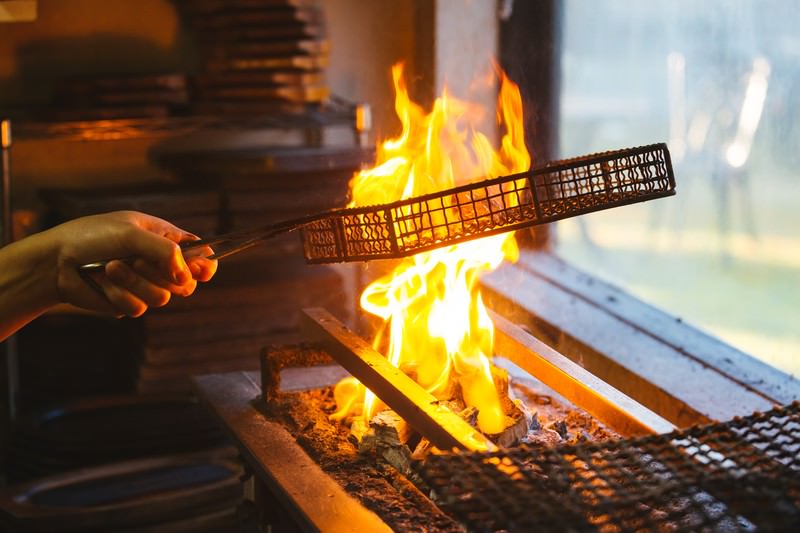
You cannot turn charcoal down. Once a bed of coals is lit it produces what it produces, and the single dial available is how far away you hold the food. So the maxim is really an instruction about how to use that dial: burn plenty of charcoal so the heat is strong and, crucially, even — and then back off, so that the energy arrives spread over the whole surface rather than scorching one patch of it. A grill held close cooks in a small, violent circle. The same grill held high cooks the whole fish at once.
What makes the distance work is that charcoal cooks almost entirely by radiation. Hard charcoal barely flames; the heat is infrared streaming off a glowing surface, and radiant heat falls away sharply with distance in a way that a flame licking the food does not. Close to good coals the air is in the region of 300 to 400°C, far hotter than anything you want on the skin of a fish. Distance is not gentleness — it is a way of keeping the fire strong while giving the heat somewhere to spread.
Distance was the only dial a charcoal cook ever had. The maxim is not philosophy. It is the manual.
Why Charcoal, and Why Binchōtan
One difference between charcoal and a gas burner is worth stating plainly, because it rescues the whole tradition from sounding like nostalgia. Charcoal is nearly pure carbon, and burning carbon gives you carbon dioxide and essentially nothing else. Gas is a hydrocarbon, and burning it gives you carbon dioxide and water — burn one molecule of methane and you get two of water vapour. That vapour reaches the food and condenses on it, and the surface has to dry out again before it can brown. A gas flame is quietly wetting the thing you are trying to dry. Cooks worked this out by taste several hundred years before anyone wrote the equation.
Japanese charcoal itself splits into two families, and the split is made in the kiln. Kurozumi, black charcoal, is smothered in a sealed kiln at the end of the burn. It is soft, lights easily, gives up a lot of heat quickly, and has been the domestic fuel of Japan for centuries. It is also the charcoal of the tea ceremony, where a particular grade cut from young kunugi oak is prized because the cut end opens like a chrysanthemum. The Forestry Agency’s own description of tea charcoal lists the criteria by which it is judged: colour, gloss, the feel of its skin, its scent, and the character of its flame. Which is to say the state grades it as an object, not a fuel.
Shirozumi, white charcoal, is a different animal. It is dragged out of the kiln still glowing and smothered with a damp powder of ash, earth and sand. The shock quenching leaves the pale surface coating that gives it its name and a hardness that has to be handled to be believed — struck together, two pieces ring like metal. It is difficult to light, burns for hours at a stable output, and produces almost no smoke and almost no smell. This is the charcoal of the yakitori counter and the eel shop.
The best of it is Kishū binchōtan from Wakayama, and the name has an unglamorous origin. In the Edo period a shipping agent in the castle town of Tanabe named Bichūya Chōzaemon handled the domain’s white charcoal, and 備長炭 was, in effect, his trade mark. Kishū treated charcoal as a monopoly export, shipped it to Edo for cash, and pushed production hard enough that the technique for the finest white charcoal in Japan was established and then handed down locally. The best grilling fuel in the world exists because a feudal government needed revenue.
Salt, and the Twenty Minutes Before
Shioyaki is the plainest method and the one that exposes technique most completely. Salt and fire, nothing else.
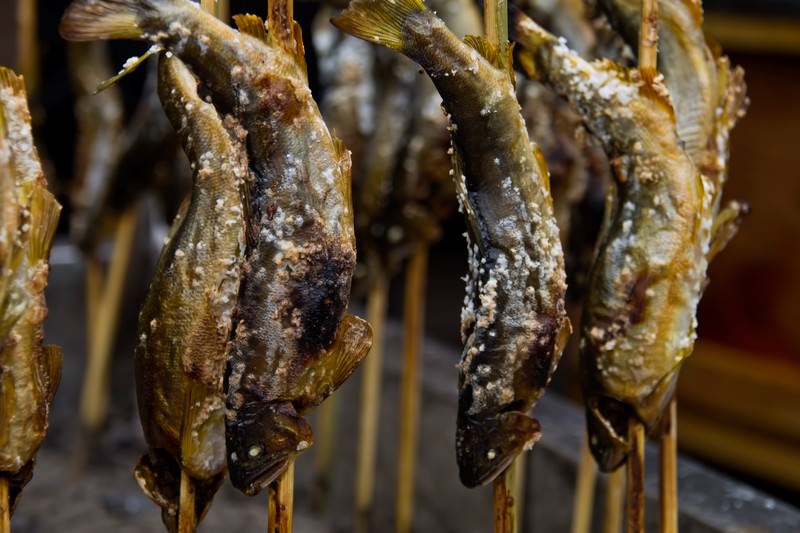
The salt is not applied at the moment of cooking. Standard practice is furi-jio: scatter salt from a height so it lands evenly — roughly one percent of the weight of the fish for a light result, up to two percent for oily or blue-backed fish — then leave it. Twenty minutes for a lean fillet, thirty minutes to an hour for something fatty. Then wipe the surface dry before it goes near heat.
Three things happen in that interval and only one of them is seasoning. Salt pulls water out of the surface, and dissolved in that water is trimethylamine, the compound behind the smell of fish past its best — wiping it away removes the off-note rather than masking it. Salt firms the flesh so the fillet holds together when turned. And it begins a slow breakdown of protein into free amino acids, a small step in the same direction that a bed of miso or sake lees takes much further over several days.
Then there is keshō-jio, cosmetic salt, which is not about flavour at all. Salt is packed firmly into the tail and fins of a whole fish before grilling. Fins are thin, they stick out into the hottest part of the fire, and they burn away to nothing — and a whole grilled sea bream with no tail is not a celebratory dish, which matters, because the whole fish with head and tail intact is the form Japan reserves for weddings, New Year and births. The packed salt shields the fins and, as the moisture cooks out, dries to a clean white that reads as ornament. It has to be rubbed in rather than sprinkled or the fish’s own juices wash it off mid-cook, and the refined version brushes the fins with egg white first so the salt grips. The technique is entirely in service of appearance, which tells you how seriously the appearance is taken.
The Skewer Decides the Shape
To a Western eye a skewer is a handle. In Japanese grilling it is closer to an armature, and kushi-uchi — the placing of it — is a formal discipline with a vocabulary of its own. It stops food curling as it contracts, it lets a cook turn and reposition a fish repeatedly without ever touching it again, and it fixes the finished shape before a single degree of heat has been applied.
Hence the named patterns. Odori-gushi, the dancing skewer, is the one everyone has seen without knowing its name: a whole ayu curved into a swimming posture, tail lifted, mouth open as though still grazing at moss on a river stone. The skewer enters below the eye on the side that will face down on the plate, weaves along the back of the spine, and emerges near the tail — never breaking the presentation surface. The river-fish variant is nobori-gushi, the climbing skewer, the undulation gentler and the tail kicked upward to suggest a fish running a current. Nui-gushi, the sewing skewer, stitches a butterflied squid flat. Noshi-gushi runs down the belly of a prawn to keep it straight. Suehiro-gushi fans several skewers out from one held point; ikada, the raft, runs them parallel like planks, which is what holds eel and loach rigid. Tsuma-ori-gushi curls the thin end of a fillet under so it has some height on the plate.
Notice what the odori-gushi rule assumes. Before the fish is cooked, the cook has already decided which side the diner will see. There is a convention for that too: umihara kawase — sea fish plated with the belly toward the guest, river fish with the back toward the guest, so that a river fish appears to be swimming in the plate as it did in the water. The phrase carries a second meaning in the kitchen, older and more practical: sea fish are split from the belly, river fish from the back. Either way, the decision comes first and everything follows from it. The side that will be seen meets the fire first and takes roughly six or seven tenths of the cooking; the reverse gets the remainder. The presentation face gets the cleanest colour and is never turned again onto a hot surface. The whole sequence runs backwards from the plate.
The Sugar Problem, and Two Cities
Tsuke-yaki — the family where a sweetened soy glaze is brushed on during cooking — is where the difficulty concentrates, and it is entirely a problem of sugar. Teriyaki is named for the gloss: teri, shine, from the sugars setting on the surface. Sugar browns beautifully and then burns, and the gap between the two states is measured in seconds. Which is why the glaze is never applied at the start. The food is grilled largely plain until it is most of the way done, and only then is the tare brushed on and the piece returned to the fire, two or three times, each coat left to dry and set before the next. Chefs speak of the third coat as the one that is purely for shine — applied evenly, never pooling, and judged by eye.
Kabayaki takes its name from a plant. Early skewered eel, cut into cylinders and grilled whole, looked like the brown spike of a cattail, gama no ho; the method appears in the record as early as 1399, in the Suzuka family diary. Whole eel grilled that way was, by all accounts, not very good — the heat could not reach the middle — and the split-and-skewered form that replaced it became the Edo dish still made today. It was so completely the local speciality that Edomae, “in front of Edo”, meant grilled eel long before it meant sushi.
The two regional versions show how much the technique controls the outcome. Kantō splits the eel along the back, skewers it, grills it plain, steams it, and only then glazes and grills again; the steaming renders out fat and gives a soft, almost collapsing texture. Kansai splits along the belly and grills straight through with no steaming, giving a firmer eel and a more direct char. The story everyone tells about the split is cultural: Edo was a samurai city where cutting a belly suggested seppuku, while Osaka was a merchant city where people preferred to speak with their bellies open. It is a good story, and it is almost certainly a later rationalisation — Edo cooks split every other fish from the belly without apparent anxiety. The likelier explanation is duller and involves the fish. Eels around Edo ran fatter, and a preliminary steaming was the way to deal with that fat; the split follows from how the eel then has to be handled. The folklore survives because it is better company than the fat.
Yūan-yaki, and a Story That May Not Be True
The most refined of the marinated grills is yūan-yaki, conventionally credited to Kitamura Yūan (1648–1719), a wealthy landowner and tea master of Katata on the shore of Lake Biwa who studied under Fujimura Yōken, one of the four great disciples of Sen no Sōtan.
He was, by every surviving account, an extraordinary palate. The Kinsei Kijin-den records that he could tell which part of Lake Biwa his water had been drawn from and caught out a servant who had fetched it from the wrong place; that eating tofu dengaku he remarked the bamboo skewer had come from far away, and was right; that he could tell whether greens had been chopped by a man or a woman. Whether he invented the dish attributed to him is another matter entirely. At least one serious commentator argues the attribution is later and honorific — that the name attached itself to a marinade because a famously discerning man had lived in Katata, not because he devised it — and Tsuji Kaichi held that the citrus version came afterwards rather than at the beginning.
What the original almost certainly was is a preservation method. Katata sits inland on a lake, freshwater fish do not keep, and soy sauce holds them. The classic yūan-ji is soy, mirin and sake in equal parts, undiluted — a proportion that makes complete sense as a preserving brine and much less sense as a modern seasoning, which is why most chefs now cut it with water. Murata Yoshihiro’s version runs soy, mirin, sake and water at 1:1:4:4 with a full twenty-four hours of steeping; at home, equal parts for three or four hours will get you most of the way. When rounds of yuzu go into the steep the dish is written 柚庵焼き, and the citrus does real work on rich fish.
It is worth registering what that marinade cost around 1700. Mirin then was not a seasoning but an expensive sweet drink, running two to three times the price of good sake, carried down to Edo from Kyoto and Osaka as a luxury import and given as a gift among court nobles, priests and samurai households. A steep made of undiluted mirin, sake and soy, used on fish carried inland at further expense, was conspicuous extravagance. Yūan-yaki entered the canon as a rich man’s dish and only later became a technique.
The Same Rule, Twice
Which brings the two halves of Japanese grilling into line. Whether the surface carries salt, a soy steep, sweet white miso, or a bed of sake lees, the instruction at the moment before cooking is identical: get the wet layer off. Wipe the salt-drawn moisture from a fillet. Wipe — never wash — the miso from a saikyō-zuke, leaving only the film that will glaze. Drain the yūan-ji before the fish goes on the skewer.
The reason takes one sentence. Water on a surface holds that surface at 100°C, and everything worth having from a grill — colour, aroma, the soy sauce amino acids turning to fragrance — happens above 120°C. Every tradition in the repertoire, arrived at separately over several centuries by people who had never heard of Maillard, converges on the same instruction. Which is the useful thing to know about Japanese cooking generally: the rules are older than the explanations, and they were right first.
The rest is the distance to the fire, and the lifetime it apparently takes to judge it.
Read, then Taste.
This article is part of Waden’s Technique series. Its companion piece, on what happens to fish and meat before the grill is ever lit, covers the fermented marinades this article picks up at the moment of ignition. Read more at waden.umamibako.com.
Waden is an editorial journal exploring the depth and beauty of Japanese food culture — its history, ingredients, artisans, and traditions. Story first, always.
Comment